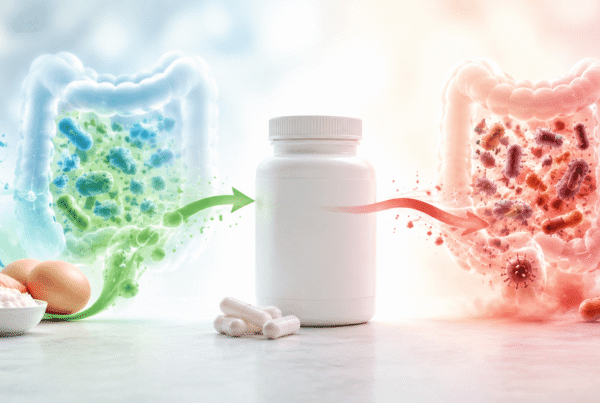
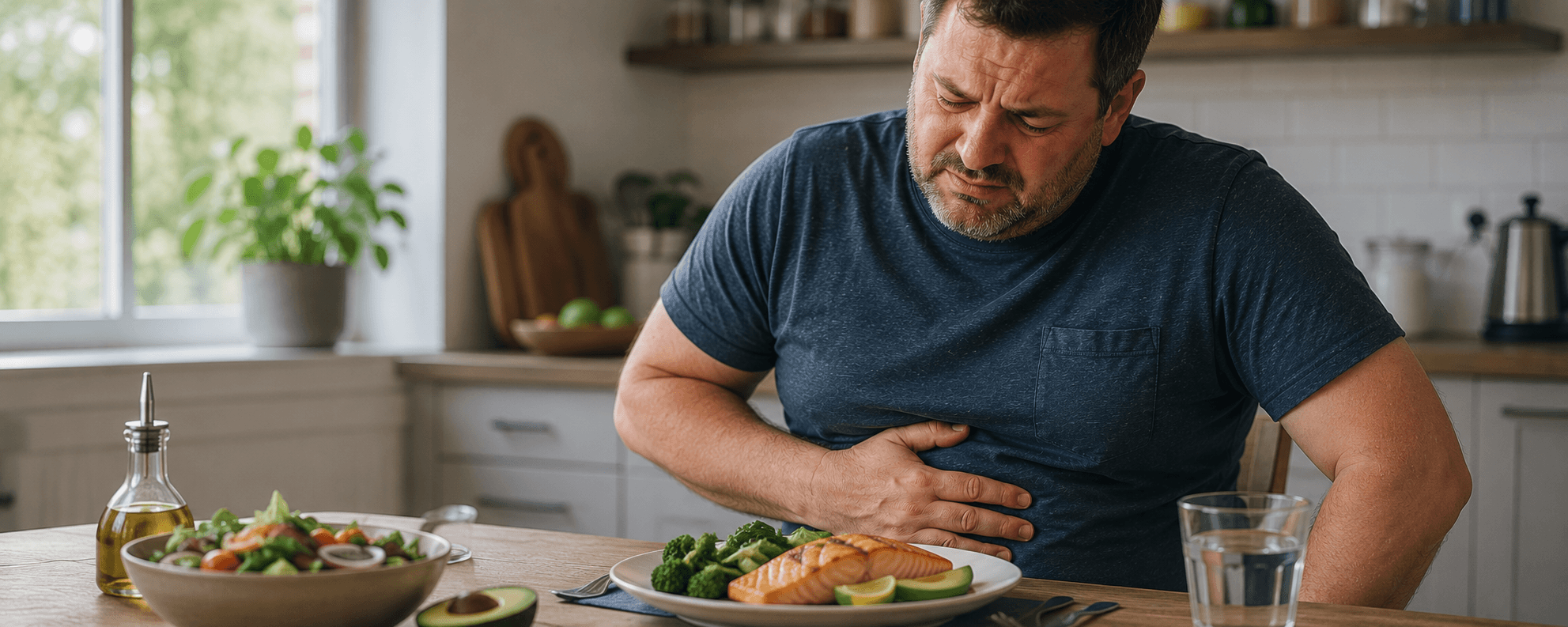
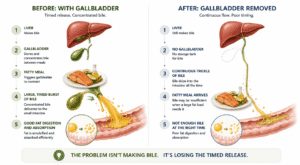
Digestive problems after gallbladder removal are common, real, and frequently missed. Without a gallbladder, bile drips into the intestine continuously instead of being stored and released in a timed dose when you eat. That mismatch causes trouble in two directions: too much bile reaching the colon between meals, which irritates it and causes urgent, loose stools; or not enough concentrated bile arriving with a fatty meal to digest it properly. Both can be supported, and both are often mislabelled as IBS.
What the gallbladder actually did
The gallbladder isn’t where bile is made — that’s the liver. The gallbladder is the storage tank. Between meals it holds bile and concentrates it; when you eat something fatty, it contracts and delivers a concentrated pulse of bile into the small intestine, timed to arrive with the food¹.
Remove it, and the liver keeps making bile, but there’s nowhere to store it. So bile trickles into the intestine steadily, all the time, whether or not there’s food to meet it¹ ².
Most people adapt to this without lasting trouble. But a meaningful minority don’t, and for them the timing problem produces ongoing symptoms.
Direction one: too much bile, in the wrong place
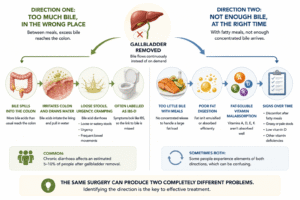
Between meals, with no food to act on, that continuously dripping bile travels down the small intestine. Normally almost all bile acids are reabsorbed near the end of the small intestine before reaching the colon. When the flow is unregulated, more bile acid than usual spills into the colon³.
Bile acids are irritating to the colon and draw water into it, which speeds everything up. The result is bile acid diarrhoea: loose or watery stools, urgency, frequent bowel movements, cramping, sometimes worse after meals³ ⁴.
Chronic diarrhoea affects an estimated 5–10% of people after gallbladder removal⁵, and it’s one of the more common reasons for persistent post-surgery symptoms. Crucially, it’s very often misdiagnosed as IBS with diarrhoea, because the symptoms look identical and nobody connects them to the surgery⁴ ⁶.
Direction two: not enough bile, at the right time
The opposite problem can also occur. When you eat a fatty meal, you no longer get that concentrated, timed release — just the steady trickle, which may not be enough to emulsify a large fat load efficiently¹.
That produces the signs of fat malabsorption: discomfort after fatty meals, pale or greasy stools, and — over time — poor absorption of the fat-soluble vitamins A, D, E and K⁷. Vitamin D deficiency is particularly common, partly because it’s widespread anyway and gallbladder-related malabsorption compounds it⁷.
Some people experience elements of both directions at once, which is part of why it can be confusing to sort out². Both directions share a downstream consequence that isn’t digestive at all. Unabsorbed fat binds calcium into insoluble soaps, which leaves dietary oxalate free to be absorbed rather than carried out in the stool — and bile acids arriving in the colon increase how permeable it is to oxalate. Those are the two established mechanisms of enteric hyperoxaluria, and each direction of the post-gallbladder problem touches one of them. So it’s worth knowing where a rising oxalate load shows up and what it costs, because the symptoms are non-digestive and easy to attribute elsewhere.
Why it gets missed
Three reasons stack up.
The symptoms mimic IBS almost exactly, so that’s often the label applied — without anyone asking whether the gallbladder surgery is the actual cause⁴ ⁶.
The connection to the surgery is easy to overlook, especially when symptoms appear or worsen months later rather than immediately.
And direct testing is genuinely difficult. The most accurate test (a SeHCAT scan) isn’t widely available, so diagnosis is frequently made by ruling out other causes, or by trialling treatment and seeing whether it helps⁴. That difficulty means the condition is underdiagnosed rather than rare.
The reassuring part
People who search for this are often months or years into unexplained symptoms and have been told there’s nothing to find.
There is something to find. Post-gallbladder digestive problems have understood mechanisms, and they respond to management aimed at the actual cause — whether that’s excess bile reaching the colon or insufficient bile meeting meals. The two problems need different approaches, which is exactly why getting the direction right matters, and why “just live with it” is the wrong answer.
What’s appropriate depends on which direction is dominant, whether there’s an overlap, and what else is going on in the gut — pre-existing IBS or SIBO can complicate the picture⁷. That’s a conversation to have with a practitioner who’ll work out which problem you actually have rather than guessing, and it’s why testing your fat-soluble vitamin status and, where available, your bile acid pattern is more useful than trial and error.
Red flags — see a doctor promptly
Most post-cholecystectomy digestive change is benign and manageable. But some signs need prompt medical assessment rather than self-management⁴:
- Black or bloody stools
- Persistently pale stools with dark urine, or yellowing of the skin or eyes
- Severe or worsening abdominal pain
- Unexplained weight loss
- Fever, or signs of dehydration
The short version
After gallbladder removal, bile flows continuously instead of on demand. That causes symptoms in two directions — too much bile irritating the colon, or too little arriving with meals — and both are commonly mistaken for IBS. They’re real, they’re understood, and they’re treatable once the direction is identified. Persistent digestive trouble after this surgery is a problem to investigate, not one to endure.
Frequently asked questions
Why do I have diarrhoea after gallbladder removal?
Without a gallbladder, bile flows continuously into the intestine rather than being released in timed doses. Between meals, excess bile can reach the colon, where it irritates the lining and draws in water, causing loose, urgent stools — known as bile acid diarrhoea.
Is it normal to have digestive problems after gallbladder surgery?
Common, yes. Most people adapt, but a meaningful minority develop ongoing symptoms — chronic diarrhoea affects an estimated 5–10%. These are real and treatable, not something you simply have to accept.
Could my post-gallbladder diarrhoea be misdiagnosed as IBS?
Frequently. Bile acid diarrhoea mimics IBS with diarrhoea almost exactly, and the link to the surgery is often overlooked, so many people are labelled with IBS when the real issue is bile-related.
Can gallbladder removal cause vitamin deficiencies?
It can. Without a timed bile release, fatty meals may not be digested as efficiently, which impairs absorption of the fat-soluble vitamins A, D, E and K. Low vitamin D is especially common.
How is bile acid diarrhoea diagnosed?
The most accurate test (a SeHCAT scan) isn’t widely available, so diagnosis is often made by excluding other causes or by a trial of treatment. This difficulty is why the condition is underdiagnosed.
When should I see a doctor?
Promptly if you have black or bloody stools, pale stools with dark urine or yellowing skin, severe abdominal pain, unexplained weight loss, fever or dehydration. These need medical assessment rather than self-management.
References
- Role of the gallbladder in storing and concentrating bile and delivering a timed release; continuous bile flow after cholecystectomy. IBS Treatment Center; general clinical physiology.
- Bile acid malabsorption and bile acid deficiency after gallbladder removal — both excess and insufficient bile can cause symptoms, sometimes together. Cleveland Clinic, Bile Acid Malabsorption.
- Bile acid malabsorption: excess bile acids reaching the colon increase fluid secretion and speed transit. Cleveland Clinic (2026).
- Post-cholecystectomy diarrhoea, misdiagnosis as IBS-D, limited testing (SeHCAT), and diagnosis by exclusion or treatment trial; red-flag symptoms. Post-cholecystectomy syndrome reviews (Cureus, 2023; Ubie clinical summary, 2026).
- Prevalence of chronic diarrhoea after cholecystectomy estimated at 5–10%. Changes in bile acid homeostasis and stool habits after cholecystectomy (clinical review).
- Bile acid diarrhoea frequently misdiagnosed as IBS-D. IBS Treatment Center (2025).
- Fat-soluble vitamin (A, D, E, K) malabsorption after gallbladder removal; vitamin D deficiency particularly common; SIBO/IBS as complicating factors. Clinical guidance on supplementation after cholecystectomy.