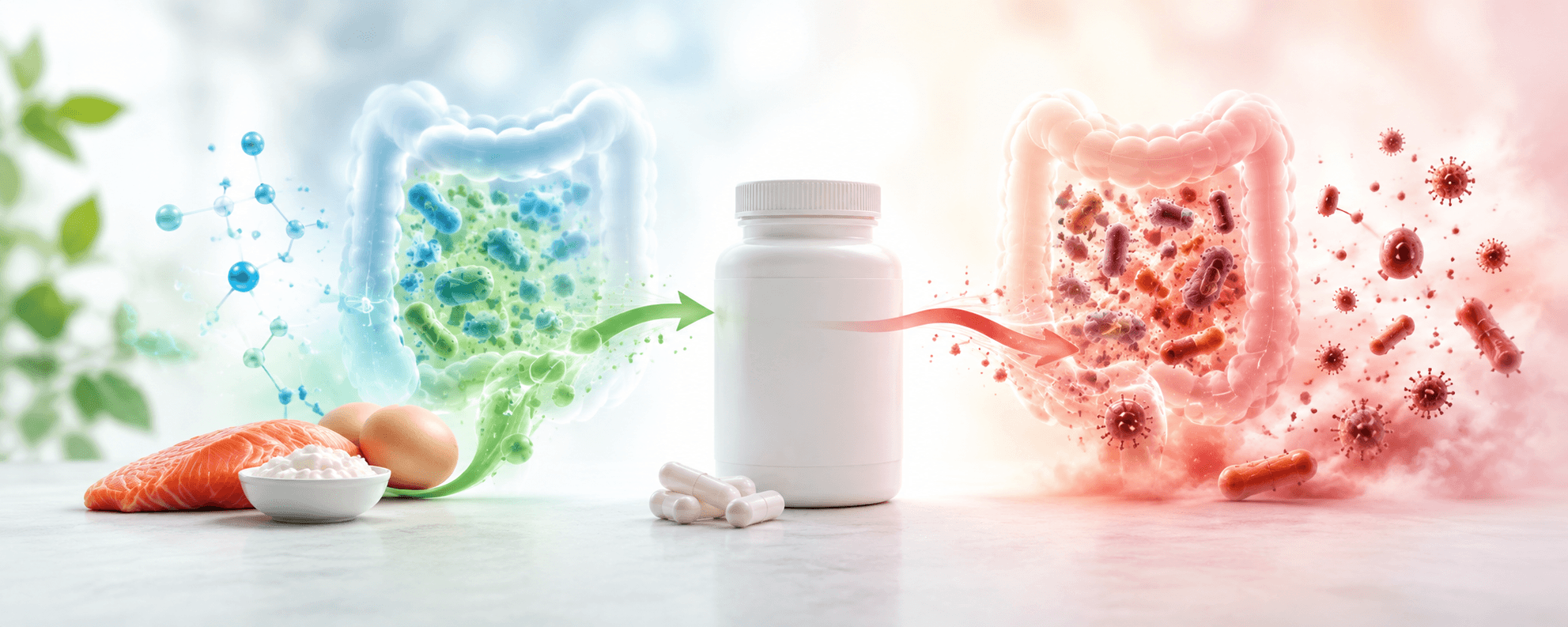
Amino acids are the building blocks of protein, and supplementing them is usually helpful. But some people feel distinctly worse on an amino acid supplement — foggy, wired, irritable, headachy, or generally unwell — and the reason is often not the amino acids themselves. It’s what the gut bacteria do with them. When the microbiome is out of balance, certain bacteria convert amino acids into compounds the body would rather not have: ammonia, and a group of reactive molecules called biogenic amines. So a “clean” supplement can produce a toxic reaction — not because the supplement is bad, but because of the gut it lands in.
What amino acids are supposed to do
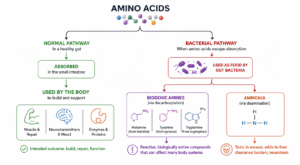
When you eat protein, or take amino acids directly, they’re meant to be absorbed in the small intestine and used to build the body’s own proteins, neurotransmitters, enzymes and more. In a well-functioning digestive system, that’s exactly what happens, and amino acid supplementation can be very useful — supporting neurotransmitter production, muscle, repair and much else.
The trouble starts when amino acids aren’t fully absorbed where they should be, and instead reach the parts of the gut where bacteria are waiting to turn them into reactive compounds.
What bacteria do with amino acids
Gut bacteria can use amino acids as food, and when they do, they transform them — a process sometimes called putrefaction, to distinguish it from the fermentation of fibre¹. Two transformations matter most.
Decarboxylation → biogenic amines. Bacteria strip a piece off an amino acid and turn it into a “biogenic amine” — a reactive, biologically active molecule. The pairings are specific and well established²:
- Histidine → histamine
- Tyrosine → tyramine
- Tryptophan → tryptamine
- Phenylalanine → phenylethylamine
- Lysine → cadaverine
- Ornithine/arginine → putrescine
Deamination → ammonia. Bacteria also break amino acids down in a way that releases ammonia, which is toxic in excess and normally has to be processed by the liver and cleared¹ ³. An overgrowth of the wrong bacteria, or a high load of unabsorbed amino acids reaching them, increases the ammonia burden³.
So the same amino acids that should have built your proteins and neurotransmitters get diverted into a stream of amines and ammonia instead. That’s the crux of the problem.
Why these compounds make you feel bad
Biogenic amines and ammonia aren’t inert — they have real effects, which is why a reaction can feel so systemic and so unlike a simple “tummy upset.”
Biogenic amines are biologically active and can influence gut motility, inflammation and the integrity of the gut barrier, and some act on the nervous system — signalling through receptors that affect mood, stress and cognition⁴ ⁵. Histamine in particular can drive the familiar histamine-intolerance picture (headaches, flushing, congestion, anxiety). Tyramine and the others have their own effects on blood pressure and the nervous system.
Ammonia, meanwhile, is a recognised neurotoxin at elevated levels, and excess production adds to the body’s clearance burden³. Excessive amine and ammonia production has been linked to gut inflammation and impaired barrier function⁶ — so the effects aren’t only felt in the gut, they can radiate into systemic effects.
The upshot: someone taking amino acids to feel better — more energy, better mood, better neurotransmitters — can end up feeling worse across several systems at once, because the supplement is being turned into the opposite of what they hoped for.
Why it happens to some people and not others
This is where it becomes an individual story rather than a property of the supplement, and it comes down to the state of the gut.
Several things push amino acids toward bacterial conversion rather than absorption:
- Bacterial overgrowth (including SIBO). If there are too many bacteria in the wrong place — particularly high in the small intestine — they intercept amino acids before proper absorption, and there’s simply more microbial machinery to convert them⁶.
- Poor protein digestion. If stomach acid or digestive enzymes are inadequate, protein isn’t broken down and absorbed efficiently, leaving more of it to reach the bacteria downstream¹.
- Slow transit. The longer material sits in the gut, the more time bacteria have to putrefy it — constipation and sluggish motility increase amine and ammonia production¹ ³.
- The specific bacteria present. Different species carry different decarboxylase enzymes, so which amines you generate depends on your particular microbiome² ⁵.
So two people can take the identical amino acid supplement and have completely different experiences — one builds neurotransmitters with it, the other manufactures a batch of biogenic amines.
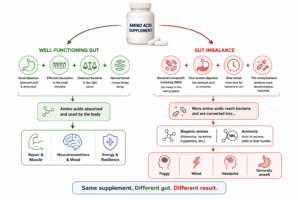
The variable isn’t the supplement. It’s the gut it meets.
The reaction is information
Here’s the reframe that matters, and it’s the same principle that runs through why active nutrient forms or methylated vitamins sometimes backfire: a bad reaction to a supplement is not simply “this doesn’t agree with me.” It’s a signal pointing at something more important.
If amino acids make you feel toxic, wired or foggy, the useful question isn’t “which brand should I switch to” — it’s why is my body turning these into the wrong thing? That reaction is, in effect, a readout of the gut: it suggests that absorption, bacterial balance, or transit isn’t right, and that fixing that is the real target. Push through the reaction and you’re feeding a broken process. Investigate it, and it becomes a clue that leads somewhere useful.
This is why simply stopping the supplement, while sensible in the moment, isn’t the whole answer. The amino acids exposed a problem that was probably affecting protein digestion and neurotransmitter production anyway — the supplement just made it obvious.
Can this be seen on testing?
To some extent, yes. Markers of bacterial protein putrefaction — including certain amine and phenolic metabolites — can show up on urine organic acid testing, and stool testing can reveal the kind of dysbiosis or overgrowth that drives conversion. These don’t diagnose the reaction directly, but they can show whether the underlying conditions for it are present, read as a pattern alongside symptoms rather than as a single number.
What this points toward
Not a protocol — every situation differs, and this belongs with a practitioner who can look at the whole picture — but the logic points somewhere specific:
- Treat a strong reaction as information, not just intolerance. It’s pointing at the gut, not the nutrient.
- Look upstream at digestion. If protein isn’t being broken down and absorbed well — stomach acid, enzymes — more of it reaches the bacteria. Fixing digestion can change everything downstream.
- Address bacterial balance and transit, since overgrowth and slow movement are what tip amino acids toward putrefaction.
- Consider that the problem may need solving before the supplement helps. Once absorption and balance improve, the same amino acids that once caused a reaction may become more useful.
The short version
Amino acid supplements can backfire when gut bacteria convert them into ammonia and biogenic amines instead of letting them be absorbed and used. That happens more with bacterial overgrowth, poor protein digestion and slow transit — so it’s a property of the gut, not the supplement. The reaction is worth reading as a signal that digestion or microbial balance needs attention, rather than a reason to simply write the nutrient off. Fix what’s driving the conversion, and the same supplement can go from harmful to helpful.
Frequently asked questions
Why do amino acid supplements make me feel worse?
Often because gut bacteria are converting the amino acids into ammonia and biogenic amines (like tyramine, tryptamine and histamine) rather than letting them be absorbed and used. These compounds have systemic effects — on mood, the gut barrier and inflammation — so a supplement meant to help can produce a toxic-feeling reaction.
What are biogenic amines?
Reactive, biologically active molecules that bacteria (and some foods) make by transforming amino acids — for example histidine into histamine, tyrosine into tyramine, tryptophan into tryptamine. In excess they can affect gut motility, inflammation, blood pressure and the nervous system.
Why do gut bacteria produce ammonia?
When bacteria break amino acids down (deamination), ammonia is released. Normally the liver clears it, but an overgrowth of the wrong bacteria, a high load of unabsorbed protein, or slow transit increases production and burden. Ammonia is a neurotoxin at elevated levels.
Why does this happen to some people and not others?
It depends on the gut. Bacterial overgrowth (including SIBO), poor protein digestion from low stomach acid or enzymes, slow transit, and which bacterial species are present all push amino acids toward bacterial conversion instead of absorption. The same supplement can affect two people completely differently.
Should I stop taking amino acids if I react to them?
Stopping is sensible in the moment, but the reaction is a clue worth following. It suggests something about digestion, bacterial balance or transit isn’t right — and addressing that is often what allows the amino acids (and protein generally) to be tolerated and useful later.
Can this be tested?
To an extent. Urine organic acid testing can show markers of bacterial protein putrefaction, and stool testing can reveal dysbiosis or overgrowth. These indicate whether the conditions that drive the conversion are present, best read as a pattern alongside symptoms rather than in isolation.
References
- Undigested protein reaching the large intestine is fermented (“putrefied”) by proteolytic bacteria into ammonia, amines, cresol, indole and phenol; slow transit and poor upstream digestion increase this. In Silico Analysis of Putrefaction Pathways (2017), PMC5682003.
- Bacterial decarboxylation of amino acids produces specific biogenic amines: histidine→histamine, tyrosine→tyramine, tryptophan→tryptamine, phenylalanine→phenylethylamine, lysine→cadaverine, ornithine→putrescine. Review of biogenic amines (2024), ScienceDirect S2405844024005322.
- Gut dysbiosis, urease-positive overgrowth and slow transit raise ammonia production from amino acid deamination, adding to clearance burden. Ammonia-producing bacteria in the gut microbiome (2025), Biome Studies.
- Microbially derived amines (tyramine, tryptamine, putrescine) affect gut motility, inflammation, and act as neuromodulators via host receptors (TAARs, GPCRs) influencing mood and cognition. Biogenic amines and the microbiome (2025), Creative Proteomics.
- Microbiota aromatic amino acid decarboxylases produce trace amines and neurotransmitters; production varies by bacterial species. Microbiota-derived AADCs review (2025), PMC12607914.
- Excessive ammonia and biogenic amine production is linked to gut dysbiosis, inflammation and impaired barrier integrity; high-protein loads reaching bacteria increase it. High-Protein Diets and Bacterial Fermentation (2025), MDPI Fermentation 11(12):678.