

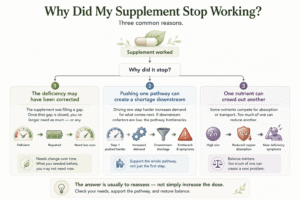
A supplement that worked and then stopped usually hasn’t gone bad and you haven’t built up a tolerance to it in the way people assume. The more common explanations are that you’ve moved past the amount your body needed, that the deficiency it was correcting has been corrected, or that pushing one pathway harder has created a shortage somewhere downstream. All three are not that uncommon, and all three are fixable — but the fix is rarely to take more.
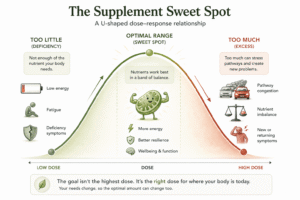
The bell curve: more isn’t better past a point
Most nutrients don’t work in a straight line. Picture a curve: you start low, add the nutrient, and climb toward the top — that’s the stretch where you feel noticeably better. Keep going past the peak and you come down the other side, and the symptoms return.
This isn’t a theory. It’s a well-described pattern in nutrition research called a U-shaped dose-response relationship, where both too little and too much produce harm and the benefit sits in a band in between.
Selenium is the clearest example. Its effects follow a narrow peak: below it, deficiency raises the risk of several diseases; above it, excess brings its own problems including increased type 2 diabetes risk¹. One analysis found a U-shaped relationship between selenium intake and cancer risk, with both the lowest and the highest intake groups at raised risk compared with those in the middle². Manganese behaves the same way — modelling of the toxicity literature produced a clean U-shaped curve, with the extremes of both deficiency and excess associated with a high probability of adverse effects³.
So the goal isn’t the highest dose you tolerate. It’s staying near the top of the curve. And if you were near the top and kept increasing, or kept taking the same amount as your needs fell, you’d expect exactly what people describe: it worked, then it didn’t.
The deficiency may simply have been corrected
The most straightforward explanation, and the most commonly missed.
If a supplement was filling a real gap, the improvement you felt was that gap closing. Once it’s closed, continuing at the same amount is no longer correcting anything — and depending on the nutrient, it may start pushing you along the far side of the curve.
Nothing has gone wrong here. The supplement did its job. What’s changed is that you no longer need what you needed six months ago.
Pushing one pathway can create a shortage in another
Biochemical pathways run in sequence, and each step needs its own cofactors. Drive one step harder and you increase demand for everything downstream of it.
If those downstream cofactors are already marginal, the effect is a bottleneck. The pathway moves faster at the front and jams further along, and intermediates accumulate where they shouldn’t. Symptomatically that can feel like the supplement turning against you, when what’s actually happened is that it exposed a shortage elsewhere.
This is one reason single high-dose nutrients sometimes cause more trouble than a broader, gentler approach, and why the answer is often to support the rest of the pathway rather than to abandon the nutrient.
One nutrient can crowd out another
Some nutrients compete directly for absorption or transport.
Zinc and copper are the textbook case. Sustained high-dose zinc reduces copper absorption — the effect is reliable enough that it’s used therapeutically in Wilson’s disease, a condition of copper overload⁴. Taken long enough at a high enough dose without attention to copper, zinc can produce a copper deficiency.
So a supplement that felt good initially can, over months, generate a second problem that produces new symptoms. The supplement is still doing what it does. The picture around it has changed.
Something else may have changed
Supplements aren’t taken in isolation. Diet shifts, stress rises, an infection comes and goes, another supplement or medication gets added, hormones change with age or cycle stage.
Any of those can alter what your body needs, and the supplement that suited the old conditions may not suit the new ones. If you added anything else around the time the effect faded — including something that seemed unrelated — that’s worth noting.
A real possibility: it may not have been doing as much as it seemed
This one is uncomfortable but belongs in the list.
People generally start a supplement when symptoms are bad. Symptoms fluctuate, and bad patches tend to be followed by better ones regardless of what’s done — a statistical effect called regression to the mean. Add the expectation effect of starting something new, and some of what feels like an initial strong response is the natural upswing plus optimism.
When things later settle back to average, that reads as “it stopped working.”
This doesn’t mean supplements don’t work, and it doesn’t mean your experience was imagined. It means that more time may have needed to pass before judging anything.
What to do when it happens
- Don’t automatically increase the dose. If you’ve passed the top of the curve, more makes it worse. Reducing is at least as likely to help.
- Try a period without it. Sometimes the clearest information comes from stopping. If symptoms return, it was doing something. If nothing changes, that’s useful too.
- Change one thing at a time. Adjusting three supplements at once means you learn nothing from the result.
- Look at what else changed around when the effect faded — other supplements, medications, diet, illness, stress.
- Consider whether the pathway needs support rather than the nutrient needs increasing. If one step is being driven hard, what’s downstream may be the limiting factor.
- Retest rather than guess, where a marker exists. It’s the difference between knowing and speculating.
The underlying principle
Almost everything above comes back to one idea: a nutrient isn’t good or bad, and a dose isn’t high or low in the abstract. Both are only meaningful relative to what your body currently needs — and what your body needs changes.
Which means a supplement regime that never changes is unlikely to keep suiting you, however well it worked when you started.
Frequently asked questions
Can you build a tolerance to supplements?
Not usually in the way people mean. What’s more often happening is that you’ve moved past the amount your body needs, the deficiency has been corrected, or driving one pathway has created a shortage further along it.
Should I take more if a supplement stops working?
Often the opposite. Many nutrients follow a U-shaped curve where too much causes problems just as too little does. If you’ve passed the optimal range, increasing the dose makes things worse.
Can taking one supplement cause a deficiency in another?
Yes. Some nutrients compete for absorption — sustained high-dose zinc reducing copper absorption is the best-known example.
How long should I take a supplement before deciding it works?
Longer than most people do. Symptoms fluctuate naturally and expectation influences early impressions, so the first few weeks are the least reliable period for judging. A response that holds over a couple of months tells you much more.
Is it normal to feel great on a supplement and then feel worse?
It’s common. The usual explanations are passing the top of the dose-response curve, correcting the original deficiency, or creating a bottleneck downstream in the same pathway.
References
- Unveiling the power of selenium: selenoproteins in antioxidant defense and immune regulation. IntechOpen (2026). Describes selenium’s U-shaped dose-response curve and the narrow optimal range.
- A U-shaped association between selenium intake and cancer risk. Scientific Reports (2024). PMC11399399
- Estimating the optimal dietary intake of manganese: a U-shaped exposure-response analysis of the toxicity literature.
- Zinc-induced copper deficiency and the therapeutic use of zinc in Wilson’s disease — standard clinical pharmacology.