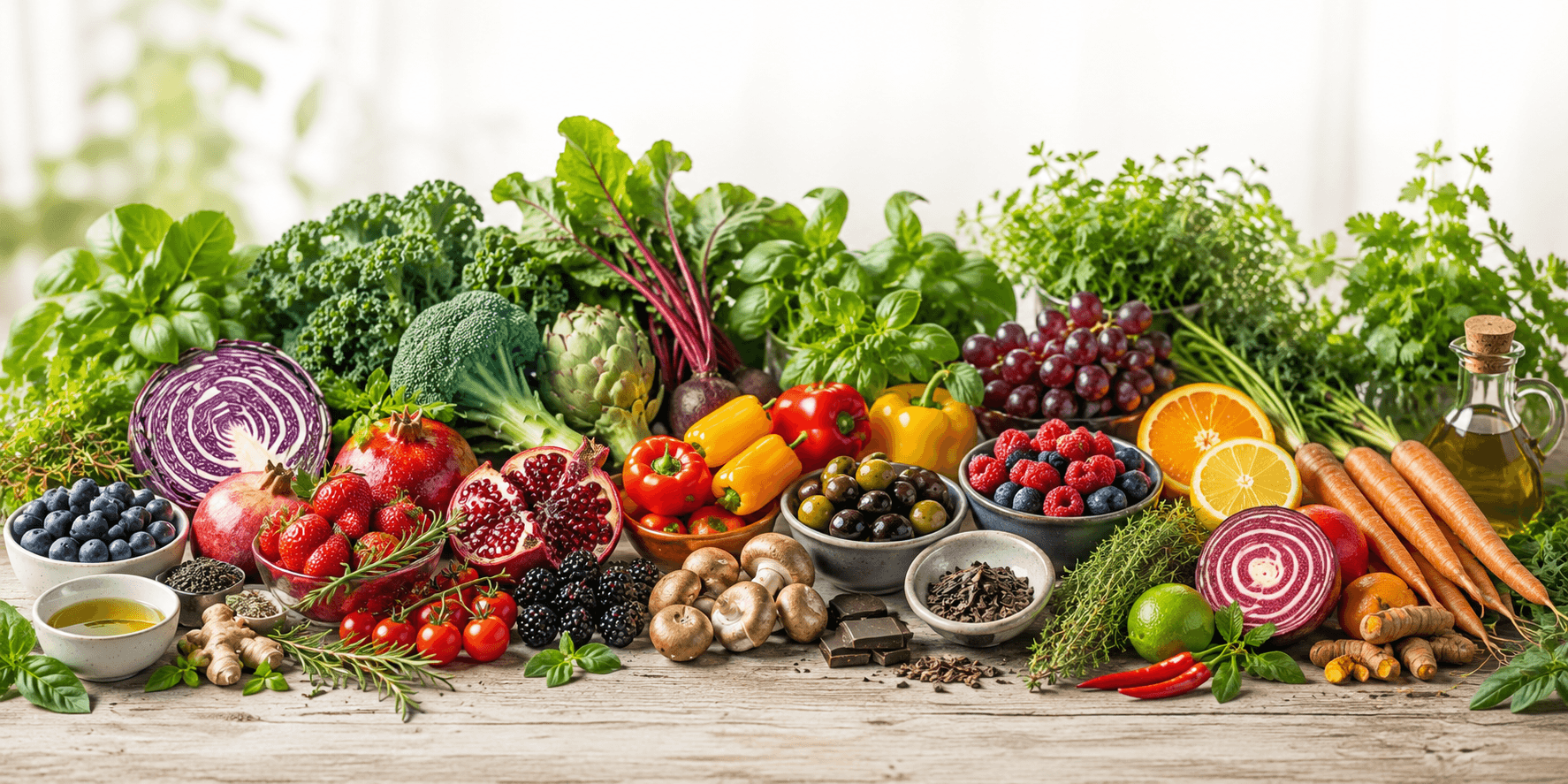
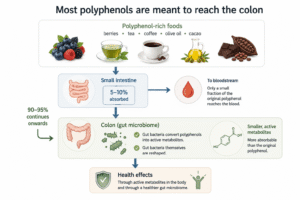
Polyphenols — the compounds in colourful plants, tea, coffee, berries, olive oil and cacao — are often dismissed as having “poor bioavailability,” meaning very little of them reaches your bloodstream intact. Only around 5–10% is absorbed in the small intestine. But that figure is measuring the wrong thing. The bulk of polyphenols travels on to the colon, and that’s not a failure of absorption — it’s where much of the benefit actually happens. Your gut bacteria convert them into smaller, more absorbable active compounds called aglycones, and the polyphenols reshape the bacteria themselves on the way through. Judging them only by what appears in the blood misses most of what they do.
What “bioavailability” means, and why it’s the wrong lens here
Bioavailability, in its usual sense, means how much of a substance reaches your systemic circulation as the parent compound. It’s a sensible measure for a drug, where the drug molecule itself is what acts on the body.
The logic goes: measure how much of the compound shows up in the blood, and that tells you how much is “working.” By that measure polyphenols look poor — only about 5–10% of ingested polyphenols are absorbed in the small intestine, with the rest passing through¹.
So they’ve been criticised as ineffective: you eat them, they’re barely absorbed, therefore they can’t be doing much. This is a case of natural compounds being judged by a drug-style yardstick that doesn’t fit how they actually work².
Where the other 90% goes
The polyphenols that aren’t absorbed in the small intestine don’t just vanish. They reach the colon, where the densest population of gut bacteria lives — and that’s the point at which the interesting biology begins³.
Gut bacteria break polyphenols down through a series of reactions into smaller, low-molecular-weight compounds — phenolic acids and metabolites like urolithins, equol and phenyl-valerolactones³ ⁴. And here’s the key: these microbial metabolites are often more absorbable than the original polyphenol, and can carry the biological activity into the bloodstream that the parent compound never could⁴.
So the low blood level of the original polyphenol isn’t evidence it did nothing. It’s evidence the body transformed it into something else first — which a test looking for the parent compound wouldn’t count. The compound that reaches your tissues isn’t what you ate; it’s what your bacteria made from it.
A familiar example: turmeric
Turmeric is the example most people have run into. Its active compound, curcumin, is taken by many for inflammation or joint pain — and is also the compound most often described as “poorly absorbed,” because blood levels of curcumin after eating it are famously low. On the surface that looks like a problem: how can it work if it barely reaches the blood?
The answer is the same reframe. Curcumin is extensively transformed — by enzymes in the gut and liver, and by the gut bacteria — into a series of metabolites, the best-studied being tetrahydrocurcumin. These metabolites are more absorbable than curcumin itself, and research suggests they carry much of the anti-inflammatory activity — in some studies acting more strongly than curcumin did. At the same time, curcumin reshapes the gut microbiome as it passes through. So the low blood level of curcumin was never the whole picture: the body converts it into active forms, and it acts on the gut on the way. Measuring only curcumin misses both.
It’s worth adding that this explains why turmeric can act despite low curcumin absorption — it doesn’t mean high-dose curcumin supplements are the answer, and much of the marketing around “enhanced absorption” formulas leans on exactly the narrow blood-level logic this article is questioning.
They also change the bacteria on the way through
There’s a second effect, entirely missed by any blood measurement.
Even the polyphenols that are never absorbed, and never converted into anything that enters circulation, still act directly on the gut environment as they pass through. They shape which bacteria thrive — favouring beneficial groups and discouraging less favourable ones⁵.
This is a real benefit happening entirely in the gut, with zero “bioavailability” in the traditional sense. The polyphenol did something useful without ever entering your bloodstream. A measure that only counts what reaches the blood scores this as nothing, when it’s arguably one of the main events.
Why “first-pass metabolism” isn’t the same as “wasted”
A related misunderstanding is worth clearing up, because it trips up even careful readers.
Many polyphenols that are absorbed get rapidly processed by the liver — conjugated and either sent for excretion or cycled back to the gut⁶. This first-pass metabolism is often cited as another reason they’re “not bioavailable”: they’re absorbed, then immediately altered, so little of the original circulates.
But being altered by the liver isn’t the same as being wasted. The conjugated forms can still be active, can be cycled back to the gut for further microbial processing, and are part of the normal route these compounds work through — not a detour that destroys them. The assumption that a compound only counts if it survives the liver unchanged is, again, a drug-model assumption that doesn’t fit.
The reframe
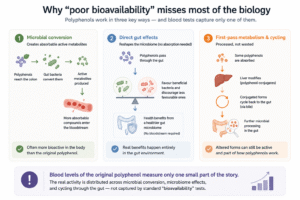
Put together, the picture inverts. “Poor bioavailability” was never measuring whether polyphenols work — it was measuring how much of the parent compound reaches the blood, which is only a small and arguably minor part of how they act.
The real activity is distributed: microbial conversion into absorbable active metabolites, direct reshaping of the gut microbiome, and the cycling of processed forms back through the gut. None of that shows up well on the one measure they were being judged by. It’s a good example of how the wrong yardstick can make something genuinely useful look worthless — and of why a single number, out of context, can point you in exactly the wrong direction.
An important note
Producing a metabolite doesn’t automatically mean a clinical benefit. The research is clear that metabolite formation and meaningful health outcomes aren’t the same thing, and the link between the two is still being worked out⁴.
People also differ in what they can make. Whether you produce certain beneficial metabolites — urolithins from pomegranate and berries, or equol from soy — depends on having the right gut bacteria, and not everyone does⁴. So the same food can benefit two people differently, depending on their microbiome. And more isn’t always better: some polyphenols show hormetic effects, useful at moderate intake but not at very high supplemental doses⁷.
So the accurate position is: polyphenols are in fact bioactive, and “poor bioavailability” understates them badly — but the benefit runs through the gut and the microbiome, varies between people, and comes from food-level intake rather than megadoses. It’s a reason to eat a rich variety of plants, not a reason to assume any polyphenol supplement is doing something.
What to take from this
- Don’t judge a plant compound by a drug’s yardstick. Low blood levels of the parent polyphenol don’t mean it’s inactive — the active forms are often what your bacteria make from it.
- The gut is where much of the action is. Polyphenols benefit you partly by reshaping the microbiome, which needs no absorption at all.
- Variety matters, because different polyphenols feed different microbial processes, and your ability to make specific metabolites depends on your bacteria.
- Food beats megadoses. The evidence is about dietary intake and gut effects, not high-dose isolated supplements, which can behave differently.
The short version
Polyphenols look poorly bioavailable because only a small fraction of the parent compound reaches the blood — but that measure misses how they actually work. Most reach the colon, where bacteria turn them into absorbable active metabolites and where they reshape the microbiome directly. The benefit is real; it just doesn’t show up on the one number they were being judged by. It’s the clearest illustration that a measurement out of context can make something valuable look like nothing.
Frequently asked questions
Are polyphenols poorly absorbed?
Only about 5–10% of ingested polyphenols are absorbed in the small intestine as the parent compound. But most of the rest reaches the colon, where gut bacteria convert them into smaller, more absorbable active metabolites — so low absorption of the original doesn’t mean they’re inactive.
If polyphenols aren’t absorbed, how do they work?
Two main ways. Gut bacteria transform them into low-molecular-weight metabolites that are more absorbable and biologically active than the parent compound. And even unabsorbed polyphenols reshape the gut microbiome directly as they pass through, which is a benefit needing no absorption at all.
What are polyphenol metabolites?
Smaller compounds — such as urolithins, equol and phenolic acids — that gut bacteria produce by breaking down dietary polyphenols. These are often what actually enters circulation and carries the biological activity, rather than the original polyphenol.
Why do people respond differently to the same polyphenol foods?
Because producing key metabolites depends on having the right gut bacteria, and not everyone does. Whether you make urolithins from pomegranate or equol from soy, for example, varies between individuals, so the same food can benefit people differently.
Does “first-pass metabolism” mean polyphenols are wasted?
No. Being processed by the liver isn’t the same as being destroyed. The altered forms can still be active and can cycle back to the gut for further microbial processing — it’s part of how these compounds work, not a detour that wastes them.
Should I take polyphenol supplements?
The evidence is strongest for polyphenols from a varied diet, working through the gut and microbiome. High-dose isolated supplements can behave differently, and more isn’t always better — some polyphenols benefit at moderate intake but not at very high doses. Eating a range of plants is the better-supported approach.
References
- Only about 5–10% of total ingested polyphenols are absorbed in the small intestine; the rest reach the colon. Catalkaya et al. (2020), Food Frontiers, citing Gowd et al. (2019).
- Polyphenols are detected in systemic circulation only at trace levels, so their health effects must be understood in light of low absorption rather than dismissed by it. Catalkaya et al. (2020); Unlocking Polyphenol Efficacy (PMC12430036).
- Poorly absorbed polyphenols reach the colon and are converted by gut microbiota, via deglycosylation, dehydroxylation, ring fission and other reactions, into low-molecular-weight metabolites. Gut Microbial Metabotypes Shape Polyphenol Bioactivity (Nutrients, 2025).
- Microbial metabolites (urolithins, equol, phenyl-γ-valerolactones, phenolic acids) are often more bioavailable than parent compounds; but metabolite production does not necessarily imply clinical benefit, and metabotype (e.g. urolithin/equol producer status) varies between people. Gut Microbial Metabotypes (2025); Unlocking Polyphenol Efficacy (PMC12430036).
- Unabsorbed polyphenols positively modulate gut microbiota composition and function, a benefit occurring without systemic absorption. Unlocking Polyphenol Efficacy (PMC12430036); Frontiers in Pharmacology (2025).
- Absorbed polyphenols undergo hepatic phase II conjugation, producing circulating conjugates with enterohepatic recycling back to the gut for further microbial metabolism. Claesen et al. (2024), Gut Microbes; First-Pass Metabolism of Berry Polyphenols (PMC7222205).
- Many polyphenols show hormetic dose responses — beneficial adaptive effects at moderate intake, potential toxicity at very high doses. Frontiers in Pharmacology (2025), citing Leri et al. (2020).