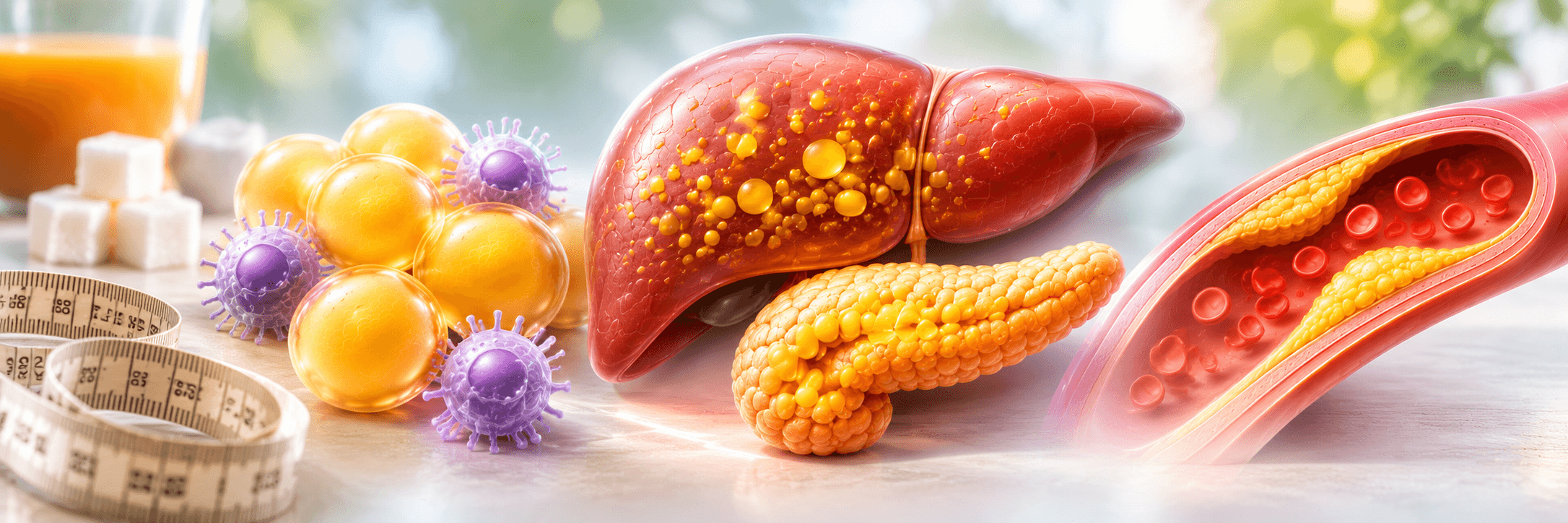
Your blood sugar is “borderline”. Your blood pressure has crept up. Your triglycerides are high, your good cholesterol is low, and your waistline keeps growing even though you don’t eat much more than you used to. Each of these often gets treated on its own, with a different tablet for each number. They’re not separate problems. They’re the visible parts of one process called metabolic syndrome, and it usually builds quietly for years, sometimes decades, before anyone puts a name to it. The good news is that the same process can be turned around, often much further than people expect.
What is metabolic syndrome?
Metabolic syndrome is a cluster of risk factors that tend to occur together and raise the risk of type 2 diabetes, heart disease and stroke. You’re considered to have it if you have three or more of these five:¹
| Marker | Threshold |
|---|---|
| Waist circumference | Varies by population. For people of European background, 94 cm or more in men and 80 cm or more in women is the usual cut-off |
| Triglycerides | 1.7 mmol/L (150 mg/dL) or higher |
| HDL (“good”) cholesterol | Below 1.0 mmol/L (40 mg/dL) in men, below 1.3 mmol/L (50 mg/dL) in women |
| Blood pressure | 130/85 or higher |
| Fasting blood sugar | 5.6 mmol/L (100 mg/dL) or higher |
Being on medication for any of these counts too. The list is useful, but it describes the end result. To understand it, you need the story of how it develops.
It starts years before your blood sugar changes
In people who went on to develop type 2 diabetes, insulin sensitivity fell steadily in the years beforehand, and then sharply in the last five years. The pancreas compensated by releasing more insulin, so blood sugar stayed close to normal for a long time. Fasting blood sugar only climbed steeply in the final three years before diagnosis.²
That’s why a normal blood sugar result isn’t the reassurance it seems. Behind the normal number, the pancreas may be working harder and harder to hold it there. A raised fasting insulin, high triglycerides or a growing waistline often show the problem much earlier than glucose does.

Stage 1: insulin rises
Insulin is the body’s main storage hormone. Every time you eat, especially refined carbohydrates and sugar, insulin rises to move the incoming fuel into your cells. Frequent eating, sweet drinks, poor sleep, ongoing stress and little movement keep insulin raised for much of the day.
Over time, the cells that receive all that fuel start to resist it. A muscle or liver cell that’s already full has good reason to stop letting more in, and the pancreas responds by making even more insulin. I’ve explained why the cells do this in is insulin resistance your cells protecting themselves?
Stage 2: fat cells fill up and become inflamed
Fat tissue is meant to store extra energy safely. As fat cells grow larger and fuller, they become stressed. Immune cells called macrophages move into the fat tissue, and the more body fat someone carries, the more of them there are. These macrophages produce almost all of the inflammatory messenger TNF-alpha that fat tissue releases, and much of its other inflammatory signalling.³ Inflamed fat tissue becomes even more insulin resistant, and its hormone signals go off course. Leptin, which should curb appetite, stops getting through, which I’ve covered in leptin resistance: why you’re still hungry after eating.
The gut adds to the fire. Endotoxins from gut bacteria leak into the blood, especially after rich meals, and push the body further towards inflammation and insulin resistance. I’ve explained that link in can gut bacteria inflame your whole body?
Stage 3: fat spills into the liver and pancreas
When fat tissue can’t store any more, fat ends up where it doesn’t belong, mainly the liver and pancreas. Muscle insulin resistance sets the pace at which fatty liver develops. Once the liver is fatty, it stops responding to insulin’s signal to hold back its sugar output, and it releases more triglycerides into the blood. Fat building up around the insulin-making cells of the pancreas then suppresses their ability to release insulin. At first this is reversible. Eventually it can become permanent.⁴
This is the stage where fasting blood sugar starts to rise, often first noticed as a high reading in the morning before you’ve eaten. I’ve explained that in why is my blood sugar high in the morning without eating?
I’ve covered what happens inside the liver in is sugar or fat to blame for fatty liver?
Where fructose fits in
Fructose, the sugar in fruit juice, soft drinks, table sugar and high-fructose corn syrup, behaves differently from glucose. When overweight adults drank fructose-sweetened drinks for 10 weeks, their livers made more fat, belly fat increased, their blood fats worsened and their insulin sensitivity fell. The same amount of glucose-sweetened drinks didn’t do this, even though both groups gained similar weight.⁵
Your small intestine is the first line of defence. It absorbs fructose and converts most of a small dose into glucose and other compounds before it reaches the liver. Larger doses overwhelm the gut, and the excess fructose reaches the liver and the bacteria in the large bowel.⁶ That’s one reason whole fruit, which delivers fructose slowly with fibre, isn’t the same as a large sweet drink.
Stage 4: the arteries
High insulin, raised blood sugar, high triglycerides, low HDL, inflammation and high blood pressure all damage blood vessel walls. This is why metabolic syndrome is so closely tied to heart attacks and strokes, often years before diabetes is diagnosed. I’ve written about how the damage happens in what actually damages your arteries?

Watch: metabolic syndrome from a fat dysregulation perspective
This talk by Ivor Cummins walks through the same progression in more detail: how years of high insulin lead to inflamed fat tissue, fat spilling into the liver and pancreas, and eventually type 2 diabetes and heart disease. It was the starting point for how I explain metabolic syndrome to clients.
Why treating the numbers isn’t enough
Medication has its place, and lowering blood pressure or blood sugar can be important. But a tablet for each number lowers the readings without changing the process underneath. Pushing more sugar into cells that are already full, for example, brings blood sugar down while the overload continues. Some diabetes researchers argue that forcing it this way, particularly with intensive insulin treatment, can do more harm than good in people with marked insulin resistance.⁷ The aim is to reduce the load that drives the whole process.
It can be reversed
When people with type 2 diabetes lost weight through surgery or a low-calorie diet, fat in their liver dropped within days, and the liver’s response to insulin returned to normal. Blood sugar came down with it.⁴
People with type 2 diabetes diagnosed within the previous six years followed a supervised low-calorie formula diet for three to five months, then a structured program to keep the weight off. After a year, almost half were in remission, with normal blood sugar and off all diabetes medication. Of those who lost 15 kg or more, 86% were in remission.⁸
Weight loss on that scale is hard to keep up. The body defends its stored fat strongly, which is why crash diets so often rebound. What the research shows clearly is how reversible this process is, especially in its earlier stages, and that the earlier you act, the more of it can be undone.
What helps turn it around
- Cut back on sugar, sweet drinks and refined carbohydrates. This lowers insulin and the fructose load on the liver.
- Stop eating all day. A consistent daily eating window that finishes earlier gives insulin time to fall, which I’ve covered in does when you eat matter as much as what you eat?
- Move, especially before breakfast. Exercise empties the muscles’ fuel stores so they can take up sugar again, and exercising before eating has a stronger effect on insulin. See does exercising on an empty stomach burn more fat?
- Sleep well. Even one short night makes the liver and muscles more insulin resistant.
- Look after your gut, to reduce the endotoxins that drive inflammation.
- Be patient with the switch to burning fat. It takes weeks, which I’ve explained in fat adaptation: why it takes longer than two weeks.
Frequently asked questions
What is metabolic syndrome?
Metabolic syndrome is a cluster of risk factors that occur together: a large waist, high triglycerides, low HDL cholesterol, high blood pressure and raised fasting blood sugar. Having three or more of these means you have metabolic syndrome, which raises the risk of type 2 diabetes, heart disease and stroke.
What causes metabolic syndrome?
Metabolic syndrome develops when insulin stays raised for years, cells become insulin resistant, fat tissue becomes inflamed and fat spills into the liver and pancreas. Refined carbohydrates and sugar, frequent eating, inactivity, poor sleep, stress and gut endotoxins all contribute.
Can you have metabolic syndrome with normal blood sugar?
Yes. Blood sugar often stays normal for years because the pancreas releases more and more insulin to hold it there. High triglycerides, low HDL, a growing waist, high blood pressure or a raised fasting insulin can show the problem long before blood sugar rises.
Is metabolic syndrome reversible?
In many people, yes, especially in the earlier stages. Reducing liver fat restores the liver’s response to insulin, and in people with type 2 diabetes diagnosed in the previous six years, substantial weight loss put almost half into remission.
Is fructose worse than glucose?
In large amounts, fructose makes the liver produce more fat and worsens blood fats and insulin sensitivity more than the same amount of glucose. Small amounts, such as in whole fruit, are largely handled by the small intestine before they reach the liver.
How is metabolic syndrome linked to fatty liver?
Fatty liver is one of the central steps. When fat tissue is full, fat builds up in the liver, which then stops responding properly to insulin, releases more sugar and triglycerides into the blood, and drives blood sugar up.
References
1. Alberti KGMM, Eckel RH, Grundy SM, et al. Harmonizing the metabolic syndrome: a joint interim statement of the International Diabetes Federation Task Force on Epidemiology and Prevention; National Heart, Lung, and Blood Institute; American Heart Association; World Heart Federation; International Atherosclerosis Society; and International Association for the Study of Obesity. Circulation. 2009;120(16):1640-1645. PMID 19805654.
2. Tabák AG, Jokela M, Akbaraly TN, et al. Trajectories of glycaemia, insulin sensitivity, and insulin secretion before diagnosis of type 2 diabetes: an analysis from the Whitehall II study. Lancet. 2009;373(9682):2215-2221. PMID 19515410.
3. Weisberg SP, McCann D, Desai M, et al. Obesity is associated with macrophage accumulation in adipose tissue. J Clin Invest. 2003;112(12):1796-1808. PMID 14679176.
4. Taylor R. Pathogenesis of type 2 diabetes: tracing the reverse route from cure to cause. Diabetologia. 2008;51(10):1781-1789. PMID 18726585.
5. Stanhope KL, Schwarz JM, Keim NL, et al. Consuming fructose-sweetened, not glucose-sweetened, beverages increases visceral adiposity and lipids and decreases insulin sensitivity in overweight/obese humans. J Clin Invest. 2009;119(5):1322-1334. PMID 19381015.
6. Jang C, Hui S, Lu W, et al. The small intestine converts dietary fructose into glucose and organic acids. Cell Metab. 2018;27(2):351-361. PMID 29414685.
7. Nolan CJ, Ruderman NB, Kahn SE, Pedersen O, Prentki M. Insulin resistance as a physiological defense against metabolic stress: implications for the management of subsets of type 2 diabetes. Diabetes. 2015;64(3):673-686. PMID 25713189.
8. Lean MEJ, Leslie WS, Barnes AC, et al. Primary care-led weight management for remission of type 2 diabetes (DiRECT): an open-label, cluster-randomised trial. Lancet. 2018;391(10120):541-551. PMID 29221645.