
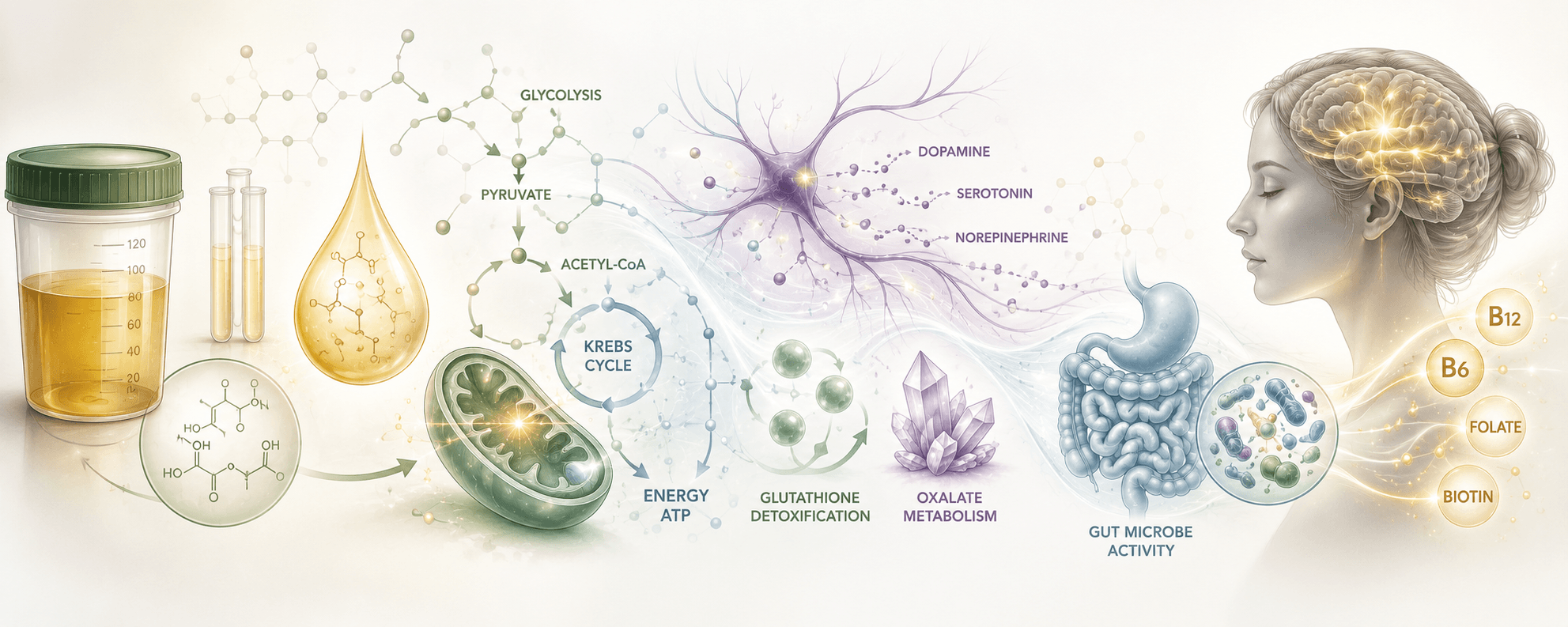
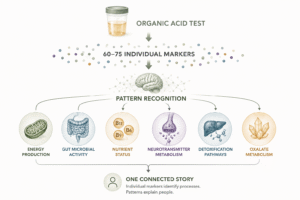
An Organic Acid Test (OAT) measures metabolic byproducts in urine — compounds left over from energy production, neurotransmitter turnover, detoxification, and the activity of bacteria and yeast in the gut. Its value isn’t in any single marker. It’s that dozens of markers from different systems appear on one page at the same time, so you can see how they relate to each other. Read marker by marker, it produces a confusing list of highs and lows. Read as a pattern, it tells you a biochemical story.
That distinction is the whole thing, and it’s where most interpretation goes wrong — including a good deal of what’s written about this test online.
What are organic acids?
Organic acids are small compounds produced as intermediate or end products of metabolism. Every time your body makes energy, processes a neurotransmitter, breaks down a fat or an amino acid, or clears a toxin, it generates them. They’re filtered by the kidneys and excreted in urine, which is why a urine sample can report on processes happening inside cells.
That’s the useful feature: most blood tests tell you how much of something is circulating. Organic acids tell you something about how well a process is running.
What does the test measure?
A full OAT typically covers:
- Energy production — glycolysis, the citric acid (Krebs) cycle, and fatty acid oxidation
- Nutrient status — functional markers for B vitamins, particularly B12, B6, folate and biotin
- Neurotransmitter metabolism — the breakdown products of dopamine, norepinephrine and serotonin
- Gut microbial activity — compounds produced by yeast and specific bacterial groups rather than by human metabolism
- Detoxification — glutathione-related markers and some environmental exposure indicators
- Oxalate metabolism
Why patterns matter more than individual markers
Take the most common mistake. Someone sees an elevated marker of clostridia activity and concludes there’s a clostridia overgrowth to treat. That’s not wrong exactly, but it uses about a tenth of the available information.
Here’s what the pattern gives you instead.
Pattern 1: Clostridia and the dopamine problem
Certain clostridia species produce HPHPA and 4-cresol¹. Both compounds inhibit dopamine beta-hydroxylase (DBH), the enzyme that converts dopamine into norepinephrine — 4-cresol does so by binding irreversibly to the enzyme’s active site².
So if that inhibition is actually happening, you’d expect to see it downstream: dopamine’s main breakdown product (HVA) rising, while norepinephrine’s (VMA) falls. The ratio between those two tells you whether the bacterial marker is having a functional consequence³.
That’s the difference between “there’s some clostridia” and “there’s clostridia, it’s inhibiting an enzyme, and here’s the neurotransmitter consequence” — which explains why the person might present with agitation, poor concentration or mood changes rather than gut symptoms.
One marker names a bug. Three markers explain a person.
Pattern 2: Where the energy problem actually sits
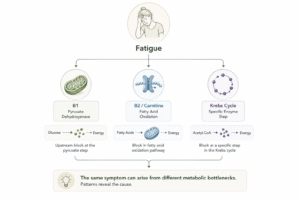
Fatigue markers on an OAT aren’t one thing. Where the abnormality falls tells you what to correct.
Lactate and pyruvate elevated together point upstream, at the pyruvate dehydrogenase (PDH) step, which depends on thiamine (B1). Elevated adipate and suberate point somewhere different — at fatty acid oxidation, where carnitine and riboflavin (B2) are the usual limiting factors. Specific Krebs cycle intermediates accumulating point to the cofactor needed at that particular step.
Same complaint, three different bottlenecks, three different corrections. A single “mitochondrial dysfunction” label would miss all of it.
Pattern 3: Distinguishing B12 from folate
Methylmalonic acid rises when B12 is insufficient, because B12 is required to convert methylmalonyl-CoA to succinyl-CoA⁴. It’s one of the best-validated markers on the whole panel, and it becomes abnormal early — before serum B12 necessarily looks low⁵.
But elevated MMA on its own doesn’t tell you whether folate is also a problem. Read alongside the folate marker, you can separate them — which matters, because supplementing the wrong one is a common and unhelpful mistake.
Pattern 4: Two problems that are really one
Elevated oxalate markers alongside markers of yeast activity suggest a different origin than elevated oxalate alone. Some fungal species produce oxalate, so treating the oxalate as purely dietary would miss the actual source.
This is the pattern-reading principle in its clearest form: two abnormalities that look separate are often one problem viewed from two angles.
Pattern 5: Where the tryptophan went
Tryptophan can go down the serotonin pathway or down the kynurenine pathway. Inflammation pushes it toward kynurenine, so inflammatory markers appearing alongside a shift in tryptophan metabolites suggests low serotonin output is downstream of inflammation, not a primary neurotransmitter problem.
Treat the mood. Or treat the inflammation and let the mood follow. The pattern tells you which.
What this test is really good at — and what it isn’t
Being honest matters, because the criticism levelled at organic acid testing is partly fair.
Well-validated markers. Methylmalonic acid as a functional B12 marker is solid and used in conventional medicine⁴ ⁵. Several markers on the panel come from established inborn-error-of-metabolism screening.
Markers with real but narrower support. The clostridia markers have published research behind them, including independent confirmation of raised HPHPA by groups in China, Turkey and Italy⁶. But a significant proportion of the dysbiosis marker literature originates from the laboratory that developed and sells the test, which is worth knowing when weighing it. It’s also worth noting these metabolites aren’t exclusive to Clostridia — p-cresol in particular is produced by a range of tyrosine-fermenting gut bacteria, so a raised marker points toward a pattern rather than identifying a single organism.
Markers where the criticism lands. Reference ranges for many of the microbial markers haven’t been independently validated in large studies⁷. Some markers are non-specific and rise for benign reasons — diet being the biggest one. D-arabinitol is a good example: strongly elevated in invasive candidiasis, but at more modest elevations there’s uncertainty about what distinguishes normal colonisation from overgrowth⁸.
What follows from that. It’s an argument for reading the test as a set of leads to follow rather than a set of diagnoses — which is exactly what pattern reading does. A single elevated non-specific marker means little. Three related markers moving together in a way that matches the person’s symptoms means something. The pattern is what carries the signal, precisely because individual markers are noisy.
It’s also why an OAT shouldn’t be the only test someone runs, and why the results need reading against symptoms, history and other testing rather than in isolation.
What can affect your results?
- Diet in the days before collection — particularly fruit, certain vegetables, and anything high in oxalate or benzoate
- Supplements, especially B vitamins, which can normalise markers you were trying to measure
- Antibiotics or antifungals, recent or current
- Kidney function, which affects excretion of everything on the panel
- Timing — most OATs use a first-morning sample, and following the collection instructions properly matters
Poor preparation is a common reason results are hard to interpret.
Who is it useful for?
The OAT earns its place when someone has symptoms across several systems at once — fatigue, brain fog, mood changes, digestive symptoms, food reactions — and standard investigations have come back unremarkable. That’s the situation where seeing multiple systems on one page is worth more than another single-system test.
It’s less useful as a general screen for someone without symptoms, and it isn’t a substitute for standard medical investigation where that’s indicated.
The short version
An OAT is not a diagnostic test. What it is, in skilled hands, is a map of which processes are struggling and how those difficulties connect — read as a pattern rather than a list.
Which is also why two practitioners can look at the same report and reach different conclusions. The data is the same. The reading and interpretation is the skill.
Frequently asked questions
What does an Organic Acid Test measure? Metabolic byproducts in urine, covering energy production, B vitamin status, neurotransmitter breakdown, gut yeast and bacterial activity, detoxification and oxalate metabolism — typically 60 to 75 markers on one panel.
Is the Organic Acid Test accurate? It varies by marker. Some, such as methylmalonic acid for B12 status, are well validated and used in conventional medicine. Others, particularly some microbial markers, have reference ranges that haven’t been independently validated and can be influenced by diet. This is why results should be read as patterns and as leads to follow, not as standalone diagnoses.
What does elevated HPHPA mean? HPHPA is produced by certain clostridia species in the gut. Its significance depends on what else is elevated — particularly whether dopamine and norepinephrine breakdown products suggest the compound is inhibiting dopamine beta-hydroxylase.
Can an Organic Acid Test detect candida? It includes markers associated with yeast activity, such as D-arabinitol. Strong elevations are meaningful, but modest elevations are harder to interpret, since it isn’t clearly established what level distinguishes normal colonisation from overgrowth.
Do I need to prepare for an Organic Acid Test? Yes. Diet in the preceding days, supplements (especially B vitamins), and recent antibiotics or antifungals can all affect results. Follow the laboratory’s collection instructions carefully.
Can I interpret my own OAT results? You can understand what individual markers represent, but the useful information is in how markers relate to each other and to your symptoms. A list of highs and lows read individually tends to produce either false alarm or false reassurance.
References
- Shaw, W. (2010). Increased urinary excretion of 3-(3-hydroxyphenyl)-3-hydroxypropionic acid (HPHPA), an abnormal phenylalanine metabolite of Clostridia spp. in the gastrointestinal tract, in urine samples from patients with autism and schizophrenia. Nutritional Neuroscience, 13(3), 135–143. doi:10.1179/147683010X12611460763968
- Southan, C., DeWolf, W. E. Jr & Kruse, L. I. (1990). Inactivation of dopamine β-hydroxylase by p-cresol. Biochimica et Biophysica Acta.
- Shaw, W. (2012). Inhibition of dopamine conversion to norepinephrine by Clostridia metabolites. [Clinical case documentation]
- Mayo Clinic Laboratories. Methylmalonic Acid, Quantitative, Urine — test definition and clinical interpretation.
- Diagnostic performances of urinary methylmalonic acid/creatinine ratio in vitamin B12 deficiency. Journal of Clinical Medicine (2020). PMC7466029
- Independent confirmations of raised urinary HPHPA: Xiong et al. (2016, China); Keşli et al. (2014, Turkey); Noto et al. (2014, Italy). [Verify full citations before publishing.]
- Organic acids test reference ranges have not been verified in independent clinical studies — see critical reviews of commercial OAT panels.
- Mailing, L. The uses and limitations of organic acids testing for gut health: a complete guide. lucymailing.com