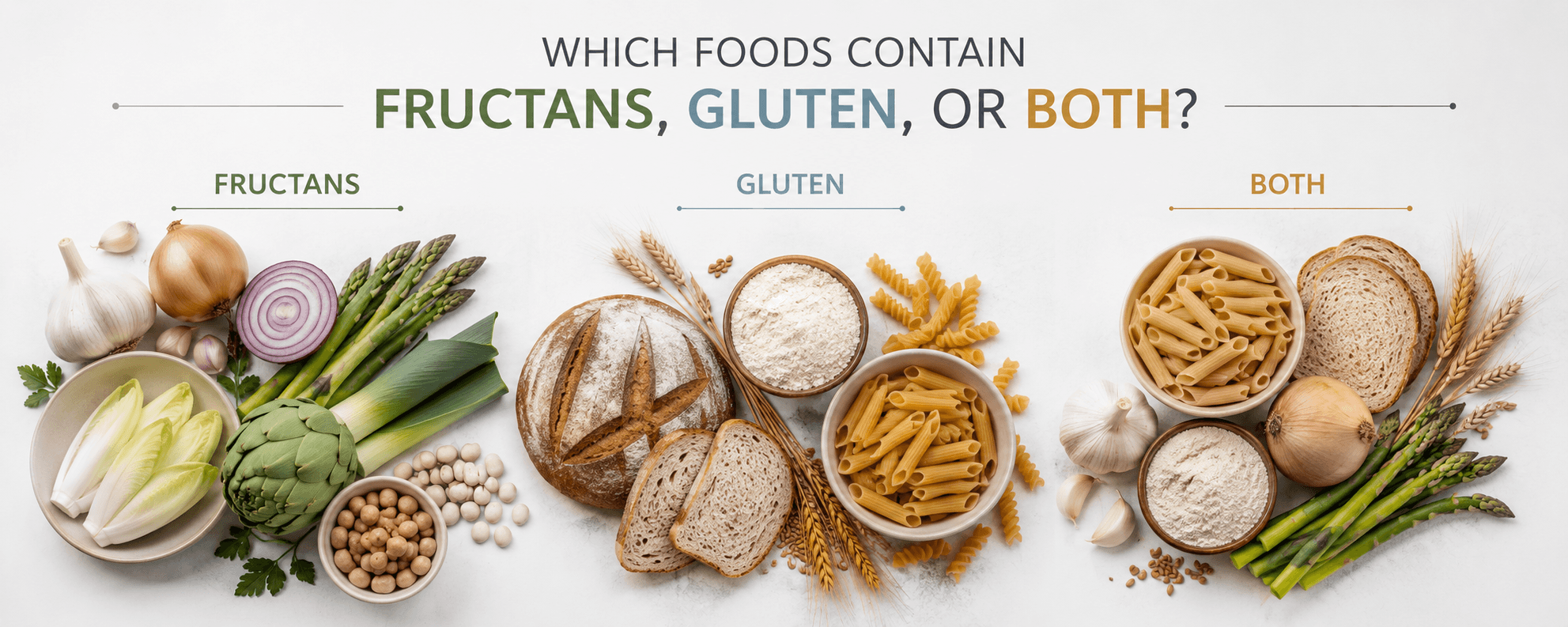
Gluten and fructans are different things that live in mostly the same foods. Gluten is a protein. Fructans are a chain of fructose molecules — a carbohydrate — and they are found in wheat, rye and barley, but also in onion, garlic, legumes and a long list of foods that contain no gluten at all. That overlap is why a gluten-free diet often produces a partial result. You remove the bread and leave the onion and garlic in, and they may have been carrying more of the load than the bread was.
This page is the food lists for both, and what to use instead. If you want to know which of the two is your problem, there is a short section on that near the end.
What is the difference between gluten and fructans?
| Gluten | Fructans | |
|---|---|---|
| What it is | A protein in wheat, rye and barley | A short chain of fructose molecules — a carbohydrate |
| Where it is found | Only in those grains and things made from them | Those grains, plus onion, garlic, legumes and many vegetables and fruits |
| Why it causes symptoms | Immune response in coeliac disease; the mechanism in non-coeliac sensitivity is not settled | Poorly absorbed, so it draws water into the bowel and is fermented by gut bacteria |
| Does the amount matter | Not in coeliac disease. Yes for most other people | Yes. It is a dose problem, and portion size changes the answer |
| Removing it means | Reading labels on grain products | Reading labels on nearly everything |
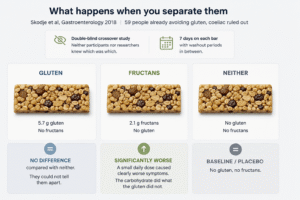
In a double-blind crossover trial, 59 people who had put themselves on a gluten-free diet, and in whom coeliac disease had been excluded, were given identical-tasting bars containing gluten, fructans, or neither. Gluten produced no significant difference against placebo. A small daily dose of fructans, just over two grams, produced significantly worse symptoms.¹ That is one trial, and it is a well-designed one in exactly the group of people who believe gluten is their problem.
Which foods contain gluten?
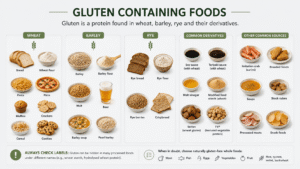
The grains themselves
| Grain | Also sold as |
|---|---|
| Wheat | Spelt, kamut, durum, semolina, farro, freekeh, einkorn, bulgur, couscous, wheat bran, wheatgerm |
| Rye | Rye flour, pumpernickel, some crispbreads |
| Barley | Pearl barley, malt, malt extract, malt vinegar, barley flour |
| Triticale | A wheat and rye cross, mostly in specialty breads |
| Oats | No gluten of their own, but routinely contaminated in processing. Buy certified gluten-free oats if this matters to you |
Where gluten hides, and what to use instead
| Where it hides | Why you would miss it | What to use instead |
|---|---|---|
| Soy sauce | Most soy sauce is brewed with wheat | Tamari labelled gluten-free, or coconut aminos |
| Stock cubes and powders | Wheat is a common bulking agent | Homemade stock, or a brand you have read the label on |
| Malt vinegar | Malt is barley | Apple cider, white wine or rice vinegar |
| Beer and ale | Brewed from barley | Wine, cider, or spirits — distillation removes the protein |
| Processed meats | Sausages, rissoles and some deli meats use wheat as a binder | Butcher-made with a stated ingredient list |
| Gravies, sauces and soups | Thickened with flour | Cornflour, rice flour, arrowroot or potato starch |
| Imitation seafood | Wheat starch is a standard binder | Actual fish |
| Licorice and some sweets | Wheat flour is used in the manufacture | Check the label rather than the category |
| Some medications and supplements | Wheat starch appears as an excipient | Ask your pharmacist, who can check for you |
| Asafoetida (hing) | Often blended with wheat flour as a carrier | Pure asafoetida, sometimes sold as gluten-free hing |
Grains and flours that contain no gluten
Rice, corn, quinoa, buckwheat (unrelated to wheat despite the name), millet, sorghum, teff, amaranth, potato, tapioca, arrowroot, chickpea flour, almond meal, coconut flour, and certified gluten-free oats.
Which foods contain fructans?
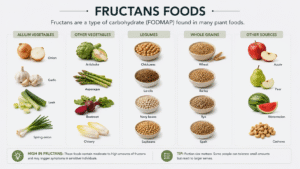
Portion size decides this one. A food is not simply high or low in fructans — a small serve of something high may sit under your threshold while a large serve of something moderate does not. The lists below are a starting point, not a verdict.
Vegetables
| Higher in fructans | Lower in fructans |
|---|---|
| Onion — all kinds, including the white part of spring onion and shallots | Green tops of spring onion, chives, leek greens |
| Garlic | Garlic-infused oil, ginger, asafoetida |
| Leek — the white bulb | Carrot, courgette, capsicum, cucumber, lettuce |
| Jerusalem artichoke, globe artichoke | Potato, sweet potato in moderate serves, parsnip |
| Beetroot, savoy cabbage, fennel bulb in larger serves | Green beans, bok choy, spinach, tomato, eggplant |
Grains and legumes
| Higher in fructans | Lower in fructans |
|---|---|
| Wheat, rye and barley in any quantity — bread, pasta, couscous, crackers | Rice, oats, quinoa, buckwheat, millet, polenta, sourdough with a genuinely long rise |
| Chickpeas, lentils, kidney beans and most legumes — these carry GOS as well | Tinned lentils and chickpeas, rinsed well, in small serves |
| Cashews, pistachios | Macadamias, walnuts, peanuts, pumpkin seeds |
Fruit
| Higher in fructans | Lower in fructans |
|---|---|
| Watermelon, nectarine, white peach, persimmon | Berries, orange, kiwifruit, grapes, unripe banana, pineapple |
| Dried fruit generally — the sugars concentrate as the water leaves | Small serves of the same fruit fresh |
Where fructans hide, and what to use instead
| Where they hide | Why you would miss them | What to use instead |
|---|---|---|
| Stock cubes, powders and liquid stocks | Onion and garlic are in nearly all of them | Homemade stock from bones and low-fructan vegetables |
| Jarred sauces, marinades and dressings | Onion or garlic powder is standard | Oil, vinegar, herbs, and garlic-infused oil |
| “Seasoning”, “spice mix” or “natural flavour” on a label | Onion and garlic powder are usually inside them | Single herbs and spices you have measured yourself |
| Hummus and most dips | Chickpeas and garlic together | Tahini-based dips, or a dip made with garlic-infused oil |
| Inulin and chicory root fibre | Added to high-fibre bars, dairy-free yoghurts, protein powders and some breads. Inulin is a fructan by definition | Read the ingredient list — it will be named |
| Chai and some herbal teas | Chicory root and dandelion root are common | Plain black, green or peppermint tea |
| Gluten-free bread | Often contains inulin or chicory root as a fibre replacement | Sourdough with a long rise, or a loaf whose label you have read |
Which foods contain both?
Wheat, rye and barley carry gluten and fructans together. Everything made from them does too — bread, pasta, pastry, most breakfast cereals, crackers, couscous, batter and crumb.
This is the reason the two get confused. Removing bread removes both at once, so improving on a gluten-free diet does not tell you which one you removed. And it is also the reason gluten-free does not usually fix a fructan problem: you have swapped the bread and kept the onion, the garlic, the stock cubes and the sauces, which is where a good deal of the fructan load lives.
Two substitutions worth knowing properly
Garlic-infused oil
Fructans are water-soluble and not oil-soluble. The flavour compounds in garlic move into oil; the fructans stay behind in the clove. So garlic-infused oil gives you the flavour without the fructan load, and it is the single most useful substitution on this page.
Three things to know. Many products labelled “garlic-infused” are flavoured rather than genuinely infused, so read the label. Because fructans are water-soluble, cooking with a whole clove and fishing it out afterwards does not work — the fructans leach into the dish. And homemade garlic oil carries a botulism risk if it is stored, since garlic can carry Clostridium botulinum and oil is a low-oxygen environment; commercially produced oils are processed to prevent that.
Asafoetida
Also sold as hing, this is a dried resin used in Indian cooking that gives a savoury, oniony flavour when bloomed in hot oil. Useful if onion and garlic are your problem. The catch is that commercial asafoetida is frequently blended with wheat flour as a carrier, which adds both gluten and fructans back into the dish. Look for pure asafoetida.
How do I tell whether it is the gluten or the fructans?
Three tests, in order of how easy they are.
- Test onion and garlic on their own. There is no gluten in an onion. If a bowl of onion soup sets you off while you are eating bread quite happily, you have your answer in a few days without reorganising your kitchen.
- Test properly fermented sourdough. A long fermentation lowers both gluten and fructans, because the bacteria consume them during the rise. Supermarket bread with “sourdough” on the packet is usually ordinary bread with flavouring, so this only works with the real thing. If real sourdough is fine and ordinary bread is not, that points at the dose rather than at gluten itself.
- Remove fructans and keep the gluten. The cleanest separation, and the most work, because it means learning a new food list while continuing to eat bread.
Give each one two weeks, and change one thing at a time. If you change two, a result tells you nothing.
One thing to do before you remove gluten
If you still eat gluten and have never been tested for coeliac disease, speak to your doctor before you take it out. The blood test looks for the antibodies your immune system makes in response to gluten, so it only works while gluten is in your diet. Remove it first and the test can come back clean in someone who has the condition. If you have already gone gluten-free, ask about the gene test instead — it works whatever you are eating, and a negative result makes coeliac disease very unlikely.
Restriction is not the goal
Low-fructan eating belongs to the low-FODMAP approach, which has reasonable trial evidence behind it for irritable bowel symptoms.² It was designed as a temporary phase, not a way of life. The protocol it comes from runs in three parts — a period of restriction lasting two to six weeks, then a structured reintroduction, then working out your own tolerances food by food. Most of the value sits in the reintroduction, and most people never get there.
There is a cost to staying restricted. Fructans are food for your gut bacteria, and reducing them lowers bifidobacteria — the species whose fermentation products feed the bacteria that make butyrate for your gut lining.³ So a long low-fructan diet narrows the population you are trying to look after. Set an end date before you start, and write it down.
Frequently asked questions
Is a fructan problem the same as a wheat allergy?
No. A wheat allergy is an IgE-mediated allergic reaction with fast onset, and it needs medical care. A fructan problem is a matter of dose and fermentation, and reactions build over hours.
Why did going gluten-free help me a bit but not completely?
Usually because you removed part of your fructan load with the bread and left the rest of it in place. Onion, garlic, stock cubes and sauces are frequently a larger source than bread was.
Can I eat sourdough if I have coeliac disease?
No. Fermentation lowers gluten but does not remove it, and there is no safe amount in coeliac disease.
Are gluten-free products lower in fructans?
Not reliably. Many gluten-free breads contain inulin or chicory root fibre, which is a fructan, added to replace the fibre lost with the wheat.
Is onion powder lower in fructans than fresh onion?
No, it is generally more concentrated by weight. A teaspoon of onion powder in a spice mix can carry more than a slice of onion.
Do I have to avoid these foods forever?
For most people, no. Fructan tolerance is a dose question, and it commonly improves as the gut improves. Retest yourself every six to twelve months rather than assuming the answer you got this year is permanent.
References:
¹ Skodje GI, Sarna VK, Minelle IH, et al. Fructan, rather than gluten, induces symptoms in patients with self-reported non-celiac gluten sensitivity. Gastroenterology. 2018;154(3):529–539. (Human, double-blind crossover, n=59.)
² Halmos EP, Power VA, Shepherd SJ, et al. A diet low in FODMAPs reduces symptoms of irritable bowel syndrome. Gastroenterology. 2014;146(1):67–75. (Human, randomised crossover.)
³ So D, Loughman A, Staudacher HM. Effects of a low FODMAP diet on the colonic microbiome in irritable bowel syndrome: a systematic review with meta-analysis. American Journal of Clinical Nutrition. 2022;116(4):943–952. (Meta-analysis of nine trials, 403 participants.)
This article is general education. It does not diagnose or treat any condition and it is not a substitute for advice from your own doctor.