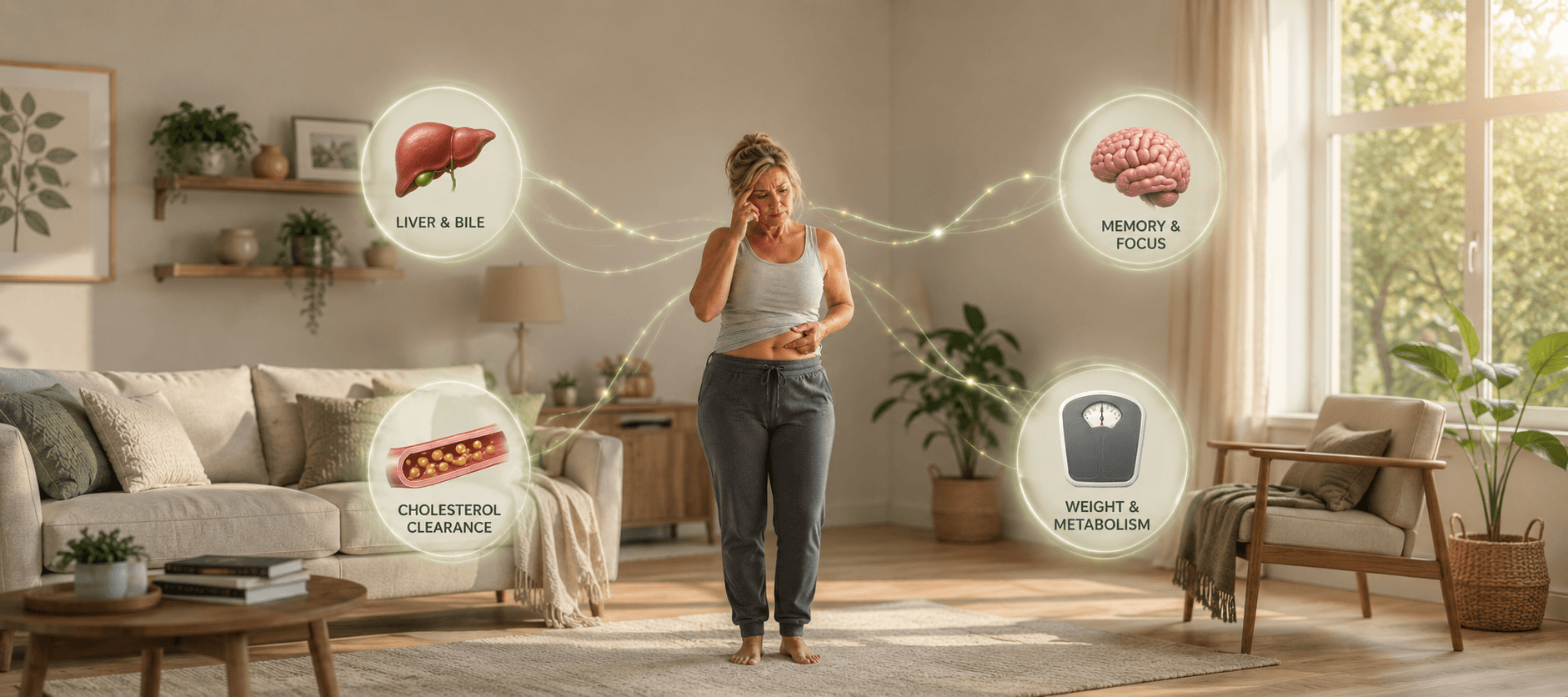
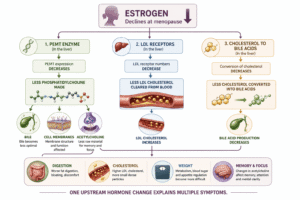
If digestion, cholesterol, weight and memory all seemed to shift after menopause, you’re not imagining it, and it isn’t just “getting older.” Oestrogen quietly supports several systems at once: it drives the enzyme that makes phosphatidylcholine (needed for healthy bile, cell membranes and the memory chemical acetylcholine), it keeps the liver clearing cholesterol efficiently, and it helps convert cholesterol into bile acids. When oestrogen falls, all of those run less smoothly — which is why the changes tend to arrive together rather than one at a time.
Oestrogen does more than reproduction
Oestrogen is usually discussed only in terms of periods, fertility and hot flushes. But it also acts as a background regulator of metabolism — switching on genes the liver and brain rely on. Several of those genes carry an “oestrogen response element,” a stretch of DNA that oestrogen binds to in order to turn the gene up.
When oestrogen is plentiful, those genes run at full tilt. When it declines, they slow. Three of them, taken together, explain a great deal of what changes after menopause.
1. Oestrogen and choline: the bile, membrane and memory link
Your liver can make its own choline-containing compound, phosphatidylcholine, through an enzyme called PEMT (phosphatidylethanolamine N-methyltransferase). The gene for PEMT contains oestrogen response elements and is strongly switched on by oestrogen¹ ². This is why, before menopause, women can make a good deal of their own phosphatidylcholine and are relatively protected from choline shortfall.
Phosphatidylcholine matters in three places at once:
- Bile. Phosphatidylcholine is a major component of bile, where it keeps cholesterol dissolved and bile flowing smoothly. Too little, and bile becomes more sludgy and prone to problems, and is discussed in the article what are the signs of sluggish bile.
- Cell membranes. Every cell membrane in the body is built largely from it.
- The brain. Choline is the raw material for acetylcholine, the neurotransmitter central to memory and attention³ ⁴.
When oestrogen falls at menopause, PEMT is no longer strongly driven, so the liver’s own production of phosphatidylcholine drops. The body becomes far more dependent on getting choline from food to make up the difference. The evidence is striking: on a low-choline diet, around 80% of postmenopausal women developed signs of choline deficiency, compared with 44% of premenopausal women⁵ ⁶.
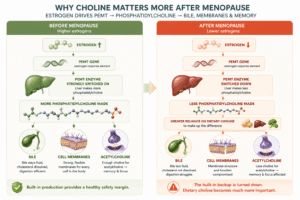
So this isn’t about one dramatic deficiency. It’s that the safety margin narrows. The same diet that was fine before menopause may no longer supply enough — and the consequences show up across bile, membranes and memory at once. That connection between low oestrogen, choline and cognitive change is an active area of research⁴.
One caveat: in well-fed conditions the diet-based route can cover bile’s phosphatidylcholine needs, so low PEMT doesn’t single-handedly starve bile⁷. It’s rather that after menopause you rely much more on dietary choline to keep all of this supplied — the built-in backup is turned down.
2. Oestrogen and cholesterol clearance
This is one of the best-established effects, and it explains why cholesterol so often rises after menopause even with no change in diet.
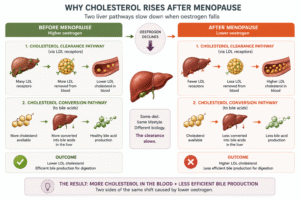
The liver clears cholesterol from the blood using LDL receptors — docking points that pull LDL (“bad” cholesterol) out of circulation. Oestrogen increases the number of these receptors⁸ ⁹. More receptors means more clearance, and lower blood cholesterol.
When oestrogen declines, LDL receptor activity falls, clearance slows, and LDL cholesterol rises — commonly to levels exceeding those of age-matched men, with a shift toward smaller, denser particles¹⁰. This is a well-documented consequence of menopause, driven by the loss of oestrogen’s support for the liver’s cholesterol-clearing machinery¹⁰.
So a woman who ate the same way for decades can suddenly be told her cholesterol is high. The food didn’t change. The clearance did.
3. Cholesterol, bile and the loop between them
Here’s where the two threads join.
Bile acids are made from cholesterol — converting cholesterol into bile acids is actually the body’s main route for getting rid of excess cholesterol. And oestrogen supports this conversion too: part of the reason oestrogen lowers cholesterol is that it accelerates the conversion of cholesterol into bile acids¹⁰.
So after menopause, with oestrogen low: the liver clears less cholesterol from the blood (fewer LDL receptors), and it converts less cholesterol into bile acids. Cholesterol that would once have been turned into bile and used for digestion instead stays in circulation. Higher blood cholesterol and less efficient bile production are two faces of the same shift.
Why the symptoms cluster
Put the three together and the after-menopause picture stops looking like a random collection of unrelated complaints:
- Digestion feels worse — less phosphatidylcholine and less efficient bile acid production affect bile quality and fat digestion.
- Cholesterol rises — reduced LDL clearance and reduced conversion of cholesterol to bile.
- Weight becomes harder to manage — shifting metabolism, and the knock-on effects of altered bile signalling on blood sugar and appetite.
- Memory and focus change — reduced phosphatidylcholine availability affects acetylcholine, the memory neurotransmitter³ ⁴.
These aren’t four separate problems. They’re the downstream effects of one upstream change — falling oestrogen — pulling on several threads that all happen to run through the liver, bile and choline.
You’re not imagining it — and there’s a genetic wrinkle
Women are so often told these changes are just ageing, or stress, or to be expected — and left there. There are real, traceable mechanisms behind them, which is a very different thing from “in your head.”
There’s also individual variation worth knowing about. A common variant in the PEMT gene reduces how well the enzyme works, and specifically how well oestrogen can switch it on⁶ ¹¹. Women carrying it are more vulnerable to choline shortfall as oestrogen falls — which may be part of why some women sail through menopause metabolically while others feel the shift more acutely. Same drop in oestrogen, different starting hardware.
What this points toward
Understanding the mechanism doesn’t hand you a prescription — every woman’s picture is different, and hormone decisions in particular are individual and belong with your doctor. But the biology does point somewhere specific.
- Dietary choline matters more after menopause, not less, because the body’s own production route is throttled. This is worth knowing, since choline is a nutrient many people barely think about.
- Rising cholesterol may be a clearance story, not a diet failure — which changes how you think about it, even if it doesn’t change what you do about it.
- Digestion, cholesterol and cognition can share a root, so they may be worth looking at together rather than as separate problems.
- Genetic variation (PEMT, and the related methylation genes) can be informative about who is more susceptible and why.
The short version
Oestrogen quietly supports choline production, cholesterol clearance and the conversion of cholesterol into bile. When it falls at menopause, all three run less efficiently — which is why digestion, cholesterol, weight and memory can shift together. These are real, connected mechanisms, not imagination and not simply age. Knowing that is the first step to doing something considered about it, rather than being told to get used to it.
Frequently asked questions
Why does cholesterol go up after menopause?
Oestrogen increases the liver’s LDL receptors, which clear cholesterol from the blood, and it helps convert cholesterol into bile acids. When oestrogen falls, both processes slow, so LDL cholesterol rises — often even without any change in diet.
Does menopause affect digestion?
It can. Oestrogen supports production of phosphatidylcholine, a key component of bile, and the conversion of cholesterol into bile acids. As oestrogen falls, bile quality and fat digestion can be affected, which is one reason digestion sometimes changes after menopause.
What does choline have to do with menopause?
The liver makes phosphatidylcholine (a source of choline) using the enzyme PEMT, which is switched on by oestrogen. After menopause, that production drops, so the body relies more on dietary choline. On low-choline diets, far more postmenopausal than premenopausal women develop deficiency signs.
Can menopause cause memory problems?
Reduced phosphatidylcholine availability affects acetylcholine, the neurotransmitter central to memory and attention. The link between falling oestrogen, choline metabolism and cognitive change after menopause is an active research area, so memory changes have a plausible biological basis rather than being purely psychological.
Are my post-menopause symptoms just ageing?
There are specific, documented mechanisms — involving choline, cholesterol clearance and bile — behind the digestive, cholesterol and cognitive changes many women notice. They’re real and connected, not simply “in your head.”
Why do some women struggle more than others?
Part of the answer is genetic. A common variant in the PEMT gene reduces how well oestrogen can switch the enzyme on, leaving some women more vulnerable to choline shortfall as oestrogen falls.
References
- Aberrant estrogen regulation of PEMT results in choline-deficiency-associated liver dysfunction — the PEMT promoter contains oestrogen-responsive elements and is under oestrogenic control. Journal of Biological Chemistry (2010).
- Perspective: Estrogen and the risk of cognitive decline — a missing choline(rgic) link? PEMT mRNA and activity are dramatically upregulated by oestrogen. Advances in Nutrition (2022).
- Oral choline reduced working-memory-related brain activation in postmenopausal women (pilot). Choline as the precursor to acetylcholine; PEMT under oestrogen control. (2025). PMC12899796
- Choline and brain functioning in postmenopausal women — PEMT is oestrogen-induced; low-oestrogen states and cholinergic/cognitive change. ClinicalTrials.gov NCT07264257.
- Fischer, L. M. et al. Choline requirements of women — ~80% of postmenopausal vs 44% of premenopausal women developed choline-deficiency signs on a low-choline diet. Referenced in Ganz (2017) and DNALabs summary.
- Fischer, L. M. et al. (2010). Dietary choline requirements of women: effects of estrogen and genetic variation. American Journal of Clinical Nutrition. — Oestrogen lowers choline requirement; PEMT SNP rs12325817 increases risk. PMC2954445
- The PEMT pathway is quantitatively not essential for biliary phosphatidylcholine secretion under normal choline supplementation. Journal of Lipid Research (2007). — The honest caveat on PEMT and bile.
- Estrogen increases hepatic LDL receptor expression — estrogen receptors are critically involved in the induction of hepatic LDL receptor expression. Arteriosclerosis, Thrombosis, and Vascular Biology (1997), 17(9), 1800.
- β-Estradiol upregulates liver LDL receptor, partly by reducing PCSK9. FEBS / HuH7 hepatocyte study (2016). PMC5008176
- Cardiovascular effects of estrogen in postmenopausal women — after menopause LDL rises and shifts to smaller, denser particles; estrogen lowers LDL via accelerated conversion of cholesterol to bile acids and increased LDL receptor expression. Circulation (1996), 93(10), 1928.
- PEMT variant rs12325817 disrupts hormonal activation of the enzyme, raising susceptibility to choline deficiency; interacts with methylation genes. Journal of Biological Chemistry / AJCN (2010).