Your gut bacteria make neurotransmitters. Not compounds that vaguely resemble them — the actual molecules, produced by bacterial enzymes doing the same chemistry your own cells do.
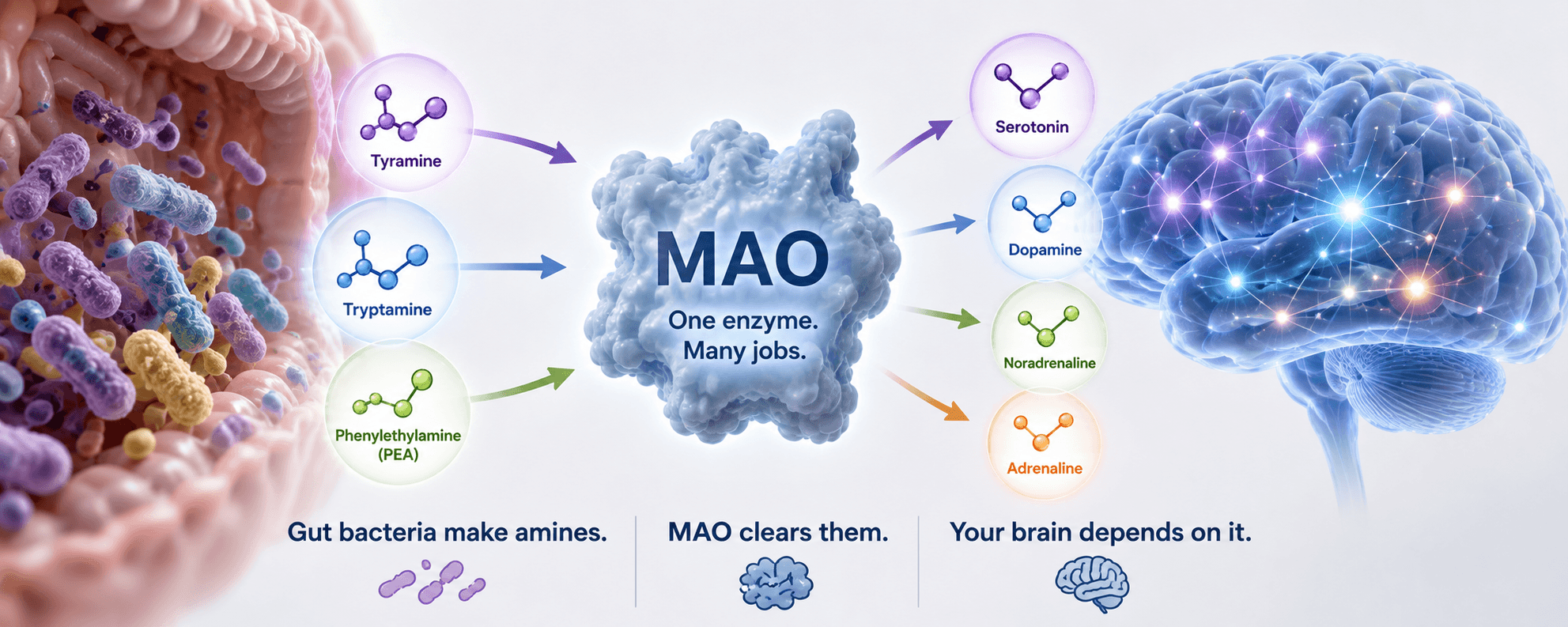
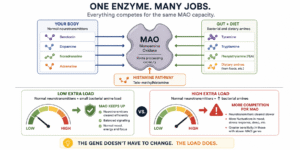
That matters because of what happens next. The amines bacteria produce are cleared by monoamine oxidase, and MAO is already the enzyme responsible for clearing your serotonin, dopamine, noradrenaline and adrenaline. It is one enzyme handling a long list of substrates, and everything on that list competes for the same capacity.
So a gut producing large quantities of tyramine and tryptamine is not just a digestive problem. It is adding to the workload of the enzyme your brain chemistry depends on.
Which neurotransmitters do gut bacteria actually make?
The main ones are a group called aromatic amines, or trace amines: tyramine, tryptamine and phenylethylamine (PEA).
They are made by a bacterial enzyme called aromatic amino acid decarboxylase (AADC), which strips the carboxyl group from an aromatic amino acid. Tyrosine becomes tyramine, tryptophan becomes tryptamine, phenylalanine becomes phenylethylamine.¹
Your own cells run the equivalent reaction. This is the same decarboxylation step that sits in your dopamine and serotonin pathways. Bacteria simply do it in the gut lumen, using the amino acids from your meal, without any reference to whether you need the product.
Five genera of Firmicutes have been shown to produce these amines abundantly: Blautia, Clostridium, Enterococcus, Ruminococcus and Tyzzerella.¹ Ruminococcus gnavus in particular correlates strongly with phenylethylamine production in human faecal samples,¹ and tryptamine production has been confirmed in R. gnavus, Clostridium sporogenes, Enterocloster asparagiformis, Blautia hansenii and Clostridium nexile.²
Enterococcus faecalis is the notable tyramine producer, using a dedicated tyrosine decarboxylase enzyme.³ Tyramine production appears to benefit the bacterium — it helps with energy generation and with surviving acid stress — so this is the organism looking after itself, not doing anything for you.³
Historically these amines were assumed to come from fermented food. They do come from food, but the gut microbiota is now recognised as a substantial additional source.¹
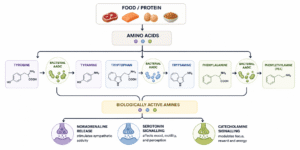
These are not inert compounds
Trace amines are called trace amines because they occur at low concentrations, not because they do little. They act on specific receptors and at low concentrations affect neurotransmission.¹
Tyramine triggers the release of noradrenaline from nerve terminals, causes peripheral vasoconstriction and raises blood glucose.³ It is a sympathetic stimulant that your body did not decide to release.
Tryptamine is structurally close to serotonin and acts as a serotonin receptor agonist, as well as an agonist at trace amine-associated receptor 1 (TAAR1).³ Engineered bacteria producing tryptamine activated serotonin receptor 4 in the gut and accelerated intestinal transit.³
Phenylethylamine is structurally related to amphetamine and modulates catecholamine signalling.
So a shift in gut population can change how much stimulant-like signalling you are exposed to, independent of anything happening in your brain.
Why MAO is the bottleneck
This is the part that explains why bacterial amines matter more than their quantity suggests, and it comes down to an unusual feature of the enzyme.
Most enzymes in neurotransmitter metabolism do exactly one job.
| Enzyme | What it does |
|---|---|
| Tyrosine hydroxylase | Tyrosine → L-dopa. That’s all. |
| Dopamine beta-hydroxylase | Dopamine → noradrenaline. That’s all. |
| PNMT | Noradrenaline → adrenaline. That’s all. |
| Tryptophan hydroxylase | Tryptophan → 5-HTP. That’s all. |
| HNMT | Histamine, and nothing else. |
| DAO | Histamine and other diamines. |
One substrate in, one product out. If that enzyme is slow, one specific thing backs up and you can usually predict what.
Monoamine oxidase does not work like this.
MAO acts on a wide range of endogenous substrates. The list includes noradrenaline, dopamine, serotonin and adrenaline, along with tele-methylhistamine and the trace amines phenylethylamine, tyramine, tryptamine, methoxytryptamine, dimethyltryptamine and the octopamines — and that list is explicitly incomplete.⁴
Split by isoform:
| MAO-A handles | MAO-B handles | Both handle |
|---|---|---|
| Serotonin, noradrenaline, adrenaline, melatonin, octopamine | Phenylethylamine, benzylamine | Dopamine, tyramine, tryptamine |
Note where the bacterial amines land.⁵ ⁶ Tyramine and tryptamine are substrates for both isoforms — the same two enzymes clearing your serotonin, dopamine and noradrenaline. Phenylethylamine goes to MAO-B, which is also your main route for dopamine breakdown in the brain.
MAO also processes drugs and other amine xenobiotics that happen to be structurally similar to its natural substrates. So the same enzyme is handling your neurotransmitters, your gut bacteria’s output, dietary amines, and a range of compounds you swallowed.
One enzyme. Many jobs. Everything competing.
Your gut wall is the first line of defence
There is a reason you are not overwhelmed by amines every time you eat.
MAO is concentrated in the intestine and liver, and intestinal MAO is predominantly MAO-A.⁷ Its function there is to break down ingested bioactive amines before they reach the systemic circulation — specifically protecting you from vasoactive compounds, tyramine above all.⁷
This is a first-pass barrier, and it works well under ordinary conditions. But it is capacity-limited, like any enzyme system. Present it with more substrate than it can process and the excess passes through.
The proof that this barrier is real and load-dependent is the cheese effect. People taking MAO inhibitors who eat aged cheese, cured meat or other high-tyramine foods can develop a hypertensive crisis, because the barrier is chemically disabled and tyramine reaches circulation intact. That is the extreme demonstration of a mechanism that operates on a spectrum.
Nobody is suggesting bacterial amine production causes hypertensive crises. The point is that the barrier exists, that it can be overwhelmed, and that a chronically overgrown gut is a chronic load on it.
What happens when you add bacterial load to a slow enzyme
Here is where genetics and gut function meet, and where the picture becomes specific to a person.
The MAOA gene carries a well-characterised variable-number tandem repeat in its promoter. The 3.5 and 4 repeat variants are associated with higher enzyme activity; the 2, 3 and 5 repeat variants with lower transcriptional activity.⁷ Reduced MAO-A activity is common, and on its own it is unremarkable.
Now consider the combination. A person with a slower MAO-A has less capacity to begin with, and every substrate on that long list is competing for it. Add a gut population producing tyramine and tryptamine daily, and you have added a substantial extra demand to an enzyme that was already the limiting step.
This is the point I make about every gene result. A variant describes a tendency under load. The variant does not change. The load does — and the gut is one of the few parts of that load you can actually alter.
It also explains why two people with the same MAOA result have completely different experiences. One has a quiet gut. One is producing bacterial amines around the clock. Same genotype, entirely different clinical picture.
Where histamine fits in
Histamine is worth following, because people frequently have histamine symptoms and MAO problems together and assume they are separate.
Histamine has two clearance routes. DAO breaks it down in the gut. HNMT methylates it inside cells, producing tele-methylhistamine.
Tele-methylhistamine is then a MAO substrate.⁴ So the methylation route for histamine ultimately delivers its product to the same enzyme handling everything else. Histamine clearance and monoamine clearance are not independent systems — they converge.
Which is why slow DAO and slow MAO-A travelling together produces a picture worse than either alone would predict. The gut route is limited and the systemic route behind it is limited too, and bacterial amines are loading the second one.
How this becomes a brain problem
The chain is short and each step is documented.
Gut bacteria decarboxylate amino acids from your food into tyramine, tryptamine and phenylethylamine.¹ These are absorbed. The intestinal MAO barrier processes what it can.⁷ What gets past reaches circulation, where it acts on trace amine receptors and triggers noradrenaline release.³ And clearing it consumes the same MAO capacity that your own serotonin, dopamine and noradrenaline require.⁴ ⁵
The consequence is not that bacteria are directly controlling your mood. It is that the enzyme regulating your neurotransmitter levels is doing a second job at the same time, and capacity spent on one is not available for the other.
That is a more modest claim than “your gut controls your brain”. It is also a more useful version of the gut brain axis than the usual framing, because it names a specific enzyme with finite capacity rather than just a connection.
Location matters too. Bacterial fermentation normally happens in the colon, well past where absorption is most active. When those organisms establish higher up, as in SIBO, amine production relocates to the small intestine — arriving at the intestinal MAO barrier in greater quantity and at the point where absorption is fastest. The same organisms do something comparable with the other product of tyrosine fermentation, which is why phenol clearance and amine clearance tend to fail in the same person.
What people describe
The symptom pattern is not specific, and these are common complaints with many possible causes. But the combination is recognisable for many:
- Anxiety or agitation that arrives without a trigger
- Feeling wired and exhausted simultaneously
- Rapid escalation under stress — zero to sixty with no middle
- Reactions to aged cheese, cured meat, wine, fermented foods, leftovers
- Headaches after those same foods
- Racing heart or blood pressure changes after meals
- Mood tracking with digestive symptoms rather than with circumstances
- Poor tolerance of supplements or medications affecting serotonin or dopamine
- Symptoms worsening after antibiotics or after a gut infection
The food reactions are the most useful pointer, because aged and fermented foods are high in exactly the amines under discussion. Someone reacting to them is telling you something about their amine handling capacity.
Testing
A urinary organic acid test reports the bacterial amines alongside the metabolites of your own neurotransmitters, which is what makes it useful here. Seeing tyramine or tryptamine on the same page as HVA and VMA lets you ask whether the bacterial load is having a functional consequence, rather than just noting that it exists.
A 24-hour urinary neurotransmitter panel does something similar from the other direction, reporting the neurotransmitters and their metabolites so the ratios indicate how the clearance enzymes are actually performing.
Either way, the principle is the same one that applies to every marker: a single elevated result means little. Bacterial amines elevated alongside a shifted pattern in your own neurotransmitter metabolites means considerably more.
What we don’t know
The biochemistry is well established. Bacterial production of these amines is directly demonstrated, the producing organisms are identified, MAO’s substrate range is thoroughly characterised, and the intestinal first-pass barrier is standard pharmacology.¹ ² ⁴ ⁷
The gaps:
- Nobody has measured how much of a healthy person’s MAO capacity is consumed by bacterial amines. The competition is certain in principle; the proportion is unknown.
- No trial has shown that reducing bacterial amine production improves mood or anxiety in humans.
- Much of the production data is in vitro culture or animal models. Bacteria producing tyramine in a flask is not the same as measuring what reaches your bloodstream.
- The interaction between MAOA variants and gut amine load is biologically sensible and has not been tested directly.
- The symptom pattern above is clinical observation, not a validated cluster.
Reading these together as a pattern is more sensible than reading any one in isolation.
In summary
Gut bacteria produce genuine neurotransmitters, chiefly tyramine, tryptamine and phenylethylamine, using the same decarboxylation chemistry your own cells use.
Those amines are cleared by monoamine oxidase — the enzyme already responsible for your serotonin, dopamine, noradrenaline and adrenaline. Unlike most enzymes in this system, which handle a single substrate, MAO handles a long and incomplete list, and everything on it competes.
Which is why gut population can shape brain chemistry without any direct route from one to the other. The connection is a shared enzyme with finite capacity.
Frequently asked questions
Can gut bacteria really make neurotransmitters?
Yes. Bacterial aromatic amino acid decarboxylases convert tyrosine, tryptophan and phenylalanine into tyramine, tryptamine and phenylethylamine respectively — the same decarboxylation step your own neurotransmitter pathways use.¹ Producing genera include Blautia, Clostridium, Enterococcus, Ruminococcus and Tyzzerella.¹
What are bacterial neurotransmitters?
Mainly the trace amines: tyramine, tryptamine and phenylethylamine. They act on trace amine-associated receptors and, in tryptamine’s case, on serotonin receptors.³ They were historically assumed to come from fermented food, but the gut microbiota is now recognised as a major source.¹
Why does MAO matter so much?
Because it isn’t a specialist. Most enzymes in this system do one job — dopamine beta-hydroxylase only converts dopamine to noradrenaline, HNMT only handles histamine. MAO acts on serotonin, dopamine, noradrenaline, adrenaline, melatonin, tele-methylhistamine, the trace amines and various drugs.⁴ Everything competes for the same enzyme.
Do bacterial amines affect brain chemistry?
Indirectly, through two routes. Tyramine triggers noradrenaline release and tryptamine activates serotonin receptors.³ And clearing them consumes MAO capacity that your own monoamines also need.⁴ ⁵ No trial has quantified how much capacity this accounts for in a person.
Why do I react to aged cheese, wine and fermented foods?
Those foods are high in tyramine and other amines. Intestinal MAO-A normally breaks them down before they reach circulation, protecting against vasoactive effects.⁷ Reacting to them suggests that capacity is limited — whether from a slower enzyme, a competing load, or both.
What is the cheese effect?
The hypertensive reaction that occurs when someone taking an MAO inhibitor eats high-tyramine food. It demonstrates that the intestinal MAO barrier is real and that overwhelming it has systemic consequences. Ordinary bacterial amine production doesn’t produce anything like this, but it operates on the same mechanism at a lower level.
Does a slow MAOA variant mean I’ll have symptoms?
No. A variant describes a tendency under load, not an outcome. Two people with the same MAOA result and very different gut populations will have very different experiences, because the substrate load is doing as much work as the enzyme.
How does histamine connect to this?
Histamine is cleared by DAO in the gut and by HNMT inside cells. HNMT’s product, tele-methylhistamine, is itself a MAO substrate.⁴ So the two systems converge, which is why histamine and monoamine problems so often occur in the same person.
Does SIBO make this worse?
Plausibly. Bacterial fermentation normally occurs in the colon, past the main absorptive surface. Overgrowth in the small intestine relocates amine production to where absorption is most active and where the intestinal MAO barrier has to handle it directly. This is mechanistically reasonable rather than demonstrated.
Can antibiotics change this?
Plausibly, in either direction, since they alter which organisms are present and therefore which amines are produced. Whether that translates into a measurable change in amine load in humans hasn’t been established.
References
- Gut bacterial aromatic amine production: aromatic amino acid decarboxylase and its effects on peripheral serotonin production. Gut Microbes. 2022;14(1):2128605. (In vitro and animal model; five Firmicutes genera, AADC characterisation, R. gnavus and PEA correlation in human faecal culture.)
- Intestinal bacteria-derived tryptamine and its impact on human gut microbiota. Frontiers in Microbiomes. 2024. (In vitro; tryptamine production confirmed in five taxa.)
- Commensal human gut microbes produce species-specific neuroactive compounds. iScience. 2025. (In vitro; E. faecalis tyramine production, tryptamine receptor activity, TAAR1 and HTR4 effects.)
- Endogenous substrates and inhibitors of monoamine oxidase. In: Monoamine Oxidase and Disease. (Review; MAO substrate range including trace amines and tele-methylhistamine, described as an incomplete list.)
- Substrate selectivity of monoamine oxidase A, monoamine oxidase B, diamine oxidase, and semicarbazide-sensitive amine oxidase in COS-1 expression systems. 2006. PMID 17142964. (In vitro; substrate overlap and cross-inhibition, notably in MAO-A.)
- Kalgutkar AS, Dalvie DK, Castagnoli N, Taylor TJ. Interactions of nitrogen-containing xenobiotics with monoamine oxidase. Chemical Research in Toxicology. 2001. (Review; isoform substrate selectivity — dopamine, tyramine and tryptamine common to both.)
- Monoamine oxidase: tissue distribution and first-pass metabolism of ingested amines. (Pharmacology reference; intestinal MAO is predominantly MAO-A and protects against systemic absorption of vasoactive amines, particularly tyramine. Also MAOA promoter VNTR activity levels.)