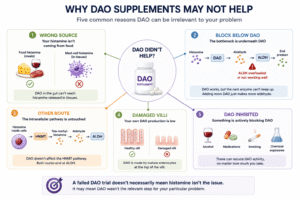
DAO supplements work for some people and do nothing for many others, and the reason is usually not the product. It’s that DAO does one narrow job — breaking down histamine in the gut lumen before it’s absorbed — and there are at least five separate ways that job can be irrelevant to your particular problem.
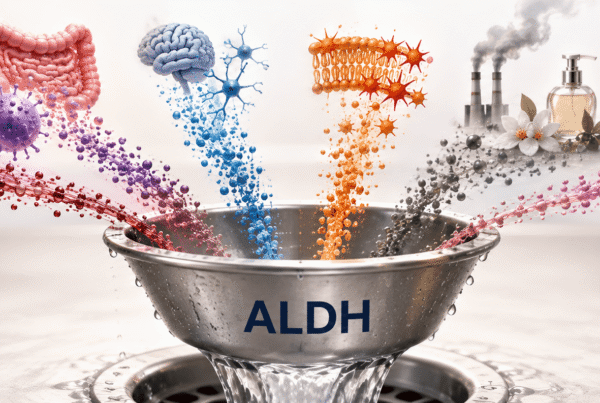
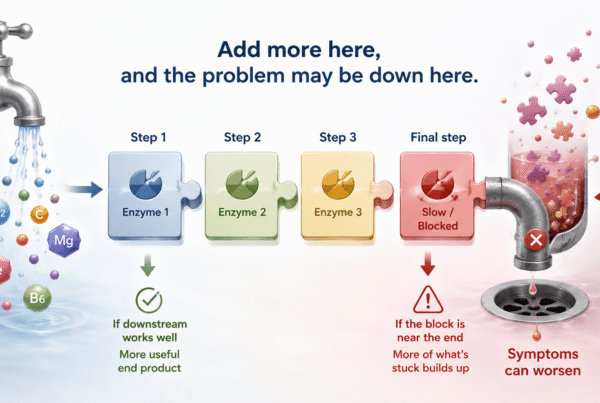
The most overlooked is that DAO doesn’t finish the job. It converts histamine into an aldehyde, which then needs a different enzyme entirely. If that second enzyme is the bottleneck, adding DAO speeds up a step that was never the problem.
What DAO actually does, and where
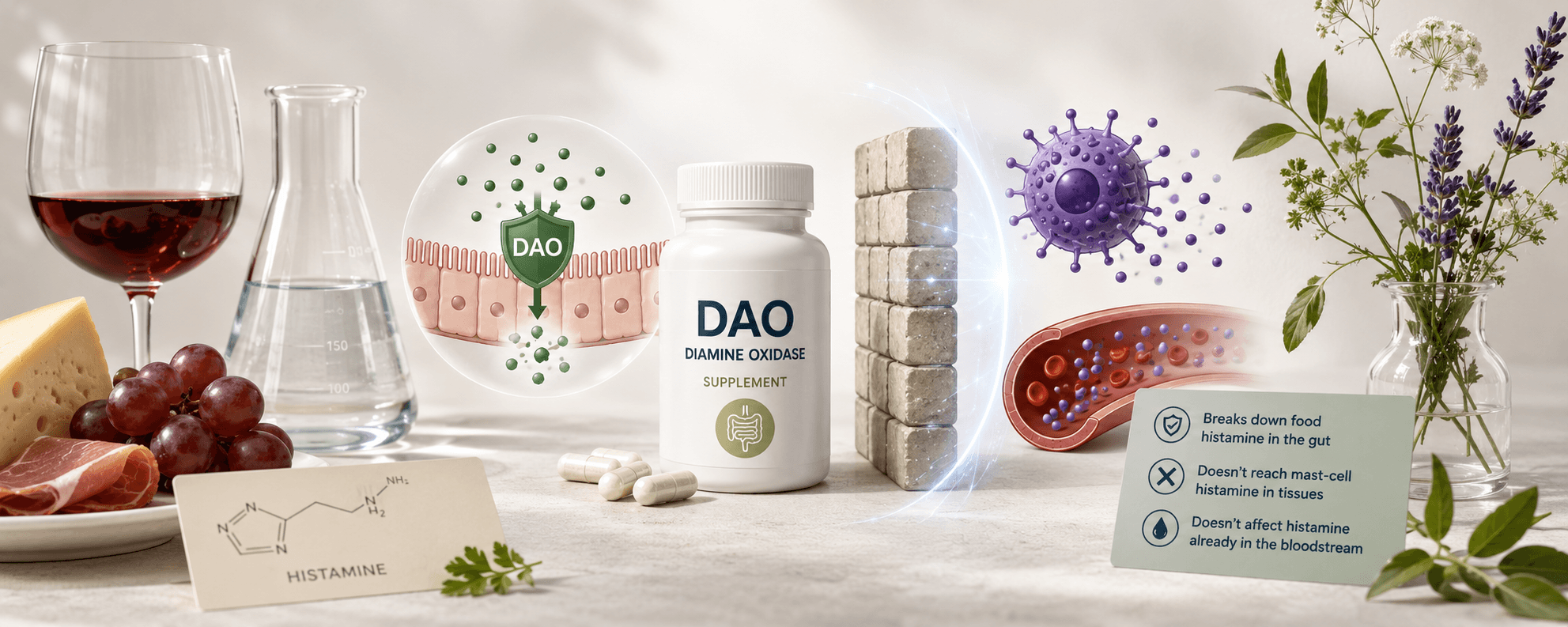
Diamine oxidase is a copper-dependent enzyme made by mature enterocytes on the upper intestinal villi.¹ It works outside the cell, in the gut lumen, breaking down histamine from food and from gut bacteria before it can be absorbed.¹ ²
That location is the whole story. Supplemental DAO is a border guard, not a cleanup crew. It intercepts histamine arriving from outside; it has no access to histamine already in your bloodstream or released from your own mast cells.
An oral DAO supplement adds more of that border guard to the gut lumen for the duration of a meal. Nothing more.
Reason one: your histamine isn’t coming from food
This is the most common explanation and the simplest.
Histamine reaching your system from a meal is what DAO addresses. Histamine released from your own mast cells is not — that’s happening in tissue, on the other side of the gut wall, and no amount of enzyme in the intestine will touch it.
So someone whose symptoms come mainly from mast cell activation, from hormonal fluctuation, from stress or from an inflammatory condition can take DAO faithfully before every meal and notice nothing at all. The enzyme is doing its job perfectly. It’s just not the relevant job.
The pointer here is whether symptoms track with meals. Reactions that appear reliably after aged cheese, wine, leftovers or fermented food suggest a dietary component. Symptoms that come and go without reference to eating, or that follow the menstrual cycle, or that flare with stress, point elsewhere.
Reason two: the block is underneath DAO
DAO does not convert histamine into something harmless. It converts histamine into imidazole acetaldehyde — a reactive aldehyde — which then has to be oxidised by aldehyde dehydrogenase into imidazole-4-acetic acid before anything is genuinely finished.³ ⁴
So DAO is not the last step. It’s the second-to-last step, and it hands its product to an enzyme that is simultaneously handling alcohol, every monoamine neurotransmitter, oxidised fats and the output of gut yeast.
If that enzyme is at capacity, adding DAO converts histamine faster into something you also can’t clear. The person has swapped one accumulating compound for another.
There’s a further turn to this. Imidazole acetic acid — the eventual end product of this pathway — blocks DAO itself.⁵ So when the downstream steps are congested, the accumulating product feeds back and inhibits the enzyme at the top. Elevated histamine also produces substrate inhibition of DAO directly.⁵
Which means a congested pathway doesn’t just fail to benefit from more DAO. It actively suppresses the DAO you already have.
The pointer for this one is telling: alcohol intolerance out of proportion to the amount, headaches from perfume or petrol, and hangover-type symptoms without drinking. Those suggest the aldehyde step underneath DAO is the actual bottleneck.
Reason three: the other route is untouched
Histamine has two clearance pathways, and DAO is only one of them.
HNMT works inside cells, methylating histamine into tele-methylhistamine. It’s the dominant route in the brain and in tissues generally, while DAO handles the gut and the extracellular space.² The two are complementary rather than interchangeable.
So if your problem sits with the intracellular route — and HNMT depends on methylation capacity, which depends on things like homocysteine status — DAO supplementation addresses a completely different system.
Worth knowing: the HNMT route also ends at an aldehyde requiring aldehyde dehydrogenase. Both roads lead to the same final step.
Reason four: the villi that make DAO are damaged
DAO is produced by mature enterocytes at the top of the intestinal villi.¹ Immature cells in the crypts don’t make it.
Which means anything that blunts villi or speeds up cell turnover reduces DAO production — coeliac disease, Crohn’s, bacterial overgrowth, chronic inflammation, chemotherapy.
An oral supplement is a workaround for this rather than a fix, and it’s a partial one. The mucosa that isn’t making DAO is usually also not doing its other jobs, so the histamine problem tends to arrive alongside other absorption and barrier issues that a DAO capsule doesn’t touch.
This is also, incidentally, the same anatomical problem that limits phenol and salicylate clearance — those enzymes sit in the same mature enterocytes on the same villi, which is one reason the two sensitivities travel together.
Reason five: something is actively blocking it
Quite a few common drugs inhibit DAO, and this has been measured directly on purified human enzyme.
At pharmacological concentrations, chloroquine and clavulanic acid inhibited DAO by more than 90%. Cimetidine and verapamil produced around 50% inhibition. Isoniazid, metamizole, acetylcysteine and amitriptyline exceeded 20%. Diclofenac, metoclopramide and thiamine came in under 20%, and cyclophosphamide and ibuprofen showed no effect at all. The authors noted that even around 30% inhibition may be clinically significant.⁶
Two of those are worth pausing on. Clavulanic acid is the second component of a very widely prescribed antibiotic combination — so a course of it is a substantial DAO hit. And acetylcysteine (NAC) appears on the list, which is worth knowing for anyone who has reacted badly to it.
Alcohol belongs here too. Alcohol and acetaldehyde inhibit DAO directly, while also releasing histamine from mast cells and competing for the aldehyde enzyme downstream.⁷ Three hits on one system, which is why a single glass of wine can produce a reaction that looks wildly disproportionate.
None of this is a reason to stop a prescribed medication. It’s a reason to know what’s contributing, and to raise it with whoever prescribed it if the timing fits.
What the evidence actually shows
Around twenty studies have looked at DAO supplementation, and most report favourable results. But the limitations are consistent and serious: small patient numbers, absent control groups, and short intervention periods.⁸ ⁹ The most-cited study was an open-label pilot in 28 patients using a symptom questionnaire, with no placebo arm¹⁰ — which is precisely the design where expectation effects are largest, since the outcome is how people rate their own symptoms.
A properly powered, double-blind, placebo-controlled trial with 400 participants has been designed and published as a protocol.⁸ Its results will be considerably more informative than anything currently available.
There’s also a question of how much a supplement can achieve even when everything works. Under simulated intestinal conditions with food present, a DAO tablet degraded roughly 30% of the histamine over 90 minutes, and stability varied noticeably depending on the food matrix.¹¹ Partial degradation, influenced by what you ate it with.
The cofactor claims, corrected
You’ll read almost everywhere that vitamin B6, copper and vitamin C are DAO cofactors and that deficiency impairs the enzyme. The picture is less clear than that.
Copper is definitely structural — DAO is a copper-containing amine oxidase and copper sits in its active site. But human evidence directly linking copper deficiency to clinically meaningful DAO deficiency is limited.¹²
DAO’s other cofactor is topaquinone, formed from one of the enzyme’s own tyrosine residues, along with calcium.¹² Not pyridoxal phosphate. Vitamin B6 is a cofactor for many amine-related reactions, and functional B6 status may influence DAO efficiency, but whether B6 deficiency significantly impairs DAO function has not been confirmed.¹²
When DAO is worth trying
Nothing above says don’t. It says know what you’re testing.
The case for a trial is strongest when symptoms track clearly with high-histamine meals, when there’s no obvious mast cell or hormonal pattern, and when the aldehyde signs — alcohol intolerance, chemical smell sensitivity — are absent.
The case is weaker when symptoms come and go independently of eating, when they follow the menstrual cycle, when alcohol produces a disproportionate reaction, or when a previous trial did nothing.
And a trial that fails is still information rather than a dead end. It tells you the bottleneck isn’t where you thought, which narrows the search considerably.
In summary
DAO supplements break down histamine in the gut lumen, before absorption. It cannot reach histamine already circulating or released from mast cells, it doesn’t touch the intracellular clearance route, and it isn’t the last step — it hands a reactive aldehyde to an enzyme that may already be the real bottleneck.
Which is why the useful question isn’t whether to take DAO. It’s where your histamine is coming from, and which step in the pathway is actually slow.
Frequently asked questions
Why doesn’t DAO help my histamine symptoms?
Most often because your histamine isn’t primarily dietary — DAO only reaches histamine in the gut lumen, not histamine released from mast cells or already in circulation. The other common reason is that the block sits below DAO, at the aldehyde step that has to finish the job.³ ⁴
Does DAO break histamine down completely?
No. DAO converts histamine into imidazole acetaldehyde, which then requires aldehyde dehydrogenase to become imidazole-4-acetic acid.³ ⁴ If that second enzyme is congested, faster conversion by DAO just produces more of something else that accumulates.
Do DAO supplements actually work?
The evidence is promising and weak. Around twenty studies report benefit, but with small numbers, no control groups and short durations.⁸ ⁹ The most-cited was an open-label pilot in 28 people with no placebo arm.¹⁰ A 400-participant double-blind trial has been designed but not yet reported.⁸
What blocks the DAO enzyme?
Measured on purified human enzyme, chloroquine and clavulanic acid inhibited it by over 90%, cimetidine and verapamil by about 50%, and isoniazid, metamizole, acetylcysteine and amitriptyline by over 20%.⁶ Alcohol inhibits it too.⁷ Never stop a prescribed medication on this basis — raise it with your prescriber if the timing fits your symptoms.
Does DAO help with mast cell activation?
Not directly. Mast cells release histamine into tissue, on the other side of the gut wall from where DAO works. An oral enzyme has no access to it.
Is vitamin B6 a DAO cofactor?
This is repeated far more confidently than the evidence supports. DAO’s cofactors are copper, calcium and topaquinone — a modified tyrosine residue within the enzyme itself — rather than pyridoxal phosphate.¹² B6 may influence DAO efficiency indirectly, but that it significantly impairs the enzyme when low hasn’t been confirmed.¹²
Why does my DAO test come back normal when I have symptoms?
Serum DAO isn’t a validated diagnostic. Results vary between laboratories and over time, and serum activity doesn’t necessarily reflect what’s happening in the intestinal mucosa.² ¹² Diagnosis still rests on symptom pattern and response to dietary change.
Should I keep taking DAO if it isn’t helping?
A trial that produces nothing after a few weeks of consistent use before meals has told you something useful — the bottleneck is elsewhere. That’s a reason to look at where, not a reason to keep going or to increase it.
References
- Evidence for dietary management of histamine intolerance. International Journal of Molecular Sciences. 2025. (Review; DAO synthesised by mature enterocytes in the upper intestinal villi, main enzyme for intestinal histamine degradation.)
- Diamine oxidase deficiency: implications for health, current management, and future directions in the treatment of histamine intolerance. 2025. (Review; DAO extracellular in gut and kidney, HNMT intracellular in liver, kidney and CNS, complementary systems.)
- Histamine pharmacogenomics. 2009. (Review; the DAO metabolite imidazole acetaldehyde is metabolised by aldehyde dehydrogenase to imidazole-4-acetic acid.)
- Dynamics of histamine in the brain. In: Basic Neurochemistry. (Textbook; both degradation routes and their aldehyde intermediates.)
- Maintz L, et al. Histamine and histamine intolerance. 2005, as summarised in subsequent reviews. (Blockage of DAO by imidazole acetic acid, and substrate inhibition of DAO by elevated histamine.)
- Evaluation of the inhibitory effect of various drugs and active ingredients on the activity of human diamine oxidase in vitro. PMC4127955. (In vitro; purified human DAO. Chloroquine and clavulanic acid >90%, cimetidine and verapamil ~50%, isoniazid, metamizole, acetylcysteine and amitriptyline >20%.)
- Alcohol-histamine interactions. 1999. PMID 10344773. (Review; alcohol and acetaldehyde inhibit DAO and liberate histamine from mast cells.)
- Study protocol for a prospective, unicentric, double-blind, randomised, placebo-controlled trial on the efficacy of a low-histamine diet and DAO enzyme supplementation. 2025. (Protocol, n=400; notes ~20 prior studies limited by small cohorts, absent controls and short intervention periods.)
- Evidence for dietary management of histamine intolerance (as above). (Limited clinical evidence; DAO activity varies with cofactors and enzyme origin.)
- Schnedl WJ, et al. Diamine oxidase supplementation improves symptoms in patients with histamine intolerance. Food Science and Biotechnology. 2019;28:1779-84. (Open-label interventional pilot, n=28, no placebo arm, symptom questionnaire.)
- Toward oral supplementation of diamine oxidase for the treatment of histamine intolerance. PMC9268349. (In vitro; ~30% histamine degradation in 90 minutes under simulated intestinal conditions, stability influenced by food matrix.)
- DAO deficiency: definition, symptoms and treatment options. 2026. (Review; DAO cofactors are copper, calcium and topaquinone. Human evidence linking copper deficiency to clinical DAO deficiency is limited, and B6’s role is unconfirmed. Serum DAO not a definitive diagnostic test.)