You get into bed and the itching starts. Your back, your arms, your shins, sometimes everywhere at once. You scratch until you have scratched yourself raw, and when you look, there is nothing there. No rash, no hives, no bite. The absence of anything to see is the most useful clue you have. Itch that comes with a rash starts in the skin. Itch with nothing to see is usually being generated further back, either by the nerves themselves or by something circulating in your blood that those nerves can detect. That changes what is worth investigating, and it explains why creams and antihistamines so often do nothing.
Why an itch with nothing to see is a different problem
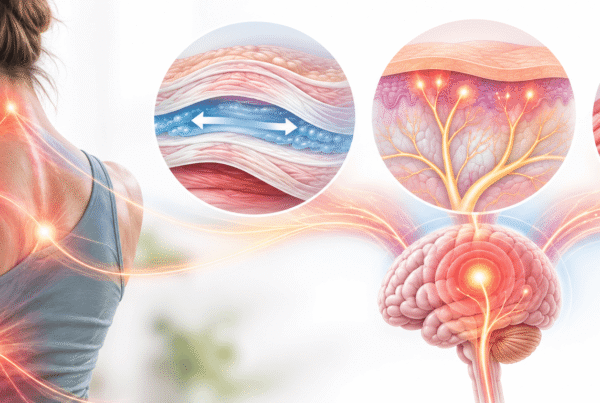
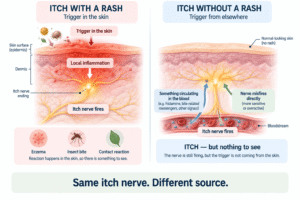
Itch is carried by fine nerve endings sitting just under the surface of your skin, close enough to the outer layer to sample what arrives there. They fire when something binds to them.
With a rash, the something is being produced locally. Insect bite, eczema, an allergic reaction, contact with an irritant. There is inflammation to see because the reaction is happening in the skin itself.
Without a rash, the nerve is still firing, so something is still binding to it. It just is not arriving from the outside. It is either reaching the nerve through your bloodstream, or the nerve is misfiring on its own. Scratching marks are your own doing, not the original problem.
That distinction is why the usual advice fails. A moisturiser treats the skin. If the skin was never the problem, the moisturiser has nothing to work on.
Why it gets worse the moment you lie down
Several measurable things change in your skin overnight, and they all push in the same direction.3,4
- Cortisol bottoms out. Your own anti-inflammatory hormone is at its lowest in the evening and through the first part of the night. Inflammatory signalling is less restrained during exactly those hours.
- Your skin leaks more water. Water loss through the skin follows a daily rhythm and peaks in the evening and overnight. A barrier that is losing water is a barrier that lets more through, in both directions.
- Your skin gets warmer. Core temperature falls at night by sending blood to the surface, which warms the skin. Warm skin lowers the threshold at which itch nerves fire.
So the timing is a real physiological pattern rather than a psychological one. It also means night-time itching on its own does not tell you the cause. Almost every cause of itch is worse at night.
When antihistamines do nothing
Most people have tried an antihistamine before they go looking for answers. When it works, histamine was involved. When it does nothing at all, that is information rather than a failure.
Histamine is only one of several substances that make these nerves fire, and there are entire itch pathways that do not involve histamine at all. Researchers have recorded from single nerve fibres in living people while applying substances that cause itching, and confirmed that non-histamine pathways run through different fibres with different firing patterns.5 An antihistamine blocks one route. It has no effect on the others.
Three of the most common non-histamine causes of itch without a rash are covered below. None of them respond to an antihistamine, and all of them respond to something.
The histamine possibility, and how to tell
Histamine is still worth taking seriously, particularly if the itching sits alongside other things that do not obviously belong together. Flushing, a racing heart after meals, headaches, a blocked nose with no infection, reactions to wine or aged cheese.
The pattern that points this way is the itching following something other than what touches your skin. If it follows meals, it is worth looking at what you ate and how long it had been in the fridge. If it follows your cycle, that has its own mechanism, since oestrogen makes mast cells easier to trigger.9 If it started after a course of probiotics, some bacterial strains produce histamine themselves, and the histamine they produce recruits mast cells through a receptor that older antihistamines do not block.10
That last point explains a common and confusing experience. An antihistamine that does nothing does not rule histamine out, because the standard ones target one receptor and part of this story runs through a different one.
If this sounds like your pattern, the place to start is why you might be reacting to more and more foods, and if the itching followed a probiotic, why probiotics can make histamine symptoms worse.
The bile possibility, and the surprise in the research
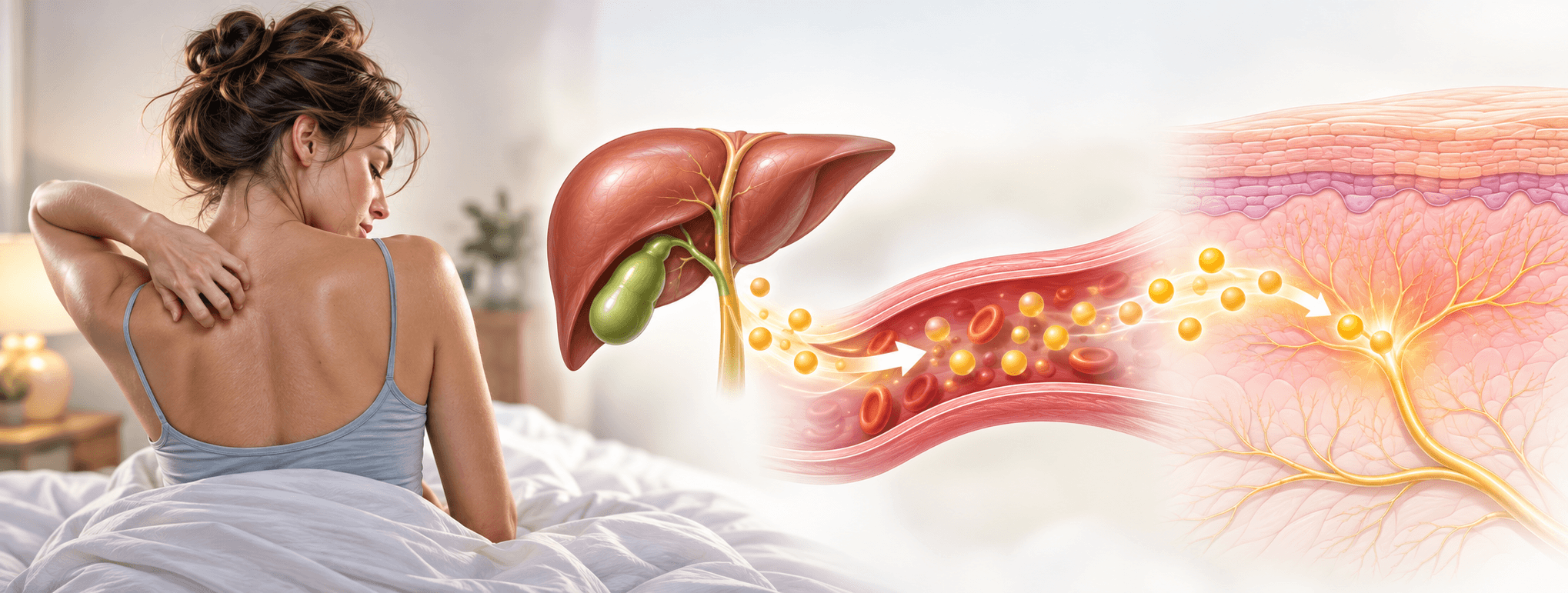
Itching without a rash is a classic feature of bile not flowing properly, and it is worth knowing about even when your liver tests are normal, because the itch often arrives before anything else does.
The textbook explanation used to be that bile salts build up in the blood and irritate the nerve endings. That explanation appears to be wrong, and the work that overturned it is unusually convincing.
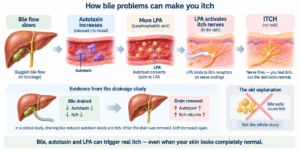
Researchers took blood serum from people with cholestasis who were itching, applied it to nerve cells, and watched the cells fire. Then they went looking for what in the serum was doing it. The answer was not bile salts. It was a fat-derived signalling molecule called lysophosphatidic acid, produced in the blood by an enzyme called autotaxin. Levels of that enzyme tracked how badly people were itching. Bile salts did not. Neither did histamine, tryptase or substance P.1
The part that makes it hard to argue with came next. In people who had a drain placed to divert bile temporarily, itching and enzyme activity both fell while the drain was in and both returned when it came out.1 Remove the cause, the itch goes. Restore it, the itch comes back.
A follow-up study found the same enzyme raised specifically in cholestatic itching and not in itching from kidney disease, lymphoma or eczema.2 So this appears to be a mechanism belonging to bile rather than a general itch pathway.
Important to note that this research was done in people with diagnosed liver disease, not in people with sluggish bile and normal blood tests, so extending it downward is reasonable but not demonstrated. And a later study in children did find bile salts correlating with itch, so the picture is not fully settled.
Practically, itching without a rash belongs on the list of things that point at bile, alongside pale stools, discomfort after fatty meals and nausea that does not fit anything else. I have written about the wider role of bile in what bile acids do besides digest fat.
Medications that cause itching with no rash
This one is frequently missed, because the itching often starts weeks or months after the medication does, so people do not connect them.6
Opioid painkillers are the clearest example, and the mechanism may be surprising. Much of the itching they cause is generated in the spinal cord rather than the skin, through the same receptors that deliver the pain relief. The nerves in your skin are not reacting to anything. The itch signal is being created further up.6 That is why antihistamines so often fail against it, and why there is nothing to see when you look.
Others worth knowing about: blood pressure medications in the ACE inhibitor group, antimalarial drugs, and some cancer treatments. Statins and a number of other common medications appear in the same literature.
None of that is a reason to stop anything. It is a reason to raise the timing with whoever prescribed it, because alternatives usually exist within the same drug class.
What needs ruling out before anything else
Generalised itching with no rash is on the short list of symptoms that can be the first sign of something systemic, and some of those things are serious.7
The standard investigation for unexplained itching with no skin changes is a blood panel covering full blood count, liver enzymes and bilirubin, kidney function, thyroid function, ferritin, glucose, and LDH. Iron deficiency causes itching without a rash and is easily missed. So does thyroid disease in either direction, and chronic kidney disease.
See a doctor promptly rather than working through the possibilities above if the itching comes with any of these:
- Weight loss you did not intend
- Night sweats, or fevers with no infection
- Yellowing of the skin or the whites of the eyes, dark urine, or pale stools
- Swollen lymph nodes
- Itching that started suddenly, is getting worse, and is severe enough to keep you awake most nights
- Itching that begins within minutes of contact with water, particularly after a hot shower
That last one is specific. Itching triggered by water contact is associated with a blood disorder that shows up on a full blood count, which is one of the reasons that test is on the list.
Where this leaves you
An itch with nothing to see is telling you something specific. The skin is doing its job and reporting accurately. What it is reporting on is arriving from somewhere else.
A reasonable sequence, in order:
- Get the blood panel done and rule out iron, thyroid, kidney and liver causes. This is the step people skip, and it is the step most likely to find something.
- Check the timing against your medications, including ones you have taken without trouble for a long time.
- Look at the pattern. After meals points one way, after fatty meals another, with your cycle another again. Itching that has no pattern at all, and is worse at night only, most often turns out to be dry skin behaving normally.
- Treat the night-time part separately from the cause. The circadian changes described above happen regardless of why you are itching, so a cooler bedroom and attention to the skin barrier before bed help whatever the underlying reason turns out to be.
Frequently asked questions
Why do I itch at night with no rash?
Several things in your skin change overnight and all of them lower the itch threshold. Cortisol, which restrains inflammation, is at its daily low. Water loss through the skin peaks in the evening. And skin temperature rises as your body sends blood to the surface to cool your core.3,4 Those changes make an existing cause worse rather than creating one, so night-time itching on its own does not identify the reason.
What does itching with no rash mean?
That the itch is being generated by your nerves or by something circulating in your blood rather than by anything in the skin. Causes include dry skin, iron deficiency, thyroid disease, kidney disease, bile not flowing properly, medications, and histamine from food or gut bacteria.7 It can also be the first sign of something systemic, so a blood panel comes before anything else.
Why do antihistamines not stop my itching?
Because histamine is only one of the substances that trigger itch nerves, and there are entire itch pathways that do not involve it. Recordings from single nerve fibres in people confirm that non-histamine itch runs through different fibres.5 An antihistamine doing nothing is evidence about the cause rather than a treatment failure.
Can liver or gallbladder problems cause itching?
Yes, and itching can arrive before anything else does. The mechanism turns out not to be bile salts irritating the skin. Itch intensity tracks a blood enzyme called autotaxin and the signalling molecule it produces, and when bile was drained temporarily both the itching and the enzyme fell together, returning when the drain was removed.1
Can medication cause itching without a rash?
Yes, and it is often missed because the itching can start long after the medication did.6 Opioid painkillers are the clearest example, and much of the itch they cause is generated in the spinal cord rather than the skin, which is why antihistamines rarely help. ACE inhibitors and antimalarials are also well described.
When should I worry about itching with no rash?
See a doctor promptly if it comes with unintended weight loss, night sweats, yellowing of the skin or eyes, dark urine, pale stools, swollen lymph nodes, or if it started suddenly and is bad enough to keep you awake. Itching that starts within minutes of contact with water also needs checking, since it is associated with a blood disorder detectable on a full blood count.
Could this be histamine intolerance?
Possibly, particularly if the itching follows meals, follows your cycle, or started after a probiotic, and if it comes with flushing, headaches or a blocked nose. Oestrogen makes mast cells easier to trigger,9 and some gut bacteria produce histamine themselves.10 A standard antihistamine failing does not rule it out, since part of this runs through a receptor those medications do not block.
References
- Kremer AE, Martens JJ, Kulik W, et al. Lysophosphatidic acid is a potential mediator of cholestatic pruritus. Gastroenterology. 2010;139(3):1008-1018. PMID 20546739.
- Kremer AE, van Dijk R, Leckie P, et al. Serum autotaxin is increased in pruritus of cholestasis, but not of other origin, and responds to therapeutic interventions. Hepatology. 2012;56(4):1391-1400.
- Patel T, Ishiuji Y, Yosipovitch G. Nocturnal itch: why do we itch at night? Acta Dermato-Venereologica. 2007;87(4):295-298.
- Lavery MJ, Stull C, Kinney MO, Yosipovitch G. Nocturnal pruritus: the battle for a peaceful night’s sleep. International Journal of Molecular Sciences. 2016;17(3):425.
- Fiebig A, Leibl V, Oostendorf D, et al. Peripheral signaling pathways contributing to non-histaminergic itch in humans. Journal of Translational Medicine. 2023. doi:10.1186/s12967-023-04698-z
- Reich A, Ständer S, Szepietowski JC. Drug-induced pruritus: a review. Acta Dermato-Venereologica. 2009;89(3):236-244.
- Butler DC, Berger T, Elmariah S, et al. Chronic pruritus: a review. JAMA. 2024;331(24).
- Maintz L, Novak N. Histamine and histamine intolerance. American Journal of Clinical Nutrition. 2007;85(5):1185-1196.
- Zaitsu M, Narita S, Lambert KC, et al. Estradiol activates mast cells via a non-genomic estrogen receptor-alpha and calcium influx. Molecular Immunology. 2007;44(8):1977-1985. PMID 17084457.
- De Palma G, Shimbori C, Reed DE, et al. Histamine production by the gut microbiota induces visceral hyperalgesia through histamine 4 receptor signaling in mice. Science Translational Medicine. 2022;14(655):eabj1895.