Nobody asks about a low homocysteine result, because nothing on the report tells you to. The reference range only has an upper limit that matters, so a low number is often not flagged and thus ignored.
But it does mean something. It can mean several different things, and some of them predict opposite consequences for the rest of your sulfur metabolism.
This article works through what a low result can indicate, why the explanation circulating in functional medicine has the mechanism backwards, and what to measure if you want an actual answer.
What the number is measuring
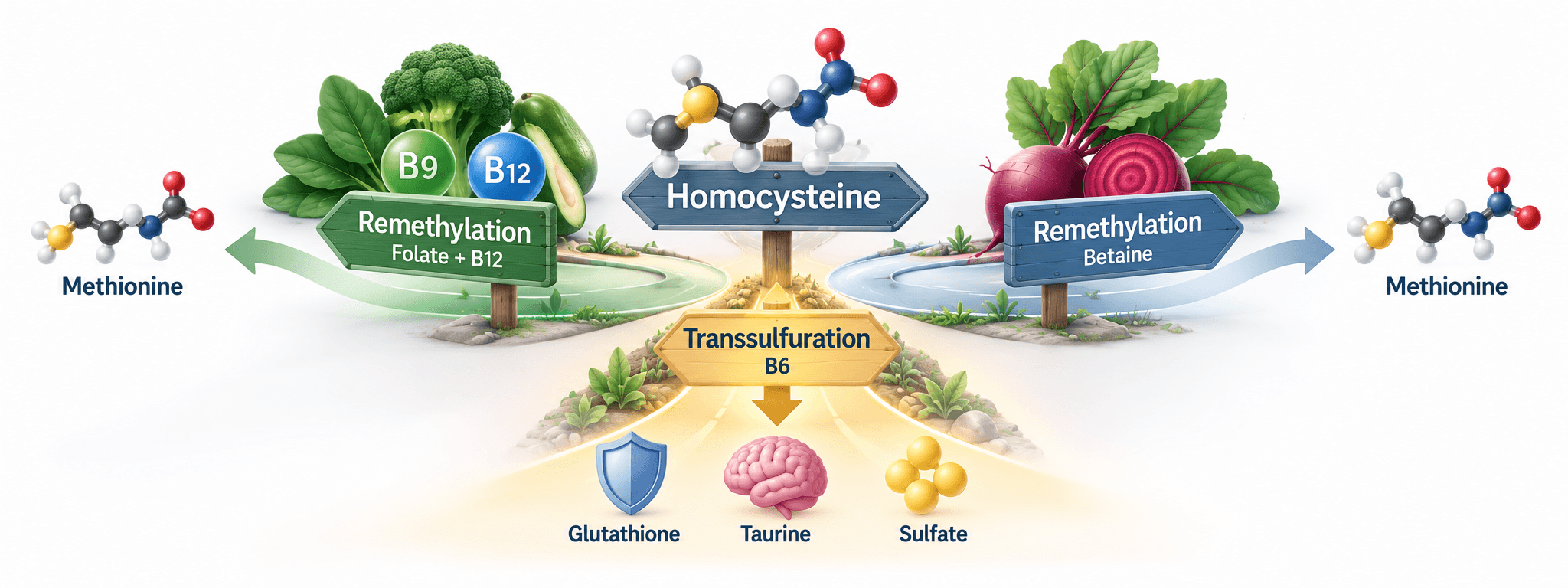
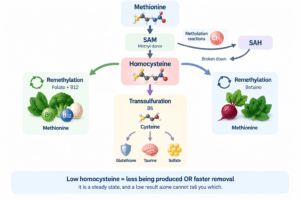
Homocysteine is not a waste product. It is a junction with three exits.
It is produced every time your body uses a methyl group. SAM (S-adenosylmethionine) donates its methyl group and becomes SAH (S-adenosylhomocysteine), SAH is broken down to homocysteine, and that happens with every methylation reaction you run — histamine clearance, catecholamine clearance, creatine synthesis, phosphatidylcholine production, DNA methylation.
From there it can go three ways. It can be remethylated back to methionine using folate and B12. It can be remethylated using betaine instead, through a separate enzyme. Or it can be committed down the transsulfuration pathway to cystathionine and then cysteine, using B6 at both steps — and cysteine is what becomes glutathione, taurine and inorganic sulfate.
So the number in front of you is a steady state. It reflects how much is being produced against how fast it is being removed.
Low means production is low, or removal is fast, or both.
The regulator that decides which exit it takes
This is the part that gets left out, and it is the reason one popular explanation does not work.
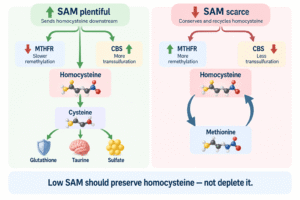
SAM controls the split. It acts as an allosteric inhibitor of MTHFR, slowing the folate cycle that feeds remethylation, and simultaneously as an activator of cystathionine β-synthase, the first enzyme of transsulfuration.¹
When SAM is plentiful, methylation capacity is not the constraint, so homocysteine gets committed to transsulfuration and converted to cysteine. When SAM is scarce, the brake on MTHFR comes off and the activation of CBS is withdrawn, so homocysteine is preserved and recycled back to methionine rather than being lost.
This matters for the following reason.
Why the popular explanation runs backwards
The chain you will read is that low SAM production means less homocysteine generated, so a low result indicates poor methylation upstream, and therefore poor sulfate production downstream.
The first half is arguable. The second half contradicts the regulation.
If SAM is low, CBS loses its activator and MTHFR loses its inhibitor. The system responds by recycling homocysteine rather than converting it. That predicts homocysteine being preserved, not depleted — and it predicts less flux to cysteine and sulfate without the homocysteine number falling.
So a low SAM concentration does not, by itself, produce a low homocysteine. The regulation pushes them apart.
But there is a second route, and it is the one that matters clinically. Homocysteine is manufactured by transmethylation, so if less methionine is coming in, or fewer methylation reactions are running, less homocysteine is made. The allosteric regulation decides how existing homocysteine is partitioned. It cannot manufacture homocysteine that was never produced.
That is why low homocysteine turns up in unwell people. Poor protein intake lowers SAM and homocysteine together, because both are downstream of the same limited supply. Low albumin lowers the measured number independently of any metabolism, since roughly 70 to 80% of plasma homocysteine is protein-bound.⁷ And impaired methionine adenosyltransferase (MAT), which converts methionine to SAM, lowers SAM and homocysteine at once while raising methionine.
So the answer to “does low SAM mean low homocysteine” is: not through the regulation, but yes through the supply. Which is a different claim with a different investigation attached.
The specific things that lower homocysteine
Low methionine intake
Homocysteine comes from methionine. Eat less methionine and you produce less. Long-term vegetarian and vegan diets lower it on this basis, though B12 deficiency pushes in the opposite direction and often dominates, which is why the vegetarian association is not always consistent.
Faster renal clearance
Plasma homocysteine tracks kidney function closely. When thyroid status was manipulated in patients, homocysteine rose in hypothyroidism and fell in hyperthyroidism, and the authors attributed the change to glomerular filtration rate rather than to vitamin status — homocysteine covaried with creatinine, not with folate or B12.²
That gives a low homocysteine a meaning nobody expects: it can be a marker of how fast your kidneys are clearing, and thyroid status is one thing that can move it.
Pregnancy
Homocysteine falls substantially in pregnancy and returns afterwards. In a longitudinal study following women from preconception, geometric mean homocysteine fell from 8.2 µmol/L before conception to 6.4 µmol/L by eight weeks of pregnancy — and the authors showed this was not explained by folic acid supplementation, haemodilution or the fall in albumin.⁸ Separate work found the decline paralleled a significant rise in the renal clearance of homocysteine.⁹
Expected physiology rather than a finding, and another illustration of how much clearance contributes to the number.
Supplementation
Anything supporting either exit lowers it. Folate, B12 and riboflavin support remethylation. Betaine supports the alternative remethylation route. B6 supports transsulfuration. Someone on a methylation protocol has a homocysteine result that reflects the protocol.
Fast transsulfuration
Good B6 status pulling homocysteine efficiently through CBS produces a low number and a well-supplied cysteine pool. This is the reading that would be good news, and there is no way to distinguish it from the others on a fasting test.
The test cannot answer the question you are asking
Fasting homocysteine and post-methionine-load homocysteine measure different things. Fasting levels are related to folate, B12 and MTHFR genotype — the remethylation side. The rise after a methionine load is what reflects transsulfuration, which is why B6 deficiency and CBS defects show up there rather than in the fasting number.¹ ³
Which means the test almost everyone has — a fasting homocysteine — is measuring the remethylation arm. If your question is whether transsulfuration is delivering enough cysteine and sulfate, the fasting number is not going to give you your answer.
The load test exists but is not routinely available outside research settings. So in practice you answer the question by measuring downstream instead.
What to measure instead
If the question is whether the transsulfuration arm is delivering, look at what it delivers:
- Albumin and total protein. Roughly 70 to 80% of plasma homocysteine is protein-bound, so a low albumin lowers the result without anything metabolic occurring.⁷
- Methionine. Low methionine alongside low homocysteine points at supply. High methionine alongside low homocysteine points at a block between methionine and SAM.
- Cystathionine. The direct product of the CBS reaction, and the marker that separates fast transsulfuration from other explanations. Available on an organic acids panel.
- Plasma cysteine. The immediate product. Low cysteine with low homocysteine argues against the fast-transsulfuration reading.
- Taurine and glutathione. Both downstream of cysteine. Low across the board suggests a supply problem rather than efficient throughput.
- B6 status. Ideally as plasma pyridoxal-5-phosphate rather than as a supplement history, since it is the cofactor for both transsulfuration steps.
- B12 and folate, plus methylmalonic acid. To establish whether the remethylation arm is well supplied, which it must be for a low result to be reassuring.
- Kidney function. Creatinine and eGFR, given how strongly clearance influences the number.
- Thyroid function. Both because it shifts homocysteine through renal handling, and because it is worth knowing independently.
A low homocysteine alongside good cysteine and glutathione is a working system. A low homocysteine alongside low cysteine, low glutathione and poor B6 status is a different situation and worth investigating properly.
What happens when CBS really is overexpressed
The CBS gene sits on chromosome 21. People with Down syndrome have three copies of that chromosome, so they have three copies of the gene, and the enzyme is genuinely overproduced as a result. Measured in fibroblasts, CBS activity in full trisomy 21 was 66% higher than in controls.⁵
This is the only human population where CBS overexpression is established rather than assumed, which makes it the natural experiment for everything above.
The metabolite pattern was measured in 42 children with confirmed full trisomy 21, against 36 of their own siblings as controls. Plasma homocysteine was significantly decreased. So were methionine, SAM and SAH. Cystathionine and cysteine were significantly increased.⁶
Three things follow from that.
Real CBS overexpression does produce low homocysteine. What has never been shown is that the common CBS variants do the same thing.
Low SAM and low homocysteine can occur together, but only when enzyme quantity overrides the regulation. With nearly twice the enzyme present, flux goes down transsulfuration regardless of what SAM is signalling. This is the exception to the argument made earlier, and it has a specific cause: excess enzyme, not scarce SAM. The direction still matters — low SAM does not produce low homocysteine, but excess CBS produces both, by draining homocysteine faster than methionine can be resynthesised and pulling SAM down with it. The study authors described exactly this: folate-dependent methionine resynthesis compromised.⁶
Cystathionine is the marker that tells them apart. It is the direct product of the reaction, and it was raised several-fold in the trisomy 21 cells.⁶ Someone with a low homocysteine and a normal cystathionine does not have a fast CBS, whatever their genotype says.
What about CBS?
The claim that CBS variants cause the enzyme to run faster, dumping sulfur and producing chronically low homocysteine, is the reason most people go looking for meaning in a low result.
It does not hold up, and I have written about it at more length in the sulfur article. The short version: if CBS genuinely ran faster in carriers, homocysteine should measure consistently lower in them, and it does not. The dramatic figures quoted for increased enzyme activity do not come from human data. Clinically established CBS mutations cause loss of function and high homocysteine, not low.
The variant claim concerns people with two normal copies, in whom increased activity has never been demonstrated — and the pattern is testable, because if CBS were running fast the cystathionine would be up. Adding the SAM regulation makes the theory harder still, since CBS activity is set by SAM availability, so what the enzyme does on a given day depends more on the state of the methionine cycle than on the sequence.
One complication worth stating
The neat version of this would be that reduced transsulfuration means reduced glutathione, and that is how it is usually presented.
In rats, vitamin B6 deficiency suppressed the hepatic transsulfuration pathway and yet increased hepatic glutathione concentration.⁴
There is a human version of the same point. In the trisomy 21 children, cysteine was significantly raised and glutathione was significantly reduced at the same time.⁶ More substrate arriving did not mean more glutathione, most likely because oxidative demand was consuming it — superoxide dismutase is also encoded on chromosome 21.
Two independent findings pointing the same way should make anyone cautious about inferring glutathione status from transsulfuration flux. The pathway has other inputs, cysteine can come from the diet as well as from homocysteine, and consumption matters as much as supply.
What we do not know
Low homocysteine has barely been studied as a finding in its own right. The enormous literature on this molecule is about elevation and cardiovascular risk, and low values are treated as the absence of a problem rather than as something to characterise.
So there is no established lower threshold, no evidence that a low result predicts anything clinically, and no study asking whether people with low homocysteine differ in cysteine, taurine or sulfate status.
The trisomy 21 work is the exception, and it describes a population carrying an extra gene copy rather than the general case. The rest of the reasoning here is drawn from the regulation of the pathway and from what is known about what raises the number. It is inference, and it should be held as inference.
In summary
A low homocysteine most often means the pathway is working — good remethylation, efficient clearance, moderate methionine intake.
Where it does indicate something, the popular explanation still has the direction wrong. A low SAM concentration tends to preserve homocysteine rather than deplete it, because SAM is what pushes homocysteine down the transsulfuration exit in the first place. The two do fall together when the limitation is upstream supply, or when CBS is genuinely overexpressed — but in both of those cases the cause is something other than poor methylation, and both are testable.
Which is why the useful move is not to interpret the number harder, but to measure what sits below it.
Frequently asked questions
Is low homocysteine bad?
Usually not. It is more often a sign that remethylation is well supplied and kidney clearance is good. There is no established lower threshold and no evidence that a low result predicts a clinical problem on its own.
Does low homocysteine mean poor methylation?
This is the common interpretation and the mechanism argues against it. SAM inhibits MTHFR and activates CBS,¹ so when SAM is low the system recycles homocysteine rather than converting it — which would tend to preserve the number rather than lower it. The two do fall together when methionine supply is limited or when CBS is overexpressed, but that is a supply question rather than a methylation one.
Does low homocysteine mean I have low glutathione?
Not reliably. Fast transsulfuration produces both a low homocysteine and a well-supplied cysteine pool, which is the opposite conclusion. Measure cysteine and glutathione directly rather than inferring them.
Can a CBS variant cause low homocysteine?
The upregulation model predicts it, but carriers do not consistently show lower homocysteine, and established CBS mutations cause high homocysteine through loss of function. CBS activity is heavily influenced by SAM availability,¹ so cofactor and substrate status matter more than genotype.
Does Down syndrome affect homocysteine?
Yes, and it is the clearest example of CBS overexpression there is. The CBS gene is on chromosome 21, so three copies means more enzyme — activity measured 66% above controls.⁵ Children with trisomy 21 show significantly lower plasma homocysteine, methionine, SAM and SAH, with raised cystathionine and cysteine.⁶ Homocysteine is being pulled out of the methionine cycle faster than it can be replaced.
Should I eat more protein if my homocysteine is low?
Only if your protein intake is genuinely inadequate, which is a separate question worth answering on its own terms. Raising methionine intake to move a lab number is treating the measurement rather than anything real.
Why does my homocysteine keep changing between tests?
Because it responds to a great many things — B vitamin intake, kidney function, thyroid status, protein intake, age, and whether you fasted. That variability is also its advantage over genetic testing: a marker that moves tells you about your current situation, where a variant never changes at all.
References
- Selhub J. Homocysteine metabolism. Annual Review of Nutrition. 1999;19:217-46. PMID 10448523. (Review. SAM acts as an allosteric inhibitor of MTHFR and an activator of cystathionine β-synthase, coordinating the two pathways; fasting versus post-methionine-load attribution.)
- Nedrebø BG, Nygård O, Ueland PM, Lien EA. Plasma total homocysteine in hyper- and hypothyroid patients before and during 12 months of treatment. Clinical Chemistry. 2001;47(9):1738-41. (Human; homocysteine raised in hypothyroidism and reduced in hyperthyroidism, covarying with creatinine rather than folate or B12, suggesting a renal mechanism. The hyperthyroid direction has not been consistent across studies.)
- Determinants of fasting and post-methionine homocysteine levels in families predisposed to hyperhomocysteinemia and premature vascular disease. Arteriosclerosis, Thrombosis, and Vascular Biology. 1999;19(5):1316-24. (Human; n=510. Fasting homocysteine related to folate, B12 and MTHFR genotype.)
- Vitamin B-6 deficiency suppresses the hepatic transsulfuration pathway but increases glutathione concentration in rats fed AIN-76A or AIN-93G diets. Journal of Nutrition. 2006. PMID 16857832. (Animal model.)
- Chadefaux B, Rethoré MO, Raoul O, Ceballos I, Poissonnier M, Gilgenkranz S, Allard D. Cystathionine beta synthase: gene dosage effect in trisomy 21. Biochemical and Biophysical Research Communications. 1985;128(1):40-4. (Human fibroblasts; CBS activity 66% above control in full trisomy 21.)
- Pogribna M, Melnyk S, Pogribny I, Chango A, Yi P, James SJ. Homocysteine metabolism in children with Down syndrome: in vitro modulation. American Journal of Human Genetics. 2001;69(1):88-95. PMID 11391481. (Human; 42 children with karyotypically confirmed full trisomy 21 against 36 sibling controls, plus lymphoblastoid cell work.)
- Refsum H, Ueland PM, Svardal AM. Fully automated fluorescence assay for determining total homocysteine in plasma. Clinical Chemistry. 1989;35(9):1921-7. (Human; methods paper. Around 70% of plasma homocysteine is protein-bound, probably by disulfide bond to albumin, with the homocysteine-cysteine mixed disulfide predominating in the free fraction.)
- The pregnancy-related decrease in fasting plasma homocysteine is not explained by folic acid supplementation, hemodilution, or a decrease in albumin in a longitudinal study. American Journal of Clinical Nutrition. 2002;76(3):614-9. PMID 12198008. (Human; longitudinal, 54 unsupplemented and 39 supplemented women followed from preconception.)
- Renal handling of homocysteine during normal pregnancy and preeclampsia. PMID 14706683. (Human; longitudinal. Plasma homocysteine fell from 6.8 µmol/L before pregnancy to 5.6 µmol/L in the first trimester, paralleled by a significant rise in the renal clearance of homocysteine.)