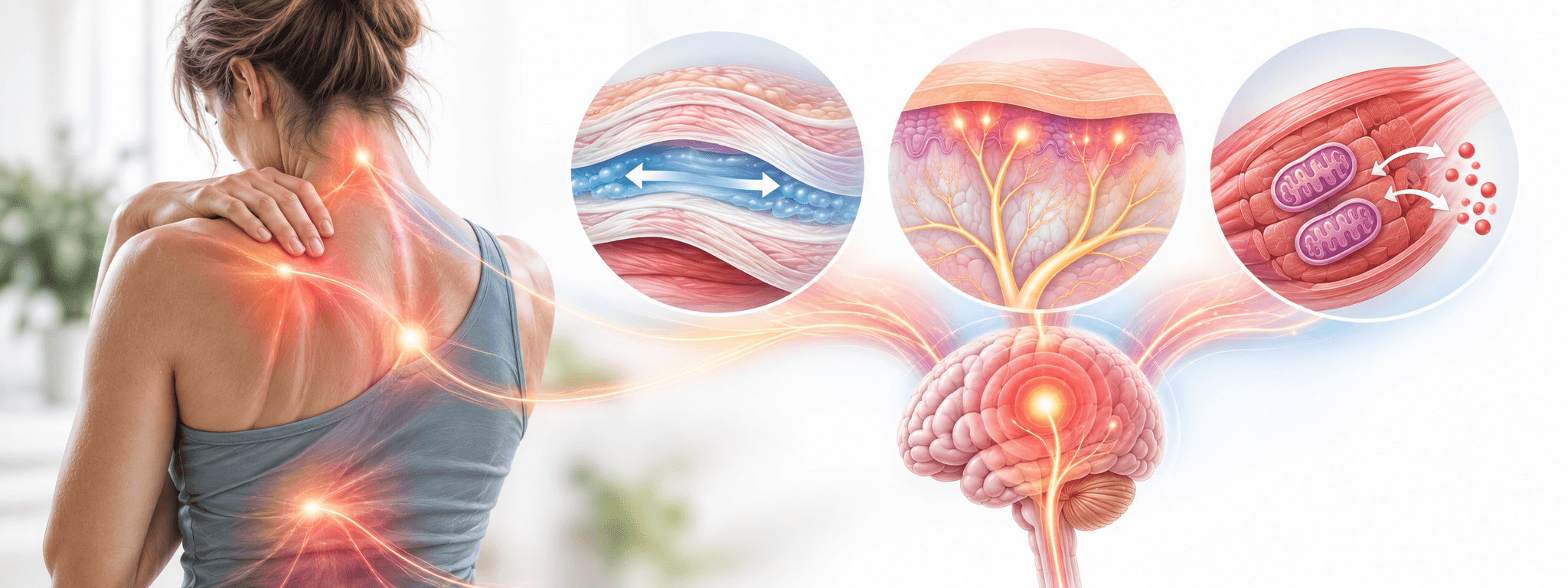
Ask someone with fibromyalgia to describe the pain and you rarely hear the words you would expect for a sore muscle. Not a knot. Not a cramp. Not a bruise. What people say is that it burns, that it spreads well past anywhere they could point to, and that there is no position that makes it stop. That description is important, because burning, spreading pain is typical of two tissues that are not muscle: the fascia wrapped around your muscles, and the small nerve fibres supplying your skin. Muscle, when you provoke it deliberately in a laboratory, produces a different sensation entirely.
The tissue nobody mentions
Fascia is the connective tissue that wraps around every muscle, every bundle of fibres inside it, and every individual fibre. Think of cling film: thin, tough, and holding the shape of what it covers. Without it your muscles would bulge and shift instead of keeping a defined outline. Think of Popeye for those who remember the 80’s cartoon character.
The part that matters for pain is not the wrapping itself but the space between the layers. Fascia is built in sheets, with a thin film of looser tissue between them so the sheets can slide over each other while you move.3 Everything you do depends on that sliding. When it stops happening properly, tissue that should glide starts to drag.
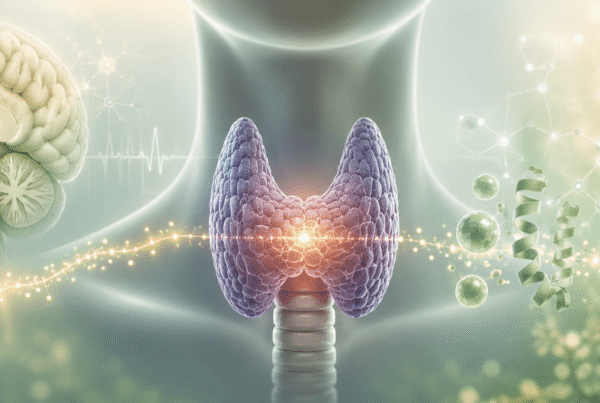
Fascia is also full of nerves. It carries sensory endings of the type that report damage, confirmed in both animal and human anatomy.2 For most of the last century it was treated as packing material. It is closer to a sensory organ that also transmits force.
Why fascia hurts differently from muscle
This has been tested directly.
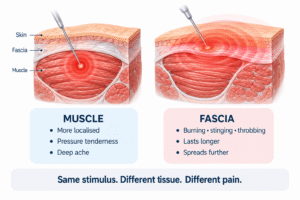
Researchers injected a salt solution that produces short-lived deep pain into three different tissues in healthy volunteers: the muscle of the lower back, the fascia over it, and the layer just under the skin. Then they asked what it felt like.1
Fascia was the most sensitive of the three by a clear margin. The pain lasted longer than pain from muscle, and it spread across a far larger area. When asked to describe it, people reached for the words burning, throbbing and stinging. The researchers took that as evidence that fascia is wired with both fast and slow pain fibres.
So the quality of the pain is not incidental. Burning and spreading is what fascia does when it is irritated, and it is measurably different from what muscle does.
One result pointed the other way. Tenderness to pressure afterwards was produced only by the muscle injection, not the fascia one. That tenderness is the thing that defines fibromyalgia on examination. So fascia explains the burning well and the tenderness poorly, which is a hint that more than one tissue is involved.
What “stuck” fascia actually means
You will read that fascia turns into scar tissue and glues your muscles together. That is not really true but creates a good visual example.
What has actually been measured is reduced sliding. Using ultrasound while people bent forward, researchers found roughly 20% less movement between the fascial layers in people with chronic low back pain than in people without it. The less the layers slid, the thicker the tissue and the more restricted the movement.3
The explanation is not scarring. Sitting between those layers is hyaluronan, a large water-binding molecule that acts as lubricant. Under certain conditions it appears to thicken, clumping to itself instead of holding water, which turns a slippery film into a sticky one. The layers then drag rather than glide. This is called densification, and the whole point of the word is that nothing has been permanently damaged, unlike in fibrosis.4,5
If that is what is happening, then the tissue has not been ruined. It has seized up. Seized tissue responds to movement, warmth and pressure. Scar tissue does not, which is why it’s important to distinguish between the two.
Is fascia the cause of fibromyalgia?
Whilst it plays a role in the fibromyalgia story, it is not the cause.
The best-supported model of fibromyalgia is central sensitisation. After enough ongoing pain signalling, the spinal cord becomes over-responsive and starts amplifying input that should not hurt at all. What that model does not answer is where the original signal comes from, or why it keeps coming.
The fascial theory is one attempt at that missing piece. The argument is that no consistent muscle damage has ever been found in fibromyalgia, that fascia is richly supplied with nerves, that its main cell releases inflammatory signals when strained, and that biopsies have shown extra collagen and inflammatory markers in the connective tissue around muscle.6,7
Why a normal massage often disappoints
Pooling the controlled studies of massage in fibromyalgia, ordinary Swedish massage produced no measurable improvement, while myofascial release produced large improvements in pain and moderate improvements in mood.8
So the usual massage appears to be a poor use of your money rather than a danger. The style that targets connective tissue does better.
Feeling worse for a day or two after firm work is commonly reported. Two things explain it. Your nervous system is already amplifying ordinary pressure before anyone touches you. And in the injection study, lingering pressure tenderness came specifically from stimulating muscle.1 Deep work into muscle is the input most likely to leave you sore.
What to look for instead
Myofascial release uses slow, sustained pressure and sideways shearing force on connective tissue rather than the long gliding strokes used on muscle. The aim is to get the layers moving on each other again.
In the largest trial, twenty weeks of it improved pain, physical function and overall severity compared with a sham treatment. Everyone was reassessed at six months and again at a year, and by then most of the difference between the groups had gone.9 A much smaller study comparing it head to head with Swedish massage also favoured myofascial release.10
Taken together, the picture is consistent. It works, the effect is real, and it fades if you stop. That is an argument for keeping something going yourself between appointments, not an argument against the treatment.
This sits with a myotherapist, remedial massage therapist or physiotherapist trained in the technique. Ask specifically whether they work with fascia, since not every remedial therapist does.
The other reason it burns
Fascia is not the only tissue that produces burning pain.
Burning is the classic description of nerve pain. And when researchers have taken small skin samples from people diagnosed with fibromyalgia and counted the nerve fibres, a large minority turn out to have real nerve abnormalities. In one study, 41% of samples from people with fibromyalgia met the criteria for small-fibre neuropathy, against 3% of samples from people without it.12 Another group found the same pattern, alongside abnormal responses to hot and cold, in people whose standard neurological examination had been completely normal.11
Two things follow from that. A substantial group carrying a fibromyalgia label have identifiable nerve damage, some of it with a treatable cause behind it, which is a reason to keep asking questions rather than stopping at the label. And the burning that fascia explains reasonably well is explained at least as well by the nerves. Both are probably feeding the same amplifier.
The ache that is not burning
Most people have a second symptom sitting underneath the burning: a heavy, worked, day-after-the-gym ache that arrives without the gym.
That one points at energy production rather than tissue. Sampling the fluid directly between muscle cells, researchers found raised lactate in the shoulder muscles of people with fibromyalgia.13 Lactate accumulates when energy production runs fast and unfinished instead of completing properly in the mitochondria. Producing it while sitting still feels much the same as producing it while running.
This is a separate problem from fascial glide, and it will not respond to manual therapy. It is one reason two people with the same diagnosis can need quite different approaches, and why the fatigue and mineral loss associated with high oxalate and other metabolic drivers are worth examining when muscle pain is out of proportion to activity. The underlying biochemistry is covered in more detail in my article on how mitochondria produce ATP through different pathways.
Sleep is not only a casualty
Almost everyone with fibromyalgia sleeps badly, and the obvious reading is that pain wakes you up.
It may also be the other way around. Over twelve thousand women with no pain and no fibromyalgia were followed for about ten years. Those who reported sleep problems at the start were around three times more likely to have developed fibromyalgia by the end, and the more often they reported sleep problems, the higher the risk climbed.14
In this case, fibromyalgia was self-reported rather than examined, and the study was criticised on exactly that point.15 But sleep problems arriving a decade ahead of the pain are hard to explain as a result of the pain.
Practically, it means sleep is worth going after in its own right rather than waiting for it to improve once the pain does.
Three problems, not one
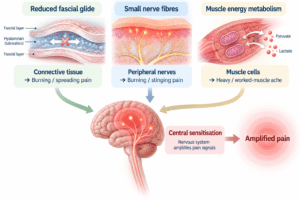
Fibromyalgia behaves like a single diagnosis and rarely acts like one. The evidence supports at least three separate contributors, and you may have any combination:
- Fascia that has stopped sliding. Responds to movement and hands-on work. Gets worse the longer you stay still.
- Small nerve fibre damage. Present in a large minority, sometimes with a findable cause of its own.
- Muscle energy production running badly. Produces the worked-muscle ache, and will not respond to bodywork at all.
All three feed a nervous system that has become very good at amplifying whatever reaches it. That is why addressing one of them usually gets you partway and then stops.
The single thing I would take from all of this is that the way your pain feels is information. Burning points away from muscle and towards connective tissue and nerve. It narrows the search, which is a considerably better position than being told your muscles hurt and nobody knows why.
Frequently asked questions
Is fibromyalgia a fascia problem?
Not exclusively, and it has not been proven to be one at all. Fascial inflammation has been proposed as a peripheral source of the ongoing pain input that drives central sensitisation in fibromyalgia, supported by small biopsy studies and by the known nerve supply of fascia.6 It remains a hypothesis. Small nerve fibre pathology is better documented and present in a substantial subgroup.12
Why does fibromyalgia pain burn instead of ache?
Burning is characteristic of fascia and of small nerve fibres rather than muscle. When hypertonic saline was injected into fascia in healthy volunteers, they described burning, throbbing and stinging, and the pain lasted longer and spread further than the same injection into muscle.1 Burning is also the standard descriptor for nerve-generated pain.
Can massage make fibromyalgia worse?
There is no trial evidence that massage causes harm. There is evidence that Swedish massage does not improve fibromyalgia outcomes, while myofascial release shows moderate benefit.8 Soreness after firm work is common and is consistent with two findings: central sensitisation already amplifies ordinary pressure, and pressure tenderness in experimental studies was produced specifically by stimulating muscle rather than fascia.1
Does myofascial release work for fibromyalgia?
Moderately, and not permanently on its own. A randomised trial of 86 people found improvements in pain, function and clinical severity after 20 weeks of treatment, with most between-group differences no longer significant at six months and one year.9 Meta-analysis across trials found large effects on pain at the end of treatment.8
Is fascia the same as scar tissue?
No. Fascia is normal connective tissue present throughout the body. What changes in restricted fascia appears to be the viscosity of the hyaluronan lubricating the loose layers between fascial sheets, reducing glide without permanently altering the tissue.4,5 That is a different process from scarring, and it is proposed to be reversible.
Why do my muscles ache as though I exercised when I did not?
Raised lactate and pyruvate have been measured in the fluid between muscle cells in fibromyalgia, indicating energy production running through glycolysis rather than completing aerobically.13 Lactate produced at rest generates the same sensation as lactate produced during hard exercise.
References
- Schilder A, Hoheisel U, Magerl W, Benrath J, Klein T, Treede RD. Sensory findings after stimulation of the thoracolumbar fascia with hypertonic saline suggest its contribution to low back pain. Pain. 2014;155(2):222-231. PMID 24076047.
- Tesarz J, Hoheisel U, Wiedenhöfer B, Mense S. Sensory innervation of the thoracolumbar fascia in rats and humans. Neuroscience. 2011;194:302-308.
- Langevin HM, Fox JR, Koptiuch C, et al. Reduced thoracolumbar fascia shear strain in human chronic low back pain. BMC Musculoskeletal Disorders. 2011;12:203. PMID 21929806.
- Stecco C, Stern R, Porzionato A, et al. Hyaluronan within fascia in the etiology of myofascial pain. Surgical and Radiologic Anatomy. 2011;33(10):891-896. PMID 21964857.
- Pratt RL. Hyaluronan and the fascial frontier. International Journal of Molecular Sciences. 2021;22(13):6845. PMID 34202183.
- Liptan GL. Fascia: a missing link in our understanding of the pathology of fibromyalgia. Journal of Bodywork and Movement Therapies. 2010;14(1):3-12. PMID 20006283.
- Liptan G. The widespread myofascial pain of fibromyalgia is sympathetically maintained and immune mediated. Journal of Bodywork and Movement Therapies. 2023;35:394-399.
- Yuan SLK, Matsutani LA, Marques AP. Effectiveness of different styles of massage therapy in fibromyalgia: a systematic review and meta-analysis. Manual Therapy. 2015;20(2):257-264. PMID 25457196.
- Castro-Sánchez AM, Matarán-Peñarrocha GA, Arroyo-Morales M, Saavedra-Hernández M, Fernández-Sola C, Moreno-Lorenzo C. Effects of myofascial release techniques on pain, physical function, and postural stability in patients with fibromyalgia: a randomized controlled trial. Clinical Rehabilitation. 2011;25(9):800-813. PMID 21673013.
- Liptan G, Mist S, Wright C, Arzt A, Jones KD. A pilot study of myofascial release therapy compared to Swedish massage in fibromyalgia. Journal of Bodywork and Movement Therapies. 2013;17(3):365-370. PMID 23768283.
- Üçeyler N, Zeller D, Kahn AK, et al. Small fibre pathology in patients with fibromyalgia syndrome. Brain. 2013;136(Pt 6):1857-1867. PMID 23474848.
- Oaklander AL, Herzog ZD, Downs HM, Klein MM. Objective evidence that small-fiber polyneuropathy underlies some illnesses currently labeled as fibromyalgia. Pain. 2013;154(11):2310-2316. PMID 23748113.
- Gerdle B, Söderberg K, Salvador Puigvert L, Rosendal L, Larsson B. Increased interstitial concentrations of pyruvate and lactate in the trapezius muscle of patients with fibromyalgia: a microdialysis study. Journal of Rehabilitation Medicine. 2010;42(7):679-687.
- Mork PJ, Nilsen TIL. Sleep problems and risk of fibromyalgia: longitudinal data on an adult female population in Norway. Arthritis & Rheumatism. 2012;64(1):281-284. PMID 22081440.
- Wolfe F. Sleep problems and risk of fibromyalgia, untenable conclusions: comment on the article by Mork et al. Arthritis & Rheumatism. 2012;64(5):1692-1693.