

“Active” or “methylated” vitamin forms are sold as strictly better — already converted, more bioavailable, more effective. For some people they are. But active forms are also more forceful: they push the systems they feed harder and faster than the basic forms do. If you feel worse on an active form — wired, anxious, headachy, irritable — the useful way to read that isn’t “I’m reacting to the supplement.” It’s that your biochemistry is being pushed in a direction it’s resisting, and the reaction is information worth understanding rather than a problem to force through.
What “active form” actually means
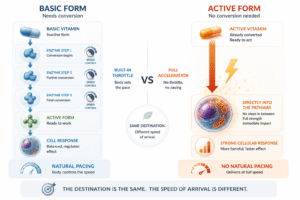
Most vitamins have to be converted before the body can use them. You take one form; a series of enzyme steps turns it into the form that actually does the work.
An “active” or “methylated” form skips those steps. It arrives already converted, ready to act — methylfolate instead of folate, methylcobalamin instead of a form the body has to process, riboflavin-5-phosphate instead of plain riboflavin¹.
The selling point is obvious: no conversion needed, so it works for people whose conversion steps are slow. And for those people it can genuinely help. But “already converted and ready to act” has a flip side that rarely gets mentioned: it also means faster and harder, with none of the natural pacing that the conversion steps would have provided.
The basic form comes with a built-in dimmer switch
This is the part worth understanding, because it explains the whole phenomenon.
When you take a basic form, the conversion steps between it and the active form act as a throttle. The body converts as much as it needs, at the rate it can handle. Those enzyme steps are, in effect, a pacing mechanism — a dimmer switch on how fast the nutrient reaches the system it drives.
An active form removes the dimmer. It delivers the finished product directly, at full strength, with no step in between for the body to regulate the pace. Non-methylated forms release their effect more gradually because a few enzyme steps still sit in the way²; active forms don’t.
So for someone whose system is already running fast, or is sensitive, or is congested somewhere downstream, the active form doesn’t just supply a nutrient — it accelerates a process that may not have wanted accelerating.
Folate and methylation: the clearest case
Methylfolate is the most common culprit, because of what it feeds into.
Methylfolate drives the methylation cycle — and methylation influences neurotransmitters, mood and stimulation. Push it hard and fast, and some people feel it as anxiety, insomnia, irritability, a racing or wired feeling, sometimes within a day or two³ ⁴.
The basic and gentler forms feed the same cycle but with steps in between, so the effect arrives more gradually and the body retains some control over the pace². Same destination, different speed of arrival — and for a sensitive person, the speed is the whole problem. (This is covered in more depth in the companion article on why methylfolate makes some people feel worse.)
It’s not only methylation
The same logic applies beyond folate.
Riboflavin’s job is to become FAD, its active form, which is central to mitochondrial energy production and to keeping other reactions balanced. Riboflavin-5-phosphate sits closer to that end point, so it drives the process more forcefully than plain riboflavin does. For someone who needs the push, that’s the point. For someone whose system is already struggling to keep pace, it accelerates a reaction that was already too fast.
Active B12 forms behave similarly — some are more stimulating, while gentler forms act as a reservoir the body draws on at its own pace, which is why they’re often better tolerated by sensitive people¹ ². The pattern repeats across nutrients: the more “finished” the form, the harder it pushes, and the less room the body has to set the pace.
The reframe: a reaction is information, not just a side effect
Here’s the part most articles miss, and it matters.
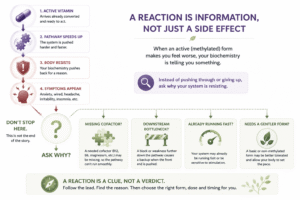
When you react to an active-form supplement, it’s tempting to conclude the supplement is bad, or that you need a lower dose and nothing more. Sometimes dose is the whole answer. But often the reaction is telling you something more useful: your biochemistry is being pushed in a direction it’s resisting — and that resistance usually has a reason.
Maybe there’s a bottleneck further down the pathway, so pushing the front end just backs things up. Maybe a needed cofactor is missing, so accelerating the reaction outruns its supply. Maybe the system was running fast already and didn’t need speeding up. Maybe something upstream — gut, detoxification, another nutrient — needs attention first.
The point is that a reaction isn’t simply “this supplement doesn’t agree with me.” It’s the body signalling that it wants to slow down here, for a reason — and the productive response is to ask what that reason is, not just to push through it or write the nutrient off entirely. The reaction is a lead to follow, not a verdict to accept.
This is a very different stance from the usual one, which treats any reaction as either an intolerance to engineer around or a sign the supplement is “detoxing” you. Neither is curiosity. The reaction is data about your particular biochemistry, and it’s worth reading.
Why “more bioavailable” isn’t automatically “better for you”
The supplement industry uses “active,” “methylated” and “bioavailable” as unqualified selling points, as though more available always means better. But bioavailability describes how readily a nutrient is used — not whether being used harder is what your body needs right now.
For a person with a genuine conversion problem and a clear pathway downstream, the active form can be exactly right. For a person who’s sensitive, whose pathway is congested, or whose system is already running fast, the same form can be too much. The form isn’t good or bad in the abstract. It’s suited or unsuited to a particular person in a particular state — which is a judgement, not a label.
A note on the evidence
The mechanism — active forms bypassing conversion and therefore acting faster and harder — is well established, and the fact that gentler forms release more gradually is straightforward biochemistry¹ ². The reports of feeling “wired” or anxious on high-dose methylated forms are consistent and widely described³ ⁴.
Where the popular explanation falls down is the word “overmethylation” itself. Methylation isn’t a delicate process that a supplement easily floods — it’s one of the most common reactions in the body, running billions of times continuously in every cell, with the universal methyl donor (SAMe) consumed and regenerated on an enormous scale every second. Against that background, a few hundred micrograms of methylfolate is not going to tip the whole body into a global methyl surplus. So the picture of “flooding your system with methyl groups” doesn’t really hold up mechanistically.
What that means is worth stating carefully, because it cuts both ways. The reactions are real — they’re consistent, reproducible, and resolve on stopping. But “overmethylation” is a poor label for them, because it misrepresents the scale at which methylation actually operates. The better explanations are local and specific rather than global: methylfolate feeding into neurotransmitter-related pathways enough to shift catecholamines and feel stimulating in a susceptible person; the methyl-trap situation when B12 is limiting; or simple individual sensitivity to a concentrated active dose, in the same way some people react to a strong coffee. So take a reaction seriously as real information — but be sceptical of “overmethylation” as the explanation, and look for the specific, local reason instead.
What to do if an active form doesn’t suit you
- Don’t assume you just need more, or that pushing through is the answer. A reaction is more often a signal to pause and look than to persist.
- Consider the basic or gentler form. Folinic acid instead of methylfolate, a gentler B12 form — these keep the natural pacing the active forms remove.
- Consider dose separately from form. A large dose of an active form and a small one are different situations; reacting to one says little about the other.
- Ask what the reaction is pointing at. A downstream bottleneck, a missing cofactor, a system that was already fast — the reaction is a clue to your biochemistry, worth exploring rather than overriding.
- Get individual guidance if it’s persistent. Reactions that keep happening are worth understanding properly with someone who can look at the whole picture, not pushing through alone.
The short version
Active vitamin forms skip the conversion steps — which also removes the body’s built-in pacing, so they push harder. For some people that’s exactly right; for others it accelerates something that didn’t want accelerating. If you feel worse on an active form, that reaction is information: your biochemistry is signalling that it wants to slow down here, and the useful move is to ask why, not to force through it. “More active” isn’t the same as “better for you” — it depends entirely on you, and on what your body is actually asking for.
Frequently asked questions
Why do active or methylated vitamins make me feel worse?
Active forms skip the conversion steps the body normally uses, which also removes the natural pacing those steps provide. So they push the systems they feed harder and faster. For a sensitive person, or one with a downstream bottleneck, that acceleration can cause symptoms like feeling wired, anxious or irritable.
Are active vitamin forms better than basic ones?
Not universally. They’re better for people with genuine conversion problems and a clear pathway downstream. For people who are sensitive, congested somewhere in the pathway, or already running fast, the gentler forms are often better tolerated. The right form depends on the person, not the label.
What does it mean if I react to a supplement?
Often it’s information rather than simply an intolerance. A reaction can mean your biochemistry is being pushed in a direction it’s resisting — because of a downstream bottleneck, a missing cofactor, or a system that was already running fast. It’s worth exploring what the reaction is pointing at rather than just pushing through.
Should I take a lower dose or a different form?
Both are worth considering, and they’re different questions. A gentler form keeps the natural pacing that active forms remove. A lower dose reduces the push without changing the form. Reacting to a high dose of an active form says little about how you’d do on a small dose or a basic form.
Is “overmethylation” a real thing?
The reactions people describe on high-dose methylated supplements — anxiety, insomnia, feeling wired — are real and reproducible. But “overmethylation” is a misleading label for them. Methylation runs billions of times a second throughout the body, so a small supplement dose doesn’t flood the system globally. The real explanations are more local — shifts in neurotransmitter-related pathways, a methyl trap when B12 is limiting, or individual sensitivity to a concentrated dose. So the reaction is real; the popular explanation for it usually isn’t.
Which forms are gentler?
Generally the less “finished” forms — folinic acid rather than methylfolate for folate, and gentler B12 forms that the body converts at its own pace. These retain a few enzyme steps that act as a natural throttle.
References
- Active/methylated forms bypass conversion steps and are ready to act; gentler non-methylated forms (e.g. hydroxocobalamin) act as a reservoir the body converts at its own pace. Seeking Health, Methyl-Free vs Methylated; Rho Nutrition (2026).
- Non-methylated forms release their effect more gradually because a few enzyme steps remain; this slower delivery can suit people sensitive to methylated nutrients. Seeking Health (2024); Methyl-Life product education.
- High doses of methylfolate and methylcobalamin can produce “overmethylation” symptoms — anxiety, insomnia, irritability, feeling wired — in sensitive individuals. SelfDecode, Methylated B Vitamins & Genetics (2025).
- Sensitivity to methylated nutrients (methyl B12, methylfolate, SAMe, TMG) can cause anxiety, jitteriness, insomnia; non-methylated forms often better tolerated. Dr Clark Store (2026); Diary of Recovery (2025).