
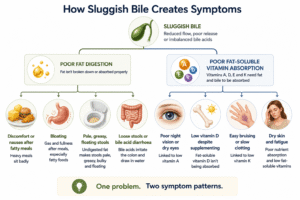
The most recognisable signs of sluggish bile are digestive: discomfort or nausea after fatty meals, bloating, pale or greasy stools that float and are hard to flush, and loose stools. But because bile also governs the absorption of fat-soluble vitamins, the signs can extend well beyond the gut — dry skin, poor night vision, easy bruising, and fatigue can all trace back to bile that isn’t flowing well. None of these is proof on its own, and some overlap with conditions that need medical attention, so the pattern matters more than any single symptom.
What “sluggish bile” means
Bile is made in the liver, stored in the gallbladder, and released into the small intestine when you eat — where it breaks fat into droplets small enough to absorb and carries the fat-soluble vitamins across the gut wall.
“Sluggish bile” describes bile that isn’t flowing or working as well as it should: reduced production, poor release, or an imbalanced bile acid mix that doesn’t do its job efficiently. It sits on a spectrum. At the mild, functional end it produces the everyday symptoms below. At the severe end — genuine obstruction or cholestasis, where bile flow is actually blocked — it’s a medical problem with more serious signs¹. This article is about the functional end, but the red flags that mean “see a doctor” are listed further down.
The digestive signs
These are the most direct, because they’re happening right where bile does its work.
- Discomfort after fatty or rich meals. If fat isn’t being emulsified properly, heavy meals sit badly — nausea, fullness, or a queasy feeling after something oily².
- Pale, greasy, floating stools. This is one of the more specific signs. Undigested fat makes stools bulky, greasy, foul-smelling, pale or clay-coloured, and prone to floating and sticking³ ⁴. The pale colour comes from the lack of bile pigment that normally darkens stool.
- Loose stools or bile acid diarrhoea. The other side of the coin. When bile acids aren’t reabsorbed properly and spill into the colon, they’re irritating and draw in water, causing urgency and loose stools⁵. This is frequently mistaken for IBS⁶.
- Bloating and gas after meals. Poorly digested fat lingering in the gut contributes to bloating, particularly after fatty food².
The signs that don’t look like digestion
These are the ones that get missed, because nobody connects them to bile. They come from the same root: if you can’t absorb fat, you can’t absorb the vitamins that travel with it — A, D, E and K¹ ⁷.
- Poor night vision or dry eyes — associated with low vitamin A⁷.
- Easy bruising or slow clotting — associated with low vitamin K⁷.
- Low vitamin D despite supplementing — a common and frustrating one; the supplement is fat-soluble, so if fat absorption is impaired, taking more doesn’t fix it⁷.
- Dry skin.
- Fatigue. Non-specific, but fat-soluble vitamin insufficiency and poor nutrient absorption contribute.
The tell here is fat-soluble vitamin levels that stay stubbornly low even with a good diet and supplements. That pattern points at absorption, and absorption points at bile. There is one more consequence of unabsorbed fat, and it is not a vitamin. Fat left in the intestine binds calcium into insoluble soaps — and calcium is also what binds dietary oxalate and carries it out in the stool. Tie up the calcium and more oxalate gets absorbed instead. Poor fat digestion can therefore raise oxalate load with no change in diet at all, which brings its own fatigue, joint pain and mineral deficiencies that resist supplementing.
Why it’s easy to miss
Two reasons.
First, most of these signs are individually unremarkable and get attributed elsewhere — the loose stools to IBS, the fatigue to stress, the low vitamin D to not taking enough. Read separately, none of them says “bile.”
Second, standard testing doesn’t routinely look at it. Liver enzymes on a basic blood panel can be completely normal while bile flow is functionally sluggish, because mild functional problems don’t necessarily show up on those markers. So people are told everything’s fine, and the pattern goes unrecognised.
Read together, though, the picture is coherent: fatty-meal intolerance plus pale stools plus low fat-soluble vitamins is a bile story.
What contributes to sluggish bile
Common contributors include gallbladder removal¹, a very low-fat diet (fat is the signal that triggers bile release, so chronically low fat can under-stimulate the system), poor gut health and an altered microbiome that shifts the bile acid balance, oestrogen influences, and reduced bile flow from a range of liver and gallbladder causes.
The gut connection is worth emphasising, because it runs both ways: bile shapes which bacteria thrive, and bacteria shape the bile acid mix. That two-way loop is covered in the companion articles on what bile acids do and primary vs secondary bile acids.
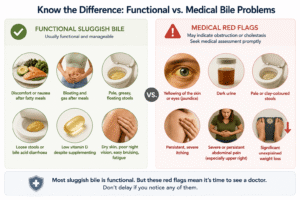
Red flags — when this needs a doctor, not an article
Most sluggish bile is functional and mild. But some signs mean the flow may be genuinely obstructed, and those need medical assessment promptly, not self-management:
- Yellowing of the skin or the whites of the eyes (jaundice)¹
- Dark urine together with pale stools¹
- Persistent, severe itching¹
- Significant unexplained weight loss
- Severe or persistent abdominal pain, especially upper right
These point toward cholestasis or obstruction rather than functional sluggishness, and they warrant a doctor’s assessment.
Can it be tested?
Yes, in a few ways. Fat-soluble vitamin levels (A, D, E, K) can flag malabsorption. Some comprehensive stool tests report bile acids directly, including the primary-to-secondary balance that indicates whether the microbial side is working. And the pattern of symptoms itself, read as a whole, is informative.
As always, the useful information is in the combination — symptoms, vitamin status and bile acid pattern together — rather than any single result.
The short version
Sluggish bile shows up as trouble with fatty meals, pale or greasy or loose stools, and — less obviously — the downstream effects of not absorbing fat-soluble vitamins. Individually these signs are easy to explain away. Together they form a recognisable pattern that standard testing often misses. And apart from the red flags above, it’s usually a functional problem with identifiable, addressable causes rather than something to live with.
Frequently asked questions
What are the signs of sluggish bile?
Discomfort or nausea after fatty meals, bloating, pale or greasy floating stools, and loose stools. Because bile governs fat-soluble vitamin absorption, signs can also include dry skin, poor night vision, easy bruising, low vitamin D despite supplementing, and fatigue.
Why are my stools pale or floating?
Pale, greasy, floating stools often mean fat isn’t being digested properly, usually due to insufficient bile. The pale colour reflects a lack of bile pigment, and the greasiness reflects undigested fat. Persistent pale stools with dark urine should be checked by a doctor.
Can bile problems cause vitamin deficiencies?
Yes. Bile is needed to absorb the fat-soluble vitamins A, D, E and K, so poor bile flow can leave these low even with a good diet. Vitamin D that stays low despite supplementing is a common example.
Can sluggish bile cause diarrhoea?
It can. When bile acids aren’t properly reabsorbed and spill into the colon, they irritate it and draw in water, causing loose stools — often mistaken for IBS.
Can your liver tests be normal and still have a bile problem?
Yes. Standard liver enzymes can be normal while bile flow is functionally sluggish, because mild functional problems don’t necessarily change those markers. This is one reason it’s often missed.
When should I see a doctor about bile symptoms?
Promptly if you have yellowing of the skin or eyes, dark urine with pale stools, persistent severe itching, unexplained weight loss, or severe abdominal pain. These suggest possible obstruction rather than functional sluggishness.
References
- Bile acid synthesis disorders and cholestasis — symptoms including jaundice, pale/clay-coloured stools, steatorrhoea and fat-soluble vitamin malabsorption. National Organization for Rare Disorders (NORD).
- Bile deficiency and impaired fat digestion — bloating, gas and discomfort after fatty meals. General clinical description; see also Cleveland Clinic, Malabsorption.
- Nutritional management of cholestasis. Clinical Liver Disease (2020), 15(6). — Steatorrhoea presenting as greasy, frothy, foul-smelling, floating or pale stools; fat-soluble vitamin deficiency.
- Malabsorption (syndrome). Cleveland Clinic. — Fatty stools (steatorrhoea): greasy, runny, smelly, light-coloured, floating.
- Bile acid malabsorption. Cleveland Clinic. — Excess bile acids reaching the colon cause water secretion and diarrhoea.
- Bile acid malabsorption frequently misdiagnosed as IBS-D. IBS Treatment Center / Cleveland Clinic.
- Nutritional management of cholestasis — deficiencies of fat-soluble vitamins A, D, E and K due to impaired fat digestion. Clinical Liver Disease (2020).