

Feeling worse on methylfolate — anxious, wired, irritable, headachy, unable to sleep — is common enough that it’s one of the most frequent questions asked about the supplement. There are two good mechanistic explanations. Methylfolate has only one way out of the body’s folate system, and that exit depends entirely on vitamin B12; if B12 is limiting, the folate accumulates rather than being used. And the dose in a typical supplement is many times what you’d get from food. There’s also a third possibility worth sitting with: the reason you were told to take it may not have been as solid as it sounded.
Why do people take methylfolate?
Usually because of an MTHFR result.
The MTHFR enzyme converts folate into 5-methyltetrahydrofolate, the form used in the methylation cycle. Common variants in the MTHFR gene reduce that enzyme’s activity, and the reasoning goes: if the conversion step is slower, skip it by taking the converted form directly.
It’s a tidy argument. It’s also where most of the trouble starts.
First, a word about the MTHFR premise
This part rarely gets said in articles about methylfolate, and it should.
MTHFR variants are extremely common — so common that they’re better described as normal population variation than as a defect. And the current consensus in medical genetics is that in the absence of elevated homocysteine, MTHFR variants alone are not a risk factor for any disease¹.
The American College of Medical Genetics published guidance advising against routine MTHFR testing on the grounds of minimal clinical utility, and a number of other professional bodies — including the American College of Obstetricians and Gynecologists, the College of American Pathologists, and the American Heart Association — discourage the test as well¹ ². Meta-analyses have not supported the associations that made the variant interesting in the first place².
So if you were told you have “the MTHFR gene” and therefore need methylfolate, the premise deserves scrutiny before the supplement does. A variant carried by a large share of the population, with no elevated homocysteine alongside it, is not by itself a reason to take anything.
That said — the fact that a variant doesn’t predict disease doesn’t mean it’s irrelevant to how you respond to supplements. Those are different questions, and the guidance above addresses the first, not the second. Which brings us to the mechanisms.
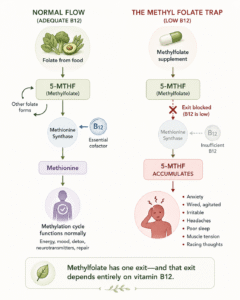
Methylfolate has only one exit, and it needs B12
This is the most useful thing to understand, and it explains most of the reactions.
Folate circulates in several interchangeable forms, and the body moves between them depending on what it needs — DNA synthesis, repair, the methylation cycle. But 5-methyltetrahydrofolate is different. The reaction that creates it runs one way only, and there is exactly one route back out: an enzyme called methionine synthase, which hands the methyl group over to homocysteine to make methionine.
That enzyme is completely dependent on vitamin B12.
So if B12 is insufficient, methylfolate has nowhere to go. It accumulates while the rest of the folate system runs short, because the folate is stuck in a form that can’t be converted back. This is long-established biochemistry, described as the methyl folate trap³.
The practical consequence: taking methylfolate when B12 is limiting can make things worse rather than better. You’re adding to a pool that’s already backed up.
Why folinic acid is often better tolerated
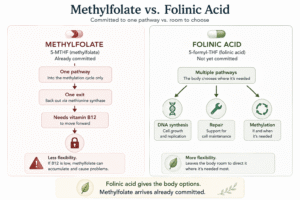
Folinic acid sits further upstream in the same system, and that position is the whole advantage.
From folinic acid, the body can go several directions — toward DNA synthesis, toward repair, or onward into the methylation cycle if that’s what’s needed. It chooses.
Methylfolate offers no such choice. It’s committed, and its single exit is B12-dependent.
The distinction is worth generalising: giving the body a nutrient it can direct is different from giving it one already committed to a single pathway. The first lets your physiology allocate. The second is micromanaging — you’ve made the decision on the body’s behalf, and if it would have chosen differently, you get symptoms.
This is a large part of why people who react badly to methylfolate often tolerate folinic acid without difficulty. It isn’t that one is stronger and one is weaker. It’s that one is flexible and one isn’t.
The dose is usually much higher than food
Worth noticing, because it’s rarely mentioned.
Dietary folate intake sits in the region of a few hundred micrograms a day, spread across meals and mixed forms. Methylfolate supplements are frequently sold in milligram quantities — multiples of what any diet would deliver, arriving in a single dose, in one committed form.
Someone who reacts to a high dose may be fine at a fraction of it. That’s a different situation from not tolerating the nutrient, and it’s worth distinguishing before ruling anything out.
What does “overmethylation” actually feel like?
The symptoms people describe are consistent: anxiety, agitation, feeling wired, irritability, racing thoughts, headache, disturbed sleep, and sometimes muscle aches or a sense of pressure in the head. They typically appear within days of starting, or after a few days of feeling unusually good.
Being straight about the evidence here: this pattern is well recognised clinically, and the underlying biochemistry gives a plausible account of it, but there isn’t a body of controlled trials establishing “overmethylation” as a defined condition. Treat it as a described clinical pattern rather than a diagnosis.
What’s not in doubt is that people report these reactions consistently, and that they resolve on stopping.
Does this mean methylfolate is bad?
No. For some people it’s exactly the right form, and the reason it exists is that the converted form genuinely is more usable for some individuals.
The problem isn’t the compound. It’s the reasoning that leads people to it — a common gene variant, interpreted as a defect, treated with a high dose of the most committed form available, often without checking B12 or homocysteine first.
Change those inputs and the same supplement behaves differently.
What to do if methylfolate doesn’t suit you
- Stop, and see whether the symptoms resolve. If they clear within days, that’s informative in itself.
- Check B12 status before trying again. Methylfolate’s only exit route depends on it, and serum B12 alone doesn’t always tell the full story.
- Check homocysteine. This is the marker that indicates whether the methylation cycle is actually struggling — far more useful than the gene result on its own.
- Consider folinic acid as an alternative form, since it leaves the body room to direct it.
- Consider the amount as well as the form. Reacting to a milligram dose says little about whether a much smaller one would suit.
- Don’t push through it. Persisting with something that consistently makes you feel worse is rarely how these situations resolve.
The underlying point
A supplement isn’t right or wrong in the abstract. It’s right or wrong for a particular person, in a particular biochemical context, at a particular amount.
Methylfolate is a good illustration because it has so little tolerance for being wrong. A single committed form, one exit, and that exit dependent on another nutrient entirely. If the context suits, it works well. If it doesn’t, you find out quickly.
Frequently asked questions
Why does methylfolate make me feel anxious or wired?
The most likely mechanism is that methylfolate has only one route out of the folate system, and that route depends on vitamin B12. If B12 is limiting, it accumulates. High doses relative to dietary folate intake also contribute.
What is the methyl folate trap?
A situation where folate becomes stuck as 5-methyltetrahydrofolate because the enzyme that converts it onward requires vitamin B12. Without sufficient B12, the folate accumulates in a form the body can’t use for its other functions.
Is folinic acid better than methylfolate?
Not better in general, but often better tolerated. Folinic acid sits upstream, so the body can direct it toward DNA synthesis, repair, or methylation as needed. Methylfolate is committed to one pathway with a single B12-dependent exit.
Do I need methylfolate if I have an MTHFR variant?
Not automatically. MTHFR variants are very common, and the current consensus is that in the absence of raised homocysteine they aren’t a risk factor for disease on their own. Homocysteine and B12 status are more informative than the gene result.
Should I get tested for MTHFR?
Major professional bodies advise against routine MTHFR testing on the grounds of limited clinical utility. Where the methylation cycle is in question, homocysteine is generally the more useful measurement.
How long do methylfolate side effects last?
People generally report symptoms resolving within a few days of stopping. If they persist, something else is likely contributing and it’s worth investigating properly.
References
- MTHFR genetic testing: is there a clinical utility? (2024). PMC11288266 — summarises the current consensus that, absent elevated homocysteine, MTHFR variants alone are not a disease risk factor, and lists the professional bodies discouraging routine testing.
- Hickey, S. E., Curry, C. J. & Toriello, H. V. (2013). ACMG practice guideline: lack of evidence for MTHFR polymorphism testing. Genetics in Medicine, 15(2), 153–156. doi:10.1038/gim.2012.165 (reaffirmed 2020)
- The methyl folate trap — the B12-dependence of methionine synthase and the consequences of its impairment for folate metabolism. Standard biochemistry; see folate and vitamin B12 metabolism reviews.