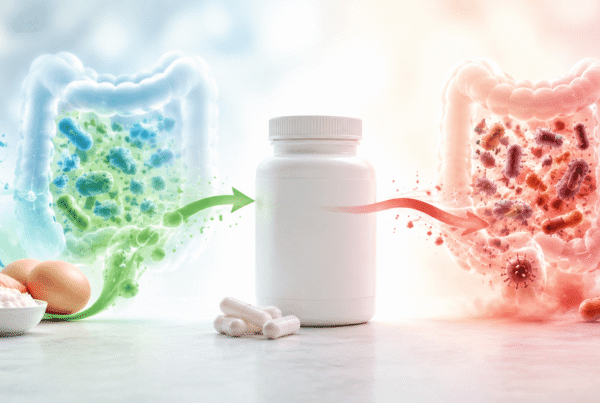
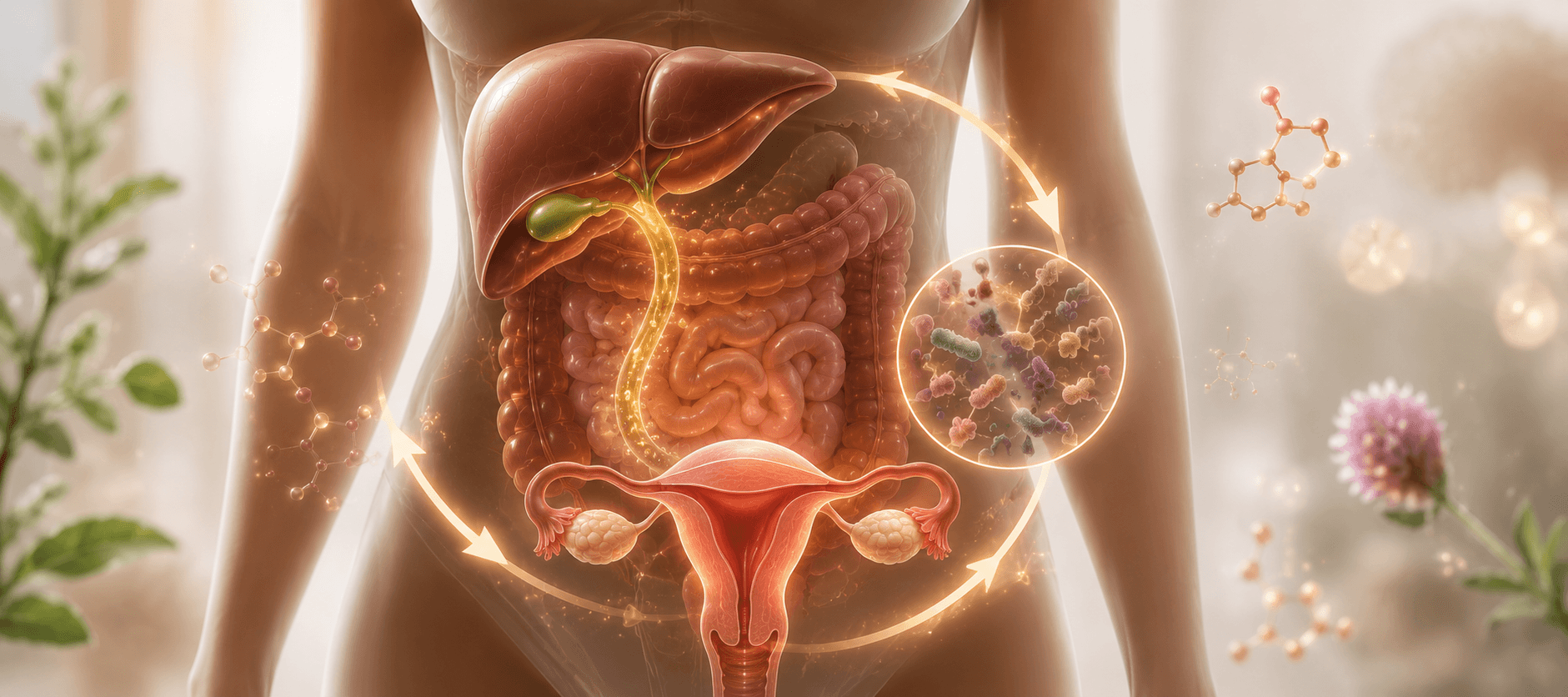
Once your liver has finished with oestrogen, it packages it for disposal and sends it out in bile, into the gut, to be excreted. But that’s not always the end of it. Certain gut bacteria can unlock the packaged oestrogen and free it back into an active form, which is then reabsorbed and returned to circulation instead of leaving the body. So oestrogen clearance isn’t just a liver job — it depends on bile flow to carry oestrogen out, and on the gut bacteria that decide whether it actually leaves or gets recycled. When either is off, oestrogen can build up.
How the body gets rid of oestrogen
Clearing oestrogen happens in stages, and the liver does the main chemical work.
First it modifies the oestrogen (phase one), then it attaches a molecule to it in a step called conjugation — mainly glucuronidation (phase two)¹. That attachment does two things: it switches the oestrogen off, making it biologically inactive, and it makes it water-soluble so it can be excreted¹ ².
The conjugated, inactivated oestrogen then leaves the liver in one of two ways: through the kidneys in urine, or through bile into the intestine¹ ². The bile route is what we’ll discuss in this article.
Where bile comes in
Bile is the delivery vehicle. The liver secretes the packaged oestrogen into bile, and bile carries it down into the gut for disposal².
This is worth being precise about, because it’s easy to overstate. Bile itself isn’t doing anything clever to the oestrogen — it’s the transport. But transport matters: if bile flow is sluggish, that whole disposal route runs slowly. Bile is one of the two exits, and a blocked or sluggish exit backs up whatever is trying to leave through it.
So good bile flow supports oestrogen clearance simply by keeping that route open. Poor bile flow narrows it.
The twist: the gut can undo the packaging
Here’s what makes oestrogen different from a simple waste product.
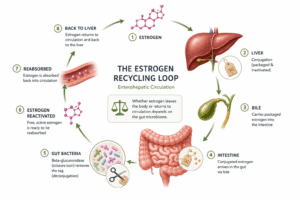
When the conjugated oestrogen arrives in the gut, certain bacteria produce an enzyme called beta-glucuronidase. This enzyme cleaves off the tag the liver attached — it deconjugates the oestrogen³ ⁴. And once that tag is removed, the oestrogen is reactivated: free, biologically active, and able to be reabsorbed across the gut wall back into circulation³ ⁴.
That loop — liver conjugates, bile delivers to the gut, gut bacteria deconjugate, oestrogen returns — is called enterohepatic recirculation⁴. The collection of gut bacterial genes governing this is now referred to as the estrobolome⁵.
In normal amounts it’s a regulatory mechanism that helps keep circulating oestrogen steady⁴. The problem is when it runs too hot.
When too much gets recycled
If the gut bacteria producing beta-glucuronidase are overactive — often because of dysbiosis, an imbalanced microbiome — more oestrogen gets deconjugated and reabsorbed rather than excreted⁶ ³.
The net effect is higher circulating oestrogen. The liver did its job and packaged the oestrogen for removal; the gut unpacked it and sent it back. Elevated beta-glucuronidase activity has been associated with excessive oestrogen reabsorption, and an overactive estrobolome has been linked with oestrogen-driven conditions⁶ ⁷.
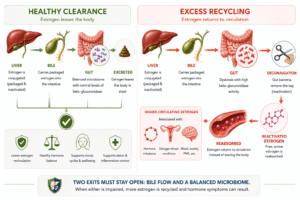
So two things need to go right for oestrogen to actually leave. Bile flow has to carry it out, and the gut bacteria have to let it go rather than recycling it. A problem in either can raise oestrogen — and the two often occur together, because bile flow and the microbiome are closely linked.
Why this connects bile, gut and hormones
This is the point where three systems that get treated separately turn out to be one loop.
Bile shapes the gut environment — it’s antimicrobial and influences which bacteria thrive. The gut bacteria in turn govern how much oestrogen is recycled. And oestrogen itself influences the gut. So sluggish bile can contribute to the kind of microbial imbalance that raises beta-glucuronidase activity, which raises oestrogen — a chain that starts at digestion and ends at hormones.
It’s a large part of why hormone symptoms sometimes don’t resolve by working on hormones alone. If the driver is on the clearance side — poor bile flow, an overactive estrobolome — then supporting oestrogen production or blocking its effects doesn’t address what’s actually happening.
The life-stage nuance
Whether more or less oestrogen recycling is helpful depends on where someone is.
In the reproductive years, an overactive estrobolome pushing oestrogen back into circulation is generally the unwanted direction, and is associated with oestrogen-excess conditions⁷. After menopause the picture shifts — reduced microbiome diversity and altered estrobolome function are common, and here the concern can run the other way, toward insufficient oestrogen availability⁷.
So this isn’t a case of recycling being simply good or bad. As with most of physiology, it’s about whether the balance fits the person and their stage of life.
The evidence
The core biochemistry is solid: hepatic conjugation, biliary excretion, microbial deconjugation by beta-glucuronidase, and reabsorption are all well established³ ⁴.
What’s still developing is the clinical fine detail — precisely how much a given person’s symptoms are driven by estrobolome activity versus other factors, and how reliably you can change outcomes by targeting it.
The short version
Oestrogen leaves the body partly through bile, into the gut — but gut bacteria can reactivate it and send it back rather than letting it go. Clearing oestrogen therefore depends on bile flow keeping that exit open and on a balanced microbiome that doesn’t over-recycle. When hormone symptoms don’t respond to hormone-focused approaches, the clearance side — bile and gut — is one of the places worth looking.
Frequently asked questions
How does the body get rid of oestrogen?
The liver inactivates oestrogen and makes it water-soluble through conjugation, then excretes it via the kidneys in urine or via bile into the gut. From the gut it’s meant to leave in stool — unless gut bacteria reactivate it first.
Can bile problems affect oestrogen levels?
Indirectly, yes. Bile is one of the two routes oestrogen uses to leave the body. If bile flow is sluggish, that disposal route runs slowly, which can contribute to oestrogen building up rather than being cleared.
What is the estrobolome?
The collection of gut bacterial genes whose enzymes metabolise oestrogen. In particular, bacteria producing beta-glucuronidase can reactivate conjugated oestrogen in the gut, allowing it to be reabsorbed instead of excreted.
What is beta-glucuronidase?
A gut bacterial enzyme that removes the tag the liver attached to oestrogen for disposal. This reactivates the oestrogen and lets it be reabsorbed. Overactivity is associated with excess oestrogen recirculation.
Can gut health affect hormone balance?
Yes. Because gut bacteria control how much oestrogen is recycled rather than excreted, the microbiome directly influences circulating oestrogen. This is one reason hormone symptoms sometimes don’t resolve without addressing the gut.
Is oestrogen recycling always bad?
No. It’s a normal regulatory process that helps keep oestrogen steady. Whether more or less recycling is desirable depends on the person and their life stage — the same pattern can be unhelpful before menopause and protective after it.
References
- Estrogen phase I and phase II metabolism — hydroxylation, then conjugation (glucuronidation and sulfation) increasing water solubility for urinary and biliary excretion. Mass-spectrometric profiling of estrogens in stool and plasma (2025).
- Conjugated oestrogen is rendered water-soluble and inactive, then excreted via bile into the small intestine. The Estrobolome / gut-oestrogen reviews (2023–2026).
- Ervin, S. M. et al. (2019). Gut microbial β-glucuronidases reactivate estrogens as components of the estrobolome. Journal of Biological Chemistry, 294(49), 18586–18599.
- Hu, S., Ding, Q., Zhang, W. et al. (2023). Gut microbial beta-glucuronidase: a vital regulator in female estrogen metabolism. Gut Microbes, 15(1), 2236749.
- Estrobolome — the collection of gut microbial genes metabolising oestrogen and governing its enterohepatic circulation. Review literature; Plottel & Blaser concept.
- Elevated beta-glucuronidase activity and excessive oestrogen reabsorption; dysbiosis shifting the reabsorption-to-excretion balance. Vibrant Wellness / estrobolome clinical reviews (2025).
- Overactive estrobolome associated with oestrogen-driven conditions; postmenopausal reduction in microbiome diversity and altered estrobolome function. The Estrobolome review (2026).