If you’ve had cancer before, or watched someone close to you go through it, the idea of a simple blood test that could catch cancer early is hugely appealing. Several such tests now exist, and some are sold directly to the public. They work by looking for tiny fragments of tumour DNA in your blood, often by reading their methylation pattern. The science is real and improving quickly. But what these tests can tell you is narrower than the marketing suggests, and knowing their limits matters before you pay for one or act on a result.
How a blood test can detect cancer
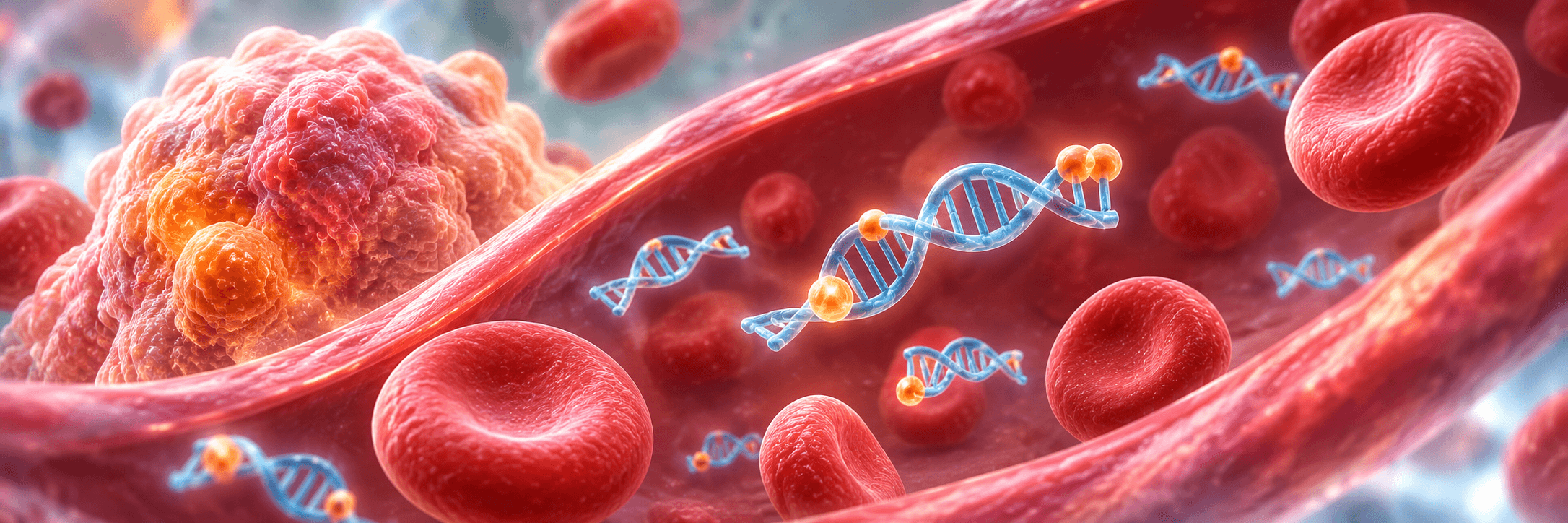
Cells all over your body are constantly dying and being replaced, and as they break down, small fragments of their DNA spill into your blood. This is called cell-free DNA. When a tumour is present, some of those fragments come from cancer cells.
Cancer cells have a distinctive methylation pattern. Genes that normally keep cell growth in check are often switched off by extra methyl tags, while other parts of the DNA lose their tags.¹ Because these patterns differ between tissues, reading them can suggest not only that cancer is present but roughly where in the body it came from.² If you’d like the background on methylation, I’ve explained it in can you turn back your biological age?
These tests are called multi-cancer early detection tests, because one blood sample screens for many cancer types at once.

The big catch: early cancers shed very little DNA
The whole point of screening is to find cancer early, when it’s most treatable. The problem is that small, early tumours release very little DNA into the blood. Advanced cancers are far easier to detect.³
In the largest validation study of one of these tests, here’s how often it picked up cancer by stage:⁴
| Cancer stage | How often the test detected it |
|---|---|
| Stage I (earliest) | About 1 in 6 |
| Stage II | About 4 in 10 |
| Stage III | About 3 in 4 |
| Stage IV (most advanced) | About 9 in 10 |
So the test is best at finding exactly the cancers that are hardest to cure, and weakest at finding the early ones screening is meant to catch. Some cancers, including many brain, kidney, prostate and thyroid cancers, shed so little DNA that they’re often missed at any stage.³
The good news on the other side is that false alarms are rare. In that same study, only about 1 in 200 people without cancer got a positive result.⁴

What a positive result really means
Even with few false alarms, a positive result doesn’t mean you definitely have cancer, because most people being screened don’t. When thousands of people over 50 without symptoms were tested, about 1 in 70 got a positive result. Of those, a little under 4 in 10 turned out to have cancer. The rest had no cancer found.⁵
Working out which was which took time: a median of about two and a half months, and longer for people who turned out not to have cancer. Most had scans and blood tests, and a few had surgery.⁵ That’s a long stretch of worry, and it’s worth thinking about before you test.
What the largest trial found
The biggest test so far is the NHS-Galleri trial in England, which tested a very large group of people with three yearly blood tests and compared them with people who had standard screening alone. Its full results were presented in mid-2026, and they show both the promise and the limits.⁶
- It did not meet its main goal. It didn’t reduce the combined number of stage III and IV cancers.
- It did reduce stage IV cancers by about 14% overall, with bigger reductions in the second and third rounds of testing.
- It found about four times as many cancers as standard screening alone, and about half of all positive results turned out to be cancer.
- It still missed many cancers. Across all cancer types, it picked up fewer than a third of the cancers that developed during the trial.
- There’s no evidence yet that it saves lives. That will take longer follow-up.
These results were released by the company that makes the test and haven’t yet been published in full in a peer-reviewed journal. The test hasn’t been approved by the US Food and Drug Administration.⁶
A negative result doesn’t rule cancer out
This is the most important thing to understand. Because these tests miss so many early cancers, a negative result is not an all-clear. If you have symptoms, such as a lump, unexplained weight loss, bleeding, a change in bowel habits or a persistent cough, see your doctor regardless of any blood test result.
It’s also not a replacement for proven screening. Bowel screening, cervical screening and breast screening all have strong evidence behind them. A blood test may one day add to them. It doesn’t replace them.
The risk of finding cancers that would never have harmed you
Screening can also find cancers that would never have caused symptoms or shortened your life. This is called overdiagnosis, and it’s a well-documented problem with screening for some cancers.⁷ Those people go through biopsies, treatment and anxiety for no benefit. A test that finds more cancers isn’t automatically better. It has to find the ones that matter, early enough to change the outcome.
There’s another quirk worth knowing. As we age, our blood cells pick up gene changes of their own, a process called clonal haematopoiesis. Those changes show up in cell-free DNA too, and in people without cancer they accounted for most of the DNA changes found in their blood.⁸ Tests that look only for gene changes can mistake them for cancer, which is one reason methylation-based tests were developed.
Where blood tests already help: after cancer treatment
For people who have already had cancer, there’s a more established use. After surgery, a blood test designed around a person’s own tumour can look for leftover cancer DNA. In an Australian-led trial in stage II bowel cancer, using this test to decide who needed chemotherapy roughly halved the number of people given chemotherapy, without increasing the chance of the cancer coming back.⁹
This kind of testing is arranged through your oncologist, using your own tumour as the reference. It’s different from the general screening tests sold directly to the public.
Genes and cancer risk
Most of the genes linked to cancer only nudge risk slightly, and your environment, diet and lifestyle shape how they behave. In that sense, most genes describe function and risk, not destiny.
But a few inherited gene changes do raise risk a lot. For women carrying a harmful BRCA1 change, the risk of breast cancer by age 80 is about 72%, and of ovarian cancer about 44%.¹⁰ If cancer runs strongly in your family, talk to your doctor about genetic counselling. That’s a far better-established path than a blood screening test.
Questions to ask before you pay for a test
- Has the test been validated in large, independent, published studies, not just on the company’s website?
- How often does it detect stage I and II cancers, not just cancer overall?
- What percentage of positive results turn out to be cancer?
- Which cancers does it miss most often?
- If I test positive, what follow-up will I need, and who will arrange and pay for it?
- Is there any evidence it reduces deaths from cancer?
If a provider can’t answer these clearly, treat that as an answer in itself.
Frequently asked questions
Can a blood test detect cancer?
Yes, some blood tests can detect fragments of tumour DNA, often by reading their methylation pattern. They are much better at detecting advanced cancers than early ones, and they miss many cancers, so they don’t replace proven screening or seeing a doctor about symptoms.
How accurate are multi-cancer early detection tests?
In the largest validation study, false positives were rare, about 1 in 200 people without cancer. But the test detected only about 1 in 6 stage I cancers and 4 in 10 stage II cancers, compared with 9 in 10 stage IV cancers.
If my cancer blood test is negative, am I clear?
No. These tests miss many cancers, especially early ones. A negative result doesn’t rule out cancer, so keep up with standard screening and see your doctor about any new or persistent symptoms.
What did the NHS-Galleri trial find?
It didn’t meet its main goal of reducing combined stage III and IV cancers, but it reduced stage IV cancers by about 14% and found more cancers than standard screening. There’s no evidence yet that it reduces deaths.
What is cell-free DNA?
Cell-free DNA is the small fragments of DNA that cells release into the blood as they break down. When cancer is present, some of these fragments come from tumour cells, and they can be detected by their methylation pattern or gene changes.
Can a blood test show if my cancer has come back?
Tests built around your own tumour can detect leftover cancer DNA after treatment, and they’re already being used to guide decisions in some cancers, such as bowel cancer. These are arranged through your oncologist.
References
1. Baylin SB, Jones PA. A decade of exploring the cancer epigenome: biological and translational implications. Nat Rev Cancer. 2011;11(10):726-734. PMID 21941284.
2. Liu MC, Oxnard GR, Klein EA, et al. Sensitive and specific multi-cancer detection and localization using methylation signatures in cell-free DNA. Ann Oncol. 2020;31(6):745-759. PMID 33506766.
3. Bettegowda C, Sausen M, Leary RJ, et al. Detection of circulating tumor DNA in early- and late-stage human malignancies. Sci Transl Med. 2014;6(224):224ra24. PMID 24553385.
4. Klein EA, Richards D, Cohn A, et al. Clinical validation of a targeted methylation-based multi-cancer early detection test using an independent validation set. Ann Oncol. 2021;32(9):1167-1177. PMID 34176681.
5. Schrag D, Beer TM, McDonnell CH, et al. Blood-based tests for multicancer early detection (PATHFINDER): a prospective cohort study. Lancet. 2023;402(10409):1251-1260. PMID 37805216.
6. GRAIL. GRAIL reports full results from NHS-Galleri trial demonstrating substantial reduction in Stage IV cancer diagnoses at 2026 ASCO Annual Meeting. Press release, 30 May 2026. https://grail.com/press-releases/grail-reports-full-results-from-nhs-galleri-trial-demonstrating-substantial-reduction-in-stage-iv-cancer-diagnoses-at-2026-asco-annual-meeting/
7. Welch HG, Black WC. Overdiagnosis in cancer. J Natl Cancer Inst. 2010;102(9):605-613. PMID 20413742.
8. Razavi P, Li BT, Brown DN, et al. High-intensity sequencing reveals the sources of plasma circulating cell-free DNA variants. Nat Med. 2019;25(12):1928-1937. PMID 31768066.
9. Tie J, Cohen JD, Lahouel K, et al. Circulating tumor DNA analysis guiding adjuvant therapy in stage II colon cancer. N Engl J Med. 2022;386(24):2261-2272. PMID 35657320.
10. Kuchenbaecker KB, Hopper JL, Barnes DR, et al. Risks of breast, ovarian, and contralateral breast cancer for BRCA1 and BRCA2 mutation carriers. JAMA. 2017;317(23):2402-2416. PMID 28632866.