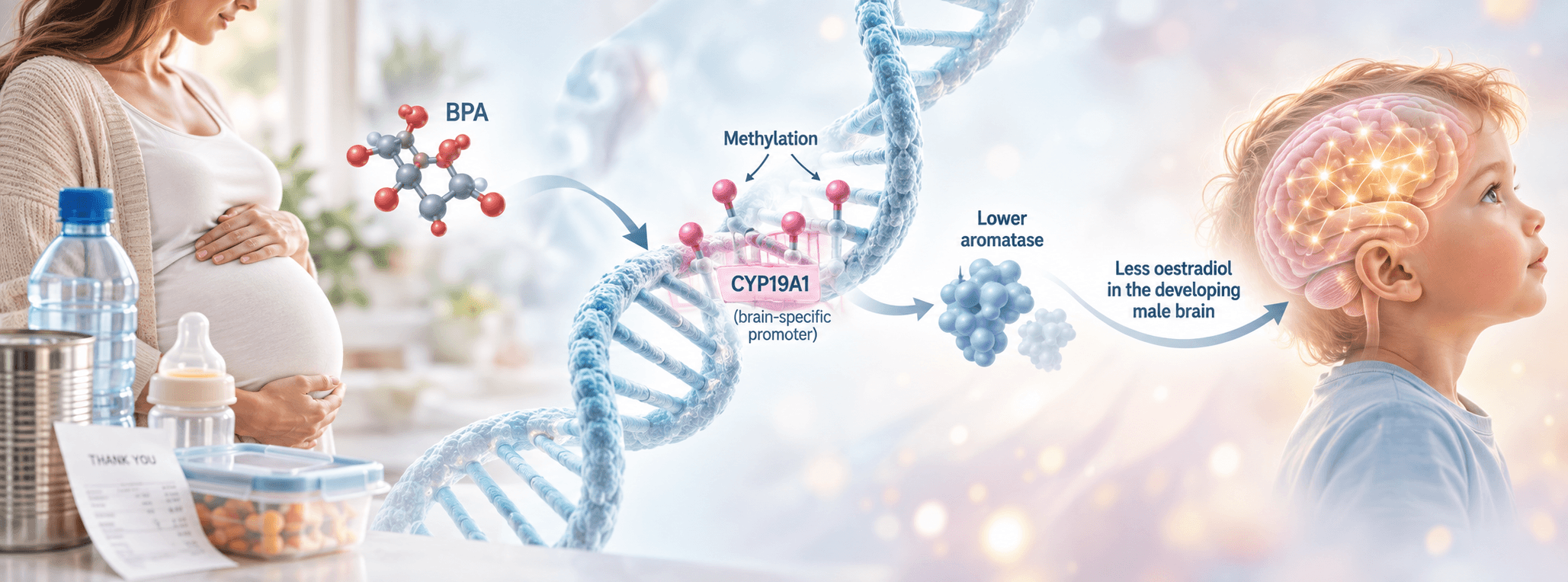
An Australian research team followed just over a thousand children from before birth and found that boys whose mothers had higher levels of the plastic chemical BPA late in pregnancy were more likely to have autism symptoms at age two and a diagnosis at age nine. The finding only appeared in boys who also carried a particular set of gene variants. Neither the chemical nor the genetics produced the effect alone. What makes the study interesting is that the researchers went looking for the mechanism and found one: BPA appeared to switch off a gene that male fetal brain development depends on, and it did it through methylation.
What the researchers actually did
The work came out of the Barwon Infant Study, a long-running Geelong birth cohort, and was published in 2024.1
They measured BPA in mothers’ urine late in pregnancy, then followed the children. At age two they assessed autism symptoms. At age nine they recorded diagnoses. They also looked at the children’s genetics, specifically at gene variants affecting how well one enzyme works, and at chemical marks on the DNA in cord blood taken at birth.
Then they repeated the key mechanism findings in a separate American cohort, and tested the mechanism directly in cells and in mice.
That combination is what raises this above the usual chemical-exposure headline. Most studies of this kind show an association and stop. This one proposed a biological pathway and then went and looked for it in four different places.
BPA, and why it is hard to avoid
Bisphenol A is used to make polycarbonate plastic and the epoxy resins that line food cans. It is in food packaging, some water bottles, till receipts printed on thermal paper, and dental sealants.
Most exposure comes through food. BPA leaches out of the container and into what it holds, and heat speeds that up considerably.
Is BPA a forever chemical?
No, and the distinction matters.
Forever chemicals are the PFAS group, used in non-stick coatings, waterproofing and firefighting foam. The name comes from the carbon-fluorine bond holding them together, which is one of the strongest in chemistry and which almost nothing in the body or the environment can break. PFAS half-lives in people are measured in years.
BPA behaves in the opposite way. The liver attaches a sugar molecule to it, which makes it water-soluble and ready for excretion, and most of a dose leaves in the urine within about six hours. A single exposure is largely gone within a day.
Which raises the obvious question. If it clears that quickly, how can it matter?
Two answers. The first is that exposure is continuous rather than occasional. You clear this morning’s dose and take on this afternoon’s, so most people carry a low level permanently despite eliminating it rapidly. The population is effectively always exposed even though no individual molecule stays long.
The second is timing, and it is the more important one here. Fetal development runs to a schedule. A gene that needs to be switched on during a particular window of brain development gets that window once. A chemical present during it can leave a lasting mark on how that gene is read, long after the chemical itself has gone. The exposure is temporary. The epigenetic change is not.
One caution on the clearance figure. Urinary BPA in people who have fasted does not fall as far as a six-hour half-life predicts, which suggests either significant exposure routes beyond food, or some storage in fat tissue. It is unsettled, and it argues against being too relaxed about how fast the body deals with it.
The enzyme in the middle of this
Aromatase is the enzyme that converts testosterone into oestradiol. Most people know it from breast cancer treatment, where drugs block it to reduce oestrogen.
Its role in the developing brain is less widely known and slightly counterintuitive. In the male fetal brain, testosterone is converted locally into oestradiol by aromatase, and it is that locally made oestrogen that drives a large part of male brain development. So a process everyone thinks of as female is doing essential work in a male brain.
This does not mean testosterone is irrelevant. It acts directly through its own receptors as well. But a substantial part of what gets attributed to testosterone in the developing male brain is actually the work of the oestradiol made from it, which is why interfering with the conversion step matters.
The gene that codes for aromatase is CYP19A1. It has several separate start switches, called promoters, which let different tissues turn the same gene on independently. One of them is used specifically by the brain. That detail matters for what follows.
How a chemical switches a gene off
Genes are not simply on or off by nature. Small chemical tags get added to and removed from DNA throughout life, and these change how readable a gene is. Adding methyl groups to the switch region of a gene generally makes it harder to read, which turns the gene down. This is what people mean by epigenetics, and it is the same methylation chemistry that runs through the MTHFR pathway.
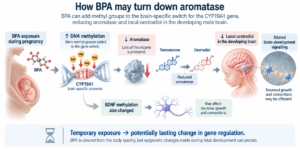
The researchers found that the higher the mother’s BPA, the more methylation was present across the brain-specific switch region of the aromatase gene in the baby’s cord blood.1 More tags on the switch, less aromatase.
They then followed the chain one step further. That aromatase methylation statistically accounted for a further change in the methylation of BDNF, a growth factor neurons depend on to develop and connect. So the sequence ran from chemical, to one gene being turned down, to a second gene being affected downstream. The same chain appeared in the American cohort.
In nerve cells grown in the laboratory, adding BPA more than halved the amount of aromatase protein present. In mice, prenatal BPA produced changes in brain structure and behaviour consistent with the model.
Why it only showed up in some boys
This is the most useful part.
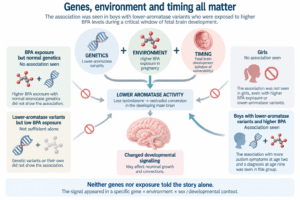
The association between BPA and autism appeared in boys who carried gene variants giving lower aromatase activity to begin with. It did not appear in boys with normal aromatase genetics, and it did not appear in girls.
So neither factor was sufficient by itself. The genetics were common and mostly harmless. The chemical exposure was ordinary and near-universal. The two together, in one sex, during one window of development, was where the signal appeared.
That is the shape of most gene-environment findings, and it is why I keep saying a variant is a question rather than an answer. Carrying a lower-activity aromatase gene tells you nothing on its own. It tells you something only once you know what that gene has been asked to cope with.
What this study does not show
This section matters, particularly if you are reading as a parent.
It does not show that BPA causes autism. This is a cohort study, which means it observes what happens without controlling anything. It can establish that two things travel together. It cannot establish that one produced the other.
It cannot explain any individual child. Autism develops out of many genes and many environmental exposures interacting over time, which is what this study itself demonstrates. No single finding of this kind accounts for a particular person’s diagnosis, and this one does not tell you why your child is autistic. It does not mean you did something wrong. There is no version of this study that makes a mother responsible.
The numbers are small. Out of just over a thousand children, 43 had an autism diagnosis. Once that group is split by sex and by genotype, the numbers being compared are smaller again. Findings from small subgroups need replication.
The exposure measurement is crude. BPA leaves the body within hours, so a urine sample captures roughly what someone was exposed to that day. Using it to represent an entire pregnancy is the best available approach but still a rough one.
The mouse and cell work supports the mechanism without proving it happens in people. A chemical halving an enzyme in a dish tells you it can. It does not necessarily tell you that it does, at the concentrations a human fetus encounters.
The finding that will get misread
The study also tested a fatty acid called 10HDA, found in royal jelly, in the mice. It improved the autism-like features in animals that had been exposed to BPA prenatally.1
The reason the researchers tested this particular fatty acid is that it acts on oestrogen receptors directly. If BPA reduces the brain’s ability to make oestradiol from testosterone, then something that stimulates the same receptors bypasses the missing step. It was a deliberate test of their own mechanism rather than a lucky find. It’s important to note that this is a long way from a treatment, and a royal jelly supplement is not the compound that was tested.
That is an interesting result in mice and the researchers themselves described it as warranting further study.
Reducing BPA exposure in pregnancy
Despite everything above, I think reducing exposure during pregnancy is sensible, and I would say so regardless of how this particular study is eventually judged. BPA is an endocrine disruptor with effects on several hormone systems, the developing brain is the most sensitive tissue there is, and the cost of reducing exposure is close to zero.
What actually makes a difference:
- Do not heat food in plastic. Heat drives leaching. Transfer to glass or ceramic before microwaving, and let hot food cool before putting it into plastic containers.
- Reduce tinned food, particularly tinned tomatoes and other acidic foods, since the lining is a significant source and acidity increases transfer.
- Avoid handling thermal paper receipts where it is easy to do so. BPA is present as free powder on the surface and is absorbed through skin.
- Use glass or stainless steel for water bottles and food storage.
- Do not put plastic containers through the dishwasher, since heat and detergent degrade the surface and increase leaching.
One caution about “BPA-free” labels. Manufacturers have largely replaced BPA with chemically related bisphenols such as BPS and BPF. These are structurally similar, and there is active research into whether they carry similar endocrine effects. The label only tells you that one specific chemical is absent. It does not tell you that the product is inert.
The aim is reducing an avoidable exposure, not eliminating plastic from your life. That second thing is not currently achievable and treating it as necessary creates more anxiety than it prevents.
Frequently asked questions
Does BPA cause autism?
No study has shown that. An Australian birth cohort found that higher maternal BPA late in pregnancy was associated with more autism symptoms at age two and diagnosis at age nine, but only in boys who also carried gene variants for lower aromatase activity.1 Cohort studies show association rather than cause, the number of diagnosed children was small, and autism is strongly heritable.
Is BPA a forever chemical?
No. Forever chemicals are the PFAS group, which resist breakdown and have half-lives in the body measured in years. BPA is processed by the liver and excreted in urine within hours. It matters despite that because exposure is near-continuous, and because a chemical present during a developmental window can leave a lasting epigenetic mark after the chemical itself has cleared.
What is aromatase and why does it matter for a baby’s brain?
Aromatase converts testosterone into oestradiol. In the developing male brain, testosterone is converted locally into oestradiol by this enzyme, and that locally made oestrogen drives a large part of male brain development. Less aromatase activity during that window means less of it.
How can a chemical switch a gene off?
By changing the chemical tags attached to DNA. Adding methyl groups to the switch region of a gene makes it harder to read, which turns the gene down without altering the gene itself. In this study, higher maternal BPA predicted more methylation across the brain-specific switch region of the aromatase gene.1
Why did it only affect boys?
Because the mechanism involves the conversion of testosterone to oestradiol in the developing male brain, which is a process specific to male fetal development. The effect also appeared only in boys who carried gene variants giving lower aromatase activity, so the exposure and the genetics were both required.
Are BPA-free plastics safer?
Not necessarily. BPA has largely been replaced with chemically related bisphenols such as BPS and BPF, which are structurally similar and under investigation for similar effects. The label confirms one chemical is absent rather than that the product has no hormonal activity.
Does royal jelly help autism?
No. A fatty acid found in royal jelly improved autism-like features in mice exposed to BPA before birth.1 That result is in animals, it has not been tested in humans for this purpose, and a royal jelly supplement is not the same substance that was tested.
What is the most useful thing to do about plastic in pregnancy?
Stop heating food in it. Heat is the main driver of chemicals moving from container into food, so transferring to glass or ceramic before microwaving removes a large share of everyday exposure at no cost.
References
- Symeonides C, Vacy K, Thomson S, et al. Male autism spectrum disorder is linked to brain aromatase disruption by prenatal BPA in multimodal investigations and 10HDA ameliorates the related mouse phenotype. Nature Communications. 2024;15:6367. (Birth cohort with independent replication, plus cell and mouse work.)
- Chevrier J, Gunier RB, Bradman A, et al. Maternal urinary bisphenol A during pregnancy and maternal and neonatal thyroid function in the CHAMACOS study. Environmental Health Perspectives. 2013;121(1):138-144.