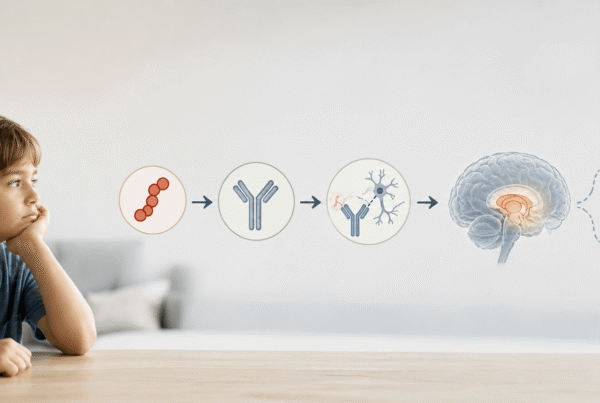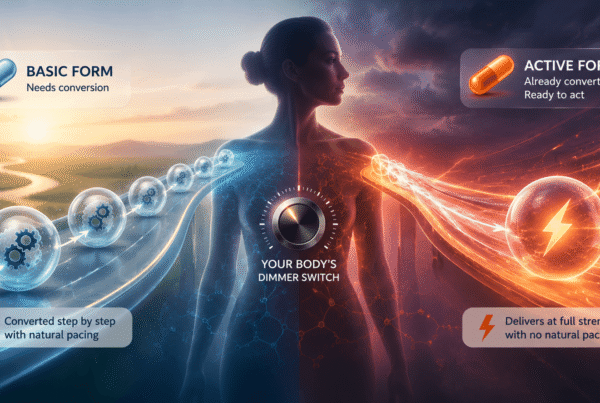

A gene variant read on its own tells you very little. What matters is where it sits in a sequence of reactions and what the variants around it are doing. A slow enzyme at the end of a pathway causes more trouble than several slow enzymes at the start, because everything upstream backs up behind it. This is why two people with the same reported variant can have completely different experiences, and why a report listing genes one at a time is close to unreadable.
The principle: a pathway drains like a bath
Biochemical pathways run in sequence. A substance enters, gets modified by one enzyme, passes to the next, and so on until it leaves as something the body can use or excrete.
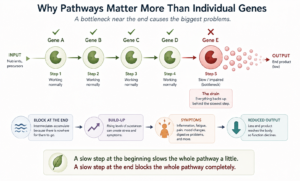
Think of a bath. The taps are the front of the pathway; the drain is the last enzyme. You can have excellent taps and it makes no difference if the plug is in — the water simply rises.
That’s the whole idea. A variant slowing an enzyme near the end of a pathway can produce symptoms all by itself, even when every other gene in that pathway is unremarkable, because there’s nowhere for the accumulating intermediates to go. A variant near the beginning is far more forgiving: everything downstream is still working, so the pathway simply runs a little slower.
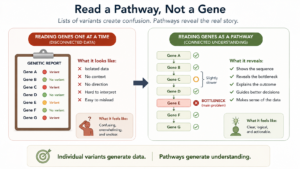
Read one gene at a time, those two situations look identical. Read as a sequence, they’re completely different problems.
Worked example: histamine
Histamine is broken down by several enzymes at different stages — one working mainly in the gut, others handling what reaches circulation, and a final set clearing the compounds produced along the way.
Those final enzymes are the drain. Someone with variants only at that end of the pathway can have genuine histamine symptoms even though the earlier steps are fine, because histamine and its breakdown products accumulate behind the block.
The same set of enzymes also handles alcohol breakdown, which is why poor alcohol tolerance often travels with histamine symptoms. That connection is invisible if you read the genes as a list, and obvious the moment you read them as a pathway.
It also changes what you’d do about it. If the block is at the end, adding support to the earlier steps pushes more material into a bottleneck. Reducing the load arriving at the pathway is more useful than speeding up its front end.
Worked example: dopamine and the “wired and tired” pattern
Dopamine is made from an amino acid, then converted onward to norepinephrine by another enzyme, then cleared by others.
Consider a combination: fast production at the front, slow conversion onward, and few receptors for dopamine to bind to. Individually none of those is dramatic. Together they describe a specific and recognisable state — dopamine accumulating because it isn’t being converted, while the effects of dopamine are muted because there’s little for it to bind to.
The result is the contradictory picture people describe as wired and tired: stimulated and agitated, and simultaneously flat and unmotivated, sometimes alternating.
No single one of those variants predicts that. The combination does.
There’s a further wrinkle worth knowing, because it shows how thin single-gene advice can be. The enzyme converting dopamine onward requires copper — but too much copper slows it rather than helping. So “this enzyme needs copper” is true and still a poor basis for taking copper.
Worked example: methylation
MTHFR is the variant everyone has heard of, and it’s a good demonstration of why single-gene reading misleads.
MTHFR sits partway along a longer sequence. What happens to the material it produces depends on what’s downstream — including whether there’s sufficient B12 for the next step, and how the enzymes further along are functioning.
So an MTHFR variant with a clear path downstream is a very different situation from the same variant with a bottleneck below it. In the first case, pushing the pathway with supplements works as intended. In the second, it adds to a queue — which is why some people feel worse rather than better on methylated B vitamins.
Same gene, same variant, opposite outcome. The difference is entirely in the context.
Fast isn’t good and slow isn’t bad
Reports tend to colour-code variants as though one direction is healthy and the other is a defect. It isn’t that simple.
A slow enzyme is only a problem if the pathway it sits in is under load. Under ordinary conditions it may never matter.
And some slow variants are actively protective. The clearest example is alcohol: people who clear it poorly feel unwell after small amounts, so they tend to drink very little, which serves them well over a lifetime. On a report that appears as a red flag. In practice it’s a built-in brake.
An intermediate result — not fast, not slow — is frequently the most useful thing to have, because it stays stable across different conditions and life stages.
What genetic results can and can’t do
This is where a lot of writing on this subject overreaches, so it’s worth being direct.
Individual variants have small effects. Single common variants typically have very small effects on risk and aren’t useful for predicting it¹. Anyone presenting one variant as an explanation for a complex health problem is overstating what the science supports.
Consumer reports don’t account for interaction. Direct-to-consumer risk estimates generally don’t incorporate gene-gene or gene-environment interaction at all, and the algorithms producing them are not well validated². Which is precisely the information a pathway reading depends on.
Pathway-level thinking is biologically sound but hard to prove. Mainstream genetics agrees that reading variants in isolation is inadequate — interaction between variants is biologically plausible, and analysing genes at the pathway level rather than one at a time is an established research approach³. What’s difficult is demonstrating specific interactions statistically, because the effects are small and the number of possible combinations is enormous.4
So the real position: reading genetics as pathways is more biologically sensible than reading it as a list, and it is not a validated method for predicting who will develop what.
Genotype is not phenotype. A variant describes a tendency under load, not an outcome. Whether it expresses depends on nutrient status, other variants, medications, stress, illness and age — most of which change over time.
So what is genetic information actually good for?
Generating hypotheses, not conclusions.
Its most defensible use is explaining things that have already happened. Why did that supplement cause a reaction when it helps most people? Why does this person tolerate one form of a vitamin but not another? Why do symptoms flare under conditions that don’t trouble anyone else?
Genetic results are good at making sense of that, and poor at predicting it in advance.
Its second use is deciding what to measure. If a pathway looks vulnerable on paper, that’s a reason to test whether it’s actually struggling — not a reason to assume it is. Functional testing shows what a pathway is doing now. Genetics suggests where to look.
Used together they’re considerably more informative than either alone: one shows the tendency, the other shows the expression.
What to take from a genetic report
- Ignore the colour coding as a verdict. Red doesn’t mean broken and green doesn’t mean fine.
- Find the pathway, not the gene. Where does this variant sit in a sequence, and what’s below it?
- Pay most attention to the end of pathways. That’s where blocks cause the most trouble.
- Look for combinations that point the same direction. One variant means little; three related ones in the same pathway is a pattern.
- Confirm before acting. A tendency on paper isn’t the same as a problem in practice. Measure it.
- Don’t treat a gene. Variants don’t change. What can change is the load on the pathway and the cofactors available to it.
The underlying point
A gene result on its own is a fact without a context, and facts without context are how people end up taking supplements that make them feel worse.
The information isn’t in the individual variant. It’s in where that variant sits, what surrounds it, and whether the pathway is under any real pressure — which is a question that testing answers and a report cannot.
Frequently asked questions
Why do two people with the same gene variant have different symptoms?
Because the variant’s effect depends on its context — where it sits in a pathway, what the other enzymes in that pathway are doing, nutrient status, and how much load the pathway is under. The same variant can be inconsequential in one person and significant in another.
Does a “slow” gene mean something is wrong?
No. A slow enzyme only matters if the pathway is under pressure, and some slow variants are protective — poor alcohol clearance being the clearest example.
Why does one slow enzyme cause symptoms when the rest of the pathway is normal?
Because pathways drain in sequence. A block near the end acts like a plug in a bath: it doesn’t matter how well the earlier steps work if there’s nowhere for the material to go.
Can genetic testing predict what diseases I’ll get?
Generally no. Individual common variants have small effects and aren’t useful for prediction. Genetic information is better at explaining unusual responses than forecasting outcomes.
Should I take supplements based on my genetic results?
Not on the results alone. A variant indicates a tendency, not an active problem. Testing whether the pathway is actually struggling is a more reliable basis for deciding anything.
Are consumer genetic reports reliable?
The genotyping itself is generally accurate. The interpretation is the weak point — these reports typically don’t account for interactions between genes or between genes and environment, and their risk algorithms are not well validated.
References
- Moore, J. H. & Williams, S. M. (2009). Epistasis and its implications for personal genetics. American Journal of Human Genetics, 85(3), 309–320. — Notes that single SNPs typically have very small effects on risk and are not useful for prediction.
- Reflections on the US FDA’s warning on direct-to-consumer genetic testing. Genomics & Informatics (2014). PMC4330248 — Notes that gene-gene and gene-environment interactions are not taken into account in DTC risk estimation, and that the algorithms are not well validated.
- Pathway-based approaches to genetic association analysis — aggregating SNP-level signals across genes and pathways rather than testing variants individually.
- Underestimated effect sizes in GWAS: fundamental limitations of single-SNP analysis. PLOS ONE (2011). PMC3225388 — On why single-variant analysis understates effects in multi-locus models.