
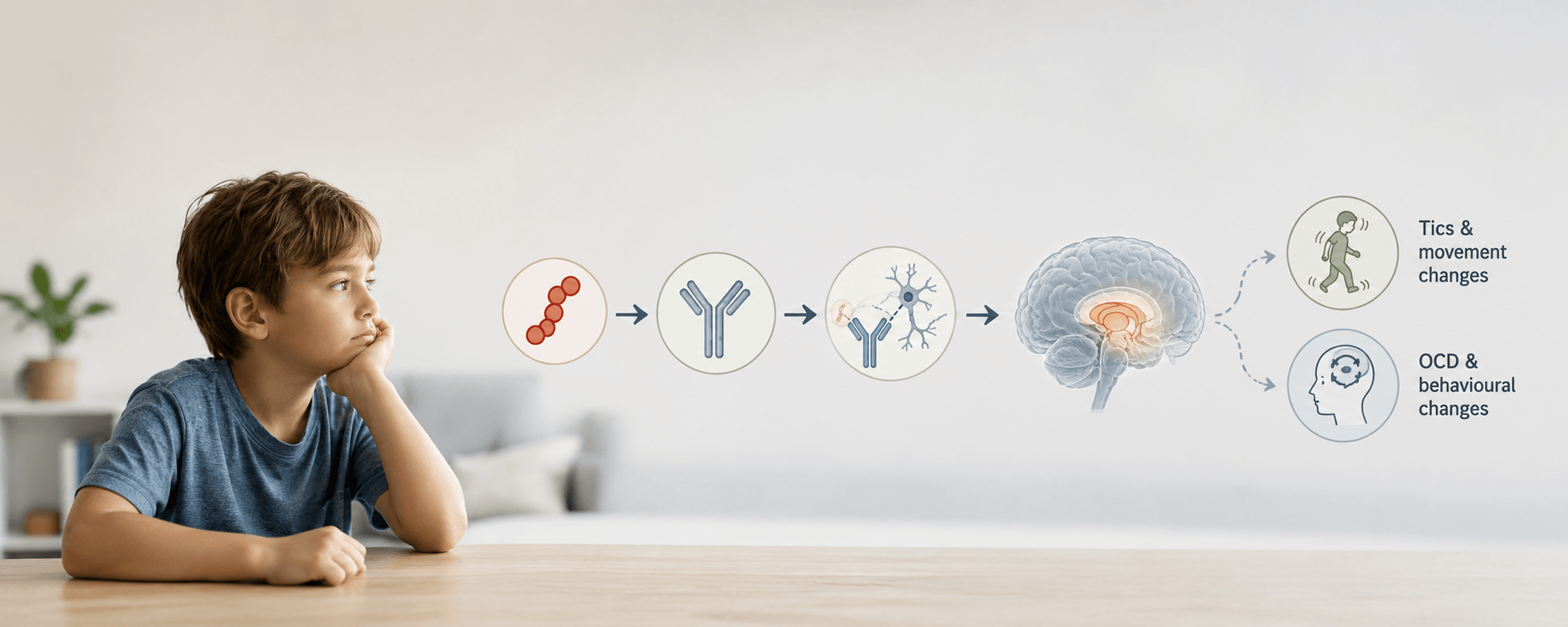
PANDAS — a sudden onset of tics, obsessive-compulsive behaviours and other neuropsychiatric symptoms in children after a streptococcal infection — is thought to involve the immune system affecting a specific brain region: the basal ganglia, where dopamine and movement-and-behaviour circuits are regulated. But here’s the part that often gets missed: the basal ganglia is a shared final common pathway. Many things can disturb it, not just strep. So a child can have PANDAS-like symptoms without having PANDAS — if something else, such as another infection or an environmental trigger, is affecting the same region. Understanding this matters, because it changes the question from “is it PANDAS?” to “what is disturbing this part of the brain?”
What PANDAS is — and how contested it is
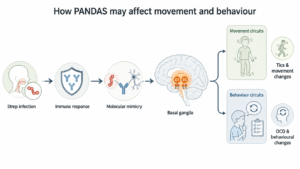
PANDAS stands for Pediatric Autoimmune Neuropsychiatric Disorders Associated with Streptococcal Infections. The idea, first described in 1998, is that in some children a strep infection triggers an immune response that, through molecular mimicry, cross-reacts with the child’s own brain tissue — producing an abrupt onset of OCD and/or tics¹.
PANDAS has been actively researched and have well-documented cases, but it remains somewhat controversial in medicine — there’s ongoing debate about its diagnostic criteria, how to interpret strep antibody tests, and how to separate it from primary neurodevelopmental conditions¹ ². Importantly, no single biomarker — not strep antibodies, not anti-brain antibodies, not commercial panels — has been shown to diagnose it reliably². It remains largely a diagnosis of exclusion, made clinically after other causes are ruled out³.
The basal ganglia: the region at the centre of it
To understand why PANDAS produces the symptoms it does — and why other things can mimic it — you have to understand the brain region involved.
The basal ganglia is a cluster of structures deep in the brain that governs movement control and a great deal of behaviour, habit and impulse regulation. It runs heavily on dopamine, and its circuits balance “go” and “stop” signals that shape both movement and behaviour⁴.
In PANDAS, the leading model is that autoantibodies interfere with dopamine receptors in the basal ganglia — research has identified candidate antibodies against dopamine D1 and D2 receptors, with the balance between them appearing to influence whether symptoms lean toward movement problems or toward OCD and tics⁵. Neuroimaging shows inflammatory changes in the basal ganglia in affected children, and the disruption of dopamine signalling there is the most developed explanation for the symptoms⁴ ⁶.
The key insight: the symptoms of PANDAS are really the symptoms of a disturbed basal ganglia. The strep-triggered autoimmunity is one way to disturb it — but the symptoms come from the region, not from the strep directly.
Why this explains so much overlap
Once you see the basal ganglia as the source of the symptoms, a lot of otherwise confusing overlap makes sense.
Tourette syndrome, some forms of OCD, tic disorders, Sydenham’s chorea, and PANDAS all share this same neuroanatomical territory⁴ ⁶. That’s why they look alike, overlap in families, and can be hard to tell apart — they’re different routes to disturbance of the same circuits. The literature describes the basal ganglia explicitly as the “final common target” of these disorders⁶.
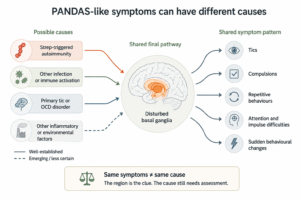
Symptoms associated with basal ganglia dysfunction — tics, compulsions, attention and impulse difficulties, repetitive behaviours — are therefore not unique to any one cause. They’re what this part of the brain produces when it’s disturbed, regardless of what did the disturbing.
The look-alikes doctors already weigh
Before extending this idea outward, it’s worth knowing what clinicians conventionally consider when a child presents with sudden tics or OCD — because PANDAS is only one item on an established list.
The usual differential includes primary obsessive-compulsive disorder, Tourette syndrome and other tic disorders, and anxiety disorders — conditions that produce very similar symptoms but typically develop gradually rather than erupting overnight. Sudden onset is the feature that makes clinicians consider PANDAS specifically, because ordinary OCD and tics usually build over weeks, months or years. Sydenham’s chorea — a movement disorder linked to rheumatic fever and also triggered by streptococcus — sits close by too, and shares striking immunological similarities with PANDAS, including some of the same candidate antibodies. More seriously, doctors also have to rule out conditions such as autoimmune encephalitis, which can present with acute neuropsychiatric change and needs prompt identification.
The point of naming these is twofold. First, it shows that “sudden tics or OCD in a child” already has a real, conventional list of explanations — PANDAS shouldn’t be the automatic conclusion, and a proper assessment works through these possibilities. Second, and this is the thread of this article: notice what nearly all of them have in common. Tic disorders, Tourette’s, Sydenham’s chorea, OCD, PANDAS — they converge on the same neuroanatomy. Which is exactly why the more useful question isn’t just “which of these is it?” but “what is disturbing this child’s basal ganglia?” — and that question, as the next section explains, has an even wider set of possible answers than the conventional list suggests.
The important implication: PANDAS-like doesn’t always mean PANDAS
If the symptoms come from a disturbed basal ganglia, and strep-triggered autoimmunity is only one thing that can disturb it, then a child can present with the full PANDAS-like picture — sudden tics, OCD, behavioural change — driven by something other than strep. Medicine has partly recognised this with a broader umbrella term, PANS (Pediatric Acute-onset Neuropsychiatric Syndrome), which describes the same acute-onset neuropsychiatric picture arising from a range of triggers, not only streptococcus⁷. PANDAS is, in effect, the strep-specific subset of PANS⁷.
What can sit under that broader umbrella? Other infections are recognised triggers. And in clinical practice, some practitioners observe similar presentations in the context of conditions such as tick-borne infections (like Lyme disease) or mould biotoxin exposure — the reasoning being that these too can drive neuroinflammation and immune activation capable of affecting the basal ganglia.
What’s important: the strep-and-PANS framework is far better established than specific claims about Lyme or mould as causes of this picture, which are more clinically observed and hypothesised than definitively proven. But the underlying principle — that the same brain region can be disturbed by more than one thing — is sound and is exactly what the PANS concept formalises.
The practical upshot: fixating on “is it PANDAS?” can be the wrong question. The more useful one is “what is disturbing this child’s basal ganglia, and is it strep, another infection, or something else?” — because the answer changes what actually needs addressing.
Why this matters — and a caution against overdiagnosis
On one side, recognising that PANDAS-like symptoms can have several drivers is valuable — it can spare a child from being locked into one diagnosis (or one treatment) when a different trigger is at work, and it encourages looking for a treatable cause rather than only managing symptoms.
On the other side, this exact reasoning can be taken too far — into attributing every childhood tic or behavioural change to hidden infections or environmental toxins, chasing elaborate testing, and arriving at confident diagnoses the evidence can’t support. Primary tic disorders are common, substantially genetic (heritability estimates of 50–80%), and often have nothing to do with autoimmunity at all². So the same open-mindedness that helps some children can harm others if it becomes a bias toward exotic explanations.
The balanced position: keep the differential broad, take the possibility of multiple drivers seriously, but hold each specific conclusion with an open mind and insist on proper assessment. This is the territory of specialists — paediatric neurologists, immunologists and others working together — not of self-diagnosis or a single practitioner’s label.
The through-line
Underneath all of this is a principle that runs through a lot of how the body works: a symptom tells you which system is affected, not necessarily what caused it. Tics and compulsions point to the basal ganglia. They don’t, by themselves, tell you whether strep, another infection, a genetic tic disorder, or something environmental is behind it. Reading the symptom as the whole answer — “tics after an illness, therefore PANDAS” — skips the more important question of what’s actually driving the disturbance. The region is the clue; the cause still has to be worked out.
What this points toward
- Take sudden neuropsychiatric changes in a child seriously and get specialist assessment. Abrupt onset of tics, OCD or behavioural change warrants proper evaluation.
- Don’t assume the cause from the symptom. PANDAS-like symptoms indicate the basal ganglia is affected, not automatically that strep is the cause.
- Keep the differential broad but grounded. Other infections and, in some clinical views, environmental factors can affect the same region — but so can common genetic tic disorders, and each conclusion needs support.
- Be wary of confident single-cause labels and elaborate testing that outruns the evidence, in either the conventional or the alternative direction.
The short version
PANDAS involves the immune system disturbing the basal ganglia — the dopamine-rich brain region controlling movement and behaviour — after a strep infection. But because the symptoms come from that region, and many things can disturb it, PANDAS-like symptoms don’t always mean PANDAS: the broader PANS concept recognises that other triggers can produce the same picture. PANDAS itself remains real but genuinely contested and hard to confirm. The useful question isn’t “is it PANDAS?” but “what is disturbing this part of the brain?” — answered through proper specialist assessment, not assumption.
Frequently asked questions
What is PANDAS?
PANDAS (Pediatric Autoimmune Neuropsychiatric Disorders Associated with Streptococcal Infections) describes a sudden onset of OCD and/or tics in children thought to follow a strep infection, via an immune response that cross-reacts with the brain’s basal ganglia. It’s actively researched but remains medically controversial and is largely a diagnosis of exclusion.
Why does PANDAS cause tics and OCD?
Because it’s thought to disturb the basal ganglia — a dopamine-rich brain region that controls movement and behaviour. Research points to autoantibodies interfering with dopamine receptors there. Tics and compulsions are what this region produces when disturbed, which is also why PANDAS overlaps with Tourette syndrome and OCD.
Can you have PANDAS-like symptoms without having PANDAS?
Yes. The symptoms come from a disturbed basal ganglia, and strep is only one thing that can disturb it. The broader term PANS (Pediatric Acute-onset Neuropsychiatric Syndrome) recognises the same picture arising from other triggers. So a child can have the PANDAS-like presentation without strep being the cause.
Can Lyme disease or mould cause PANDAS-like symptoms?
Some practitioners observe similar presentations with tick-borne infections or mould exposure, reasoning that these can drive neuroinflammation affecting the basal ganglia. This is more clinically observed and hypothesised than definitively proven — but the underlying principle, that the same brain region can be disturbed by different triggers, is what the PANS concept formalises.
Is PANDAS a proven diagnosis?
It’s contested. It’s a real and researched phenomenon, but there’s ongoing debate about its criteria, and no single test — including strep antibodies, anti-brain antibodies or commercial panels — reliably diagnoses it. It’s typically diagnosed clinically after excluding other causes, which is part of why it’s controversial.
What should I do if my child suddenly develops tics or OCD?
Seek prompt medical assessment from appropriate specialists — sudden neuropsychiatric changes in a child warrant proper evaluation. Avoid assuming a single cause from the symptoms alone, and be cautious of confident labels or elaborate testing that outrun the evidence, in either conventional or alternative directions.
References
- PANDAS was first described in 1998 as abrupt-onset OCD and/or tics following Group A streptococcal infection, proposed to act via molecular mimicry and autoimmunity against the basal ganglia. Rheumatology/Psychiatry Advisor review (2025–2026); Streptococcus pyogenes clinical manifestations (NCBI Bookshelf, NBK607260).
- PANDAS remains controversial, with ongoing debate over criteria and serology interpretation; no biomarker (ASO, anti-DNase B, anti-basal-ganglia antibodies, Cunningham Panel) has adequate individual-level diagnostic accuracy; primary tic disorders are highly heritable (50–80%). Narrative review, Int. J. Mol. Sci. (2026), PubMed 42196589.
- PANDAS is diagnosed clinically as a diagnosis of exclusion after ruling out other causes. PANDAS “Myth or Reality” review, Microorganisms (2023), PubMed 37894207.
- The basal ganglia governs movement and behaviour via dopamine-driven circuits; inflammation and disrupted dopamine signalling there explain the characteristic tics and OCD. Rheumatology Advisor review (2026); PANDAS pathophysiology literature.
- Candidate autoantibodies against dopamine D1 and D2 receptors; the D2R/D1R antibody ratio correlates with symptom phenotype (movement vs neuropsychiatric). Ben-Pazi et al. (2013); Menendez (2024), summarised in NCBI Bookshelf NBK607260.
- The basal ganglia is described as the “final common target” of PANDAS, Sydenham chorea, Tourette syndrome and related OCD/tic disorders, explaining their clinical overlap. MedLink Neurology, PANDAS (2026); Rheumatology Advisor (2026).
- PANS (Pediatric Acute-onset Neuropsychiatric Syndrome) is the broader umbrella for acute-onset OCD/neuropsychiatric symptoms from heterogeneous triggers, with PANDAS as the streptococcus-associated subset; heterogeneous inflammatory mechanisms involve the basal ganglia. PANS/PANDAS immunological review, PMC11430956.