Cutting sugar when you have a yeast overgrowth is reasonable. Cutting almost everything is where it stops working, and the reason sits in the organism’s biochemistry.
Candida is not dependent on sugar. When glucose runs short it switches to amino acids, organic acids and fats, and it has dedicated metabolic pathways for doing so. More importantly, the version of Candida growing on those alternative fuels is a different organism in practical terms — its cell wall is rebuilt, it sticks to surfaces more readily, it becomes harder for antifungals to kill, and it becomes harder for your immune system to see.
So the goal of removing sugar is worth keeping. The goal of removing everything is not. Which is why I don’t recommend “Anti-Candida Diets” for my clients with Candida overgrowth.
Candida is supposed to be there
Candida albicans is a normal member of the human gut, mouth and skin community in most healthy people. It is not an invader that got in. It is a resident that sometimes changes behaviour.
That distinction shapes everything below, because the realistic aim is not elimination. It is returning an organism you will always carry to the form and quantity it occupies in someone who feels well.
What people describe when it gets out of balance is familiar enough: bloating, recurrent thrush, itching, brain fog, fatigue, and cravings that feel compulsive rather than chosen.
It does not only eat sugar
This is the claim that most anti-candida diets are built on, and it is only true of Candida‘s preferences, not its capabilities.
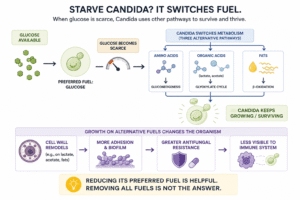
Glucose is the preferred fuel. When it is available, Candida uses it. When it is not, three other metabolic routes come online: gluconeogenesis, the glyoxylate cycle, and beta-oxidation of fatty acids.¹ Between them these allow the organism to run on amino acids, organic acids such as lactate and acetate, ethanol, and fats.
This is not a marginal survival mechanism. Genes for all three pathways are switched on when Candida is engulfed by a macrophage — an environment where the immune cell is deliberately withholding glucose — and the organism survives there anyway.²
The strongest evidence that these pathways matter is what happens when they are removed. Strains engineered without the glyoxylate cycle or without gluconeogenesis are severely less able to cause infection in animal models, and strains unable to perform fatty acid beta-oxidation are moderately less able.¹ Being able to run on something other than glucose is itself a virulence factor.
Which is the first problem with the starvation model. Glucose is scarce in the lower gut regardless of what you eat, and Candida is well adapted to exactly that.
Starved Candida gets harder to kill
This is the part that changes what you do, and it is not widely known outside the mycology literature.
When Candida albicans is grown on lactate rather than glucose, it rebuilds its cell wall. The change is not cosmetic. Lactate-grown cells showed extensive cell wall remodelling that correlated with increased resistance to stress and to antifungal drugs, along with increased adherence and biofilm formation, compared with the same organism grown on glucose.³
The same pattern appears in Candida glabrata. Growth on acetate, lactate, ethanol or oleate produced cell wall remodelling that thinned the inner beta-glucan and chitin layer while thickening the outer mannan layer — and altered both oxidative stress resistance and resistance to an antifungal drug.⁴
Then there is the finding that matters most. Growth on lactate triggers masking of beta-glucan in the cell wall, and beta-glucan is the main structure your immune system uses to recognise fungi. The organism becomes less visible.⁵
Put those together and the practical picture is uncomfortable. Remove Candida‘s preferred fuel entirely and you do not get a weakened organism. You get one that is stickier, more inclined to form biofilm, more resistant to the antifungals you might use next, and harder for your own immune system to detect.
Two honest limits on that. All of this work is in culture, using defined single carbon sources, not in a human gut where many fuels are available at once. And nobody has run the study that would settle it — taking people on strict anti-candida diets and measuring what happens to their fungal populations. What the research establishes is the mechanism. The clinical translation is inference.
The switch between harmless and invasive
Candida changes shape, and the shape determines what it does to you.
As a budding yeast it is a rounded single cell that lives on the mucosal surface. As a hypha it forms branching filaments that adhere to and penetrate epithelial cells, causing tissue damage. Pseudohyphae sit between the two. The transition runs in both directions and is reversible.⁶
The relationship to disease is direct: strains that filament poorly are fitter as harmless residents and less able to cause invasive infection, while filamentation is the trait most closely tied to tissue invasion and escape from immune cells.⁶
What triggers the switch to the invasive form is the relevant part here. The known stimuli include neutral or alkaline pH, body temperature, serum, carbon dioxide, cell density — and carbon starvation and nitrogen starvation.⁷ ⁸ Certain alternative carbon sources are themselves hyphal triggers, including the amino acid proline and N-acetylglucosamine.⁸
So nutrient limitation is on the list of things that push Candida toward its filamentous, tissue-invading form. That is the opposite of what an aggressive restriction is trying to achieve.
The caution I would attach: these triggers are established in laboratory conditions, and the gut is not a laboratory. Filamentation in a living animal does not track in vitro models neatly. But “starve it and it becomes harmless” is not supported by any of this, and something closer to the reverse has better support.
What about spores?
You will hear that strict dieting forces Candida into a dormant spore state where it waits out the restriction. The idea is half right, and the half that is wrong is worth correcting because it circulates widely.
Candida does form chlamydospores — large, thick-walled cells produced at the tips of hyphae. And nutrient conditions do control it: starvation favours their formation, while glucose and peptone suppress it.⁹ So the direction of the claim is correct.
But chlamydospores are not the survival capsules the word “spore” implies. Testing found them no more resistant to heat, starvation or dryness than ordinary yeast cells, and they are rarely observed in infected tissue at all.⁹ In Candida the term describes a shape rather than a function.
So dormancy is the wrong worry. What actually happens under restriction is more mundane and more consequential: the organism switches fuel, rebuilds its cell wall, and becomes harder to kill and harder to see. That is a better argument against extreme restriction than the spore story, and it has the evidence behind it.
Does Candida make you crave sugar?
The craving is real. Almost everyone with a yeast problem describes it, and it is one of the most reliable things people report. What I cannot tell you is that Candida causes it, because that has never been shown.
The idea belongs to a broader hypothesis — that gut microbes manipulate host eating behaviour in ways that serve the microbe at the host’s expense, through vagal signalling, reward pathways and appetite hormones. That was published as a hypothesis paper proposing mechanisms and calling for testing, not as a finding.¹⁰ It remains where it was.
Where the evidence has actually landed is different from the popular version. The clearest work on gut organisms and sugar preference involves a bacterium, Bacteroides vulgatus, and the metabolite it produces increases GLP-1 and reduces sugar preference. That is a microbe suppressing sweet cravings, not driving them.
What I would say instead, because it does not require the unproven step: blood sugar instability produces cravings reliably, and it travels with the gut problems that also allow yeast overgrowth. Fermentation of carbohydrate produces alcohols and aldehydes that affect how you feel and what you reach for. The craving and the overgrowth plausibly share upstream causes without one causing the other.
This matters practically, because if you have been told the cravings are the yeast talking, and then they persist after treatment, you conclude the treatment failed. Often what is actually happening is a blood sugar problem that was never the yeast’s doing.
So does sugar still matter?
Yes, and I want to be unambiguous about this, because “strict diets backfire” gets misread as “diet doesn’t matter.”
Glucose is Candida‘s preferred fuel and it grows fastest on it. A diet high in sugar and refined carbohydrate genuinely supports overgrowth, and reducing it genuinely helps. Nothing above changes that.
What changes is the target. The useful move is removing the things that feed it fastest — added sugar, refined flour, sweetened drinks, alcohol, excessive fruit juice. The unhelpful move is progressive elimination of whole food groups until the diet is meat and green vegetables, because that is where you start selecting for the harder-to-kill version and starving your own microbiome at the same time.
There is a second cost that is easy to miss. The bacteria that keep Candida in check need fermentable carbohydrate and polyphenols to survive. Strip those out and you weaken the population that was containing the yeast, while the yeast switches to a fuel you cannot remove from your diet without starving yourself.
Why bile matters more than what’s on your plate
If diet were the main determinant, everyone eating a Western diet would have a yeast problem and nobody on a whole-food diet would. That isn’t what happens, and bile is a large part of the reason.
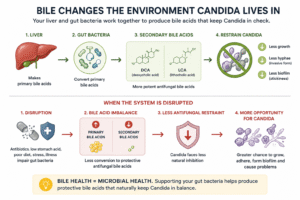
Bile acids are antifungal. This is not a general claim about digestion — it has been measured directly. At the concentrations actually found in the caecum, the secondary bile acids deoxycholic acid and lithocholic acid inhibited Candida albicans growth, and also inhibited germ tube formation, hyphae and biofilm development.¹¹ So bile suppresses both the amount of yeast and its switch into the invasive form.
The detail that makes this useful is which bile acids do it.
Secondary bile acids inhibit Candida. The primary bile acid taurocholic acid promotes it.¹¹ ¹² Your liver makes primary bile acids; gut bacteria convert a portion of them into secondary ones. So the protective form is not the one you produce — it’s the one your microbiome makes for you.
That has a direct consequence. A bile acid profile heavy in primary and short on secondary is the pattern that favours yeast, and it points at the bacterial conversion step rather than at the liver. It’s worth understanding how primary and secondary bile acids differ and what the ratio tells you, because that ratio is a large part of whether Candida can establish.
Antibiotics produce exactly this shift. In treated mice, primary bile acids rose and secondary bile acids fell, alongside increased susceptibility to Candida colonisation — and short-chain fatty acids, which also inhibit Candida growth and hyphal formation, dropped at the same time.¹³ ¹⁴
Which reframes the antibiotic story. The usual explanation is that antibiotics kill the bacteria competing with yeast. That’s part of it. But they also remove the organisms performing the bile acid conversion, so you lose the antifungal metabolite as well as the competition.
The same logic applies without antibiotics. Poor bile flow, thick bile, a removed gallbladder or low bile salt production all mean less bile arriving to be converted in the first place. And because the signs of sluggish bile are often mild and non-digestive, this frequently goes unnoticed in someone being treated repeatedly for yeast.
Two limits worth stating. The bile acid work is in vitro and in mice, not human trials. And nobody has shown that improving bile flow reduces Candida in people. The mechanism is well characterised; the intervention data isn’t there.
The oxalate connection is probably a bile connection
High oxalate and high yeast markers turn up together on organic acid testing often enough that the field treats it as cause and effect — the yeast is assumed to be producing the oxalate.
I’d suggest a simpler explanation. Both are downstream of the same upstream problem.
When fat isn’t digested properly, unabsorbed fatty acids bind the calcium that would otherwise bind dietary oxalate and carry it out in the stool, so more oxalate is absorbed instead. That’s a documented mechanism with a name — enteric hyperoxaluria. At the same time, impaired bile means less substrate for secondary bile acid production, which removes an antifungal restraint on Candida.
One bile problem, two findings. They appear together because they share a cause, not because either produces the other.
This matters for what you do about it. If the yeast is making the oxalate, treating the yeast should fix the oxalate. If both come from a bile and fat digestion problem, then killing yeast without addressing bile leaves the actual driver in place — and the yeast tends to return. The second version is what I see more often, and it explains the pattern of people who clear yeast repeatedly and keep getting it back.
Being fair to the alternative: fungi genuinely do produce oxalic acid, and Aspergillus niger definitively does. What hasn’t been demonstrated is that gut yeast colonisation raises oxalate in a living person. So the shared-cause explanation isn’t proven either — it’s the one that requires fewer unevidenced steps, and it points at something actionable. The full picture is in the article on what a high oxalate load actually does and where it comes from.
A sensible dietary approach
Direction rather than protocol, since what applies depends on what else is going on.
Remove first:
- Added sugar in all its forms, including honey, agave and syrups
- Refined flour and white starches
- Sweetened drinks, fruit juice, energy drinks
- Alcohol, which is both a fermentation product and a fuel
- Dried fruit, which is concentrated sugar in a small volume
Keep:
- Whole vegetables, including starchy ones in ordinary portions
- Whole fruit, in sensible amounts, with the lower-sugar ones favoured
- Legumes and intact whole grains if you tolerate them — these feed the bacteria doing the containing
- Adequate protein and fat, since undereating drives the cravings you are trying to manage
- Polyphenol-rich foods — herbs, olive oil, tea, berries — which have antimicrobial activity without simply being fuel
How to run it:
- Set an end date. Six to twelve weeks is a trial. Two years is a lifestyle you did not choose.
- Change one thing at a time so you can tell what worked.
- Eat enough. Extreme restriction plus undereating is the combination that fails most reliably.
- Investigate fat digestion and bile function. This is the one most often skipped, and it sits upstream of both the yeast and the oxalate.
- Expect the diet to be part of the answer rather than all of it. Bile flow, motility, stomach acid, antibiotic history and immune function all determine whether yeast can establish, and none of them respond to what you remove from your plate.
- If a strict phase has already failed, the answer is unlikely to be a stricter one.
What we don’t know
The metabolic biology is solid. Alternative carbon utilisation is well characterised, the cell wall remodelling and antifungal resistance findings are directly measured, and the morphological switch and its triggers are established.¹ ³ ⁴ ⁵ ⁶
The gaps are real:
- All of the carbon source work is in culture, using single defined fuels. The human gut presents many at once, and the relative concentrations are nothing like a laboratory medium.
- No study has taken people on strict anti-candida diets and measured what happened to their fungal populations or to fungal virulence markers. The mechanism is established; the clinical consequence is inference from it.
- Filamentation in living animals does not follow in vitro models closely, so the starvation-to-hyphae link is weaker in the body than it looks in a dish.
- The craving mechanism attributed to Candida remains a hypothesis rather than a finding.¹⁰
- My clinical observation — that people who go strictest often do worst, and frequently arrive after several rounds of it — is observation, not data.
In summary
Candida is not a sugar-dependent organism. It prefers glucose and it grows fastest on it, but it runs perfectly well on amino acids, organic acids and fats, and the version growing on those alternatives is more adherent, more resistant to antifungals, and less visible to your immune system.
Cutting the things that feed it fastest is sound. Progressive elimination until almost nothing is left removes the fuel your protective bacteria need, while the organism you are targeting simply switches to something else.
Which is why the question worth asking is not how much more to remove, but why the yeast was able to establish in the first place.
Frequently asked questions
Does Candida only feed on sugar?
No. Glucose is preferred, but Candida has dedicated pathways — gluconeogenesis, the glyoxylate cycle and fatty acid beta-oxidation — that let it run on amino acids, organic acids and fats.¹ ² Strains lacking these pathways are substantially less able to cause infection, so the flexibility is a virulence trait rather than a fallback.¹
Can a strict anti-candida diet make things worse?
Possibly, and the mechanism is documented even if the clinical outcome hasn’t been trialled. Candida grown on non-glucose fuels rebuilds its cell wall, becomes more adherent, forms more biofilm, and shows increased resistance to antifungal drugs.³ ⁴ It also masks the beta-glucan your immune system uses to recognise it.⁵
Does Candida go dormant or form spores when you starve it?
It forms chlamydospores, and starvation does favour them while glucose suppresses them.⁹ But they are not resistant survival spores — they are no more resistant to heat, starvation or dryness than ordinary yeast cells, and are rarely seen in infected tissue.⁹ The real concern is not dormancy but the shift to a harder-to-kill, harder-to-see form.
What makes Candida invasive?
The switch from budding yeast to hyphae, which adhere to and penetrate epithelial cells. Triggers include neutral or alkaline pH, body temperature, serum, carbon dioxide, cell density, and both carbon and nitrogen starvation.⁷ ⁸ The transition is reversible in both directions.⁶
Does Candida cause sugar cravings?
Not demonstrably. The idea that gut microbes manipulate appetite to serve themselves was published as a hypothesis, and it has not been established for Candida in humans.¹⁰ The cravings are real, but blood sugar instability and the gut problems that permitted the overgrowth are more likely explanations than the yeast issuing instructions.
So should I still cut sugar?
Yes. Added sugar, refined flour, sweetened drinks and alcohol are worth removing, because glucose is what Candida grows fastest on. The distinction is between removing what feeds it fastest and eliminating food groups until your own protective bacteria have nothing left either.
Do keto and low carb diets help or hurt candida?
Neither straightforwardly. Removing refined carbohydrate genuinely reduces Candida‘s fastest fuel. But a ketogenic diet supplies abundant fat and amino acids, and Candida metabolises both through beta-oxidation and gluconeogenesis.¹ ² It also removes the fermentable carbohydrate your protective bacteria depend on. So the yeast keeps eating while its competition starves, which is not the intended result.
Is die-off real, or am I reacting to the diet itself?
Both are possible and they are hard to tell apart. Feeling worse when starting a restrictive phase is frequently attributed to die-off, but abrupt carbohydrate restriction, undereating, and dropping caffeine or alcohol at the same time all produce overlapping symptoms. If you feel worse for more than a week or two, that is a reason to reassess rather than push through.
How long should an anti-candida diet last?
Treat it as a trial with an end date — six to twelve weeks is usually enough to tell you whether diet is part of your picture. If a strict phase has already failed once, a stricter one is unlikely to be the answer.
Does bile kill candida?
Secondary bile acids inhibit it. At concentrations found in the caecum, deoxycholic and lithocholic acid suppressed Candida albicans growth and also blocked germ tube, hyphal and biofilm formation.¹¹ The primary bile acid taurocholic acid does the opposite and promotes growth and morphogenesis.¹¹ ¹² Since gut bacteria perform the primary-to-secondary conversion, the protective form depends on your microbiome rather than your liver alone.
Why does candida keep coming back after treatment?
Usually because the conditions that allowed it are still in place. Impaired bile flow means less substrate for the secondary bile acids that restrain it, and antibiotics deplete both the competing bacteria and the organisms performing bile acid conversion.¹³ ¹⁴ Treating the yeast without addressing why it could establish tends to buy time rather than resolve it.
Are candida and oxalate problems connected?
They travel together, but probably not because one causes the other. Impaired fat digestion raises oxalate absorption by tying up the calcium that would otherwise bind it, and simultaneously reduces the bile-derived compounds that restrain yeast. One upstream problem, two downstream findings. Fungi do produce oxalic acid, but gut yeast raising oxalate in a person has never been demonstrated.
Why do anti-candida diets fail so often?
Usually because diet was never the whole problem. Whether yeast can establish depends on bile flow, gut motility, stomach acid, antibiotic history and immune function, and none of those change based on what you remove from your plate.
References
- Ramírez MA, Lorenz MC. Mutations in alternative carbon utilization pathways in Candida albicans attenuate virulence and confer pleiotropic phenotypes. Eukaryotic Cell. 2007;6(2):280-90. PMID 17158734. (Animal model and in vitro; glyoxylate cycle, gluconeogenesis and beta-oxidation mutants.)
- Chew SY, Ho KL, Cheah YK, Sandai D, Brown AJP, Than LTL. The glyoxylate cycle and alternative carbon metabolism as metabolic adaptation strategies of Candida glabrata. Journal of Biomedical Science. 2019;26(1):52. PMID 31301737. (Review; macrophage engulfment and carbon starvation response.)
- Ene IV, Heilmann CJ, Sorgo AG, et al. Carbon source-induced reprogramming of the cell wall proteome and secretome modulates the adherence and drug resistance of the fungal pathogen Candida albicans. Proteomics. 2012. (In vitro; lactate-grown vs glucose-grown cells.)
- Chew SY, Ho KL, Cheah YK, et al. Physiologically relevant alternative carbon sources modulate biofilm formation, cell wall architecture, and the stress and antifungal resistance of Candida glabrata. International Journal of Molecular Sciences. 2019;20(13):3172. (In vitro.)
- Ballou ER, Avelar GM, Childers DS, et al. Lactate signalling regulates fungal beta-glucan masking and immune evasion. Nature Microbiology. 2016;2:16238. (In vitro and animal model.)
- Noble SM, Gianetti BA, Witchley JN. Candida albicans cell-type switching and functional plasticity in the mammalian host. Nature Reviews Microbiology. 2017;15(2):96-108. (Review.)
- Environmental stimuli promoting the yeast-to-hyphal switch in Candida albicans: neutral or alkaline pH, carbon starvation, nitrogen starvation, cell density, oxygen concentration and temperature above 35°C. Scientific Reports. 2017;7. (Review of established triggers.)
- Systematic metabolic profiling identifies de novo sphingolipid synthesis as hypha-associated and essential for Candida albicans filamentation. mSystems. 2022. (In vitro; hyphal stimuli include nitrogen starvation, low sugar, and alternative carbon sources such as proline and N-acetylglucosamine.)
- Böttcher B, Palige K, Jacobsen ID, Hube B, Brunke S. Candida species rewired hyphae developmental programs for chlamydospore formation. Frontiers in Microbiology. 2016;7:1697. (In vitro; starvation favours chlamydospores, glucose represses; chlamydospores are not more resistant than yeast cells.)
- Alcock J, Maley CC, Aktipis CA. Is eating behavior manipulated by the gastrointestinal microbiota? Evolutionary pressures and potential mechanisms. BioEssays. 2014;36(10):940-9. (Hypothesis paper; proposes mechanisms, does not demonstrate them.)
- Guinan J, Villa P, Thangamani S. Secondary bile acids inhibit Candida albicans growth and morphogenesis. Pathogens and Disease. 2018;76(3):fty038. PMID 29648597. (In vitro at in vivo caecal concentrations; DCA and LCA inhibit growth, germ tube, hyphae and biofilm.)
- Guinan J, Thangamani S. Antibiotic-induced alterations in taurocholic acid levels promote gastrointestinal colonization of Candida albicans. FEMS Microbiology Letters. 2018;365(18):fny196. (Animal model and in vitro; primary bile acid promotes growth and morphogenesis.)
- Antibiotic-induced gut metabolome and microbiome alterations increase the susceptibility to Candida albicans colonization in the gastrointestinal tract. FEMS Microbiology Ecology. 2020;96(1):fiz187. (Animal model; primary bile acids up, secondary bile acids down after antibiotics.)
- Guinan J, Wang S, Hazbun TR, Yadav H, Thangamani S. Antibiotic-induced decreases in the levels of microbial-derived short-chain fatty acids correlate with increased gastrointestinal colonization of Candida albicans. Scientific Reports. 2019;9:8872. (Animal model and in vitro.)