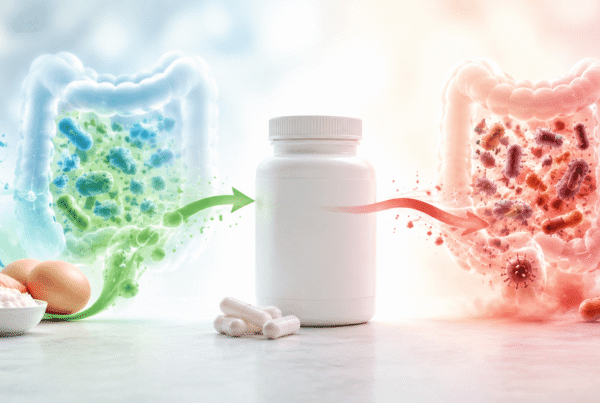
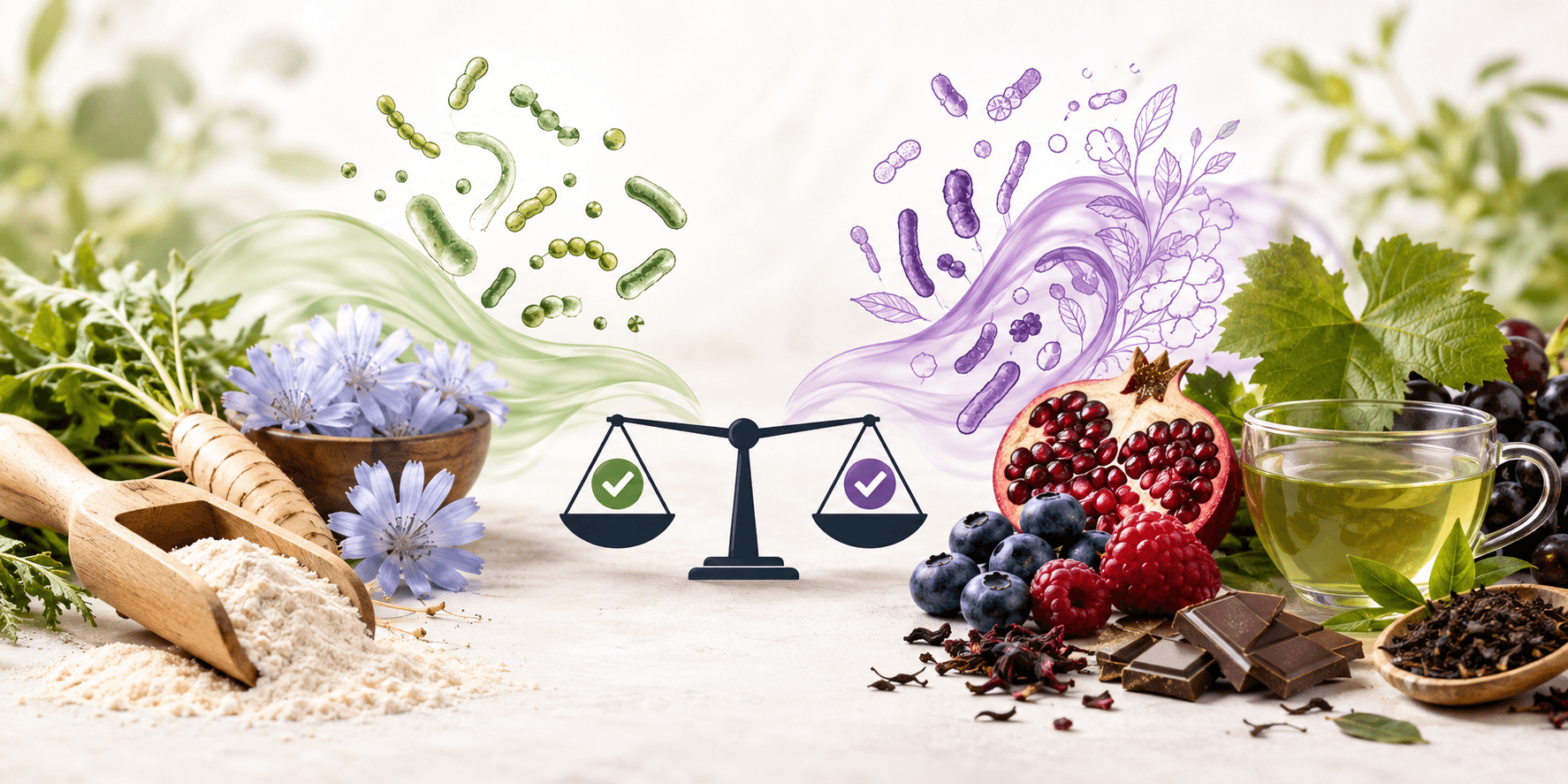
“Feed your good bacteria” is sound general advice — prebiotics like inulin genuinely nourish a healthy gut. But in small intestinal bacterial overgrowth (SIBO), that same advice can backfire. The problem in SIBO isn’t too few good bacteria; it’s too many bacteria in the wrong place — the small intestine, where they shouldn’t be dense. Feeding them there, with highly fermentable prebiotics, can mean more fermentation, more gas and worse symptoms. Polyphenols behave differently and are often better tolerated. But neither is a blanket rule, and the popular “prebiotics are always good for the gut” message is exactly the kind of oversimplification that trips people up.
Why “feed your good bacteria” is usually good advice
Prebiotics — inulin, fructo-oligosaccharides (FOS), galacto-oligosaccharides (GOS), resistant starch — are food components your own body can’t digest, so they travel to the colon where beneficial bacteria ferment them¹. In a healthy large intestine this is genuinely beneficial: it supports a diverse microbiome, feeds the gut lining, and produces short-chain fatty acids with wide-ranging benefits¹ ².
For most people, most of the time, this is why prebiotics are recommended, and the advice is well-founded. The trouble is that it’s given as though it applies to everyone — and there’s one group for whom the logic partly inverts.
Why SIBO changes the picture
The key to understanding this is where the problem is.
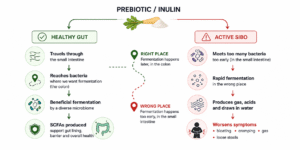
In a healthy gut, the small intestine is only sparsely populated with bacteria, while the dense bacterial community lives further down, in the colon. SIBO is when bacteria overgrow in the small intestine — the wrong place for a large, actively fermenting population³.
This matters because the small intestine is where you absorb nutrients, and it isn’t built to handle heavy fermentation. So the framing of “too few good bacteria, feed them up” doesn’t fit SIBO. The issue isn’t a deficit of good bacteria — it’s an excess of bacteria in a location where their fermentation causes trouble. Feeding that population more fermentable material is, for this specific situation, adding fuel to the problem.
How fermentable prebiotics can backfire in SIBO
Take inulin, the most common prebiotic, as the example.
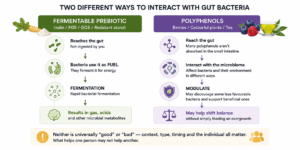
Inulin isn’t digested in the small intestine, so in SIBO it becomes available to the overgrown bacteria there and is intensively fermented — producing gases and acids that can worsen the classic symptoms of bloating, gas and cramping, precisely because the fermentation is happening where it shouldn’t⁴. Inulin also draws water into the intestine osmotically, which can loosen stools⁴. For someone with an already gas-producing overgrowth, adding a highly fermentable prebiotic can noticeably worsen how they feel.
This is why blanket gut-health advice can misfire: the person with SIBO takes the widely recommended prebiotic, feels worse, and can’t understand why the “good for your gut” supplement is causing problems. The supplement isn’t bad. It’s the wrong intervention for their particular situation — a case of context deciding whether something helps or harms.
The honest complication: it’s not “prebiotics are bad for SIBO”
Here’s where I have to be straight, because the tempting version of this article — “prebiotics feed the overgrowth, so avoid them” — is too simple and not fully accurate.
The evidence is genuinely mixed. While highly fermentable prebiotics can worsen symptoms during active SIBO, some studies have found that certain prebiotics, used carefully and often alongside specific probiotics, actually improved SIBO symptoms rather than worsening them⁵. Prebiotics also differ enormously from one another — they vary in chain length and structure, which changes how quickly and by which bacteria they’re fermented² ⁶.
So the accurate, defensible position is narrower than “prebiotics bad”: highly fermentable prebiotics like inulin can worsen symptoms during active overgrowth, which is why the universal “take prebiotics for gut health” advice can backfire for this group — but prebiotics as a category aren’t simply the enemy, and timing, type and the individual all matter. Getting that nuance right is what separates useful guidance from another oversimplification pointing the other way.
Where polyphenols come in
This is where polyphenols — the compounds in colourful plants, berries, tea and so on — become interesting for SIBO, because they behave differently from fermentable fibre.
Rather than being a straightforward fuel that bacteria ferment for energy, polyphenols have antimicrobial and modulating effects on the gut microbiome — they can discourage some less favourable bacteria while supporting beneficial ones⁷. (This connects to the broader story of how polyphenols work through the gut, covered in the article on why polyphenols work despite “poor bioavailability.”) The appeal in a SIBO context is that they may help shift the microbial balance without simply feeding an overgrowth the way a fermentable prebiotic does.
Two honest caveats, though. First, this is a promising and biologically plausible mechanism, not a proven SIBO treatment — the research is still developing, and it shouldn’t be oversold. Second, polyphenols aren’t universally gentle either. Some people can’t clear phenolic compounds fast enough to tolerate them, so “polyphenols instead of prebiotics” is not a guaranteed swap that suits everyone.
The real lesson underneath all this
Step back and the useful principle isn’t about which specific supplement wins. It’s that a “healthy” intervention is only healthy in the right context.
Prebiotics are genuinely good for most guts and can be the wrong choice for an overgrown small intestine. Polyphenols are promising but not universally tolerated. The same input helps one person and harms another, depending on what’s actually going on in their gut — which is why blanket rules (“everyone should take prebiotics”) fail the people who don’t fit the assumption behind them.
And in SIBO specifically, feeding bacteria was never the goal. The goal is getting the bacteria back into the right place and quantity — which usually means addressing why the overgrowth happened (things like impaired motility, low stomach acid or poor bile flow, covered elsewhere), not deciding which thing to feed them.
What this points toward
Not a protocol — SIBO needs proper diagnosis and a practitioner’s guidance, since it has several causes and types. But the framing helps:
- Don’t assume “good for the gut” means good for your gut. If you have overgrowth, the standard prebiotic advice may not apply to you.
- If a “healthy” gut supplement makes you feel worse, that’s information — potentially a sign of overgrowth, worth investigating rather than pushing through.
- Type and timing matter. Highly fermentable prebiotics during active SIBO are the likeliest to cause trouble; the picture can change once the overgrowth is addressed.
- Look for the cause of the overgrowth, since feeding or not feeding bacteria is downstream of why they overgrew in the first place.
The short version
“Feed your good bacteria” is good general advice that can backfire in SIBO, because the problem there is bacteria in the wrong place, not too few of them — so highly fermentable prebiotics like inulin can worsen gas and bloating. Polyphenols behave differently and may help shift the balance, though that’s promising rather than proven, and not everyone tolerates them. The real lesson is that a “healthy” intervention depends entirely on context, and blanket gut-health rules fail the people they don’t fit.
Frequently asked questions
Can prebiotics make SIBO worse?
Highly fermentable prebiotics like inulin can worsen symptoms during active SIBO, because they’re intensively fermented by the overgrown bacteria in the small intestine, producing gas and drawing in water — leading to more bloating and discomfort. This is why standard “take prebiotics for gut health” advice can backfire for people with overgrowth.
So are prebiotics always bad for SIBO?
No — that’s an oversimplification. The evidence is mixed: some prebiotics, used carefully and sometimes with specific probiotics, have improved SIBO symptoms in studies. Prebiotics also differ a lot in how fermentable they are. Type, timing and the individual all matter, so it’s not a simple “avoid all prebiotics” rule.
Why does “feed your good bacteria” not work for SIBO?
Because SIBO isn’t a shortage of good bacteria — it’s an overgrowth of bacteria in the small intestine, where they shouldn’t be dense. Feeding them there with fermentable material adds to the fermentation causing the symptoms. The goal in SIBO is rebalancing location and quantity, not feeding bacteria up.
Are polyphenols better than prebiotics for SIBO?
Polyphenols behave differently — they have antimicrobial and modulating effects rather than simply being fermented for fuel, so they may help shift the balance without feeding an overgrowth. But this is promising rather than proven, and some people react to phenolic compounds, so it isn’t a guaranteed swap that suits everyone.
If a gut supplement makes me feel worse, what does that mean?
It can be useful information. Feeling worse on a “healthy” prebiotic can be a sign of bacterial overgrowth, since you may be feeding fermentation in the wrong place. It’s worth investigating the cause rather than pushing through, ideally with a practitioner.
What actually helps SIBO then?
SIBO needs proper diagnosis and treatment, which has several approaches depending on the type. Crucially, it usually means addressing why the overgrowth happened — such as impaired gut motility, low stomach acid or poor bile flow — rather than focusing only on what to feed or not feed the bacteria.
References
- Prebiotics (inulin, FOS, GOS, resistant starch) are non-digestible components fermented by beneficial bacteria in the colon, supporting microbial diversity, the gut barrier and short-chain fatty acid production. SIBO Academy evidence guide (2026); prebiotic fermentation reviews.
- Prebiotics vary in chain length, structure and degree of polymerisation, which affects how quickly and by which bacteria they are fermented and their short-chain fatty acid output. In Vitro Fermentation of Selected Prebiotics (PMC6213619); commensal carbohydrate-metabolism characterisation (2024).
- In a healthy gut the small intestine is sparsely colonised while dense bacterial populations reside in the colon; SIBO is overgrowth of bacteria in the small intestine. Cleveland Clinic, SIBO; malnutrition/SIBO literature.
- Inulin is not digested in the small intestine, is intensively fermented producing gas and acids, and draws water in osmotically — worsening bloating, gas and loose stools in SIBO. SIBO Academy evidence-oriented guide (2026); casa de sante SIBO guide (2025).
- Evidence is mixed: some studies found prebiotics (e.g. inulin with bifidobacteria; the prebiotic lactulose) improved SIBO symptoms rather than worsening them, supporting selective feeding rather than blanket avoidance. Pascoe herbal healthcare review (2024); Byron Herbalist case discussion.
- Prebiotic chemical structure (linkage type, degree of polymerisation) determines utilisation by the microbiota and therefore effects — prebiotics are not interchangeable. In Vitro Fermentation of Selected Prebiotics (PMC6213619).
- Polyphenols exert antimicrobial and microbiota-modulating effects — discouraging some less favourable bacteria while supporting beneficial ones — behaving differently from fermentable fibre; promising for gut balance but not an established SIBO treatment. Polyphenol–microbiome literature; see companion polyphenol article.