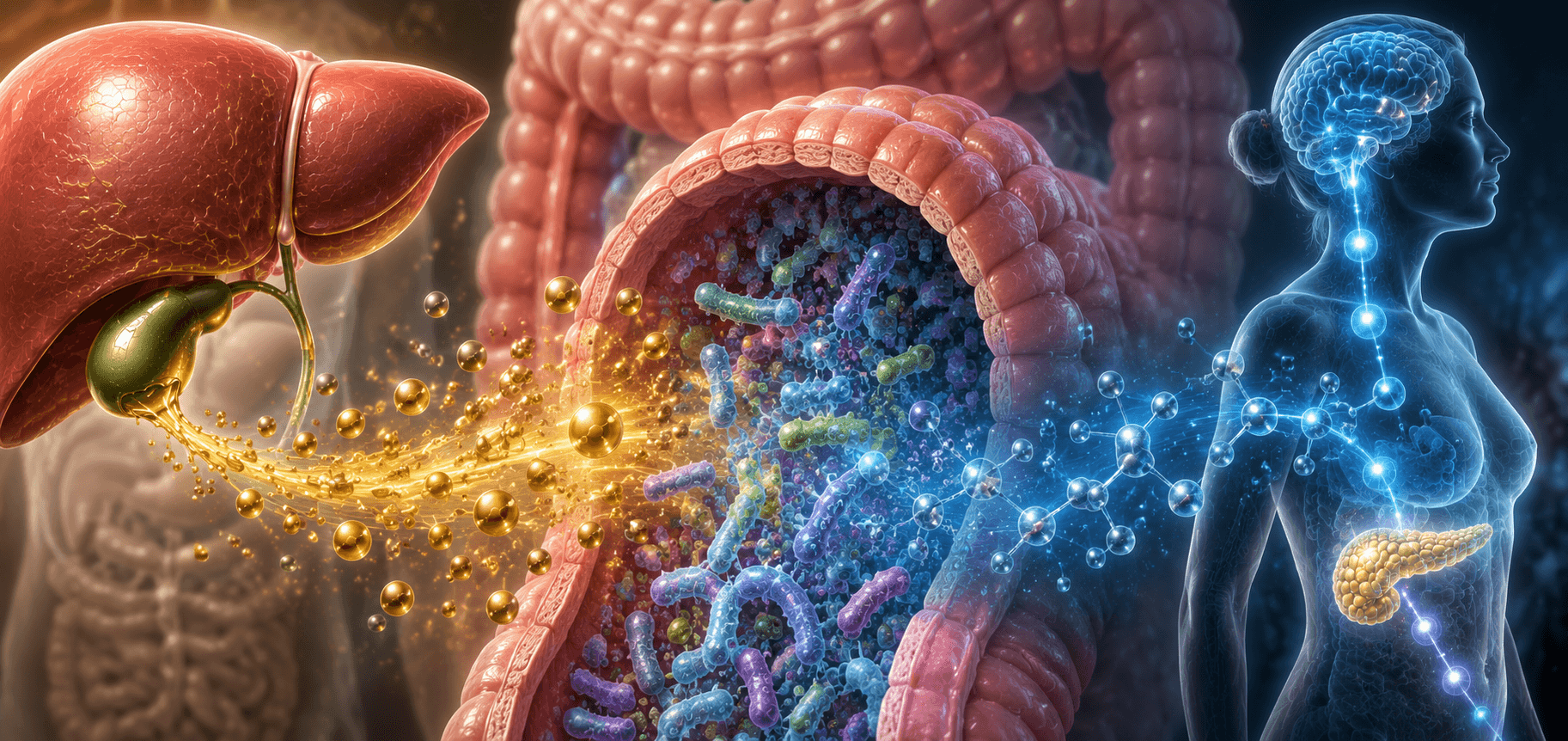
Primary bile acids are the ones your liver makes. Secondary bile acids are what your gut bacteria turn them into after they reach the intestine. The difference matters because the two groups behave differently in the body, and because the balance between them tells you where a problem is coming from. A profile heavy in primary bile acids and short on secondary usually points not at the liver, but at the gut — the bacterial step that converts one into the other isn’t happening as it should.
Where each one comes from
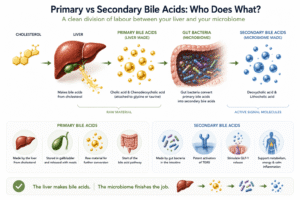
Your liver makes primary bile acids from cholesterol. The two main ones are cholic acid (CA) and chenodeoxycholic acid (CDA). They’re conjugated — attached to either glycine or taurine — stored in the gallbladder, and released into the small intestine when you eat.
Once they’re in the intestine, resident bacteria go to work on them. Through a series of transformations, certain gut bacteria convert the primary bile acids into secondary bile acids — chiefly deoxycholic acid (DCA) and lithocholic acid (LCA). These are chemically distinct molecules.
So there’s a clean division of labour: the liver produces the raw material, and the microbiome does the conversion. Neither can do the other’s job.
Why the conversion changes the molecule’s behaviour
Secondary bile acids aren’t simply used-up primary ones. The conversion changes how strongly they interact with the body’s bile acid receptors.
The secondary bile acids are among the more potent activators of TGR5 — the receptor involved in releasing GLP-1, supporting energy expenditure, and calming inflammation. (Those downstream effects are covered in the companion articles on what bile acids do and bile and weight.)
Which means the conversion step isn’t a housekeeping detail. It’s part of how bile acids do their signalling work. Convert too few, and you’re not just short of a molecule — you’re short of the signal that molecule carries.
What the balance tells you
This is where reading primary and secondary together becomes useful, in a way that a single total never could.
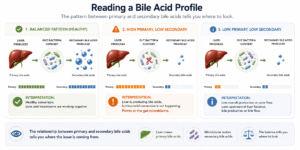
Plenty of primary, little secondary. The liver is producing bile acids, but the bacterial conversion isn’t happening. This points at the gut microbiome — either the converting bacteria are depleted, or something is disrupting the environment they work in. The liver is doing its part.
Low primary overall. A different situation, pointing further upstream at production or flow rather than conversion.
A shift in which secondary bile acids dominate. Not all secondary bile acids are benign. Some bacteria push bile acids down an oxidised route, producing forms that are inflammatory rather than helpful. So the question isn’t only how much secondary bile acid is present, but which kinds.
The single number — total bile acids — hides all of this. The pattern is where the information is.
Why this is really a microbiome story
The practical consequence of all this is that your bile acid profile is, to a large degree, a readout of your gut bacteria.
Different bacterial groups do different things to bile acids. Some perform the helpful conversion to the beneficial secondary forms. Others generate the inflammatory oxidised versions. So the mix of bile acids you end up with reflects the mix of organisms you’re carrying.
This is why bile acid imbalances usually aren’t corrected by acting on bile directly. If the conversion step is the problem, the target is the bacteria doing the converting — change the microbial picture and the bile acid profile tends to follow.
It also explains a loop that keeps these problems in place. Bile acids influence which bacteria can thrive, and bacteria determine which bile acids you produce. A disturbance in either can become self-reinforcing, which is part of why sluggish bile and gut imbalances so often appear together and persist together.
A note on the evidence
The biochemistry here is well established: the primary-to-secondary conversion by gut bacteria is standard, long-understood physiology, and the receptor activity of these bile acids is well characterised.
What’s less settled is the clinical fine detail — exactly which patterns predict which outcomes, and how much you can move a person’s health by shifting their bile acid profile. That’s an active research area. As with any single test, it belongs alongside symptoms and other findings, not on its own.
The short version
Primary bile acids come from your liver; secondary bile acids come from your gut bacteria acting on them. The ratio between them is one of the more informative things on a bile acid panel, because it separates a liver question from a microbiome question — and most of the time, it points at the microbiome.
Frequently asked questions
What is the difference between primary and secondary bile acids?
Primary bile acids (cholic acid, chenodeoxycholic acid) are made by the liver from cholesterol. Secondary bile acids (deoxycholic acid, lithocholic acid) are produced when gut bacteria convert the primary ones in the intestine. They’re chemically distinct and behave differently in the body.
What does a high primary, low secondary bile acid pattern mean?
It usually means the liver is producing bile acids but the bacterial conversion step isn’t happening — which points at the gut microbiome rather than the liver. The converting bacteria may be depleted or disrupted.
Are secondary bile acids good or bad?
Both, depending on which ones. Some are potent activators of beneficial signalling. Others, produced down an oxidised route by different bacteria, are inflammatory. This is why the specific pattern matters more than the total.
What produces secondary bile acids?
Specific groups of gut bacteria. Which secondary bile acids you end up with depends on which organisms are present, so the profile is largely a reflection of your microbiome.
How do you improve a bile acid imbalance?
Usually by addressing the gut microbiome rather than targeting bile directly, since bacteria drive the conversion. What’s appropriate depends on what’s disrupting it, which is why testing is more useful than guessing.
References
- Chiang, J. Y. L. & Ferrell, J. M. (2020). Bile acid receptors FXR and TGR5 signaling in fatty liver diseases and therapy. American Journal of Physiology — Gastrointestinal and Liver Physiology, 318(3), G554–G573.
- Recent advances in understanding bile acid homeostasis — gut-to-liver axis and the microbial transformation of primary to secondary bile acids. PMC5698910
- Gut microbiota metabolism of bile acids and its contribution to metabolic outcomes. Metabolites (2021), 11(11), 733.