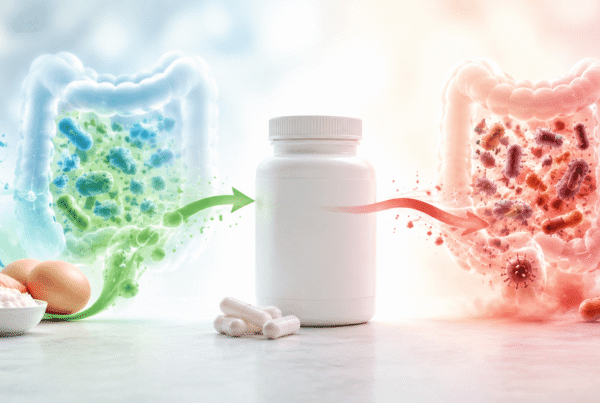
If weight is far harder to shift than your diet and activity would predict, one under-recognised reason is bile acid signalling. Bile acids trigger the release of GLP-1 — the same satiety and blood-sugar hormone that the well-known weight-loss injections are built to mimic. When your bile acid mix is imbalanced, often because of the gut bacteria that shape it, that natural GLP-1 signal is weaker than it should be. So this isn’t about willpower or calories in the simple sense. It’s a signalling problem, and signalling problems have causes that can be looked into.
The hormone everyone’s suddenly heard of
GLP-1 has become a household term because of the weight-loss medications built around it. Those drugs work by imitating a hormone your gut already makes. GLP-1 slows stomach emptying, improves how your body handles glucose, and tells your brain you’ve had enough to eat.
The part that gets lost in the noise about the drugs: you produce GLP-1 yourself, every time you eat, and how well you produce it varies from person to person. Some of that variation comes down to bile.
How bile acids switch on GLP-1
Bile acids aren’t only fat digesters. They’re signalling molecules that bind to receptors around the body, and one of those receptors — TGR5 — sits on specialised hormone-producing cells in the lining of your intestine.
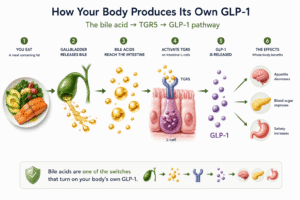
When bile acids activate TGR5 on those cells, the cells release GLP-1¹. That’s a direct, established link: bile acids arriving in the right part of the intestine are one of the triggers that tell your gut to produce its own satiety hormone.
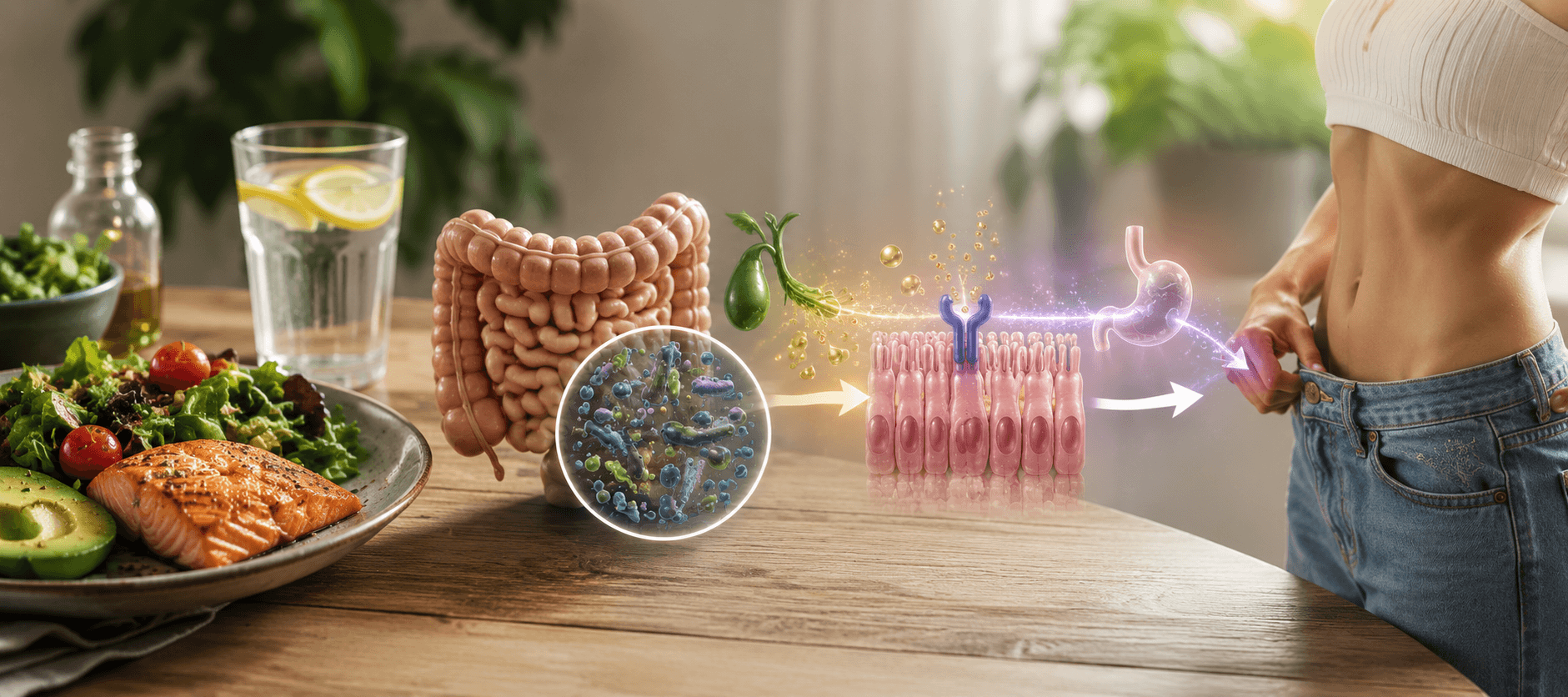
So the sequence is: you eat, bile is released, bile acids reach the lower intestine, they activate TGR5, and GLP-1 goes up. Appetite settles, blood sugar is handled better, and you feel satisfied.
If any step in that chain is weak, the whole signal is weak.
Where the imbalance comes in
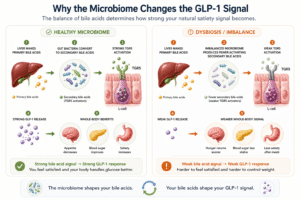
Not all bile acids activate TGR5 equally. The secondary bile acids — the ones your gut bacteria produce by converting the primary bile acids your liver makes — are among the stronger activators.
Which means the strength of your GLP-1 signal depends partly on your microbiome. If the bacteria that produce those activating secondary bile acids are depleted, or the balance has shifted toward less favourable forms, you generate a less effective signal from the same meal.
This is why the problem is better described as a bile acid imbalance than simply “low bile.” It’s often not about quantity. It’s about which bile acids you have, and that’s a joint product of your liver and your gut bacteria.
The evidence that actually matters in people
This is where it moves beyond theory, and it comes from an unexpected source: weight-loss surgery.
Bariatric surgery produces metabolic improvements that are difficult to explain by reduced eating alone — blood sugar often improves within days, before meaningful weight is lost². Researchers looking for why found bile acids.
After these operations, circulating bile acid levels rise and GLP-1 secretion increases³. In humans, the surgery shifts the bile acid profile toward forms that activate TGR5, and one such bile acid tracked with diabetes going into remission³.
The most telling evidence is from animal work that isolated the mechanism. Redirecting bile to the lower intestine reproduced the metabolic benefits of bypass surgery — and those benefits disappeared when the GLP-1 pathway was blocked⁴. In other words, the bile-to-GLP-1 link wasn’t incidental to the improvement. It was necessary for it.
And in humans directly: delivering bile acids to the lower intestine raised gut satiety hormones and increased satiety⁵.
So the chain — bile acids, TGR5, GLP-1, appetite and glucose control — isn’t a hopeful extrapolation from a petri dish. Parts of it are demonstrated in people.
Limits
Two things need saying.
First, this is one contributor among several. Weight regulation involves thyroid function, insulin, sleep, stress, muscle mass, medications and more. Bile acid signalling is an important piece, not the whole picture.
Second, the clearest human evidence comes from surgical and infusion studies — deliberate, dramatic interventions. Whether improving someone’s bile acid profile through addressing their microbiome produces a comparable effect is biologically reasonable but not proven to the same standard. Treat it as a well-supported mechanism worth investigating in an individual.
Why “eat less, move more” can stall here
The useful thing about understanding the mechanism is what it explains.
If your GLP-1 response to food is blunted, you feel less satisfied after eating, your blood sugar is handled less smoothly, and hunger returns sooner. Eating less becomes a fight against a weakened satiety signal rather than a straightforward choice. The same plate of food does less for you than it does for someone with an intact signal.
That’s not a failure of discipline. It’s a physiological headwind — and it’s one with an identifiable, addressable cause.
What this suggests doing
Not a protocol — every situation is different, and this is one factor among many — but the logic points somewhere specific.
- Look at the microbiome, not just the bile. Since gut bacteria shape which bile acids you produce, the bile acid profile usually improves by correcting the bacterial picture rather than by targeting bile directly.
- Find out what your bile acids are actually doing. Some comprehensive stool tests report primary versus secondary bile acids, which shows whether the microbial conversion step — the one that makes the TGR5-activating forms — is happening.
- Treat stalled weight as information. Weight that won’t move despite genuine effort is a signal that something mechanistic is in the way. Bile acid signalling is one of the things worth ruling in or out.
The short version
Your gut makes its own version of the hormone some weight-loss drugs imitate, and bile acids are one of the switches that turn it on. When your bile acid balance is off — usually because of the bacteria that shape it — that switch works less well.
It reframes stubborn weight from a question of effort to a question of signalling. And signalling can be examined, which effort alone cannot.
Frequently asked questions
Can bile problems make it hard to lose weight?
There’s a well-supported mechanism. Bile acids trigger the release of GLP-1, the satiety and blood-sugar hormone that weight-loss medications mimic. An imbalanced bile acid profile produces a weaker GLP-1 signal, which can make weight harder to shift. It’s one contributor among several, not the whole story.
Do bile acids affect GLP-1?
Yes. Bile acids activate a receptor called TGR5 on hormone-producing cells in the intestine, and that activation stimulates GLP-1 secretion. This is established biochemistry.
Is this the same as the weight-loss injections?
The drugs mimic GLP-1 from outside. Bile acids are one of the ways your body produces GLP-1 itself. Same hormone, different source — one pharmaceutical, one physiological.
How do gut bacteria come into it?
Gut bacteria convert the primary bile acids your liver makes into secondary bile acids, and those secondary forms are among the stronger activators of the GLP-1 pathway. So your microbiome partly determines the strength of your own GLP-1 signal.
How would I know if this applies to me?
Some comprehensive stool tests report the balance of primary and secondary bile acids, which indicates whether the relevant conversion is happening. Stubborn weight alongside digestive symptoms or a history of gut problems raises the likelihood, but testing is what tells you.
Can I fix it?
Often by improving the gut microbiome rather than targeting bile directly, since the bacteria shape the bile acid profile. What’s appropriate depends on what’s driving the imbalance, which is why it’s worth investigating rather than guessing.
References
- Chiang, J. Y. L. & Ferrell, J. M. (2020). Bile acid receptors FXR and TGR5 signaling in fatty liver diseases and therapy. American Journal of Physiology — Gastrointestinal and Liver Physiology, 318(3), G554–G573.
- Bile acids mediate metabolic benefits of weight-loss surgery — metabolic improvements occur before significant weight loss. Vanderbilt University Medical Center / Gastroenterology (2019).
- Alterations in bile acid kinetics after bariatric surgery in patients with obesity with or without type 2 diabetes (2024). PMC11345581 — surgery shifts human bile acid profiles toward FXR/TGR5 activation; a 6α-hydroxylated bile acid covaried with diabetes remission.
- Role of bile acids and GLP-1 in mediating the metabolic improvements of bariatric surgery. Gastroenterology (2019). PMID: 30445014 — bile diversion improves glucose homeostasis via an intestinal FXR-GLP-1 axis; benefits lost in GLP-1-receptor-deficient mice.
- Effect of bile acids on satiety, cell function and body weight — human studies where bile acid delivery to the distal intestine raised GI satiety hormones and increased satiety.