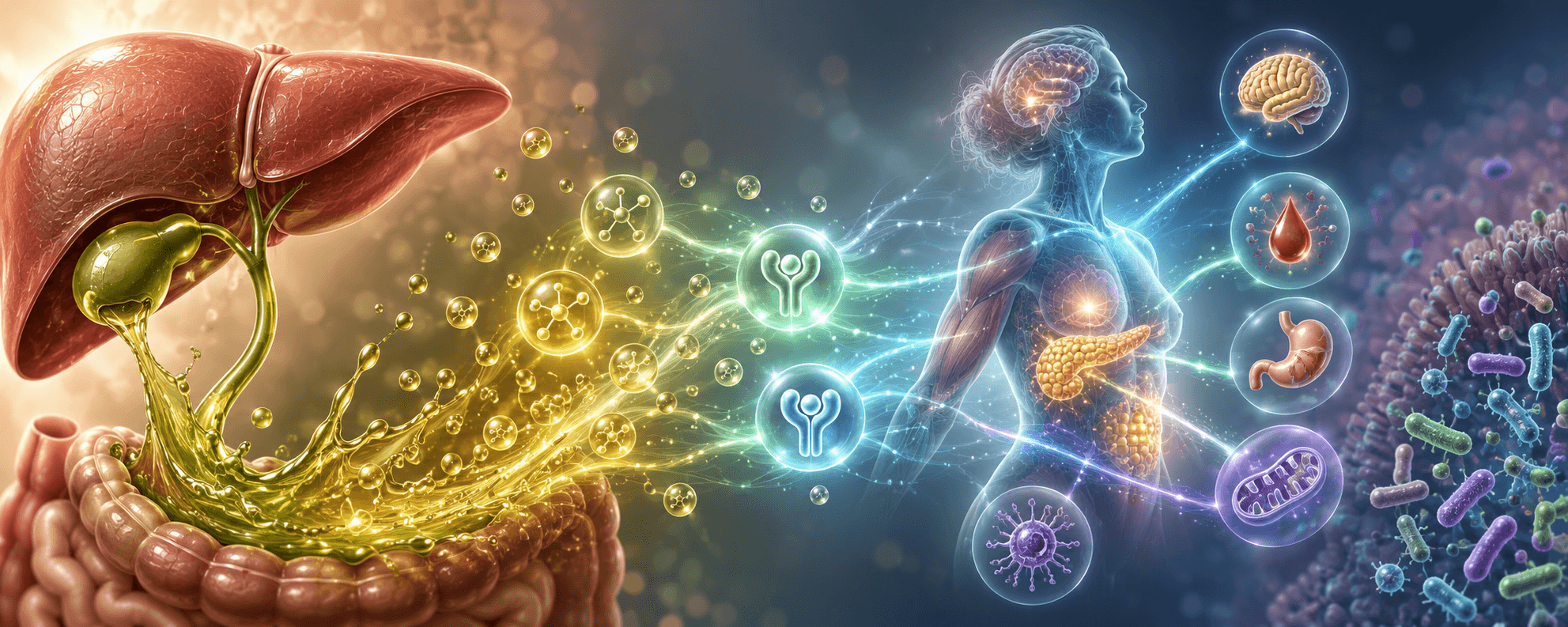
Bile acids digest fat, and that’s the part most know. What’s become clear over the past two decades is that they do a lot more than just that. They also work as signalling molecules when they bind to receptors in the gut, liver and elsewhere. That binding influences blood sugar regulation, appetite, energy expenditure, inflammation and which bacteria can live in your intestine. Which means a bile problem can show up as fatigue, stubborn weight, blood sugar instability or poor detoxification — symptoms that don’t look like a digestive complaint at all.
Where bile acids come from
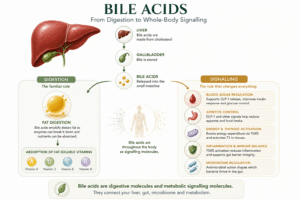
Bile acids are made in the liver from cholesterol. In fact, converting cholesterol into bile acids is the body’s main route for getting rid of it — which means bile production and cholesterol handling are the same process viewed from different ends.
Once made, bile acids are conjugated — joined to either taurine or glycine — and secreted into bile, which is stored in the gallbladder. When you eat something containing fat, the gallbladder contracts and releases bile into the small intestine.
Most of it is then reabsorbed further down and returned to the liver to be used again. That recycling loop runs several times a day.
The familiar job: digesting fat
Bile acids are detergents. They break dietary fat into droplets small enough for enzymes to work on and for the intestinal wall to absorb.
That includes the fat-soluble vitamins — A, D, E and K. So poor bile function can produce signs of deficiency in those vitamins even when dietary intake is perfectly adequate. Someone can eat well, supplement, and still not absorb what they’re taking.
This is the mechanism behind the most recognisable bile symptoms: discomfort after fatty meals, pale or greasy stools, nausea with rich food. There is a second consequence that is easier to miss. Unabsorbed fat in the intestine binds calcium, forming insoluble soaps. Calcium is also what binds dietary oxalate and carries it out in the stool — so when calcium is tied up in soaps, more oxalate is absorbed instead. Poor fat digestion raises oxalate load without any change in what you are eating, which is one route to the fatigue and mineral loss that comes with high oxalate.
Primary and secondary bile acids: where the microbiome comes in
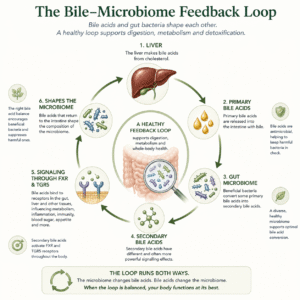
The liver makes primary bile acids. Once they reach the intestine, resident bacteria convert a portion of them into secondary bile acids — chemically different molecules with different effects.
This step matters more than it sounds. It means the composition of your bile isn’t determined by your liver alone. It’s a joint product of your liver and your gut bacteria, and if the bacterial population shifts, the bile acid mixture shifts with it.
Specific bacterial groups do that conversion. Others push bile acids down a different route, producing oxidised forms that are inflammatory rather than useful. So the same raw material becomes either helpful or harmful depending on which organisms are present.
A pattern of plenty of primary bile acids and very little secondary tells you the liver is doing its part and the microbial step isn’t happening — which points at the gut, not the liver.
The part that changed the picture: bile acids are signalling molecules
For most of the twentieth century bile acids were regarded as detergents and little else. That changed with the discovery that they’re natural ligands for two receptors: a nuclear receptor called FXR, and a membrane receptor called TGR5¹.
Those receptors aren’t confined to the digestive system. FXR is found in the liver and intestine; TGR5 appears in intestinal hormone-secreting cells, adipose tissue, muscle and immune cells².
That distribution is the whole point. It means bile acids aren’t just acting on the food in front of them — they’re reporting on the fed state to tissues throughout the body, and those tissues respond. Bile acids are now described as metabolic integrators: molecules that coordinate glucose, lipid and energy metabolism rather than simply assisting digestion³.
What that signalling controls
Blood sugar and appetite — your own GLP-1
When bile acids activate TGR5 on hormone-secreting cells in the intestinal lining, those cells release GLP-1² ⁴.
GLP-1 is the hormone many weight-loss and diabetes medications are built to mimic. It stimulates insulin release, improves glucose tolerance and suppresses appetite.
So bile acid signalling is part of how you produce your own GLP-1 in response to eating. If that signalling is impaired — because the bile acid mixture is wrong, or the microbial conversion step isn’t happening — that response is weaker than it should be.
Which is a mechanism for why some people find weight much harder to shift than their diet would predict, and why blood sugar can be unstable without any obvious dietary explanation.
Energy expenditure — and a direct link to thyroid
This one connects bile to a system most people would never associate with it.
In a landmark study, bile acids were shown to increase energy expenditure in brown fat and skeletal muscle. The mechanism runs through TGR5, and it works by switching on type 2 deiodinase — the enzyme that converts T4 into active T3 inside the cell⁵.
In other words, bile acid signalling contributes to local thyroid hormone activation in the tissues that burn the most energy. Animals lacking that enzyme lost the effect entirely⁵.
Worth being clear about the evidence: this work was done in mice and in human cells, not in a human clinical trial. But it establishes a real biochemical link between bile and thyroid function — and it’s one explanation for the overlap between sluggish bile, low energy and difficulty with weight.
Inflammation and immune signalling
TGR5 activation is anti-inflammatory. It suppresses inflammatory cytokine production, reduces immune cell activation, and supports the integrity of the intestinal barrier² ⁶.
So poor bile acid signalling doesn’t just impair digestion — it removes a brake on inflammation in the gut wall.
Regulating its own production, and the bacteria around it
FXR activation feeds back to the liver to slow bile acid synthesis when enough is present, and controls the transporters that move bile acids around¹. It’s a self-regulating loop.
Bile acids are also antimicrobial. Their presence in the small intestine helps limit bacterial overgrowth. Reduced bile flow means one of the gut’s own controls on overgrowth is weakened — which is part of why sluggish bile and bacterial overgrowth so often occur together.
The loop that runs both ways
Here’s what makes bile problems persistent.
Gut bacteria determine which bile acids you end up with. Bile acids determine which bacteria can thrive. Each shapes the other.
So a disturbance in either can become self-sustaining. Dysbiosis alters the bile acid pool; the altered pool no longer restrains the organisms causing the dysbiosis; dysbiosis persists.
It also explains why correcting bile problems usually means working on the microbiome rather than on bile directly. Fix which bacteria are present, and the bile acid profile tends to follow.
What it looks like when this isn’t working
Some of these are recognisably digestive. Most aren’t.
- Discomfort after fatty meals, nausea with rich food, pale or greasy stools
- Loose stools — bile acids are alkaline and irritating to the gut lining, and excess reaching the colon draws in water
- Signs of low fat-soluble vitamin status despite adequate intake
- Weight that won’t shift in proportion to diet and activity
- Blood sugar instability, energy dips after meals
- Recurrent bacterial overgrowth
- Difficulty clearing hormones and other compounds through the liver
The unifying feature is that most of these don’t announce themselves as bile problems, which is why the connection is so often missed.
Can bile acids be measured?
Yes. Some comprehensive stool tests report bile acids in detail — primary versus secondary, individual named acids, and whether they’re taurine- or glycine-conjugated.
That detail is what makes them interpretable. A high total tells you little. A pattern of high primary with low secondary points at the microbial conversion step. A shift toward one conjugation route tells you something about how the liver is handling the process. And oxidised forms appearing where they shouldn’t points at a particular kind of microbial imbalance.
As with most functional testing, the information is in the relationship between the numbers rather than in any one of them.
A note on the evidence
The core science here is solid: bile acids are established ligands for FXR and TGR5, and those receptors are distributed as described¹ ².
The downstream metabolic effects — GLP-1 release, energy expenditure, thyroid hormone activation, anti-inflammatory action — come largely from animal and cell studies. Human clinical data is much thinner, and there are meaningful differences between species in bile acid biology⁶. Drug development targeting these receptors is active but has not been straightforward.
So this is a well-described mechanism with strong preclinical support, not a proven clinical intervention.
The short version
Bile acids do far more than break down fat. They’re a communication system between the gut, the liver, the microbiome and the rest of the body’s metabolism.
Which reframes what a bile problem is. Not simply poor fat digestion, but a disrupted signal — and disrupted signals show up wherever the signal was supposed to arrive, rather than where it started.
Frequently asked questions
What do bile acids do?
They emulsify dietary fat so it can be digested and absorbed, including fat-soluble vitamins A, D, E and K. They also act as signalling molecules, binding to receptors that influence blood sugar regulation, appetite, energy expenditure, inflammation and gut bacterial balance.
What is the difference between primary and secondary bile acids?
The liver makes primary bile acids. Gut bacteria convert some of them into secondary bile acids in the intestine. A pattern of high primary and low secondary suggests the microbial conversion step isn’t happening, which points at the gut rather than the liver.
Can bile problems affect weight?
There’s a plausible mechanism. Bile acids stimulate GLP-1 release — the same hormone that weight-loss medications mimic — and contribute to energy expenditure in fat and muscle tissue. Impaired bile acid signalling would weaken both. Most of this evidence is preclinical.
Is there a connection between bile and thyroid?
Yes, at least mechanistically. Bile acids activate the enzyme that converts T4 into active T3 inside cells, particularly in brown fat and skeletal muscle. This was demonstrated in mice and human cells.
Can poor bile flow cause bacterial overgrowth?
Bile acids are antimicrobial and help limit bacterial growth in the small intestine. Reduced bile flow weakens that control, which is one reason sluggish bile and overgrowth often occur together.
Why do bile problems cause loose stools?
Bile acids are alkaline and irritating to the gut lining, and excess bile acid reaching the colon draws water into it. The result is sometimes called bile acid diarrhoea.
How do you fix a bile acid problem?
Often by addressing the gut microbiome rather than the bile directly, since gut bacteria determine much of the bile acid profile. What’s appropriate depends on what’s actually driving it, which is why testing is more useful than guessing.
References
- Chiang, J. Y. L. & Ferrell, J. M. (2020). Bile acid receptors FXR and TGR5 signaling in fatty liver diseases and therapy. American Journal of Physiology — Gastrointestinal and Liver Physiology, 318(3), G554–G573. doi:10.1152/ajpgi.00223.2019
- The critical role of the bile acid receptor TGR5 in energy homeostasis: insights into physiology and therapeutic potential. International Journal of Molecular Sciences (2025), 26(14), 6547.
- Recent advances in understanding bile acid homeostasis. PMC5698910
- Role of bile acids in the regulation of food intake, and their dysregulation in metabolic disease. PMC8066182
- Watanabe, M. et al. (2006). Bile acids induce energy expenditure by promoting intracellular thyroid hormone activation. Nature, 439(7075), 484–489. doi:10.1038/nature04330
- Clinical relevance of the bile acid receptor TGR5 in metabolism — review noting scarce clinical studies and significant interspecies differences. The Lancet Diabetes & Endocrinology (2016).