
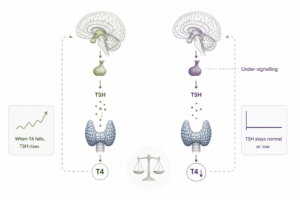
A low or low-normal T4 alongside a normal TSH is an unusual combination, because the two normally move in opposite directions. When T4 falls, TSH should rise to compensate. If it hasn’t, the signalling above the thyroid may be the problem rather than the thyroid gland itself — and because most thyroid screening starts and stops with TSH, this pattern is one of the more commonly missed findings in thyroid testing.
How thyroid testing usually works
The pituitary monitors circulating thyroid hormone and releases TSH to tell the thyroid how hard to work. The relationship is inverse: when thyroid hormone is low, TSH rises; when it’s high, TSH falls¹.
That inverse relationship is why TSH alone is used as a first-line screen, and for the most common form of thyroid disease — primary hypothyroidism, where the thyroid gland itself is underactive — it’s a good test. A single TSH measurement is an appropriate screening method for that². It’s worth being clear about this, because a lot of writing on this topic implies TSH testing is useless. It isn’t.
The limitation is specific: TSH-first screening assumes a healthy hypothalamus and pituitary. When the problem sits there instead, the assumption fails².
What low T4 with normal TSH points to
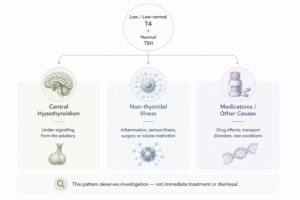
Central hypothyroidism. This is the textbook explanation for the pattern: the thyroid gland is capable, but the pituitary isn’t sending enough TSH to drive it. Because the pituitary is the part that’s underperforming, TSH can be low, normal, or even slightly raised — it just isn’t rising the way it should³. Measuring only TSH misses it entirely².
Two things are worth mentioning here. Central hypothyroidism is genuinely rare in the general population — estimates run around 1 in 20,000 to 1 in 80,000⁴. But it’s much more common in people with any pituitary involvement, and it rarely appears in isolation from other pituitary signs⁵. So it’s not something to assume, and it is something to look for when there’s reason to.
It’s also demonstrably missable. In one published case, a woman spent twenty years accumulating diagnoses and specialist referrals — rheumatology, renal, respiratory, a neurology workup for suspected myositis — while repeatedly normal TSH results reassured clinicians that her thyroid wasn’t the issue⁶.
Non-thyroidal illness. Serious illness, inflammation, surgery and prolonged calorie restriction all suppress the thyroid axis, producing low thyroid hormone with a TSH that stays unhelpfully normal⁷. This is a physiological adaptation rather than thyroid disease, and it resolves when the underlying problem does.
Medications and other causes. Several drugs affect thyroid hormone levels or binding, and there are rarer transport and receptor defects that produce this pattern².
What about T4 that’s low-normal rather than low?
This is where interpretation gets harder.
A T4 sitting at the very bottom of the range with a normal TSH is not diagnostic of anything by itself. Reference ranges are population-derived, and plenty of well people sit at the low end. Making a diagnosis on that basis alone isn’t supportable.
What it does justify is looking further, particularly if there are symptoms consistent with low thyroid function or any reason to suspect pituitary involvement. Published guidance on this pattern is that a low free T4 with normal TSH warrants a structured workup rather than either dismissal or immediate treatment⁸.
Why doesn’t the T3 tell you?
Most active thyroid hormone isn’t made by the thyroid. T4 is the prohormone, and it’s converted to T3 in peripheral tissue — mainly liver and kidney — by deiodinase enzymes¹.
That conversion step depends on nutritional status. The deiodinases are selenium-containing enzymes, and selenium and zinc status correlate with the T3-to-T4 ratio⁹. Iron status also affects thyroid hormone production and conversion.
So poor conversion is a real phenomenon with a real mechanism. What it isn’t, on current evidence, is something you can diagnose from a single ratio on a blood test.
The reverse T3 question
Reverse T3 is an inactive form produced when T4 is converted down the alternative pathway. It’s widely tested in functional and integrative medicine, often using an rT3-to-T3 ratio as evidence of impaired conversion.
Where that sits in mainstream medicine: reverse T3 testing is not recommended in the clinical practice guidelines of the American Thyroid Association or the American Association of Clinical Endocrinologists, and “reverse T3 dominance” is not a recognised diagnosis in mainstream endocrinology¹⁰. The ATA’s position is that in healthy, non-hospitalised people, measuring reverse T3 doesn’t help establish whether hypothyroidism is present¹. A review of reverse T3 ordering practice concluded the diagnostic utility is questionable and the ratio-based approach isn’t supported by peer-reviewed evidence¹⁰.
What raised reverse T3 is probably telling you
Here’s the part that usually gets skipped, and it reframes the whole question.
Converting T4 into reverse T3 rather than T3 isn’t a malfunction. It’s something the body does deliberately, and it does it under recognisable circumstances: illness, inflammation, surgery, starvation and prolonged stress all shift conversion down that pathway¹¹.
The reason is energy. T3 is the signal that drives oxidative metabolism — it increases mitochondrial activity and oxygen consumption. But producing energy always produces free radicals as a by-product, because that’s an unavoidable feature of how the electron transport chain works. Run the system harder and you generate more of them. If antioxidant capacity is already stretched, or free radical production is already high, then turning down T3 signalling reduces the oxidative burden the cell has to cope with.
Seen that way, a raised reverse T3 with low T3 is the body applying a brake. It’s slowing energy production because running at full rate is currently costing more than it’s worth.
This isn’t a fringe interpretation. It’s the standard explanation in endocrinology for why the low T3 state of illness generally shouldn’t be treated with thyroid hormone — the change is understood as an adaptive response to conserve energy, and correcting it hasn’t been shown to improve outcomes¹². The debate in the literature is about whether it stays adaptive when illness becomes prolonged, or turns into something that worsens the situation¹³.
Which brings it back to how to read the marker. Not every abnormal result is a problem to be corrected. Some of them are the body doing exactly what it should, given the conditions it’s working under. A raised reverse T3 is worth taking seriously — not as something to push back down, but as a question about what the body is responding to. Find that, and the pattern usually resolves on its own.
Why this gets missed
Three things stack up:
TSH-first protocols. Many laboratories run TSH alone and only add T4 if TSH is abnormal. If TSH is normal, T4 is never measured, so the pattern can’t be seen. Some laboratories have changed their guidance to tell clinicians that a normal TSH excludes primary but not secondary hypothyroidism⁶.
Symptoms are non-specific. Fatigue, cold intolerance, weight change, low mood and cognitive slowing get attributed to many things. Without a test result pointing at the thyroid, it usually isn’t revisited.
“Normal” is doing a lot of work. A result inside a population reference range isn’t necessarily right for the individual, and the relationship between markers can be abnormal even when each number is not.
What’s worth asking for
If you have persistent symptoms and have been told your thyroid is fine on the basis of a TSH:
- Free T4 and free T3 measured alongside TSH, not TSH alone
- Thyroid antibodies, if autoimmune thyroid disease hasn’t been excluded
- Iron studies, selenium and zinc status, since these affect conversion
- Inflammatory markers, since inflammation suppresses the axis independently
- Assessment of other pituitary hormones, if there’s reason to suspect central causes — central hypothyroidism rarely occurs alone⁵
If a low free T4 with normal TSH is found, that’s a reason for proper endocrine assessment rather than something to manage with supplements.
Frequently asked questions
Can you have hypothyroidism with a normal TSH? Yes, though it’s uncommon. Central hypothyroidism — where the pituitary doesn’t produce enough TSH — presents with low free T4 and a TSH that is low, normal, or only slightly raised. TSH-only screening misses it.
Why is TSH tested first? Because it’s a good screening test for primary hypothyroidism, which is by far the most common form. The limitation is that it assumes the pituitary and hypothalamus are working normally.
What causes low T4 with normal TSH? Central hypothyroidism, non-thyroidal illness from serious illness or inflammation, certain medications, and rarer transport or receptor defects. Low-normal T4 with normal TSH can also occur in healthy people.
Is reverse T3 worth testing? Professional guidelines don’t recommend routine reverse T3 testing, and “reverse T3 dominance” isn’t a recognised diagnosis. What a raised result does indicate is that the body is deliberately diverting T4 away from the active pathway — usually in response to illness, inflammation, stress or restriction — to reduce energy production. Read that way it’s useful context about what the body is responding to, rather than a finding to correct directly.
Do you need selenium and zinc for thyroid function? The enzymes that convert T4 to active T3 are selenium-dependent, and selenium and zinc status correlate with the ratio of T3 to T4. Deficiency can impair conversion.
References
- American Thyroid Association. Thyroid Function Tests. thyroid.org
- Low free thyroxine and normal thyroid-stimulating hormone in infants and children: possible causes and diagnostic work-up. European Journal of Pediatrics (2021). PMC8195777
- The diagnosis and management of central hypothyroidism in 2018. Endocrine Connections (2019), 8(2). doi:10.1530/EC-18-0515
- Measurement of serum free thyroxine index may provide additional case detection compared to free thyroxine in the diagnosis of central hypothyroidism. Case Reports in Endocrinology (2015). PMC4686635
- Evans, C. et al. (2024). Current utility of first-line FT4 and TSH in screening for central hypothyroidism. Clinical Endocrinology. doi:10.1111/cen.15068
- Lessons learnt from a case of missed central hypothyroidism. Endocrinology, Diabetes & Metabolism Case Reports (2017). PMC5712835
- An update on non-thyroidal illness syndrome. Journal of Endocrinological Investigation (2021). PMC8285315
- Central hypothyroidism with low TSH compared to normal TSH is associated with more advanced pituitary disease and less favourable metabolic profile. Journal of Clinical Medicine (2025). PMC11857551
- Olivieri, O. et al. (1996). Selenium, zinc, and thyroid hormones in healthy subjects: low T3/T4 ratio in the elderly is related to impaired selenium status. Biological Trace Element Research. PMID: 8834378
- Garnett, E. R. & Pagaduan, J. V. (2020). Trust your endocrinologist — report and recommendations on the ordering of reverse T3 testing. Annals of Clinical & Laboratory Science, 50(3), 383.
- The Non-Thyroidal Illness Syndrome. Endotext (NCBI Bookshelf). NBK285570
- Euthyroid sick syndrome: an adaptive response to reduce tissue metabolism and preserve energy during systemic illness; treatment with thyroid hormone is not currently recommended. Endocrinology and Metabolism Clinics of North America (2014).
- Peeters, R. P. (2007). Non-thyroidal illness: to treat or not to treat? Annales d’Endocrinologie, 68(4), 224–228.