

Yes — several physical conditions produce symptoms that are difficult to distinguish from depression and anxiety, including low thyroid function, depleted adrenal output, androgen-dominant hormone patterns, and ongoing inflammation. This doesn’t mean mood symptoms are “not real” or that psychiatric treatment is the wrong answer. It means it’s worth knowing what you’re treating, because if there’s a physiological driver running underneath, treating the mood alone tends to underperform.
Before anything else: this is not an argument against antidepressants or psychiatric care. Sometimes medication is the right first step. Sometimes both are needed. Nobody should stop or delay treatment based on an article, and if you’re currently unwell, keep working with the people already looking after you. What follows is about what’s worth investigating alongside, not instead.
Why physical causes get missed
Mood symptoms are usually assessed by how someone feels and functions, which is appropriate — that’s what’s causing the problem. But fatigue, low motivation, poor concentration, irritability, disturbed sleep and flat mood are also what you get from a body that isn’t producing enough energy or isn’t signalling properly.
The symptoms look the same from the outside. The difference only shows up on testing, and only if the right things are tested and read properly.
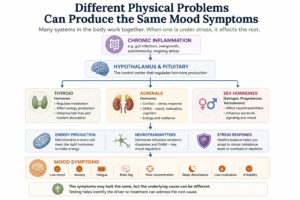
How does thyroid function affect mood?
Low thyroid function is the most familiar physical cause of depressive symptoms, and it’s usually screened for. The catch is how it’s screened.
Most testing starts with TSH, and if TSH is in range the investigation often stops. But T4 sitting at the low end with a normal TSH is worth attention. Thyroid hormone affects mitochondrial energy production directly, so low T4 shows up as fatigue and cognitive slowing. It also influences bile flow, which affects absorption of fat-soluble vitamins — A, D, E and K — so the knock-on effects extend beyond the thyroid itself.
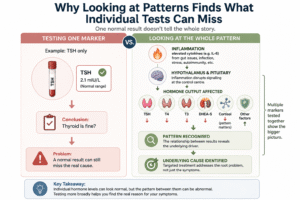
Someone can be told their thyroid is fine on the basis of a single normal TSH while T4 was never measured, or was measured and read as acceptable because it fell inside a range.
What do the adrenals have to do with it?
The adrenal glands produce cortisol and DHEA in response to demand. Under sustained stress — physical, emotional or inflammatory — that output changes over time.
Two things are worth reading properly:
DHEA-S against age, not just range. DHEA-S normally runs high through adolescence and the twenties, then declines. A result at the bottom of the range in a teenager is out of step with their stage of life, even though it’s technically “normal.” Reference ranges span all ages, which is why an in-range result can still be wrong for the person in front of you.
Cortisol production versus cortisol available. Free cortisol shows what’s circulating. Metabolised cortisol shows total production, including what’s already been cleared. Low free cortisol with high metabolised cortisol means the body is producing plenty and clearing it fast, which is a different situation from genuinely low production — and it’s invisible unless both are measured.
Can hormones affect serotonin?
Testosterone and serotonin interact, and an androgen-dominant state tends to dampen serotonin signalling. That can present as low mood, irritability, flat affect or anxiety.
This is most often missed in women and in adolescents, because the presenting complaint is mood, so hormones don’t get looked at. If the mood picture tracks with an androgen-dominant hormone picture, that’s worth knowing before deciding what’s driving what.
Related: an oestrogen level tells you how much is present, but oestrogen metabolites tell you what the liver is doing with it. Two people with identical levels can have quite different metabolite patterns, and the pattern is often more informative than the number. That only shows up on testing designed to measure metabolites.
How does inflammation come into it?
Inflammatory signalling molecules such as IL-6 act on the brain, not just on tissue. They interfere with hypothalamic and pituitary signalling — and the hypothalamus and pituitary sit upstream of thyroid, adrenal and reproductive hormone production.
The practical consequence is that an ongoing infection, gut overgrowth, or inflammatory load can produce a hormone picture that looks like a primary hormone problem. The hormone results are real, but they’re downstream. Treating them without addressing the driver is why hormone treatment sometimes doesn’t hold.
Why testing them separately misses things
Thyroid, adrenal and reproductive hormones are usually investigated by different practitioners at different times, and read one at a time. But they’re one signalling system with three outputs, all running off the same upstream control.
Test one in isolation and you get a number. Test them together and you can see which direction the problem is coming from — whether the thyroid is the problem, or whether the thyroid is just the most visible part of something happening further upstream.
That’s also why the relationship between markers usually matters more than any single one. A page of results where every individual number sits inside its range can still describe a pattern that doesn’t make sense for that person.
What’s worth asking for
If you want the physical side properly ruled in or out:
- A full thyroid panel, not TSH alone — including T4 and T3
- DHEA-S, interpreted against your age rather than the whole-population range
- Cortisol measured across the day, ideally with metabolites rather than a single reading
- Markers of inflammation
- Iron studies, B12 and vitamin D, which are simple and commonly relevant
None of this replaces mental health care. It sits alongside it, and it changes how everything else is interpreted.
In summary
Physical drivers don’t explain every case of depression or anxiety, and it would be wrong to suggest they do. Plenty of mood disorder has no such driver, and psychiatric treatment is often exactly what’s needed.
But when the physical picture is doing enough work to explain the mood picture, treating only the mood is asking medication to compensate for something it can’t fix. Investigating first — or at the same time — costs little and tells you what you’re actually dealing with.
Frequently asked questions
Can low thyroid cause depression? Yes. Thyroid hormone affects mitochondrial energy production, so low thyroid function commonly presents as fatigue, cognitive slowing and low mood. It can be missed when only TSH is tested.
Can your hormones be normal on a blood test and still be a problem? Yes. Reference ranges cover a wide population and a wide age span, so a result can be technically in range but wrong for that individual — and the relationship between markers can be abnormal even when each one is not.
Should I get my hormones checked before starting antidepressants? It’s reasonable to investigate physical contributors alongside a mental health assessment, and worth discussing with your doctor. It shouldn’t delay treatment if you’re unwell, and it’s not a reason to stop medication you’re already taking.
Can gut problems cause anxiety or depression? Indirectly, yes. Chronic gut infection or overgrowth keeps inflammatory signalling elevated, and those signals interfere with hypothalamic and pituitary function, which sits upstream of hormone production.
Does low DHEA mean adrenal fatigue? “Adrenal fatigue” isn’t a recognised medical diagnosis. What can be measured is adrenal output — DHEA-S and cortisol production — and whether it’s appropriate for the person’s age and circumstances.