Homocysteine is usually reported as a cardiovascular risk marker and then ignored if it’s only mildly raised. That’s a mistake, because a high homocysteine tells you something considerably more immediate: your methylation reactions are being inhibited right now, all of them, by the same molecule.
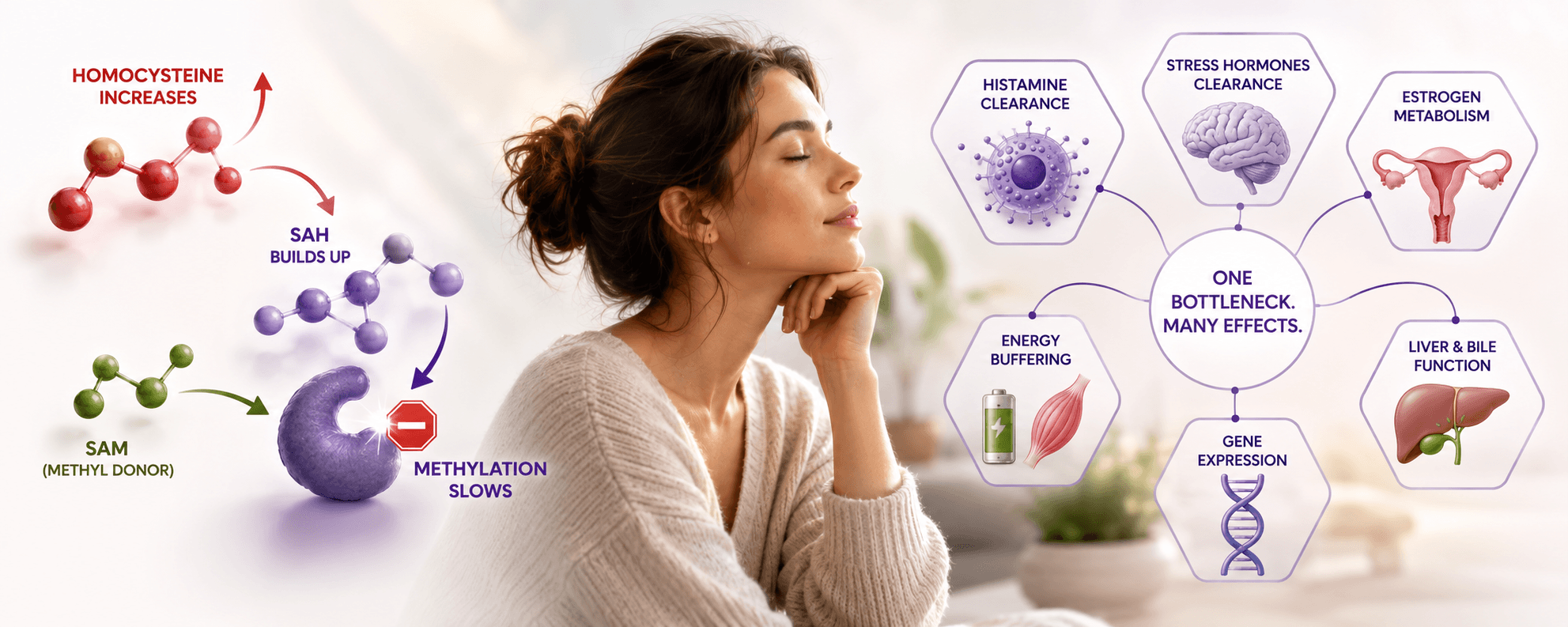
The reason is a piece of chemistry that isn’t obvious from the standard pathway diagram. The enzyme that produces homocysteine runs in both directions, and it thermodynamically prefers the reverse. When homocysteine accumulates, that enzyme runs backwards — converting homocysteine back into S-adenosylhomocysteine, or SAH.
And SAH binds to the active site of methyltransferases and shuts them down.
Which is why a single raised number can produce symptoms in histamine, hormones, energy and bile at the same time. It isn’t several problems. It’s one shared resource running short.
The mechanism, briefly
Every methylation reaction in your body uses the same donor, S-adenosylmethionine (SAM). A methyltransferase takes the methyl group from SAM and attaches it to something — histamine, a catecholamine, DNA, a phospholipid. What’s left behind is SAH.
SAH then has to be removed, and only one enzyme does it: SAH hydrolase, which splits SAH into adenosine and homocysteine.¹
That reaction is reversible, and under cellular conditions it actually favours SAH synthesis rather than breakdown.¹ It only runs in the useful direction because the products — homocysteine and adenosine — are normally being removed quickly.
So when homocysteine builds up, the reaction reverses. Raised homocysteine drives SAH back up, and chronic SAH elevation follows directly from that reversal.²
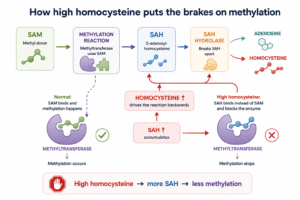
SAH is not an inert leftover. It binds with high affinity to the active site of cellular methyltransferases, producing product inhibition of the enzyme.² It looks almost identical to SAM — same molecule, one methyl group short — so it occupies the site and does nothing.
This has been shown in people rather than only in cell culture. Plasma homocysteine, plasma SAH and DNA hypomethylation in lymphocytes rise together.²
What that switches off
Methyltransferases are not a niche category. They handle a set of jobs that look completely unconnected until you notice they share a donor.
HNMT methylates histamine — the intracellular clearance route, dominant in the brain and tissues generally.
COMT methylates catecholamines, so dopamine, noradrenaline and adrenaline clearance. COMT also handles catechol oestrogens, meaning oestrogen metabolism runs through the same donor pool.
GAMT methylates guanidinoacetate to make creatine — the phosphocreatine system that buffers ATP in muscle and brain.
PEMT methylates phosphatidylethanolamine to make phosphatidylcholine, which the liver needs for bile composition and for exporting fat.
DNA methyltransferases handle gene expression, which is why DNA hypomethylation tracks with homocysteine in the human data.²
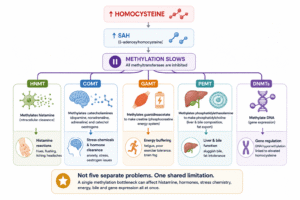
Read that list against a symptom picture and the pattern falls out. Histamine reactions, stress chemicals that won’t clear, oestrogen metabolism problems, poor energy buffering, sluggish bile — one raised marker sitting underneath all of it.
Which is also why someone with high homocysteine can react to almost everything. It isn’t a series of separate intolerances. It’s one limitation appearing wherever you happen to look.
The methyl budget, and why the reactions compete
The next question is whether these reactions genuinely compete, or whether there’s enough SAM to go round.
They compete, and the numbers are striking. Two enzymes dominate methyl consumption: GAMT making creatine, and PEMT making phosphatidylcholine. Together they account for roughly 85% of SAM-dependent transmethylation.³
Their exact split is disputed. Creatine synthesis was long thought to use over 70% of methyl groups in humans. But PEMT knockout mice have plasma homocysteine around 50% lower than normal mice, which implies phospholipid methylation is a much larger consumer than that leaves room for. And a reassessment of human creatine metabolism found dietary creatine can supply up to half of daily requirements in people who eat meat, so the synthesis figure needed revising down.⁴ ⁵
What isn’t disputed is that these two enzymes use most of the supply, and that everything else — histamine, catecholamines, oestrogen, DNA — is competing for what remains.
The clearest demonstration of that competition is a piglet study. Infusing guanidinoacetate, the substrate for creatine synthesis, doubled methyl incorporation into creatine — and simultaneously reduced methyl incorporation into phosphatidylcholine by 80% and into protein by 40%.⁶
Increase demand at one methyltransferase and the others are measurably starved.
One practical consequence: dietary creatine spares methyl groups, since creatine you eat is creatine you don’t have to synthesise. Someone eating little or no meat is manufacturing all of their own, which is a substantial standing methyl demand that a meat-eater doesn’t carry.
Why the number matters more than the gene
MTHFR gets the attention here, and homocysteine is the marker that actually tells you something.
A variant describes a tendency. Homocysteine describes what your methylation cycle is doing today, with your current B12, folate, B6, choline and betaine status, your current thyroid function, your current kidney function, and your current everything else.
Two people with identical MTHFR results and different homocysteine values are in completely different situations. Two people with identical homocysteine and different MTHFR results are in broadly similar ones. The measurement outranks the sequence.
This is also why supplementing on the basis of a gene result and not measuring the outcome is unsatisfying. The gene doesn’t change. Homocysteine does, and it tells you whether anything you did worked.
What raises it
Homocysteine has three possible fates: remethylation back to methionine, conversion down the transsulfuration pathway toward cysteine and glutathione, or export from the cell. It rises when the first two are limited.
Remethylation needs B12 and folate, or betaine as an alternative route. Transsulfuration needs B6, and it’s the route that also feeds glutathione synthesis — which is why homocysteine and antioxidant capacity are related rather than separate topics.
Beyond nutrients: reduced kidney function raises homocysteine, since the kidney does a large share of the clearing. Hypothyroidism raises it. So do several medications. And high methyl demand raises it from the other end, since every methyl group spent produces one molecule of homocysteine.
That last point is worth sitting with. Homocysteine isn’t only a marker of poor recycling. It’s also a marker of high consumption — which means a person under heavy methylation demand can have a raised value with perfectly adequate B vitamins.
What actually helps
Direction rather than protocol:
Measure it before deciding anything. Homocysteine is inexpensive, widely available and interpretable. A methylation strategy without it is guessing.
Work out which side is the problem. Poor recycling and high demand both raise homocysteine, and they need opposite responses. B12, folate and B6 status address the first. Reducing methyl demand addresses the second.
Look at the whole input list, not just folate. B12, folate, B6, choline and betaine all feed this cycle by different routes, and folate is only one of them.
Check thyroid and kidney function. Both affect homocysteine independently of nutrient status, and neither is fixed by supplements aimed at methylation.
Expect pathway-specific support to disappoint while it’s high. Working on histamine or catecholamines while the shared donor is limited tends to produce partial results at best. This is the step that sits underneath the others.
Re-measure. The whole value of this marker is that it moves. A repeat after a few months tells you whether the reasoning was right.
In summary
High homocysteine reverses the enzyme that normally removes SAH, so SAH accumulates. SAH occupies the active site of methyltransferases and inhibits them — all of them, since they share the same donor and the same product.
Which means one raised number sits underneath histamine clearance, catecholamine and oestrogen metabolism, creatine synthesis and phosphatidylcholine production simultaneously. Not several problems. One.
And why, when someone reacts to almost everything, this is among the first things worth measuring — because it’s a shared limitation rather than a long list of separate intolerances.
Frequently asked questions
What does high homocysteine actually do?
It reverses the SAH hydrolase reaction, raising SAH.¹ ² SAH binds to the active site of methyltransferases and inhibits them,² so every methylation-dependent process slows at once — histamine clearance, catecholamine and oestrogen metabolism, creatine synthesis, phosphatidylcholine production and DNA methylation.
Why would one marker cause so many different symptoms?
Because those reactions aren’t independent. They all use the same methyl donor and all produce the same inhibitory product. A limitation in the shared resource appears wherever you look, which reads as many separate problems and is one.
Is homocysteine only a heart risk marker?
That’s how it’s usually reported, but it’s also a direct readout of methylation capacity. The cardiovascular association is what it’s tested for; the methylation information is what makes it useful in this context.
Is homocysteine more useful than an MTHFR result?
Considerably. A variant describes a tendency that never changes. Homocysteine describes what the cycle is doing now, given your current nutrient status, thyroid function and kidney function — and it changes when something works.
Can homocysteine be high with normal B12 and folate?
Yes. Every methyl group spent produces a homocysteine molecule, so high methylation demand raises it from the consumption side. Reduced kidney function, hypothyroidism and various medications also raise it independently of nutrient status.
Does eating meat affect methylation?
Indirectly. Dietary creatine can supply up to half of daily requirements in people who eat meat,⁴ ⁵ and creatine you eat is creatine you don’t have to methylate into existence. Someone eating little or no meat carries that synthetic demand themselves, and creatine synthesis is one of the two largest consumers of methyl groups.³
Do methylation reactions really compete with each other?
Yes, and it’s been measured. Infusing the substrate for creatine synthesis into piglets doubled methyl incorporation into creatine while reducing incorporation into phosphatidylcholine by 80% and into protein by 40%.⁶
What level of homocysteine is a problem?
Labs typically flag values above around 15 µmol/L, and research thresholds are generally lower, so where the line sits is contested. Worth knowing: the SAH mechanism is a mass-action effect with no threshold — more homocysteine shifts the equilibrium further, continuously.
Should I work on histamine or on homocysteine first?
If homocysteine is raised, it sits underneath histamine clearance rather than beside it. Support aimed at the individual pathway tends to disappoint while the shared donor is limited.
References
- S-adenosyl-L-homocysteine hydrolase: structure, function and applications. Biomolecules. 2026. (Review; SAHH catalyses the reversible hydrolysis of SAH, is the rate-limiting enzyme of the methionine cycle, and modulates the SAM/SAH ratio. Requires NAD+.)
- Yi P, Melnyk S, Pogribna M, et al. Increase in plasma homocysteine associated with parallel increases in plasma S-adenosylhomocysteine and lymphocyte DNA hypomethylation. Journal of Biological Chemistry. 2000. (Human study; chronic SAH elevation follows the homocysteine-mediated reversal of the SAH hydrolase reaction, and SAH binds with high affinity to the methyltransferase active site producing product inhibition.)
- Guanidinoacetate N-methyltransferase: overview. (Review; PEMT and GAMT together account for roughly 85% of SAM-dependent transmethylation.)
- Stead LM, Brosnan JT, Brosnan ME, et al. Is it time to reevaluate methyl balance in humans? American Journal of Clinical Nutrition. 2006. PMID 16400042. (Review and animal data; PEMT knockout mice have plasma homocysteine ~50% lower, and dietary creatine supplies up to 50% of requirements in non-vegetarians.)
- The nutritional burden of methylation reactions. 2012. PMID 23196816. (Review; creatine and phosphatidylcholine synthesis consume most methyl groups, and methionine can become limiting for protein and phosphatidylcholine synthesis when creatine synthesis is upregulated.)
- Partitioning of methyl groups in piglets infused with guanidinoacetate. Journal of Nutrition. 2013. (Animal model; GAA infusion doubled methyl incorporation into creatine while reducing incorporation into phosphatidylcholine by 80% and into protein by 40%.)