
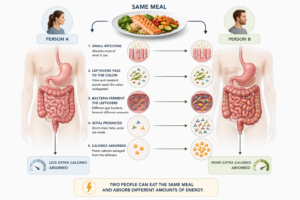
Two people can eat the identical meal and absorb different numbers of calories from it, partly because of the bacteria in their gut. The food that isn’t digested in your small intestine reaches your colon, where gut bacteria ferment it — extracting energy that would otherwise pass straight through. Different gut communities extract different amounts, so your microbiome is genuinely one input into how much energy you get from food. What’s much less settled is the popular version of this — that a particular “obesity ratio” of bacteria makes people fat — which turns out to be more complicated and probably too simple.
How gut bacteria get you extra calories
Your small intestine absorbs most of what it can from a meal. But some material — particularly fibre and resistant starch — it can’t break down, and that passes on to the colon.
The colon is where the bulk of your gut bacteria live, and they ferment that leftover material. In doing so they produce short-chain fatty acids (SCFAs) — small molecules that the body can absorb and use for energy¹. So food your own digestion couldn’t touch becomes a source of calories after all, by way of your bacteria.
This is why the microbiome is sometimes described as adding a metabolic step your own body doesn’t have. And because people carry different bacterial communities, the amount of energy salvaged this way varies from person to person.
The evidence it actually changes calorie absorption
This isn’t just theory — it’s been measured, though the cleanest experiments are in animals.
The landmark finding: transferring gut bacteria from obese mice into germ-free mice caused those mice to gain more fat than transfers from lean mice — same food, different microbiome, different outcome². The obese-type microbiome was shown to have a greater capacity to harvest energy from the diet².
In humans the evidence is more indirect but points the same way. A crossover study found that a roughly 20% increase in the Firmicutes group of bacteria was associated with around 150 extra calories harvested per day³. And when researchers compared weight loss from bariatric surgery against an equivalent very-low-calorie diet, the energy-reabsorbing potential of the microbiome changed differently between the two — falling after surgery⁴. Underfeeding, meanwhile, lowers microbial energy harvest, adding to the deficit⁵.
So the core claim holds: your gut bacteria are one real factor in how many of a food’s calories you actually absorb.
Where the popular story overreaches
Here’s where it matters, because this topic has a widely repeated version that runs ahead of the evidence.
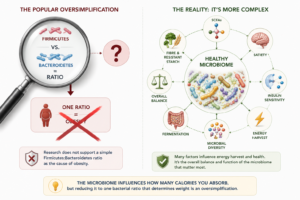
You’ll often read that a high ratio of Firmicutes to Bacteroidetes — two dominant bacterial groups — is “the obesity ratio,” and that shifting it is the key to weight. The energy-harvest research above gave rise to that idea. But it hasn’t held up cleanly. Multiple studies, including one following children across 12 years, found no reliable relationship between that ratio and body weight⁶. The picture is far messier than a single ratio you can label good or bad.
The reasonable position: the microbiome influences energy harvest — that’s real — but reducing it to one bacterial ratio that determines your weight is an oversimplification the evidence doesn’t support.
And the calories cut both ways
There’s a further twist that the “bacteria give you extra calories” framing misses entirely.
The same short-chain fatty acids that supply energy also do helpful things. They improve satiety and insulin sensitivity, and in humans, delivering one of them (propionate) to the colon actually reduced appetite, body weight and fat⁷ ⁸. So more fermentation isn’t straightforwardly “more calories and therefore worse.” The molecules produced can increase energy intake and improve how the body handles that energy at the same time.
This is the part worth holding onto: a marker like “high SCFA production” isn’t simply good or bad. It depends which SCFAs, in what context, doing what. The same output can point in opposite directions depending on the rest of the picture — which is true of most things in the gut.
What genuinely shifts the calories you absorb
Rather than chasing a bacterial ratio, the things that actually change how much energy you extract are more concrete.
- Fibre and resistant starch. These reach the colon undigested. Some of their energy is salvaged by bacteria as SCFAs, but you absorb less than the label implies, and they bring satiety and metabolic benefits alongside.
- How food is cooked and processed. Cooking and cooling starchy foods forms resistant starch; heavily processed foods give up more of their energy in the small intestine before bacteria ever get involved. (Covered in the companion article on why “calories in, calories out” is too simple.)
- The overall state of your microbiome — its diversity and balance — rather than any single ratio. A disrupted gut affects far more than calorie harvest.
Can you see what your microbiome is doing?
To an extent. The byproducts of bacterial metabolism — including markers of fermentation and of specific microbial activity — can be measured in urine through organic acid testing, and in stool through microbiome analysis. These don’t give a simple “you absorb X extra calories” number, but they can show patterns: whether fermentation is high, whether particular groups are over- or under-represented, whether there’s dysbiosis.
As with most testing, the value is in the pattern rather than a single figure — and in reading it alongside symptoms and the rest of the picture, not in isolation.
The short version
Your gut bacteria really do affect how many calories you absorb, by fermenting what your own digestion leaves behind — so two people can get different energy from the same meal. But the popular “obesity ratio” story oversimplifies it, the ratio itself is contested, and the byproducts involved improve satiety and blood sugar as well as supplying energy. The microbiome is a genuine factor in energy balance; it just isn’t the simple lever it’s often sold as.
Frequently asked questions
Can gut bacteria affect how many calories you absorb?
Yes. Food your small intestine can’t digest reaches the colon, where bacteria ferment it into short-chain fatty acids you can absorb for energy. Different microbiomes extract different amounts, so two people can absorb different calories from the same meal.
How much difference does the microbiome make to calorie absorption?
In one human crossover study, a roughly 20% increase in Firmicutes bacteria was associated with about 150 extra calories harvested per day. Animal transplant studies show an “obese-type” microbiome harvests more energy from the same diet.
Is the Firmicutes to Bacteroidetes ratio the cause of obesity?
This is contested. The idea came from real energy-harvest research, but several studies — including one following children for 12 years — found no reliable link between that ratio and body weight. The microbiome influences energy harvest, but a single ratio doesn’t determine weight.
Are short-chain fatty acids from bacteria good or bad?
Both, depending on context. They supply energy, which adds calories, but they also improve satiety and insulin sensitivity — and delivering one (propionate) to the colon reduced appetite and body weight in humans. More fermentation isn’t simply worse.
How can I tell what my gut bacteria are doing?
Organic acid testing (urine) and microbiome stool testing can show patterns of fermentation and bacterial balance. They don’t give an exact calorie figure, but they can reveal whether fermentation is high or whether there’s an imbalance, best read alongside symptoms.
What actually changes how many calories I absorb?
Concrete factors: fibre and resistant starch (partly salvaged by bacteria but less absorbed than labelled), how food is cooked and processed, and the overall balance of your microbiome — rather than any single bacterial ratio.
References
- Gut bacteria ferment undigested fibre and resistant starch into short-chain fatty acids that are absorbed and used for energy. Gut microbiota and energy balance reviews; Proceedings of the Nutrition Society (2014).
- Turnbaugh, P. J. et al. (2006). An obesity-associated gut microbiome with increased capacity for energy harvest. Nature, 444, 1027–1031. Transplanting obese-mouse microbiota into germ-free mice increased fat gain.
- A crossover clinical trial found a ~20% increase in Firmicutes abundance associated with ~150 kcal increased energy harvest. Reviewed in The human gut microbiota: metabolism and perspective in obesity (PMC6219651).
- Energy-reabsorbing potential of the microbiome decreased after laparoscopic sleeve gastrectomy but increased during a very-low-calorie diet, at equal weight loss. PMC4330959.
- Underfeeding lowered microbial energy harvest (decreased plasma/faecal SCFA), adding to the host’s caloric deficit. Exploring the influence of gut microbiome on energy metabolism in humans (2023).
- Multiple studies, including a 12-year childhood cohort, found no reliable relationship between the Firmicutes-to-Bacteroidetes ratio and body weight. PMC8873392.
- SCFAs activate FFAR2/FFAR3 and can increase satiety and insulin sensitivity; dietary fibre lowers energy density. Proceedings of the Nutrition Society (2014).
- Targeted colonic delivery of propionate reduced appetite, body weight and adiposity and improved insulin sensitivity in humans. Referenced in PMC8873392.