

“Calories in, calories out” isn’t wrong, exactly — energy balance is real, and you can’t escape physics. The problem is that it’s treated as simple arithmetic when both sides of the equation are moving targets. The calories you actually absorb from a food can differ substantially from the number on the label, depending on how it’s cooked, how processed it is, and what’s living in your gut. And the calories you burn shift with your thyroid, your hormones and your history of dieting. So the equation holds — but the numbers people plug into it are far less fixed than the maths implies.
Where the label number comes from
The calorie counts on food have a source, and it’s older than you’d think: a system of conversion factors worked out in the late 1800s, called the Atwater factors — roughly 4 calories per gram of protein, 4 per gram of carbohydrate, 9 per gram of fat¹.
It was a genuine achievement for its time, and for many foods it’s a reasonable approximation. But it makes an assumption that doesn’t always hold: that your body extracts the food’s full theoretical energy, regardless of the food or the person. Modern feeding studies — the kind that actually measure what goes in and what comes out — show that assumption breaks down in specific, predictable ways.
“Calories in” is not what the label says
The clearest evidence comes from nuts, because they’ve been studied carefully.
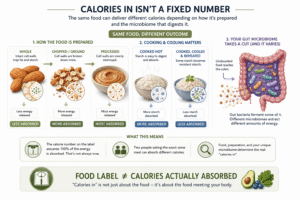
When researchers measured the energy people actually absorb from almonds, rather than the energy the almonds theoretically contain, the label overstated it dramatically. One study found the Atwater factors overestimated almond energy by around 32%²; controlled human trials consistently find roughly 5–26% of a nut’s calories are never absorbed at all³.
The reason is physical. Much of a nut’s fat is trapped inside intact cell walls, and if those walls don’t break down, the fat passes through and is either fermented by gut bacteria or excreted rather than absorbed³ ⁴. The energy was there on paper; your body just never got it.
Legumes behave the same way — measured energy from chickpeas and lentils came in 8–16% below the Atwater prediction⁵. So for a range of whole foods, the “calories in” figure on the label is an overestimate of what you actually take up.
Cooking and processing change the number
Here’s where it gets practical: the same food can deliver different calories depending on what you do to it.
Grinding, roasting and processing break down the food matrix that traps energy. Whole almonds give up less energy than chopped ones; chopped less than almond butter⁴. The more broken-down the food, the more of its calories you absorb — which is one quiet reason heavily processed foods deliver more usable energy than their whole-food equivalents, beyond just their ingredients.
Cooking does the same thing for starches, and there’s a twist in the other direction: cooking then cooling certain starchy foods (rice, potatoes, pasta) converts some of the starch into resistant starch, which the small intestine can’t digest — so it passes to the colon as fibre rather than being absorbed as calories. The same food, cooked and eaten hot versus cooked, cooled and reheated, can yield different amounts of available energy.
None of this shows up in a calorie-counting app, which treats a food as a fixed number regardless of how it reached your plate.
Your gut bacteria take a cut — and it varies
The food that isn’t absorbed in the small intestine reaches the colon, where the microbiome goes to work — and different microbiomes extract different amounts of energy from the same food.
This isn’t a rounding error. Research reprogramming the gut microbiome has shown measurable changes in how much dietary energy the body harvests⁶. And recent work suggests the century-old calorie factors can misestimate absorption partly because they don’t account for what gut bacteria do with what reaches them⁷.
So two people eating an identical meal can absorb different numbers of calories from it, because their gut communities differ. “Calories in” is not just a property of the food — it’s a property of the food meeting your particular digestive system.
“Calories out” moves too — especially when you cut calories
The other side of the equation is just as variable, and it’s where dieting so often stalls.
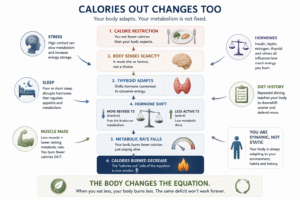
Your resting metabolic rate — the energy you burn simply staying alive — accounts for the majority of your daily energy expenditure, and it isn’t fixed. When you cut calories substantially, the body reads it as scarcity and downshifts. The thyroid is central to this: under calorie restriction, more of the thyroid hormone T4 is converted into reverse T3, an inactive form that effectively puts the brakes on metabolism, rather than into active T3⁸. (This is covered in more depth in the companion articles on thyroid function.)
This is an adaptation, not a fault — the body protecting itself during perceived famine. But its practical effect is that “calories out” falls as you eat less, which is exactly why cutting calories produces diminishing returns, and why the same deficit that worked at first eventually stops working. The denominator moved.
Stress hormones, sleep, muscle mass and a history of repeated dieting all shift this number too. The person burning calories today isn’t burning them at the same rate they were three months ago.
So does this mean calories don’t matter?
No — and this is the honest part, because it’s where a lot of “calories are a myth” content goes wrong.
Energy balance is real. You can’t create or destroy energy, and a genuine, sustained surplus or deficit does change body weight. Anyone claiming calories are irrelevant is overstating the case as badly as anyone claiming they’re simple arithmetic.
The accurate position sits between the two: calories count, but they can’t be counted precisely. Both “in” and “out” are estimates that shift with the food, the preparation, the gut and the metabolic state of the person. The equation is true; the inputs are approximations. So calorie counting can be a useful rough guide, but treating it as an exact science — and blaming yourself when the arithmetic doesn’t deliver — misunderstands how the body actually works.
What’s more useful than counting
- Think in terms of food quality and biochemical effect, not just the number. The same calorie count from different foods triggers different hormonal and metabolic responses — different effects on insulin, satiety and what you burn.
- Notice what a food does to your appetite and energy afterwards, not just what it “cost.” A food that leaves you satisfied and steady is doing something a calorie tally can’t capture.
- Treat a stall as information about “calories out,” not just “calories in.” Weight that won’t move despite eating less can mean metabolism has downshifted — in which case eating even less can be counterproductive.
- Favour whole, less-processed foods — partly because your body absorbs less of their theoretical energy, and partly for everything else they bring.
The short version
Calories in, calories out is a real principle wrapped around unreliable numbers. What you absorb depends on the food, how it’s prepared and your gut; what you burn depends on your thyroid, hormones and dieting history. Energy balance still governs weight — but it’s a moving equation, not a fixed sum, which is why precise calorie counting so often fails to match what actually happens on the scale.
Frequently asked questions
Is “calories in, calories out” a myth?
Not a myth, but an oversimplification. Energy balance genuinely governs body weight. What’s misleading is treating it as exact arithmetic, because both the calories you absorb and the calories you burn vary with the food, its preparation, your gut bacteria and your metabolic state.
Do you absorb all the calories on a food label?
Often no. Food labels are based on a century-old system that assumes full energy extraction. Human studies show you absorb noticeably less from some whole foods — roughly 5–26% less from nuts, for example — because energy stays trapped in the food’s structure and passes through unabsorbed.
Does cooking change how many calories you get?
Yes. Grinding, processing and cooking break down the food structure that traps energy, so you absorb more from more-processed forms. Cooking and then cooling starchy foods can do the opposite, forming resistant starch that passes through undigested.
Can gut bacteria affect how many calories I absorb?
Yes. Food not absorbed in the small intestine reaches the colon, where gut bacteria extract energy from it — and different microbiomes extract different amounts. Two people eating the same meal can absorb different numbers of calories from it.
Why does my metabolism slow when I diet?
When you cut calories substantially, the body reads scarcity and lowers your resting metabolic rate to conserve energy, partly by shifting thyroid hormone toward the inactive reverse T3 form. It’s a protective adaptation, and it’s why the same calorie deficit eventually stops producing results.
Should I bother counting calories at all?
It can be a useful rough guide, but not an exact science. Because both sides of the equation are estimates, it’s often more useful to focus on food quality, how foods affect your appetite and energy, and whether your metabolism may have downshifted — rather than trusting the numbers precisely.
References
- The Atwater factors (approx. 4/4/9 kcal per gram for protein/carbohydrate/fat) date from the late 1800s and underlie modern nutrition labels. Historical overview; StudyFinds/USDA summaries (2026).
- Novotny, J. A. et al. Discrepancy between Atwater-factor predicted and empirically measured energy values of almonds — ~32% overestimation. American Journal of Clinical Nutrition.
- Energy available from nuts is roughly 5–26% lower than Atwater factors predict, because fat is trapped within intact cell walls and excreted. Nuts for Life summary of USDA feeding trials; ~20% unabsorbed in an almond crossover trial.
- Food processing and structure impact the metabolizable energy of almonds: whole < chopped < almond butter for absorbed energy. Food & Function (2016).
- Measured metabolizable energy of chickpeas and lentils is 8–16% lower than Atwater predictions. Controlled crossover feeding trial.
- Reprogramming the human gut microbiome reduces dietary energy harvest — whole-room calorimetry study. PMC9901041.
- Atwater factors can misestimate calorie absorption partly by not accounting for gut bacterial energy extraction. StudyFinds / DAMM model coverage (2026).
- Under calorie restriction, T4 conversion shifts toward inactive reverse T3, lowering metabolic rate as an adaptive response. Thyroid physiology literature; see companion thyroid articles.