
Propionic acid is a short-chain fatty acid that comes from two places: it’s produced by bacteria fermenting undigested carbohydrate in the gut, and it’s added to processed food as a preservative (E280). In cell and animal studies, high levels interfere with mitochondrial energy production and change how the developing brain forms. Whether it contributes to autism in humans isn’t established — but the mechanism is plausible, it’s measurable on testing, and gut function is one of the few factors in autism that can actually be addressed.
Autism diagnoses have risen sharply over the past three decades. Much of that rise reflects broader diagnostic criteria and better recognition — children who would once have been missed, or labelled something else entirely, are now identified. Whether that fully accounts for the increase is still debated, and it’s reasonable to ask what environmental factors may also be contributing. Gut function and diet are one avenue worth examining, and that’s what this article is about.
Autism is complex and multifactorial. Nothing here is a single-cause explanation, and this article isn’t suggesting one. It looks at one metabolite, what it does, and why it turns up so often in the testing of children with autism and gut symptoms.
What is propionic acid?
Propionic acid (PPA), or propionate, is a short-chain fatty acid (SCFA) produced when intestinal bacteria ferment undigested carbohydrate and some proteins. The main SCFAs are:
- Propionic acid
- Butyric acid
- Acetic acid
Short-chain fatty acids are necessary for health, not harmful in themselves. Which ones get produced depends largely on which bacteria are present. Propionate has roles in appetite regulation, immune function, gene expression through histone deacetylase inhibition, neurotransmitter synthesis and release, cell signalling, and mitochondrial and lipid metabolism.
So propionic acid isn’t a “bad” molecule. Like most things in physiology, it’s a question of quantity and ratio. In excess, it creates problems.
Where does propionic acid come from in food?
Propionic acid is a widely used preservative, labelled E280 and also appearing as calcium propionate, sodium propionate, or calcium salt of propanoic acid. It’s approved and common in:
- Bread and baked goods
- Cheese
- Some juices and dried fruit
- Packaged foods generally, where it extends shelf life
The same compound is used in livestock feed, and sodium propionate induces early satiety in sheep and cattle, so they eat less. How much reaches us through meat is difficult to quantify.
Worth knowing: the same preservative appears under several different names on labels, and manufacturers generally choose the version that sounds least alarming.
But dietary propionate is usually the smaller contribution. In someone with bacterial overgrowth, far more is produced internally than is eaten.

How does clostridia overgrowth raise propionic acid?
Clostridia is a normal gut resident. When it overgrows, it becomes a significant producer of propionic acid — and undigested carbohydrate gives it more to ferment.
The metabolic problem is what propionate does inside the mitochondria.
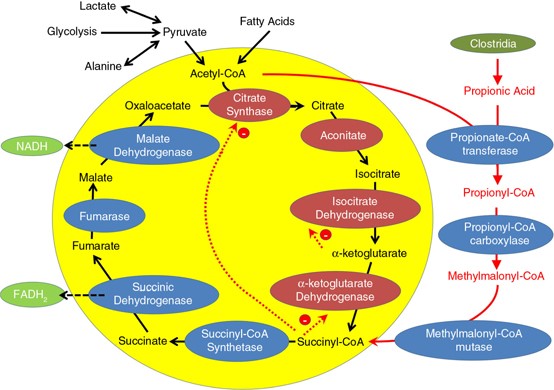
The citric acid cycle (Krebs cycle, TCA cycle) is how cells turn fuel into ATP. Carbohydrate and protein become pyruvate, which enters the mitochondria and forms acetyl-CoA, which then runs around the cycle producing energy.
Propionate enters that cycle at a different point — at succinyl-CoA, roughly halfway round. In doing so it can:
- Compete for and deplete coenzyme A and carnitine, both needed to move fuel into the cycle
- Effectively short-circuit the first half of the cycle
- Inhibit complex I of the electron transport chain
The practical effect is reduced cellular energy production. Since the brain is one of the most energy-demanding tissues in the body, that matters.
Carnitine is used to clear excess propionyl groups, so ongoing propionate load depletes it. That in turn affects fatty acid metabolism and ammonia clearance, and it’s why abnormal acylcarnitine patterns are a common finding where clostridia overgrowth is present.
Can you measure this on a test?
Yes, which is part of why this is worth understanding rather than just speculating about. An Organic Acid Test shows markers reflecting both clostridia activity and propionate load — including HPHPA and 4-cresol for clostridia species, and methylcitrate and 3-hydroxypropionic acid where propionate is accumulating faster than it can be cleared.
That turns a theoretical mechanism into something you can look at, act on, and re-test.
Why do autistic children often react to gluten, casein and soy?
Two things contribute.
First, carbohydrate digestion itself. Intestinal biopsy research has found reduced disaccharidase enzyme activity and reduced carbohydrate transporter expression in autistic children with gastrointestinal symptoms (Williams et al., 2011). Poorly digested carbohydrate means more substrate for bacterial fermentation, which means more propionate. Many autistic children react to carbohydrate for this reason, and it’s one of the more consistent findings in the literature.
Second, Clostridia has been proposed to interfere with the DPP-IV enzyme in the small intestine, which is involved in breaking down casein (dairy), gluten (wheat) and soy proteins. This is a plausible mechanism rather than a firmly established one, but it’s a common clinical explanation for why this particular trio of foods causes trouble.
What does propionic acid do to the brain?
Here it’s important to be clear about what kind of evidence exists, because it’s mostly not human.
In cell studies: a 2019 study in Scientific Reports exposed human neural stem cells to high concentrations of propionic acid. The cells produced fewer neurons and more glial cells, with disrupted connectivity between them (Abdelli et al., 2019). This was done in culture, not in a developing human brain, but it demonstrates a direct effect on how neural tissue develops.
In rodent studies: rats given propionic acid directly into the brain show repetitive behaviour, reduced social interaction, altered neurotransmitter levels including glutamate, dopamine and norepinephrine, neuroinflammation with activated microglia, and seizure-like activity (MacFabe and colleagues). These findings are striking, and they’re also the reason to be careful: the doses and the delivery route don’t reflect what happens in a child eating bread.
In humans: studies have compared faecal short-chain fatty acids between autistic and non-autistic children. Results are genuinely mixed — some report higher propionate, others report lower. What is more consistent is that gastrointestinal symptoms occur at higher rates in autistic children than in their peers.
So the honest summary is this: there’s a well-described mechanism, clear effects in cells and animals, and inconsistent human data. That’s an area worth investigating, not a settled cause.
What can actually be done about it?
The parts of this that are modifiable are the gut ones.
- Eat fresh food where you can. This is worth doing on general nutritional grounds regardless of the propionate question — processed and packaged foods are also lower in B vitamins, folate, zinc and magnesium, all of which matter for methylation, detoxification and gene expression.
- Read ingredient lists. As a rule of thumb, shorter is better. Propionate is one preservative among thousands in use, and it’s the one that happens to have been studied.
- Address digestion, not just diet. If carbohydrate isn’t being digested properly, restricting food only goes so far — the underlying enzyme and transport problem is the target.
- Test rather than guess. Bacterial overgrowth and propionate load are measurable. Testing tells you whether this is relevant for a particular child or a dead end.
- Work with someone experienced in this area. Every child is different, and this is one piece of a much larger picture. Nothing here should be used to self-treat, and any supplement or dietary intervention should be discussed with your practitioner.
A note on framing: nothing in this article is about what a parent did wrong. Gut microbial composition is shaped by genetics, birth circumstances, antibiotic exposure, infection, environment and diet — most of which nobody chooses. The reason to look at gut function isn’t blame. It’s that unlike most factors in autism, it’s one you can actually do something about.
Frequently asked questions
What is propionic acid? A short-chain fatty acid produced by gut bacteria fermenting undigested carbohydrate. It’s also used as a food preservative, labelled E280 or calcium/sodium propionate.
Which foods contain propionic acid? It’s commonly added to bread and baked goods, cheese, some juices and dried fruit, and packaged foods generally, where it extends shelf life.
Is propionic acid harmful? Not in itself — it has normal physiological roles in appetite, immune function and gene expression. Problems arise with excess, which usually comes from bacterial overgrowth in the gut rather than from food.
Does propionic acid cause autism? No, that isn’t established. High propionate affects neural development in cell studies and produces autism-like behaviour in rodent models, but human evidence is inconsistent. It’s a plausible contributing factor in some children, not a cause of autism.
Why do autistic children often have gut problems? Reduced carbohydrate-digesting enzyme activity and altered carbohydrate transport have been found in intestinal biopsies of autistic children with GI symptoms. Poorly digested carbohydrate feeds bacterial fermentation, which can drive further imbalance.
Can propionic acid be tested for? Yes. An Organic Acid Test shows markers of clostridia activity and propionate load, which makes it possible to check whether this is relevant in an individual case rather than assuming it.
References
- Abdelli, L. S., Samsam, A. & Naser, S. A. (2019). Propionic acid induces gliosis and neuro-inflammation through modulation of PTEN/AKT pathway in autism spectrum disorder. Scientific Reports, 9, 8824.
- Williams, B. L. et al. (2011). Impaired carbohydrate digestion and transport and mucosal dysbiosis in the intestines of children with autism and gastrointestinal disturbances. PLoS ONE, 6(9), e24585.
- MacFabe, D. F. (2012). Short-chain fatty acid fermentation products of the gut microbiome: implications in autism spectrum disorders. Microbial Ecology in Health and Disease, 23.
- Frye, R. E. et al. (2015). Gastrointestinal dysfunction in autism spectrum disorder: the role of the mitochondria and the enteric microbiome. Microbial Ecology in Health and Disease, 26.