

A blood test tells you what’s in your blood. It doesn’t necessarily tell you what’s inside your cells — and for many nutrients, that’s where they actually do their work. This is why you can have a “normal,” or even high, blood level of something and still be functionally short of it at the tissue level. The body works hard to keep certain things stable in the bloodstream, sometimes by quietly draining them from tissue to do so. So a reassuring blood result and a genuine deficiency are not mutually exclusive.
Blood is the delivery system, not the destination
Think of blood as the road network, not the warehouses. Most nutrients are used inside cells — in the mitochondria making energy, in enzymes running reactions, in the machinery of nerves and muscles. Blood is how they get there. Measuring the level in blood tells you what’s in transit, which isn’t the same as what has arrived and is being used.
For some markers those two things track closely, and a blood level is a good proxy. For others they can diverge sharply. Knowing which is which is most of the skill in reading results — and it’s where standard interpretation, which treats “in range” as “fine,” often goes wrong.
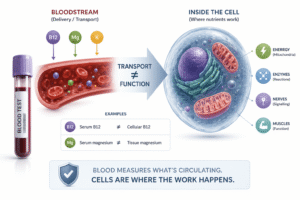
Vitamin B12: the clearest example
B12 is the textbook case, because there’s a way to check cellular function directly and compare it with the blood level.
Serum B12 measures how much is circulating. But B12 does its actual work inside cells, as a cofactor for two enzymes. When it’s genuinely available inside the cell, those reactions run and their by-products stay low. When it isn’t, a by-product called methylmalonic acid (MMA) builds up — and MMA is measurable¹.
Here’s the key point: MMA can be elevated, signalling a functional B12 shortage at the tissue level, even when serum B12 sits in the normal range¹ ². The blood says “enough”; the cells say “not enough.” Elevated MMA and homocysteine together are highly sensitive for this functional deficiency despite normal serum B12³.
This isn’t fringe. It’s why specialists checking for B12 deficiency in unclear cases don’t rely on the serum level alone — they add MMA and homocysteine, precisely because serum B12 can miss it¹ ⁴.
And the red cells can mislead too
You might expect a blood count to catch it, through MCV — the marker of red-cell size, which rises in classic B12 deficiency. Sometimes it does. But functional B12 deficiency often shows up with a completely normal MCV, because nerve and cellular effects can appear before red cells enlarge⁵. And if iron deficiency is present alongside it, that shrinks red cells and can cancel out the enlargement entirely, leaving a normal-looking MCV over two deficiencies⁵.
So a normal MCV doesn’t rule out a B12 problem — which is simply the same lesson again. The blood marker isn’t reporting the cellular reality.
Magnesium: normal blood, empty stores
If B12 is the clearest example, magnesium is the most striking.
Less than 1% of the body’s magnesium is in the blood⁶. The rest is in bone, muscle and soft tissue. And the body keeps the blood level tightly controlled — because the heart and nervous system depend on it — by pulling magnesium out of those tissue stores whenever blood levels start to dip⁶ ⁷.
The consequence is exactly what you’d expect: your tissue stores can be substantially depleted while your serum magnesium still reads perfectly normal⁷. Serum magnesium is widely acknowledged to be a poor indicator of total-body or intracellular magnesium⁶. One recent population study estimated that around two-thirds of adults may sit in a chronic latent magnesium-deficiency zone — low enough to matter, not low enough to flag on a standard result⁸.
So “your magnesium is normal” frequently means “your blood magnesium is normal,” which is a much smaller statement than it sounds.
Electrolytes: the body robs tissue to protect the blood
This principle — blood stability maintained at the expense of tissue — is a general feature of how the body works, and it shows most clearly in extreme situations.
In malnutrition and starvation, whole-body potassium and magnesium can be severely depleted. Yet serum levels of both often stay normal or near-normal, because the body releases them from tissue and bone to keep the blood concentration up⁹. The blood looks fine while the reserves are running out.
The reserves being drained only becomes visible at a revealing moment: refeeding. When someone malnourished starts eating again, insulin drives potassium, magnesium and phosphate rapidly back into cells — and the blood levels can suddenly crash, because there was never as much spare as the normal blood result implied⁹. The deficiency was real the whole time; the blood test just wasn’t showing it.

Even glucose: a snapshot versus the trend
The same limitation applies to things people assume a blood test measures perfectly.
A single blood glucose reading is a snapshot — it tells you the level at that one moment, which swings with food, stress and time of day. It says little about how glucose has been running over time.
That’s why HbA1c exists. It reflects the average blood glucose over roughly the previous three months, by measuring how much glucose has attached to red blood cells over their lifespan. It’s more informative not because it’s a fancier test, but because it captures a trend rather than a moment. A normal fasting glucose with a raised HbA1c tells a story a single reading never could — the snapshot looked fine, the pattern didn’t.
What “normal” on a lab report actually means
There’s one more layer worth understanding, because it changes how much weight “in range” deserves.
A reference range is built statistically. A large sample of people is tested, and the range is drawn to capture roughly the middle 95% of them⁶. “Normal” therefore means “statistically common in the population that was measured” — not “optimal,” and not “healthy.”
That distinction matters most where inadequacy is widespread. If a large share of the sampled population is quietly running low on something — as appears to be the case with magnesium⁸ — then that widespread inadequacy is baked into what counts as “normal.” Being in range means being similar to everyone else, which is only reassuring if everyone else is well-supplied. Sometimes they’re not.
This isn’t a reason to distrust every blood test. Reference ranges are genuinely useful and most results mean what they appear to. It’s a reason to hold “in range” a little more lightly for the specific markers where blood and tissue can diverge, or where population-wide shortfall is likely.
So what do you do with this?
- Match the test to the question. For B12, if function is in doubt, MMA and homocysteine tell you more than the serum level. For glucose over time, HbA1c beats a single reading.
- Read blood and symptoms together. A normal result alongside clear symptoms of deficiency isn’t automatically a contradiction to be dismissed — it may be the blood-versus-cell gap showing.
- Treat “normal” as one input, not a verdict — especially for the markers above.
- Look at patterns, not single numbers. A normal serum B12 with a high MMA, or a normal glucose with a raised HbA1c, is more informative than either figure alone.
An honest note
None of this means blood tests are unreliable or that “normal” should be ignored. For most markers, most of the time, the blood level is a good guide, and standard reference ranges do their job. The point is narrower and important: for certain nutrients and situations — B12, magnesium, the electrolytes under stress, glucose over time — the blood level and the cellular reality can genuinely differ, and knowing where that gap exists is what stops a normal result from being falsely reassuring. Interpreting that well is a job for you and a practitioner who reads the whole picture, not for a single number in isolation.
The short version
Blood tests measure what’s in the blood, which isn’t always what’s in the cells. The body will protect blood levels by drawing from tissue, so stores can run low while the result still reads normal — magnesium and the electrolytes are the clearest cases, and B12 can be checked directly through MMA. “Normal” means statistically common, not optimal. So a reassuring blood level is worth having, but it isn’t always the end of the story.
Frequently asked questions
Can you be deficient with a normal blood test?
Yes, for certain nutrients. Blood measures what’s circulating, not what’s inside cells, and the body often keeps blood levels stable by drawing from tissue stores. So tissue can be depleted while the blood level still reads normal — magnesium is a common example.
Can you have normal B12 but still be deficient?
Yes. Serum B12 can sit in the normal range while B12 isn’t working properly inside cells. This functional deficiency shows up as raised methylmalonic acid (MMA) and often homocysteine, which is why these are checked when a B12 problem is suspected despite a normal level.
Why is serum magnesium a poor test?
Because less than 1% of the body’s magnesium is in the blood, and the body keeps that blood level tightly controlled by pulling magnesium from bone and muscle. Tissue stores can be significantly depleted while serum magnesium still reads normal.
Why is HbA1c better than a single glucose test?
A single glucose reading is a snapshot that swings with food and time of day. HbA1c reflects average blood glucose over about three months, so it captures the trend rather than one moment — a normal fasting glucose can accompany a raised HbA1c.
Does “normal” on a blood test mean healthy?
Not exactly. A reference range captures the middle of the tested population, so “normal” means statistically common, not optimal. Where a shortfall is widespread in the population, that inadequacy is built into what counts as normal.
Can a high nutrient level mean a problem?
It can, depending on the nutrient. A high blood level in someone not supplementing can sometimes indicate the nutrient isn’t being taken up and used by cells properly, so it accumulates in circulation. It’s a reason not to rule out a functional problem on a single serum figure.
References
- Methylmalonic acid reflects intracellular/metabolic B12 status and can be elevated even when serum B12 appears normal. Pernicious Anaemia Society; Superpower MMA biomarker overview.
- Serum B12 can appear normal while intracellular B12 activity is inadequate; MMA rises as a functional marker. Superpower / clinical laboratory guidance.
- Elevated MMA and homocysteine together are ~99.8% sensitive for functional B12 deficiency, defined as raised metabolites despite normal serum B12. PMC (gastric cancer / B12 metabolite study).
- B12 deficiency work-up: CBC plus serum B12 and folate, with MMA and homocysteine added when results are non-diagnostic. StatPearls, Vitamin B12 Deficiency; Merck Manual, Megaloblastic Anemias.
- Macrocytosis (MCV > 100) is not a sensitive indicator of functional B12 deficiency — patients can be functionally deficient with a normal MCV; concurrent iron deficiency can mask macrocytosis. College of American Pathologists module; StatPearls, Macrocytic Anemia.
- Less than 1% of body magnesium is in serum; serum magnesium is a poor indicator of total-body or intracellular magnesium; reference ranges derived from population distributions. Journal of Nutrition (2026); Magnesium: Are We Consuming Enough? (PMC6316205).
- Intracellular magnesium depletion can occur with serum magnesium in the normal range (normomagnesemic magnesium deficiency); body mobilises magnesium from stores to maintain serum. Hypomagnesemia: A Clinical and Nutritional Update (PMC13009017).
- Estimated ~68% of US adults below the chronic latent magnesium deficiency threshold. Journal of Nutrition (2026), updated serum magnesium reference interval study.
- In starvation/malnutrition, whole-body potassium and magnesium are depleted while serum levels remain normal or near-normal due to release from tissue and bone; refeeding drives them into cells and can cause serum levels to fall sharply. ScienceDirect, Magnesium Depletion overview; refeeding syndrome literature.