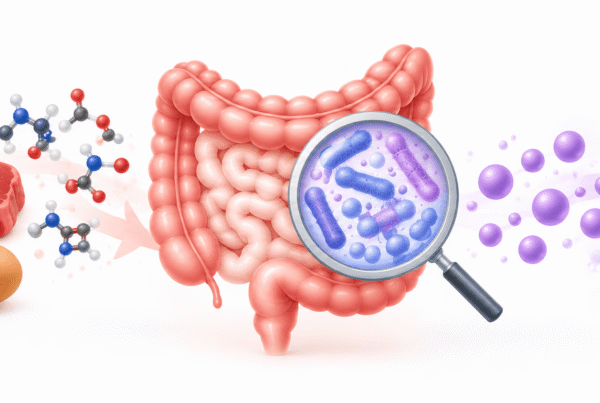
The list starts short. Something obvious goes first, usually dairy or gluten. Then aged cheese and leftovers. Then berries and spices. Then almonds and spinach. Then garlic and eggs. By the second year the safe list is white rice, chicken and peeled zucchini, and the reactions are still happening.
This progression is common enough that it deserves a mechanistic explanation. Histamine, phenol and salicylate, sulfur, and oxalate intolerance turn up in the same people far more often than chance would predict, and they tend to arrive in roughly that order.
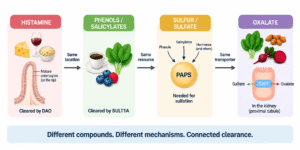
They cluster because they are connected, but not through one shared cause. Each pair is linked by a different mechanism. Understanding which link you are dealing with is what determines whether the diet keeps narrowing or starts widening again.
Why you cannot tell them apart by symptoms
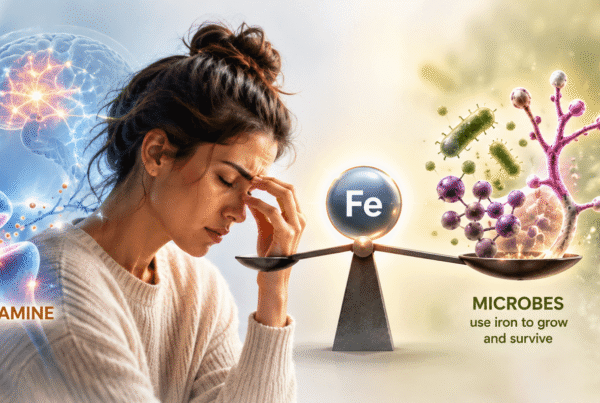
The first practical problem is that all four produce overlapping presentations. Fatigue, headache, brain fog, flushing, itch, gut symptoms, joint pain and poor sleep appear on every one of the lists.
That overlap is not a coincidence. Several of these compounds act on the same tissues — vascular tone, mast cells, mitochondrial energy production — so the downstream symptom is similar regardless of which compound is accumulating.
Timing can help tell the difference. Histamine reactions are usually fast, within minutes to an hour, and often involve flushing, nasal congestion or increased heart rate. Salicylate and phenol reactions are more often delayed and cumulative, building over a day or two of repeated exposure. Oxalate symptoms are the slowest and least food-linked, often showing as pain and fatigue with no obvious meal association. Sulfur reactions split depending on which part is not working well, which is covered in the sulfur article.
But timing is a weak signal when three of them are active simultaneously, which is the usual situation by the time someone is asking this question. Food diaries stop being informative once the reactive load is high enough that most meals produce symptoms.
Link one: histamine and phenols share an address
Diamine oxidase (DAO) is the enzyme that clears histamine arriving from food. The SULT1A enzymes sulfate phenols and salicylates. These are unrelated proteins doing unrelated chemistry.
They live in the same cells.
Both are expressed in the mature enterocytes lining the small intestinal villi.1 2 The villus is not uniform along its length. Enterocytes are born in the crypt at the base, mature as they migrate upward, work for around three days, and are shed from the tip. Metabolic capacity, including both histamine degradation and phase II conjugation, is a property of the mature cells further up.
So anything that shortens the villus or shifts the population toward immature cells removes both enzymes at once. It does not matter that the two pathways are chemically unrelated. They are casualties of the same anatomy.
This is why coeliac disease, inflammatory bowel disease and small intestinal bacterial overgrowth (SIBO) all appear in the histamine intolerance literature and in the phenol literature separately, and why a person who develops one after a gut infection so often develops the other within months. In a histopathology series of patients with confirmed small intestinal bacterial overgrowth (SIBO), villous blunting was the only feature significantly more common than in controls.3
Link two: phenols and sulfur share a substrate
Sulfation does not happen with sulfate directly. It requires an activated donor called PAPS (3′-phosphoadenosine-5′-phosphosulfate), and every sulfation reaction in your body draws from the same PAPS pool.
That pool covers dietary phenols and salicylates, bacterial phenols such as p-cresol, steroid hormones, thyroid hormone, catecholamines, and the sulfate built into the mucin layer over your gut lining.
Two things reduce it. Excess demand, and inadequate sulfate supply upstream.
The competition side is directly measured in humans. In a pharmacometabonomic study, people with high pre-dose urinary p-cresol excreted proportionally less paracetamol as sulfate and more as glucuronide after a standard dose.4 A bacterial phenol load displaces other phenols from the pathway and makes phenol reactions worse.
The supply side is where sulfur intolerance enters. If the transsulfuration pathway is not delivering sulfate, or if sulfate is being lost at the kidney, PAPS availability falls and salicylate clearance falls with it — regardless of how well the enzyme itself works.
Which produces the situation that makes no sense. Someone reacts badly to sulfur foods and simultaneously has too little usable sulfate to clear salicylates. Both are true at once, and reducing sulfur intake worsens the second while easing the first.
Link three: sulfur and oxalate share a door
Sulfate is freely filtered by the kidney and then reabsorbed in the proximal tubule. The final step of that reabsorption is handled by Sat-1, the transporter encoded by SLC26A1, which moves sulfate out across the basolateral membrane into the blood.5
Sat-1 is an exchanger rather than a pump. It can only move sulfate in one direction by moving something else in the other, and oxalate is one of the anions it will take.
This competition has been measured. In an oocyte expression system, sulfate uptake through sat-1 was competitively inhibited by oxalate with an inhibition constant of 63.5 µM, and oxalate uptake showed a Km of 53.5 µM — close enough to each other to indicate the two anions are interacting at the same site on the protein.6 Those concentrations are in the range found in the serum of people with hyperoxaluria.
The consequence is that sulfate and oxalate handling cannot be considered separately. A high oxalate load occupies capacity that sulfate also needs, and sulfate lost in urine is sulfate unavailable for PAPS production.
The same study concluded that sat-1 works preferentially as a sulfate-bicarbonate or oxalate-bicarbonate exchanger rather than as a direct sulfate-for-oxalate swap.6 The neat “one oxalate in, one sulfate out” version is a simplification of it.
Follow that one more step and you have the loop that keeps the cluster going. Oxalate load drives sulfate loss. Sulfate loss reduces PAPS. Reduced PAPS worsens salicylate and phenol clearance. This is covered in more depth in the sulfur article, but it is the reason the two sensitivities so often show up in the same person.
Note the asymmetry here. Oxalate does not join this cluster through an enzyme, because humans do not have an enzyme that breaks oxalate down. We depend on gut bacteria for that. So oxalate is not part of the villus story at all — it enters through transport and through bile.
Link four: everything meets at the methionine cycle
This is the least discussed connection and the one that ties histamine back to the sulfur end of the chain.
Histamine has two clearance routes. DAO handles what arrives from food, in the gut. HNMT handles histamine inside cells and in the brain, and it does so by methylation, using SAM (S-adenosylmethionine) as the methyl donor.
SAM donates its methyl group and becomes SAH (S-adenosylhomocysteine), which is hydrolyzed to homocysteine. Homocysteine then either recycles back toward methionine or continues down transsulfuration to cysteine — and cysteine is what gets oxidised to the inorganic sulfate that becomes PAPS.7
So one metabolic node supplies both the methyl groups that clear histamine and the sulfate that clears phenols. They are not competing for the same molecule, but they draw on the same cycle, and anything that slows that cycle affects both arms.
So someone with a sluggish methionine cycle can present with histamine symptoms, phenol reactivity and low sulfate at the same time, and treating any one of them in isolation produces only partial results.
Bile sits above several of these
One more upstream factor deserves naming, because it affects three of the four.
Dietary oxalate is mostly bound to calcium in the gut and leaves in the stool. That only works if fat is being absorbed properly. When it is not, unabsorbed fatty acids bind the calcium instead, leaving oxalate free to be absorbed, and unabsorbed bile acids reaching the colon increase mucosal permeability to oxalate directly.8 9
Bile also shapes which organisms establish in the gut, and low bile slows transit. Both change the bacterial phenol and histamine load arriving at an already limited enterocyte population.
So poor bile flow can raise oxalate absorption, alter the microbial picture that drives phenol and histamine production, and contribute to the mineral shortfalls that sulfur metabolism depends on. It is frequently the earliest modifiable thing in the whole sequence, and it is regularly missed because it presents as fatigue and food reactions rather than as a digestive complaint.
Why removing all four makes it worse
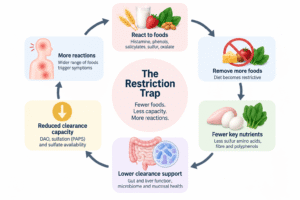
Each elimination diet is reasonable in isolation and if time-limited. Stacked together and for a prolonged period of time, they interact badly.
A low sulfur diet removes cysteine, which is the rate-limiting substrate for both glutathione and inorganic sulfate. Less sulfate means less PAPS, which means worse phenol and salicylate clearance. The sulfur restriction directly worsens the salicylate problem.
A low phenol diet removes most of the polyphenol intake that supports a favourable microbial population, and the bacterial phenol load is a large part of what was consuming PAPS in the first place.
A low oxalate diet removes a substantial share of nuts, seeds and vegetables.
A low histamine diet removes fermented food, aged protein and most leftovers.
Avoid all four and what remains is a diet low in protein, low in fibre, low in the substrates that feed the microbiome, and low in the sulfur amino acids the whole clearance system is built from. The diet that produces symptom relief in month one is a diet that reduces clearance capacity by month six.
This is the trap, and it is why the cluster tends to widen rather than resolve. Each restriction produces real short-term improvement, which is why people tend to stick to it.
Working out which link you are dealing with
Which of these applies determines the direction to take:
- Reactions began after a gut infection, food poisoning, antibiotic course or a period of severe stress. The villus story is likely primary. Both DAO and sulfation capacity are anatomically dependent, and both recover when a damaged gut lining is addressed.
- Fat digestion is visibly poor — discomfort after fatty meals, pale or greasy stools, fat-soluble vitamins that stay low on supplementation. Start with bile. It sits above oxalate absorption and above the microbial picture.
- Reactions are worst with wine, dried fruit and processed meats but eggs and broccoli are tolerated. That points at the sulfite conversion step rather than sulfur generally, and molybdenum status should be looked at.
- Reactions cluster around colour and around herbal preparations. Phenol and salicylate clearance, which means asking what is consuming the PAPS — usually bacterial phenol production.
- Symptoms are pain, fatigue and urinary rather than food-timed. Oxalate is more likely, and the question is what raised absorption or reduced degradation. Antibiotic history matters here.
- Everything reacts and nothing correlates. Look upstream at the methionine cycle and at sulfate status rather than at any individual food group.
What actually helps
The principle is that capacity is what changes, and capacity is upstream of every one of these compounds.
- Treat each elimination as diagnostic and time-limited. Decide before starting what would count as enough information, and plan the reintroduction at the same time.
- Do not stack restrictions simultaneously. Running three at once makes it impossible to attribute anything, and produces a diet with real nutritional cost.
- Address fat digestion and bile before working on any individual compound, if there is any sign it is involved.
- Establish whether bacterial overgrowth is present rather than assuming it, and treat it slowly enough that phenol release does not outpace clearance.
- Protect sulfate supply rather than restricting it further, unless the sulfite conversion step is specifically implicated.
- Check the cofactors the whole system runs on — B6, molybdenum, magnesium, zinc, copper, iron. Enzyme capacity on any given day is determined far more by substrate and cofactor availability than by sequence.
- Expect the reintroduction order to matter. The compound that improves first is usually the one furthest downstream, and the last to recover is usually whatever depends on the villus.
In summary
These four intolerances are not four separate problems that happen to occur together, and they are not one problem with four names. They are four clearance systems joined by four different mechanisms — one anatomical, one substrate, one transport, one metabolic.
Which is why the question worth asking is not which foods to remove next, but which of those four links is failing, and what is sitting upstream of it.
Frequently asked questions
Why do my food intolerances keep multiplying?
Because the systems that clear these compounds are connected. Losing capacity in one reduces capacity in the others, either by removing a shared enzyme population, draining a shared substrate pool, or occupying a shared transporter. The foods have not changed. The clearance has.
Should I do a low histamine, low oxalate and low salicylate diet at the same time?
Not if it can be avoided. Running them together makes attribution impossible and produces a diet that is nutritionally poor in exactly the substrates the clearance pathways need. One at a time, each treated as a time-limited trial, gives you information the combined approach cannot.
Which one should I address first?
Usually whichever has the clearest upstream driver rather than whichever produces the worst symptoms. Bile and fat digestion sit above oxalate. Bacterial overgrowth sits above both phenols and histamine. Working on a driver changes several outputs at once, while working on a compound changes one.
Is this the same thing as MCAS?
Mast cell activation syndrome is a diagnosis about mast cell behaviour. The clustering described here is about clearance capacity. They can coexist, and a person with genuine mast cell involvement will also have whatever clearance limitations they have. The distinction matters because the treatments are different, and because a label describing the symptom does not identify what is driving it.
Can genetic testing tell me which of these I have?
Not reliably. The largest analysis of SULT1A variation found no association between genotype and measured enzyme activity, in people whose enzyme deficiency was real and confirmed. Substrate availability, gut integrity and competing load do more of the work than sequence does.
Will my tolerance ever come back?
It frequently improves, because in most cases the enzymes are present and under-supplied rather than absent. How much and over what timeframe depends on what caused the loss. Villous recovery is the slowest of these, and is measured in months rather than weeks.
References
- Maintz L, Novak N. Histamine and histamine intolerance. American Journal of Clinical Nutrition. 2007;85(5):1185-96. PMID 17490952. (Review. DAO as the principal enzyme for ingested histamine; HNMT as the separate cytosolic route. The villus-tip localisation in mature enterocytes originates with Wollin et al. 1998 and is carried in this review.)
- Teubner W, Meinl W, Florian S, Kretzschmar M, Glatt H. Identification and localization of soluble sulfotransferases in the human gastrointestinal tract. Biochemical Journal. 2007;404(2):207-15. (Human tissue analysis.)
- Lappinga PJ, Abraham SC, Murray JA, Vetter EA, Patel R, Wu T-T. Small intestinal bacterial overgrowth: histopathologic features and clinical correlates in an underrecognized entity. Archives of Pathology & Laboratory Medicine. 2010;134(2):264-70. (Human histopathology series; observational.)
- Clayton TA, Baker D, Lindon JC, Everett JR, Nicholson JK. Pharmacometabonomic identification of a significant host-microbiome metabolic interaction affecting human drug metabolism. PNAS. 2009;106(34):14728-33. (Human study; correlation between pre-dose p-cresol and sulfation capacity, not a controlled intervention.)
- Markovich D, Aronson PS. Specificity and regulation of renal sulfate transporters. Annual Review of Physiology. 2007;69:361-75. (Review. NaS1 at the apical membrane and SAT1/SLC26A1 at the basolateral membrane complete transtubular sulfate reabsorption.)
- Krick W, Schnedler N, Burckhardt G, Burckhardt BC. Ability of sat-1 to transport sulfate, bicarbonate, or oxalate under physiological conditions. American Journal of Physiology – Renal Physiology. 2009;297(1):F145-54. PMID 19369292. (In vitro; oocyte expression system. Sulfate uptake competitively inhibited by oxalate, Ki 63.5 µM; oxalate Km 53.5 µM, indicating interaction at the same site. Authors conclude sat-1 works preferentially as a sulfate-bicarbonate or oxalate-bicarbonate exchanger.)
- Stipanuk MH. Sulfur amino acid metabolism: pathways for production and removal of homocysteine and cysteine. Annual Review of Nutrition. 2004;24:539-77. PMID 15189131. (Review. SAM coordinately regulates flux through remethylation and transsulfuration.)
- The management of patients with enteric hyperoxaluria. Urolithiasis. 2016;44(1):45-51. PMID 26645872. (Review; human. Fat malabsorption increases binding of dietary calcium by free fatty acids, and unabsorbed bile salts and fatty acids reaching the colon increase colonic permeability to oxalate.)
- Hyperoxaluria: a gut-kidney axis? Kidney International. 2011. (Review; the two mechanisms of fat-malabsorption hyperoxaluria stated explicitly.)