Histamine intolerance is usually discussed as two things: the histamine in your food, and the histamine your own mast cells release. There is a third source, and it accounts for a large part of what neither of the other two explains.
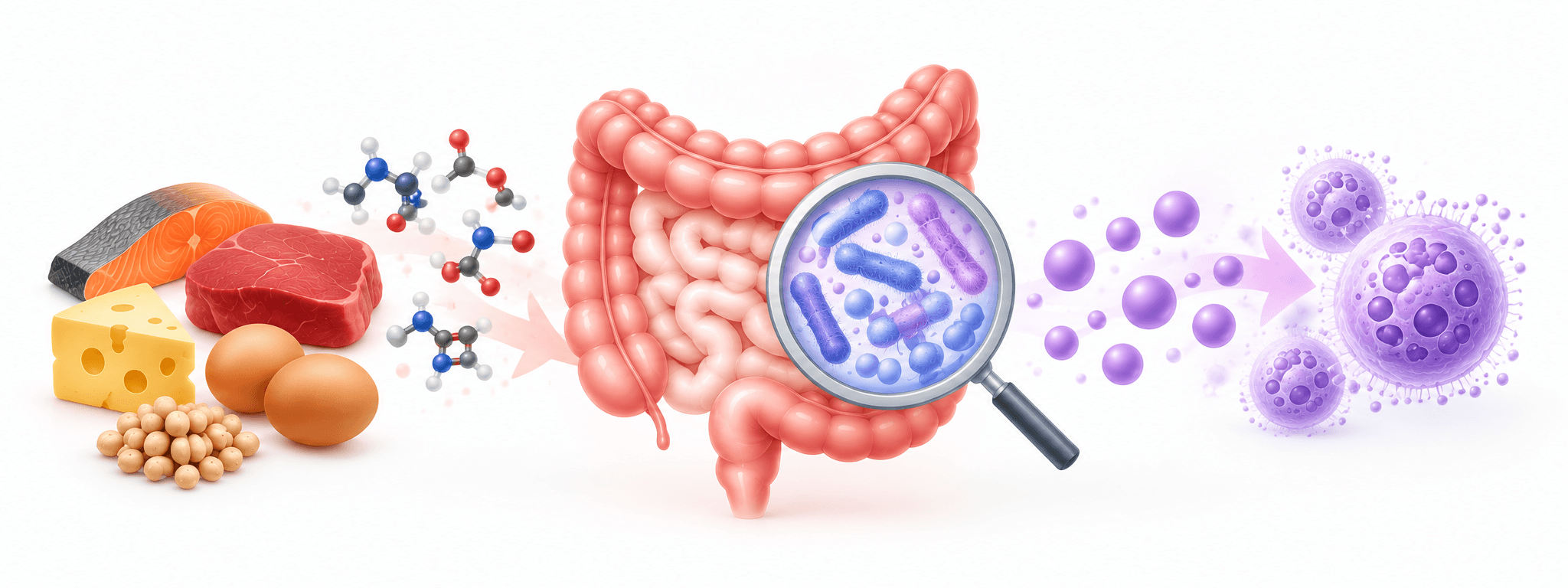
Some bacteria manufacture histamine. They do it in food during fermentation and storage, and they do it inside your intestine, continuously, from the protein you eat. Which means a person can eat a strict low histamine diet, have no obvious mast cell problem, and still be producing histamine all day.
It also explains one of the more demoralising experiences in this area — taking a probiotic to improve your gut and getting worse.
How a bacterium makes histamine
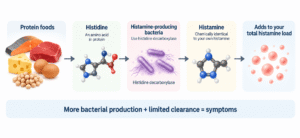
Histamine is made from the amino acid histidine, by removing a carboxyl group. The enzyme that does it is histidine decarboxylase (HDC).
You have your own version, used in mast cells and elsewhere. Many bacteria have their own, unrelated version, and they use it for their own purposes — decarboxylation reactions of this type help generate metabolic energy and help the organism survive an acidic environment.
Histidine is present in most protein-containing food, and abundant in fish, meat, dairy and legumes. So any bacterium carrying the gene and sitting in a protein-rich environment has both the tool and the raw material.
The output is chemically identical to the histamine your own cells make. Your body has no way to tell the difference, and no separate clearance pathway for it.
Why “high histamine foods” are really “bacterially processed foods”
Look at any high histamine food list and the same categories appear: aged cheese, cured meat, wine, sauerkraut, soy sauce, kefir, vinegar, leftovers.
What those foods share is not a botanical or nutritional category. It is time and bacteria. Fresh cabbage contains almost no histamine. Sauerkraut does, because the fermentation that makes it sauerkraut is bacterial decarboxylation working on the amino acids in the cabbage. The longer the ferment, the more accumulates.
The same applies to storage. A piece of fish is low in histamine when it is fresh, and becomes higher the longer it sits, particularly if the temperature is not tightly controlled.
The extreme version of this is a recognised food poisoning. Scombroid poisoning happens when fish with naturally high free histidine — tuna, mackerel, mahi-mahi — is mishandled after catching, and histamine-forming bacteria convert that histidine into large quantities of histamine.1 2 The symptoms look exactly like an allergic reaction and are regularly misdiagnosed as one.
Three important details carry across to ordinary histamine intolerance.
Cooking does not help. Histamine is heat stable. Once it has formed in the food, cooking the food does not remove it.2
The bacteria do not have to still be alive. Histidine decarboxylase can continue producing histamine after the organisms that made the enzyme are gone, which has been shown directly using recombinant versions of the enzyme from the relevant species with no bacteria present.1 So a food that is not spoiled, does not smell wrong and has been refrigerated can still be accumulating histamine.
Refrigeration helps less than assumed. Some histamine-forming organisms work at low temperatures. Morganella psychrotolerans was described specifically for this — it produces histamine in seafood at refrigeration temperatures.3
Put together, this explains why food lists disagree with each other so much. The same food contains different amounts of histamine depending on how long it has been sitting and how it was handled. The list is trying to describe a property the food does not really have.
The organisms doing it inside you
The same chemistry runs in your intestine.
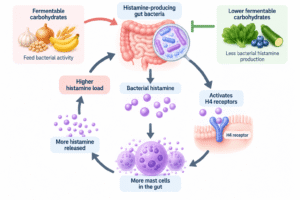
Researchers took faecal microbiota from patients with irritable bowel syndrome and used it to colonise germ-free mice. Mice colonised with microbiota from patients who had high urinary histamine developed visceral hypersensitivity and mast cell activation. Mice colonised from patients with low urinary histamine did not.4
They then identified the organism responsible. Klebsiella aerogenes, carrying a particular histidine decarboxylase gene variant, was the major histamine producer, and it was abundant in the microbiota of patients with IBS across three independent cohorts compared with healthy people.4
Two further findings from that work matter more than the identification itself.
The bacterial histamine acted through the histamine 4 receptor (HRH4) to recruit mast cells into the intestine.4 So bacterial histamine does not simply add to your histamine load. It changes the tissue, by bringing in more of the cells that release histamine themselves. That is a real amplification loop.
And when the colonised mice were fed a diet lower in fermentable carbohydrates, bacterial histamine production fell substantially, along with the hypersensitivity and the mast cell accumulation.4 Which offers a mechanism for something clinically familiar — that a low FODMAP approach sometimes helps histamine symptoms in a way that has nothing to do with removing histamine from the diet.
Other organisms carry the same capability. Morganella morganii is the one most consistently named, along with species of Proteus, Enterobacter, Klebsiella, Citrobacter and Raoultella.1 2 These are Gram-negative organisms that turn up on stool testing as overgrowths.
Why this is different from dietary histamine
Three practical differences, and they explain a lot of confusing experience.
It is continuous rather than tied to meals. Dietary histamine arrives in a bolus and produces a reaction with some timing relationship to eating. Bacterial production runs whenever substrate is available, which is most of the time. Symptoms lose their connection to specific meals, which is exactly the point at which people conclude their food diary is useless.
Diet cannot remove it. You can eliminate every aged and fermented food you own and the organisms in your intestine will carry on converting the histidine in your chicken breast. This is the most common reason a low histamine diet produces a partial response and then stalls. The partial response is real information — it tells you a portion of the load was dietary and the rest is coming from somewhere else.
It arrives in the wrong place. Your first-line defence against histamine from food is the DAO enzyme, made by mature enterocytes on the small intestinal villi. Bacterial production happening in the colon is downstream of most of that capacity. And when overgrowth relocates fermentation up into the small intestine, production is happening in the same space as absorption, at the same time as whatever arrived from your meal.
The probiotic problem
Lactic acid bacteria are among the organisms that carry histidine decarboxylase. This is well documented in the food science literature, because it is a spoilage and safety issue in fermented products.
Which means some probiotic strains add histamine.
You will find lists of species to avoid — usually naming Lactobacillus reuteri, casei, bulgaricus and Streptococcus thermophilus. Those lists are useful but technically wrong, because they are stated at the wrong level.
Strain, not species
Histamine production is a property of individual strains, not of species. The clearest demonstration of this is a study of Lactobacillus hilgardii, in which the entire histamine-producing pathway was found to sit on an unstable plasmid — a piece of DNA separate from the chromosome, which the organism could retain or lose depending on culture conditions.5
This shows the trait is not a fixed feature of the species. It is carried on mobile genetic material. Two strains sharing a species name can differ completely in whether they produce histamine at all.
The practical consequence is that a label saying Lactobacillus reuteri does not tell you whether that product will produce histamine. You need the strain designation, and even then the information usually is not published. Most manufacturers do not test for it, so avoiding it altogether is the reasonable step with limited information.
The complication nobody mentions
Bacterial histamine is not automatically a problem, and there is good work showing the opposite.
A specific L. reuteri strain was found to suppress TNF, an inflammatory cytokine — and the compound responsible turned out to be histamine, produced by that strain’s own histidine decarboxylase gene cluster. Inactivating those genes removed the anti-inflammatory effect. The mechanism ran through the histamine H2 receptor (HRH2).6
So the same molecule that causes your symptoms is, in that context, doing something useful. Bacterial histamine production is a normal microbial behaviour with a signalling role, not necessarily a problem.
What makes it a problem is the combination of production exceeding clearance in a person whose clearance is already limited. That is the same framing that applies to dietary histamine.
Histamine-degrading strains
Some organisms are said to break histamine down or to suppress its production, and Lactobacillus plantarum, Bifidobacterium longum and Bifidobacterium infantis are the names often mentioned.
For context, amine-degrading capability in lactic acid bacteria is documented in food science contexts, where the goal is reducing biogenic amines in a fermented product. Whether taking those organisms as a supplement measurably lowers histamine load in a person is not to certain.
Working out whether this applies to you
Pointers rather than a test:
- A low histamine diet helped and then plateaued, with symptoms continuing at a lower level
- Reactions have lost their timing relationship to meals
- Symptoms are worse with protein-heavy meals regardless of how fresh the food is
- Probiotics, fermented foods or a “gut healing” protocol made things distinctly worse
- Bloating, gas and abdominal pain travel with the histamine symptoms rather than being separate
- A low FODMAP or low fermentable carbohydrate trial improved histamine symptoms, which points at production rather than intake
- Stool testing shows overgrowth of Klebsiella, Morganella, Proteus, Citrobacter or Enterobacter
What actually helps
What applies depends on where the histamine is coming from:
- Treat the low histamine diet as a measurement rather than a treatment. A partial response quantifies the dietary share and tells you the rest is being produced somewhere.
- Handle food for freshness rather than avoiding categories. Cook and eat, freeze portions rather than refrigerating leftovers, buy fish that has been properly handled. This is more useful than most food lists, because it addresses the variable that actually determines histamine content.
- Investigate overgrowth rather than assuming it. If bacterial production is a large share of the load, no amount of dietary restriction will resolve it.
- Try a probiotic one strain at a time if you try one at all. A multi-strain blend that makes you worse gives you no information about which component did it.
- Consider fermentable carbohydrate intake as a variable separate from histamine intake. The two are usually conflated and they are not the same thing.
- Work on clearance alongside production. Production only matters relative to capacity, and the enzyme that clears dietary and bacterial histamine sits on the same intestinal surface the overgrowth is affecting.
In summary
Histamine has three sources, not two. Your food, your mast cells, and the organisms living in your intestine converting the histidine in your food while you are not eating.
The bacterial share is the one a low histamine diet cannot touch, and it is the reason so many people find the diet helps and then stops helping.
Which is why the question worth asking is not only which foods contain histamine, but what in your gut is manufacturing it.
Frequently asked questions
Can probiotics cause histamine intolerance?
They can add to an existing histamine load. Some bacterial strains carry histidine decarboxylase and convert histidine into histamine. In someone with adequate clearance this passes unnoticed; in someone already close to their limit it can produce a clear worsening. It is not causing the intolerance so much as loading it further.
Which probiotic strains produce histamine?
The species named most often are Lactobacillus reuteri, casei, bulgaricus, delbrueckii and Streptococcus thermophilus. But production is strain-specific rather than species-wide — in one documented case the whole pathway sat on a plasmid the organism could lose.5 A species name on a label does not tell you what a particular strain does.
Are Bifidobacterium probiotics safe for histamine intolerance?
Most Bifidobacterium species are not known histamine producers, which is why they appear in low histamine recommendations. That makes them a reasonable default. The further claim that they actively degrade histamine is repeated more confidently than the evidence supports.
Why did my low histamine diet stop working?
Most commonly because it only ever addressed part of the load. Removing dietary histamine lowers the baseline, but bacterial production inside the gut continues regardless of what you eat, and your own mast cells are unaffected by diet. A partial response is informative rather than a failure.
Can SIBO cause histamine problems?
Plausibly, by two routes at once. Overgrowth can include organisms that produce histamine, and it damages the villi where DAO is made — so production rises while clearance falls. The direct human evidence for this specific combination is limited, but both halves are separately documented.
Does cooking destroy histamine in food?
No. Histamine is heat stable and survives normal cooking.2 The enzyme that produces it can also continue working after the bacteria themselves are gone,1 which is why food that seems perfectly fresh can still carry a significant amount.
Why do leftovers affect me so much?
Because histamine accumulates in stored protein food through bacterial action, and refrigeration slows this less than people assume — some histamine-forming organisms work at refrigerator temperatures.3 Freezing portions immediately after cooking is more effective than refrigerating them.
Is there a test for bacterial histamine?
Not a specific one. Stool testing can identify organisms known to carry the capability, and urinary histamine reflects total load, but neither tells you what proportion of your histamine is bacterial in origin.
References
- Hungerford JM. Scombroid poisoning: a review. Toxicon. 2010;56(2):231-43. (Review. Includes work showing histidine decarboxylase from histamine-producing species continues to generate histamine with the bacteria absent.)
- Lehane L, Olley J. Histamine fish poisoning revisited. International Journal of Food Microbiology. 2000;58(1-2):1-37. (Review. Bacterial histamine formation in fish; heat stability of histamine.)
- Emborg J, Dalgaard P, Ahrens P. Morganella psychrotolerans sp. nov., a histamine-producing bacterium isolated from various seafoods. International Journal of Systematic and Evolutionary Microbiology. 2006;56:2473-9. (Species description; histamine production at refrigeration temperatures.)
- De Palma G, Shimbori C, Reed DE, et al. Histamine production by the gut microbiota induces visceral hyperalgesia through histamine 4 receptor signaling in mice. Science Translational Medicine. 2022;14(655):eabj1895. (Animal model using germ-free mice colonised with human faecal microbiota, plus abundance data from three human cohorts. Not a human intervention trial.)
- Lucas PM, Wolken WAM, Claisse O, Lolkema JS, Lonvaud-Funel A. Histamine-producing pathway encoded on an unstable plasmid in Lactobacillus hilgardii 0006. Applied and Environmental Microbiology. 2005;71(3):1417-24. (In vitro; demonstrates the trait is plasmid-borne and can be lost.)
- Thomas CM, et al. Histamine derived from probiotic Lactobacillus reuteri suppresses TNF via modulation of PKA and ERK signaling. PLoS ONE. 2012. (In vitro; human monocytoid cells and targeted bacterial mutagenesis.)