Low ferritin with a normal blood count is one of the most common findings in people with unexplained fatigue, and iron is the obvious answer. When it makes someone feel worse instead — agitated, wired, headachy, more anxious rather than more energetic — the usual conclusions are that they can’t tolerate the form, or that they should push through.
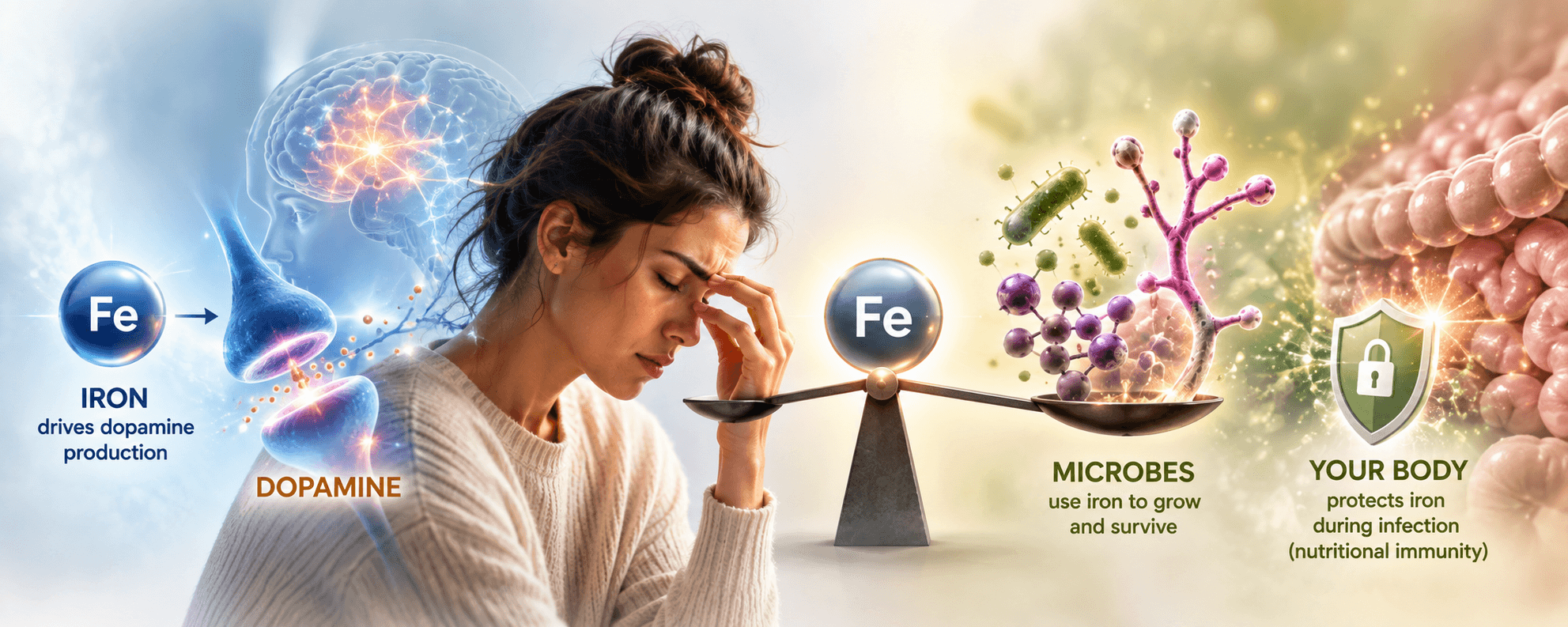
Neither is usually right. Iron is the cofactor for the first step of making dopamine, so it does increase dopamine production which is important. The problem is what happens to that dopamine next, and whether anything else in your gut is also waiting for iron.
Low ferritin without anaemia is a real finding
Haemoglobin is the last thing to fall. The body protects red blood cell production at the expense of everything else, so a person can have depleted iron stores, and the functional consequences of that, while their full blood count still reads normal.
The symptoms that show up first are neurological rather than haematological: fatigue that sleep doesn’t fix, poor concentration, low motivation, restless legs, hair shedding, cold intolerance. That cluster looks nothing like the pale, breathless picture of anaemia, which is why it gets attributed elsewhere.
So the person is usually right that they need iron. The question is whether now is the moment.
Why iron raises dopamine
Tyrosine hydroxylase (TH) converts tyrosine to L-dopa, the first and rate-limiting step in making dopamine, noradrenaline and adrenaline.¹ It requires an enzyme-bound non-heme ferrous iron, along with tetrahydrobiopterin (BH4) and oxygen.¹ ²
Rate-limiting matters here. This enzyme is the control valve on the entire catecholamine pathway, so its cofactor status determines how much dopamine the brain can make.
The same enzyme family includes tryptophan hydroxylase (TPH), which starts serotonin synthesis, and phenylalanine hydroxylase (PAH).² All are non-heme iron and BH4 dependent, so iron status sits underneath serotonin production too.
This is a really good reason to correct iron, and it explains why the symptom picture of low ferritin looks so much like the symptom picture of low dopamine.
Why that can backfire
Dopamine has two ways out, and both can be obstructed.
It converts onward to noradrenaline via dopamine beta-hydroxylase (DBH), or it’s broken down by monoamine oxidase (MAO).
DBH is irreversibly inactivated by p-cresol, a compound produced by certain gut bacteria from tyrosine. That inactivation is a covalent modification of the active site rather than simple competition,³ so recovering capacity means synthesising new enzyme rather than clearing the compound. Notably, DBH requires copper and ascorbate (vitamin C) — not iron — so improving iron status does nothing for this step.
MAO, meanwhile, is handling serotonin, adrenaline, melatonin, a histamine metabolite and any bacterial amines arriving from the gut. Its capacity is shared and finite.
So increasing production into a pathway with congested exits gives you accumulated dopamine rather than converted dopamine. The subjective result is agitation, irritability and feeling wired — which is not what someone hoped for, and can coexist with a test showing dopamine as low.
There’s an additional layer. Dopamine inhibits tyrosine hydroxylase (TH) itself. Structural work shows dopamine binding fixes a helix from the enzyme’s regulatory tail into the active site, physically blocking it, and this is reversed by phosphorylation at serine 40.⁴ Noradrenaline also acts as a feedback inhibitor.⁵
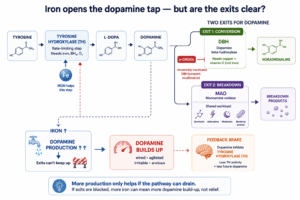
So the pathway has its own brake. If dopamine can’t leave, it shuts down the enzyme you were trying to support — which is a reasonable explanation for why iron sometimes produces a brief improvement followed by a return to baseline or worse.
Organisms want your iron too
The second mechanism has nothing to do with neurotransmitters.
Iron is essential for nearly all microorganisms, which is why the body actively withholds it during infection — binding it up in transferrin, lactoferrin and ferritin so invaders can’t reach it. This is a recognised arm of immune defence called nutritional immunity.⁷ ⁸
Candida albicans is well studied here. Iron acquisition is essential to its virulence, and strains lacking the genes needed to survive in low-iron environments are less able to cause disseminated infection.⁷ ⁹ Iron is specifically required to sustain hyphal growth¹⁰ — the filamentous, tissue-invading form rather than the harmless budding one.
The reverse holds as well. Iron deprivation changes the fungal cell surface and makes cells from iron-limited biofilms more susceptible to antifungal drugs, and doxycycline — which chelates iron — markedly increases Candida‘s susceptibility to fluconazole.⁸
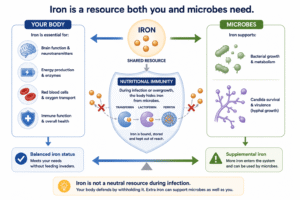
Most of that work concerns tissue and bloodstream infection. In its ordinary commensal niche in the gut, Candida appears to be relatively iron-replete already, based on the expression of its iron-regulated genes.¹¹ So the claim that an iron supplement feeds gut yeast is mechanistically plausible but not directly demonstrated — the evidence describes a different location, where iron is genuinely scarce.
What can be said is that iron matters a great deal to these organisms, that the body withholds it deliberately during infection, and that adding it back is not a neutral act when there’s an active overgrowth.
This is also the reasoning behind interest in lactoferrin. It’s an iron-binding protein that holds iron in a form the host can use while keeping it away from microbes, and combining it with antifungal agents has produced synergistic effects in laboratory work.⁸
Free iron generates reactive compounds
Iron that isn’t bound to a protein participates in reactions that generate reactive oxygen species. Those in turn peroxidise fats, producing reactive aldehydes.
Someone whose aldehyde clearance is already occupied — the pattern that shows up as alcohol intolerance and reactions to perfume or petrol — has little spare capacity for more. Adding unbound iron to that situation increases production into a system that’s already at its limit.
When the number is misleading
Ferritin is an acute phase protein. It rises with inflammation regardless of iron status, so an inflamed person can have good ferritin levels and be depleted in iron.
Inflammation also raises hepcidin, the hormone that regulates iron. High hepcidin reduces absorption from the gut and locks iron inside storage cells — which means that during active inflammation, supplemental iron is both poorly absorbed and less available even once absorbed.
Two consequences follow. A single ferritin result is difficult to interpret without markers of inflammation alongside it. And giving iron during an inflammatory period is a poor use of the opportunity, because much of it won’t reach where it’s needed while a proportion sits in the gut where organisms can access it.
What actually helps
Direction rather than protocol:
Interpret ferritin alongside inflammation. A normal ferritin in an inflamed person tells you very little, and a low one during inflammation tells you the timing is wrong.
Ask what dopamine’s exits look like before pushing synthesis. Agitation on iron rather than energy is a pointer at the conversion or clearance steps rather than at the iron.
Deal with overgrowth before repleting. If there’s an active yeast or bacterial problem, the sequence matters — iron given into that situation is shared with organisms that want it.
Treat a reaction as information. Feeling agitated on iron is telling you something specific about which part of the catecholamine pathway is congested.
Consider gut integrity. Absorption depends on the intestinal surface, so poor absorption and poor tolerance frequently share a cause.
Re-measure rather than assuming. Ferritin moves, and it’s the only way to know whether an approach is working.
In summary
Iron is the cofactor for the rate-limiting step of dopamine synthesis, so it does what it’s expected to do — it increases production. Whether that helps depends on whether dopamine can leave, and both exits can be obstructed, one of them irreversibly.
Iron is also wanted by the organisms in your gut, which is why the body withholds it during infection rather than distributing it freely.
Which is why reacting badly to iron is rarely about the iron. It’s usually about what else is happening at the same time — and that’s a question about sequence rather than about tolerance.
Frequently asked questions
Why does iron make me feel agitated or wired?
Iron is the cofactor for tyrosine hydroxylase, the rate-limiting step in dopamine synthesis,¹ so it increases dopamine production. If dopamine’s exits are congested — conversion to noradrenaline, or breakdown by MAO — the extra accumulates rather than being used, which feels like agitation rather than motivation.
Can you be iron deficient without being anaemic?
Yes, and it’s common. Red cell production is protected at the expense of other iron-dependent processes, so stores can be depleted while a full blood count reads normal. The early symptoms are neurological — fatigue, poor concentration, low motivation, restless legs — rather than the classic anaemia picture.
Does iron feed candida?
Iron is essential to Candida‘s virulence and specifically required for hyphal growth, the invasive form,⁷ ¹⁰ and the body withholds iron during infection as an immune strategy.⁷ ⁸ But that evidence concerns tissue and bloodstream infection, and gut Candida appears already iron-replete.¹¹ So it’s plausible and not directly demonstrated for a gut overgrowth.
Does MAO need iron?
No. This claim circulates but MAO-A and MAO-B are flavoenzymes requiring covalently bound FAD, so riboflavin.⁶ Iron’s link to dopamine is through synthesis, not clearance.
Why did iron help at first and then stop?
One possible explanation is the pathway’s own brake: dopamine inhibits tyrosine hydroxylase by binding into its active site.⁴ If dopamine accumulates because it can’t be converted onward, it suppresses the enzyme you were supporting — producing an initial improvement followed by a return to baseline.
My ferritin is normal but I have every symptom of low iron.
Ferritin rises with inflammation regardless of iron status, so a normal result in an inflamed person is hard to interpret. Reading it alongside inflammatory markers tells you considerably more than reading it alone.
Should I take iron during an infection or flare?
Inflammation raises hepcidin, which reduces absorption and locks iron into storage — so it’s absorbed poorly and used poorly at exactly that time, while a proportion remains in the gut. It’s usually a poor moment to replete, rather than a wrong thing to do.
What about lactoferrin instead?
Lactoferrin binds iron in a form the host can use while keeping it from microbes, and it has shown synergy with antifungals in laboratory work.⁸ That’s the mechanism that makes it interesting; clinical evidence in this context is limited, and it’s a question for whoever is managing your care.
References
- Stable preparations of tyrosine hydroxylase provide the solution structure of the full-length enzyme. Scientific Reports. 2016;6:30390. (Structural; TH requires enzyme-bound non-heme ferrous iron, BH4 and molecular oxygen, and catalyses the rate-limiting step of catecholamine synthesis.)
- Tyrosine hydroxylase: overview. (Review; TH, tryptophan hydroxylase and phenylalanine hydroxylase form the non-heme iron and BH4-dependent aromatic amino acid hydroxylase family.)
- Goodhart PJ, DeWolf WE, Kruse LI. Mechanism-based inactivation of dopamine beta-hydroxylase by p-cresol and related alkylphenols. Biochemistry. 1987;26(9):2576-83. PMID 3607034. (In vitro; purified enzyme, irreversible covalent modification.)
- Structural mechanism for tyrosine hydroxylase inhibition by dopamine and reactivation by Ser40 phosphorylation. (Cryo-EM and biochemical; dopamine binding fixes a regulatory helix in the active site, blocking it.)
- Peripheral dopamine: catecholamine synthesis and degradation. (Review; noradrenaline acts as a feedback inhibitor of TH.)
- Progress in monoamine oxidase (MAO) research in relation to genetic engineering. 2004. PMID 14697876. (Review; both MAO isoforms require FAD as a covalently bound cofactor.)
- Essential metals at the host-pathogen interface: nutritional immunity and micronutrient assimilation by human fungal pathogens. 2015. PMID 26242402. (Review.)
- Iron at the centre of Candida albicans interactions. PMC5996042. (Review; nutritional immunity, iron-limited biofilm susceptibility to amphotericin B, doxycycline iron chelation increasing fluconazole susceptibility, lactoferrin synergy with antifungals.)
- Iron acquisition in the pathobiology of Candida albicans. 2017. (Review; iron acquisition essential for virulence.)
- Candida albicans requires iron to sustain hyphal growth. 2021. (In vitro.)
- Candida albicans oropharyngeal infection is an exception to iron-based nutritional immunity. PMC10128012. (Animal model and transcriptional profiling; the commensal gut niche is inferred to be iron replete, while kidney invasion places the fungus in an iron-deficient state.)