If your headaches, hives, anxiety, bloating or insomnia arrive at the same two points every month, that timing is the most useful diagnostic information you have. It points at histamine, and specifically at the way oestrogen and histamine interact.
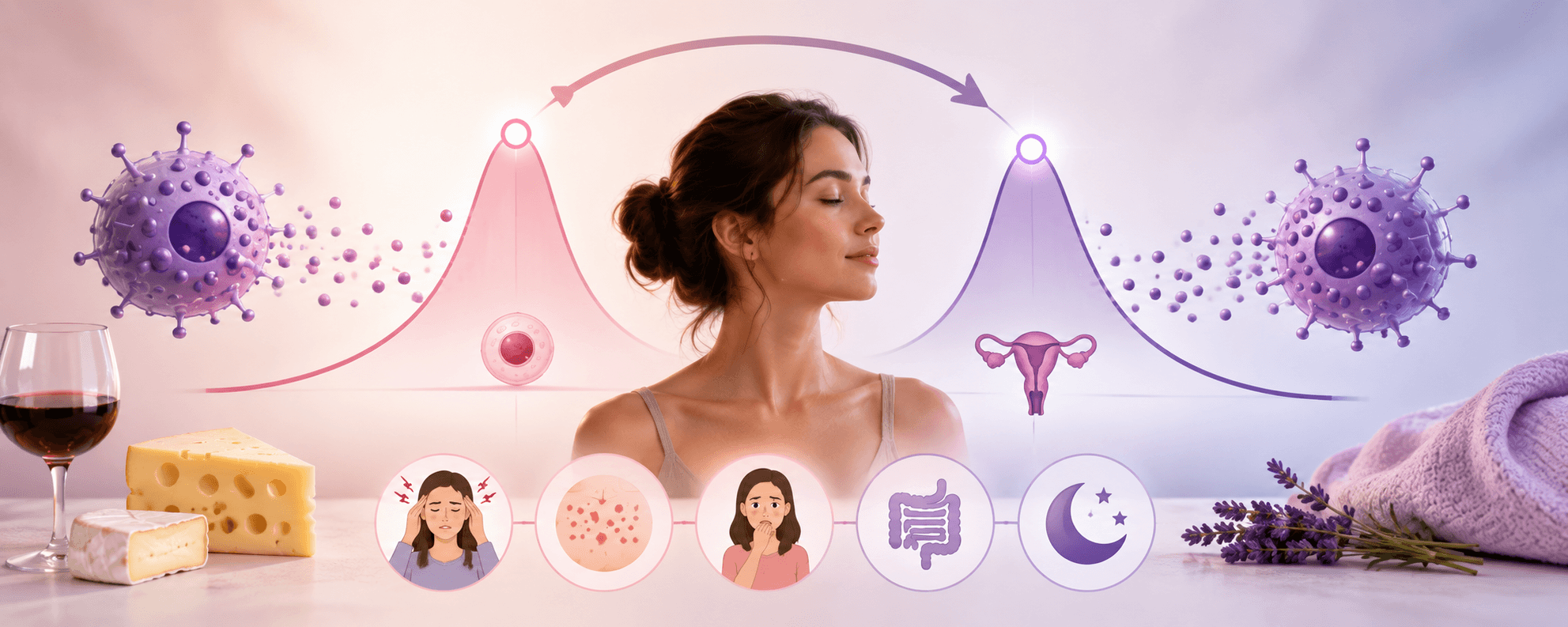
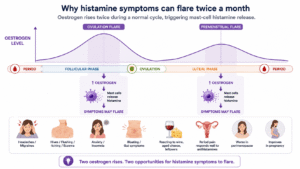
Oestrogen causes mast cells to release histamine. That much is well demonstrated, at concentrations your own body reaches, with the mechanism identified. It explains why symptoms cluster around ovulation and again in the days before a period — the two points where oestrogen rises.
You’ll also read that histamine stimulates the ovaries to make more oestrogen, completing a self-amplifying loop. That half is real but much weaker than it’s usually presented, and the distinction matters for what you do about it. I’ll come back to it.
Signs your symptoms are cycle-linked
The pattern is more specific than “worse before my period”:
- Symptoms flaring for a day or two mid-cycle, then settling, then returning in the week before bleeding
- Headaches or migraines arriving at the same cycle days each month
- Hives, flushing, itching or eczema that comes and goes on a monthly rhythm
- Anxiety or insomnia that appears without a life reason and lifts once bleeding starts
- Bloating and gut symptoms that track the cycle rather than what you ate
- Reacting to wine, aged cheese or leftovers at some points of the month and not others
- Period pain that responds unusually well to antihistamines
- Symptoms worsening in perimenopause, or arriving there for the first time
- Symptoms improving markedly during pregnancy
Those last two are worth noticing, because they’re the ones that most strongly implicate hormones rather than something you’re eating.
Direction one: oestrogen triggers histamine release
Mast cells carry oestrogen receptors. When human and mouse mast cells were exposed to physiological concentrations of estradiol — not artificially high doses — they partially degranulated, releasing the preformed mediators stored in their granules.¹
Two details make that study convincing rather than suggestive. The effect ran through membrane oestrogen receptor-alpha and a calcium influx, so there’s an identified mechanism. And mast cells from mice engineered without oestrogen receptor-alpha did not degranulate in response to estradiol at all.¹ That’s a proper control.
Estradiol also enhanced IgE-driven mast cell activation, shifting the dose at which an allergen produces a response.¹ So oestrogen doesn’t only release histamine directly — it lowers the threshold at which everything else does.
Which explains something people describe often: not that they react to new things during certain cycle weeks, but that they react to the same things more.
Environmental oestrogens produce the same effect, and this was demonstrated by the same group.²
Direction two: does histamine drive oestrogen back?
Here is where I part company with most of what’s written on this.
The claim that histamine stimulates the ovaries to produce more oestrogen, closing a self-amplifying loop, does have a source. Human granulosa cells taken from the follicular fluid of 17 women undergoing IVF were cultured in serum-free medium. Histamine produced a dose-related increase in estradiol secretion, and the effect was blocked specifically by an H1 receptor antagonist but not by an H2 antagonist.³
So the mechanism exists, in human cells, with receptor specificity demonstrated. That’s real.
What almost nobody mentions is the concentration. The maximal stimulatory effect occurred at 10⁻³ mol/L — one millimolar.³ Circulating histamine in a person sits in the low nanomolar range. That is roughly a millionfold difference.
Local concentrations immediately around a degranulating mast cell are far higher than plasma levels, so the finding isn’t irrelevant. But it is a long way from demonstrating that ordinary histamine elevations drive ovarian oestrogen production in a living person.
There’s a further complication. In gonadal tissue elsewhere, histamine’s effect on steroid production is biphasic — low concentrations stimulate and high concentrations inhibit, acting through different receptor subtypes.⁴ So “more histamine, more steroid” isn’t necessarily a reliable direction.
My position: oestrogen driving histamine release is well evidenced and worth acting on. Histamine driving oestrogen back is a real mechanism demonstrated at concentrations that may not be physiologically relevant. The relationship is better described as one strong direction with a possible weak return than as a vicious cycle.
If it’s a runaway loop, you have to break the cycle. If it’s mainly one-directional, you’re managing the oestrogen side and the total histamine load — which is a more tractable problem and matches what actually helps people.
Where progesterone fits
Progesterone is usually described as the opposing hormone — stabilising mast cells and supporting histamine clearance. Clinically that framing works: the luteal phase in a cycle with good progesterone tends to be easier than one without, and the symptom pattern in perimenopause fits a picture of oestrogen fluctuating while progesterone declines.
The research is less tidy. Estradiol and progesterone together regulate mast cell migration into the uterus and induce their maturation — and their degranulation.⁵ So progesterone isn’t simply a brake on mast cells in every tissue.
What I’d say: the clinical pattern is consistent and widely observed, and the mechanism is less settled than the confident version implies.
Why the month has two peaks
Oestrogen rises twice in a normal cycle. It climbs steeply to a peak just before ovulation, drops, then rises again more modestly in the luteal phase before falling away before bleeding.
If oestrogen triggers mast cell degranulation, symptoms should track those rises. And that is exactly the pattern women describe: a mid-cycle flare lasting a day or two, then relief, then a longer premenstrual stretch.
Someone who assumes their symptoms are food-related will find the picture baffling, because the same meal produces a reaction one week and not the next. Tracking symptoms against cycle day rather than against food usually resolves the confusion within a couple of months.
The clearance side
Production is only half of it. Whether histamine accumulates also depends on how fast you clear it.
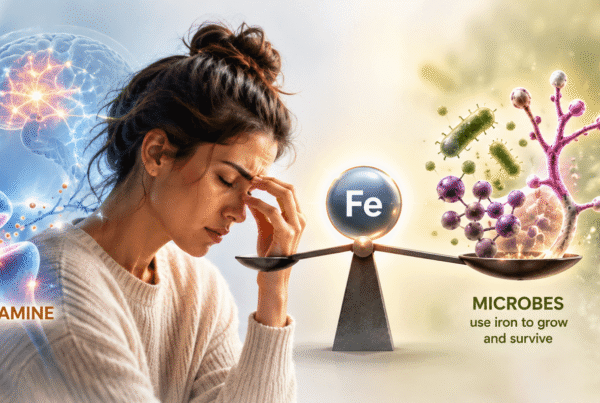
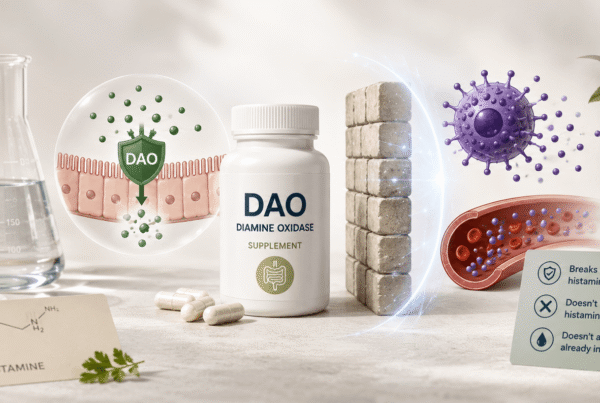
Two enzymes do that work. DAO handles histamine in the gut and extracellular space; HNMT handles it inside cells. Both hand their product to aldehyde dehydrogenase, which is also dealing with alcohol, neurotransmitter breakdown and oxidised fats.
This is why cycle-linked symptoms and food reactions so often coexist. The hormonal rise adds histamine to a system whose clearance capacity is fixed. Someone with plenty of spare capacity absorbs the monthly rise without noticing. Someone already close to their limit tips over twice a month.
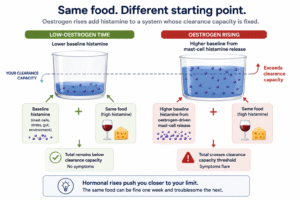
It also explains why a low-histamine diet helps partially and never completely. Removing dietary histamine lowers the baseline, which buys room — but it does nothing about the histamine your own mast cells release on a hormonal signal.
Pregnancy is the clearest natural experiment here. The placenta produces DAO in large quantities, and histamine intolerance frequently improves markedly during pregnancy before returning afterwards. A dramatic rise in clearance capacity, with symptoms following it.
Perimenopause
This is when the picture most often changes, and the reason is the pattern rather than the level.
Perimenopausal oestrogen doesn’t decline smoothly. It fluctuates, sometimes reaching higher peaks than in a regular cycle, interspersed with sharp drops. Since it’s the rises that trigger degranulation, erratic surges produce a more chaotic symptom pattern than a predictable cycle did — while progesterone, which used to provide some counterweight, declines earlier and more consistently.
Which is why women in their forties describe developing allergies they never had, or reacting to foods they’ve eaten all their lives. It’s rarely a new allergy. It’s the same mast cells with a less predictable signal.
What this explains
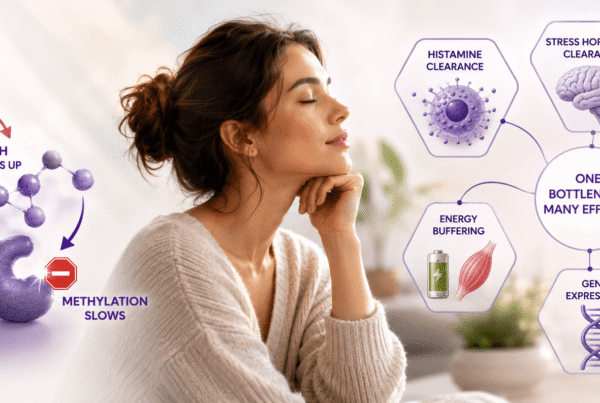
Histamine receptors are distributed widely — brain, gut, uterus, skin, blood vessels — which is why one mechanism produces symptoms that seem unrelated to each other.
Anxiety and insomnia at particular cycle points. Migraines with reliable monthly timing. Period pain, since histamine acts on the uterus. Bloating and gut symptoms tracking hormones rather than food. Flushing, hives and skin reactivity.
What ties them together is not the tissue but the timing. Symptoms in several unrelated systems that all arrive on the same cycle days are pointing at a shared mediator, and histamine is the most likely candidate.
What actually helps
Direction rather than protocol, since what applies depends on which part is driving it:
Track against cycle day, not against food. Two months of noting symptoms alongside cycle day usually reveals the pattern, and it’s the single most useful thing you can do before changing anything.
Work on total load rather than individual triggers. Because the hormonal rise is added to whatever is already there, lowering the baseline from any source creates room. That’s dietary histamine, gut-derived histamine, and clearance capacity together.
Consider clearance, not just production. If reactions include alcohol intolerance or chemical smell sensitivity, the bottleneck is likely to be at the aldehyde step below both histamine pathways rather than at histamine itself.
Treat a low-histamine diet as a diagnostic trial. If it helps partially, that confirms histamine is involved and tells you the rest is coming from somewhere other than food. That’s useful information rather than a failed diet.
Look at gut function. DAO is made by mature cells on the intestinal villi, so anything damaging that surface reduces clearance regardless of what your hormones are doing.
Take the cycle seriously as a variable in testing. A hormone or neurotransmitter test taken in a symptom-free week tells you very little about a symptomatic one.
What we don’t know
The oestrogen-to-mast-cell direction is well established, with a mechanism, physiological concentrations and a knockout control.¹ ²
The gaps:
- The histamine-to-oestrogen direction was demonstrated at around one millimolar, roughly a millionfold above circulating levels.³ Whether it operates at physiological concentrations in a person is unknown.
- Histamine’s effect on gonadal steroid production is biphasic in other tissue, so the direction of the effect may depend on concentration.⁴
- The mast cell work is in cell lines and animal models, not in cycling women.
- Progesterone’s role as a mast cell stabiliser is widely asserted; the underlying research shows a more complicated picture.⁵
- No trial has tested whether reducing histamine load improves cycle-linked symptoms.
- The symptom pattern described here comes from clinical observation, not validated criteria.
What the evidence supports is that oestrogen releases histamine and lowers the threshold for everything else to. The rest is reasonable inference.
In summary
Oestrogen makes mast cells release histamine, at concentrations your body actually reaches, and it lowers the threshold at which other triggers do the same. That single mechanism explains symptoms appearing twice a month in tissues that have nothing else in common.
The return direction — histamine driving oestrogen production — has a source but was demonstrated at concentrations far above anything circulating. Which makes this less a vicious cycle than a one-way push onto a clearance system with a fixed capacity.
Which is why the question worth asking isn’t only what you’re eating, but what else is already occupying the capacity when your oestrogen rises.
Frequently asked questions
Why do my histamine symptoms get worse before my period?
Oestrogen triggers mast cells to release histamine and lowers the threshold at which other triggers do the same.¹ Oestrogen rises twice in a cycle — before ovulation and again in the luteal phase — which is why symptoms typically flare at those two points rather than continuously.
Is the oestrogen-histamine loop real?
Half of it is well demonstrated. Oestrogen causing mast cell degranulation was shown at physiological concentrations with an identified mechanism and a knockout control.¹ The return direction rests on a study using around one millimolar histamine³ — roughly a millionfold above circulating levels — so describing it as a self-amplifying loop goes beyond what has been shown.
Why do I react to wine and cheese some weeks but not others?
Because the food is added to whatever histamine is already present. In the weeks when oestrogen is raising your baseline, a food that was fine before now pushes you past your clearance capacity. Same food, different starting point.
Why did this start in my forties?
Perimenopausal oestrogen fluctuates rather than declining smoothly, sometimes reaching higher peaks than a regular cycle, while progesterone declines earlier. Since the rises trigger degranulation, erratic surges produce a more chaotic pattern. New reactions at this age are usually the same mast cells with a less predictable signal.
Why do symptoms improve during pregnancy?
The placenta produces large amounts of DAO, the main enzyme clearing histamine in the gut and extracellular space. Clearance capacity rises dramatically, and symptoms often follow — then return afterwards.
Does progesterone help histamine symptoms?
The clinical pattern suggests so, and it’s consistent with what happens when progesterone declines in perimenopause. The mechanism is less settled than usually stated — research shows progesterone and estradiol together also drive mast cell maturation and degranulation in the uterus.⁵
Will a low-histamine diet fix this?
Partially at best. It lowers the dietary contribution, which creates room, but it can’t affect histamine your own mast cells release on a hormonal signal. A partial response is informative — it confirms histamine is involved and tells you the rest is coming from elsewhere.
Can period pain be histamine-related?
Histamine acts on receptors in the uterus, and cycle-linked pain frequently travels with other histamine symptoms. Pain that responds unusually well to antihistamines is a reasonable pointer, though not a diagnosis.
What’s the best time to test hormones if my symptoms are cyclical?
During a symptomatic phase, with the cycle day recorded. A test taken in a good week can look entirely normal and tell you nothing about what’s happening in a bad one.
References
- Zaitsu M, Narita S, Lambert KC, et al. Estradiol activates mast cells via a non-genomic estrogen receptor-alpha and calcium influx. Molecular Immunology. 2007;44(8):1977-85. PMID 17084457. (In vitro; human and murine mast cell lines plus primary bone marrow-derived mast cells. Physiological estradiol caused partial degranulation; cells from oestrogen receptor-alpha knockout mice did not respond.)
- Narita S, Goldblum RM, Watson CS, et al. Environmental estrogens induce mast cell degranulation and enhance IgE-mediated release of allergic mediators. Environmental Health Perspectives. 2007;115(1):48-52. (In vitro and animal.)
- The effect of histamine on progesterone and estradiol secretion of human granulosa cells in serum-free culture. Gynecological Endocrinology. 1993;7(4). (In vitro; human granulosa cells from 17 IVF patients. Dose-related increase in estradiol, maximal at 10⁻³ mol/L, blocked by an H1 but not an H2 antagonist.)
- Dual role of histamine in modulation of Leydig cell steroidogenesis via HRH1 and HRH2 receptor subtypes. 2005. PMID 15917347. (In vitro; 1 nM histamine stimulated steroid production while 10 µM inhibited it.)
- Estradiol and progesterone regulate the migration of mast cells from the periphery to the uterus and induce their maturation and degranulation. PLOS One. 2010;5(12):e14409. (Animal model.)