If a mouthful of wine gives you a headache, if perfume in a lift makes you feel ill, if you get hangover symptoms without drinking, the common factor is usually a class of compounds called aldehydes — and the enzyme that clears them.
Aldehyde dehydrogenase is not primarily an alcohol enzyme, though that is how it’s usually described. It is the final step of several pathways that have nothing to do with drinking: histamine breakdown, the breakdown of every monoamine neurotransmitter, the clearance of damaged fats, and the disposal of compounds produced by yeast and bacteria in your own gut.
All of those routes converge on the same enzyme. Which means aldehydes from completely unrelated sources compete for one limited capacity — and someone whose internal production is already high will react to external exposures nobody around them notices.
Signs that aldehyde load is your problem
The pattern is distinctive enough to be worth recognising:
- Alcohol producing symptoms out of proportion to the amount, sometimes from a single mouthful
- Facial flushing, a racing heart, or a stuffy nose after a small drink
- Hangover-type symptoms — headache, fatigue, brain fog, nausea — without alcohol at all
- Headaches from perfume, aftershave, cleaning products, paint, petrol or new carpet
- Noticing smells that other people say they can’t detect
- Feeling ill in damp or mouldy buildings
- Feeling markedly worse when treating a yeast or bacterial overgrowth
- Reacting to fermented foods, vinegar and ripe fruit
- Histamine symptoms that don’t improve on a DAO supplement
- Symptoms worsening after intense exercise or an inflammatory episode
Nobody has all of these. What matters is the combination of alcohol intolerance with chemical smell sensitivity — that pairing is unusual and it points fairly directly at aldehyde handling.
What aldehydes are, and why they matter
An aldehyde is a carbon-oxygen double bond with a hydrogen attached. That structure is chemically reactive: aldehydes readily form adducts with proteins, DNA and lipids, meaning they bind to and modify the molecules they encounter.¹
That reactivity is the point. Aldehydes are almost always intermediates rather than end products — a halfway stage in a longer breakdown sequence. Your metabolism produces them constantly and is designed to convert them onward within moments.
Problems arise when production outpaces conversion. Then the intermediate accumulates and starts modifying things it shouldn’t.
The enzyme that clears them
Humans have nineteen functional aldehyde dehydrogenase genes.² The one that does most of the work is ALDH2, which sits inside mitochondria and is described as among the most efficient human enzymes for metabolising biologically produced aldehydes.³
ALDH2 converts an aldehyde into the corresponding acid, which is far less reactive and can be disposed of normally. It requires NAD to do this, which is important because it ties aldehyde clearance to cellular energy status.⁴
What ALDH actually has to clear
This is the section that changes how the whole picture looks, because the list is much longer than alcohol.
Alcohol
The familiar one. Ethanol is converted to acetaldehyde, and acetaldehyde is converted by ALDH2 to acetic acid. When that second step is slow, acetaldehyde accumulates — and acetaldehyde, not alcohol, produces the flushing, headache and nausea.
Histamine — by both routes
This one is routinely missed and it matters enormously.
DAO does not convert histamine into something harmless. It converts histamine into imidazole acetaldehyde, which then requires aldehyde dehydrogenase to become imidazole-4-acetic acid.⁵ The methylation route arrives at the same place: HNMT produces tele-methylhistamine, MAO converts that to another aldehyde, and ALDH finishes it.⁶
Both histamine clearance routes terminate at ALDH.
Every monoamine neurotransmitter
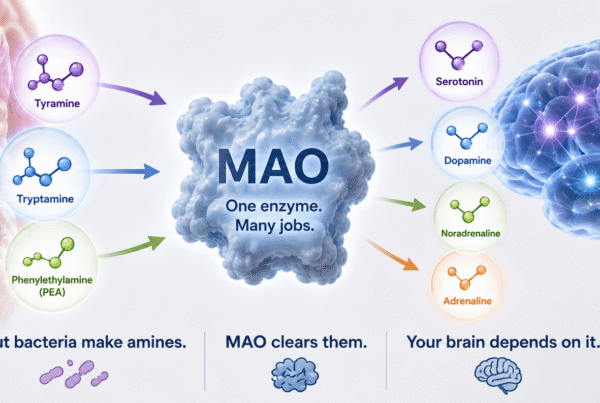
When MAO breaks down dopamine, the immediate product is an aldehyde called DOPAL. Noradrenaline produces DOPEGAL. Serotonin and the trace amines produce their own aldehydes. In each case ALDH performs the next step.³
DOPAL is not a benign intermediate. It has been described as the toxic dopamine metabolite, it causes cell death in vitro and in vivo, and it drives aggregation of alpha-synuclein.⁷ Within dopaminergic neurons, ALDH2 is the principal enzyme detoxifying it.⁸
So the enzyme clearing your wine is also clearing your dopamine.
Damaged fats
When polyunsaturated fats are oxidised, they break into reactive aldehydes — chiefly 4-hydroxynonenal (4-HNE), malondialdehyde and acrolein.¹ ³ These are produced continuously in proportion to oxidative stress, so inflammation, infection, intense exercise and poor mitochondrial function all raise the load.
The environment
Vehicle exhaust, smog, factory emissions, cigarette smoke, pesticides and herbicides all contribute aldehydes.¹ Formaldehyde and acetaldehyde are among the commonest indoor air contaminants, released from building materials, furnishings and fragranced products.
Yeast and bacteria in your own gut
Candida albicans produces acetaldehyde — both from ethanol and by fermenting glucose directly, at levels described as carcinogenic in vitro.⁹ ¹⁰ Several oral bacteria do the same, including Neisseria, Streptococcus and Rothia species.¹¹
This is the source most people never consider. Someone with a yeast overgrowth is producing acetaldehyde internally, continuously, without ever touching a drink.
Which is why it behaves like a drain
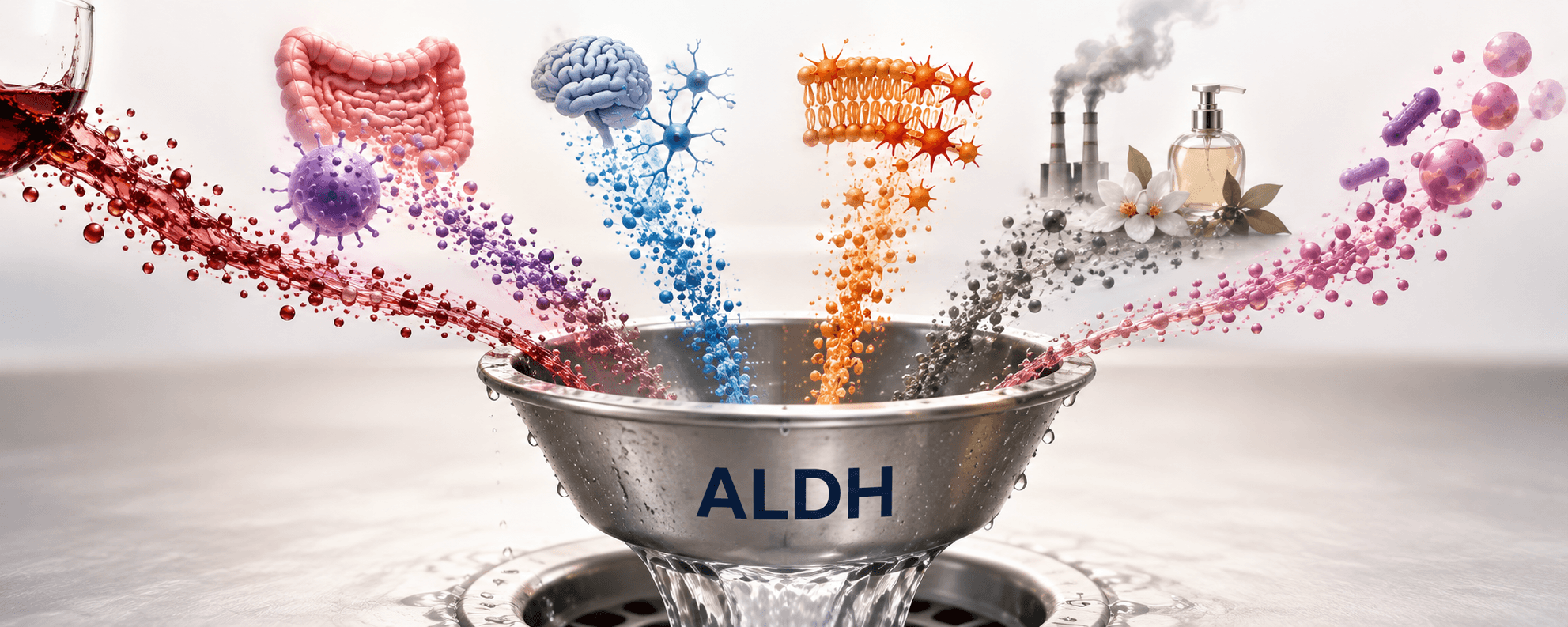
Put that list together and the picture is clear. Alcohol, histamine, every monoamine, oxidised fats, air pollution and gut organisms all deliver aldehydes to the same enzyme.
The published term for this is aldehydic load — the total burden from biological and environmental sources combined.³
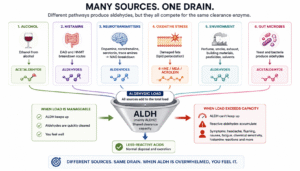
A pathway drains from the bottom. A block at the last step doesn’t slow one process, it backs up everything feeding into it. And because ALDH sits at the bottom of so many separate pathways, a limitation there produces symptoms that look completely unrelated to each other: alcohol intolerance, histamine reactions, mood and energy problems, chemical sensitivity, all in one person, all from one bottleneck.
It also explains why the load can arrive from anywhere. A yeast overgrowth uses capacity that would otherwise have been available for a glass of wine. An inflammatory flare producing 4-HNE uses capacity that would otherwise have handled a perfume in a lift. The sources are unrelated. The enzyme is the same.
The cycle that keeps it going
There is a feedback loop here that deserves attention, because it explains why this tends to worsen rather than stabilise.
4-HNE and malondialdehyde — the aldehydes produced by lipid peroxidation — inhibit ALDH activity at physiologically relevant levels. And critically, they do not inhibit MAO.⁴
Read that again, because the consequence is significant. Oxidative stress slows the enzyme that clears aldehydes while leaving untouched the enzyme that produces them. Production continues at full rate into a drain that has narrowed.
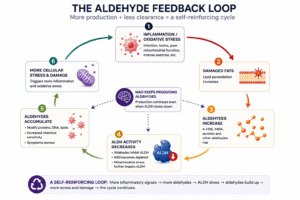
The backup route doesn’t rescue it either. Aldose reductase, which would normally compensate when ALDH is impaired, is itself inhibited by malondialdehyde.⁴
So a period of inflammation, infection or high oxidative stress doesn’t just add aldehydes — it reduces your ability to clear them, at the same time, through the same compounds. That is a self-reinforcing loop, and it’s a reasonable explanation for why chemical and alcohol sensitivity often appears after an illness, a mould exposure or a prolonged stressful period rather than being lifelong.
The genetics, stated accurately
The best-known ALDH variant is rs671 in ALDH2, sometimes written ALDH2*2 or Glu504Lys. It’s the cause of the alcohol flushing reaction.
The effect size is unusual for a common variant. Heterozygotes retain roughly 10–45% of normal enzyme activity; people carrying two copies have around 1–5%.¹² After a controlled alcohol challenge, rs671 carriers showed a six-fold increase in acetaldehyde compared with people carrying the standard version.¹³
It’s also common — 28–45% in East Asian populations, affecting around 540 million people worldwide, and rare in Western populations.¹² ¹⁴
That last point is where a lot of interpretation goes wrong. If you’re not of East Asian descent, rs671 is unlikely to be your explanation. But it isn’t the only inactivating variant. Two others — rs747096195 and rs190764869 — were shown to cause facial flushing and roughly a two-fold rise in acetaldehyde in heterozygous carriers, with reduced enzyme efficiency confirmed in purified protein.¹³ Alcohol flushing is not exclusive to one ancestry, and the common commercial gene panels don’t test for these.
Which brings me to the point I make about every gene result. A variant describes a tendency under load, not an outcome. Someone with a slower ALDH and a quiet gut, low inflammation and clean air may never notice. The same variant alongside a yeast overgrowth and a damp house produces a person who can’t walk down the detergent aisle. The genotype didn’t change. The load did.
And the load is the part you can do something about.
Why DAO supplements often disappoint
Follow the histamine chain through and this becomes obvious.
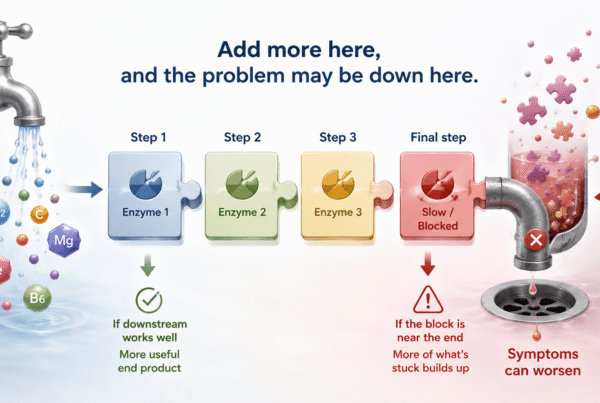
DAO converts histamine to imidazole acetaldehyde. If ALDH is at capacity, that aldehyde accumulates. The histamine has technically been broken down and the person feels no better, because the block was never at or just DAO — it was one step underneath.
Alcohol illustrates the same point from another angle. Acetaldehyde from alcohol competes directly with histamine’s aldehyde metabolite for the same enzyme, while alcohol and acetaldehyde simultaneously release histamine from mast cells and inhibit DAO.¹⁵ Three separate hits on the same system, which is why a single glass of wine can produce a reaction that seems wildly disproportionate.
Why treating yeast can make you feel worse
If yeast is producing acetaldehyde, then killing yeast releases more of it, faster, while the disposal enzyme is unchanged.
Feeling worse at the start of an antifungal or antimicrobial protocol is usually attributed to die-off or endotoxin release. Aldehyde load is a plausible additional contributor, and it points at a different response: reduce the rate rather than push through, and consider whether the disposal step has any spare capacity before increasing the production step.
This is the same sequencing problem that shows up everywhere in this area. The intervention isn’t wrong. The order is.
What actually helps
Direction rather than protocol, since what applies depends on where your load is coming from:
Work out which sources are yours. Internal production from yeast or bacterial overgrowth, oxidative stress from inflammation, environmental exposure, and dietary alcohol are four different problems with four different answers. Most people have more than one.
Reduce total load before worrying about individual triggers. Because everything shares one enzyme, lowering any source frees capacity for all the others. Someone who clears a gut overgrowth often finds their perfume tolerance improves, without having done anything about perfume.
Treat inflammation as an aldehyde source, not just a symptom. Lipid peroxidation produces aldehydes that then inhibit the enzyme clearing them. Interrupting that loop matters more than it looks.
Go slowly with antimicrobial treatment. Killing organisms that produce aldehydes increases the load at exactly the moment capacity is already limited.
Address the aldehyde step before the steps above it. Support aimed at histamine or at neurotransmitters tends to disappoint while the shared final step is congested.
Reduce controllable exposure while you work on the rest. Fragranced products, damp buildings and traffic exposure are the ones people have most control over. This is symptom management rather than a fix, but it buys room to work on the causes.
In summary
Aldehyde dehydrogenase is the final step for alcohol, both histamine routes, every monoamine neurotransmitter, oxidised fats, environmental pollutants and the output of gut yeast and bacteria. One enzyme, at the bottom of all of them.
Which is why a limitation there produces a set of symptoms that appear unconnected — alcohol intolerance, chemical sensitivity, histamine problems, mood and energy complaints — and why the total load matters more than any individual trigger.
And why the question worth asking isn’t which exposure to avoid next, but what’s currently occupying the capacity.
Frequently asked questions
Why can’t I tolerate alcohol at all?
Usually because acetaldehyde, the intermediate between alcohol and acetic acid, isn’t being cleared fast enough. Acetaldehyde causes the flushing, headache and nausea — not the alcohol. Reduced ALDH2 activity is one cause; a high existing aldehyde load from other sources is another, and the two combine.
Why do perfumes and chemical smells give me headaches?
Fragranced products, exhaust, smoke and building materials all contain aldehydes.¹ If aldehyde clearance is already occupied, a small additional exposure has nowhere to go. The mechanism is plausible and consistent with the biochemistry, though it hasn’t been directly demonstrated in people with chemical sensitivity.
Can you have hangover symptoms without drinking?
Yes. Yeast produces acetaldehyde — the same compound responsible for hangovers — both from ethanol and by fermenting glucose directly.⁹ ¹⁰ Someone with a significant overgrowth is generating it internally and continuously.
What is aldehyde dehydrogenase?
The enzyme family that converts reactive aldehydes into much less reactive acids. Humans have nineteen functional versions;² ALDH2, inside mitochondria, does most of the work on biologically produced aldehydes.³
Is aldehyde sensitivity genetic?
Partly. The rs671 variant reduces ALDH2 activity to roughly 10–45% in heterozygotes and 1–5% in homozygotes,¹² but it’s largely confined to East Asian populations. Other inactivating variants exist and aren’t on standard panels.¹³ More importantly, a variant only produces symptoms when the load is high enough to expose it.
Why doesn’t DAO help my histamine symptoms?
Because DAO produces imidazole acetaldehyde, which then needs aldehyde dehydrogenase.⁵ If that step is congested, breaking histamine down faster just generates more of something you also can’t clear. The block is underneath DAO rather than at it.
Why do I feel worse when treating candida?
Yeast produces acetaldehyde, so killing it releases more, faster, while your clearance capacity is unchanged. This is usually attributed to die-off; aldehyde load is a plausible contributor and suggests slowing the rate rather than pushing through.
Does inflammation make aldehyde problems worse?
Yes, and in two directions at once. Lipid peroxidation during oxidative stress produces 4-HNE and malondialdehyde — and both inhibit ALDH while leaving MAO, which produces aldehydes, unaffected.⁴ Production stays constant while clearance falls.
Can this improve?
Frequently, because it’s usually a capacity problem rather than a fixed one. The enzyme’s activity is set by genetics, but the demand on it isn’t — and reducing any one source frees capacity for all the others.
References
- The role of mitochondrial aldehyde dehydrogenase 2 (ALDH2) in neuropathology and neurodegeneration. (Review; aldehydic load from alcohol and food, environmental pollutants, neurotransmitter and amino acid metabolism, and lipid peroxidation.)
- Neuroprotective effects of aldehyde dehydrogenase 2 activation in rotenone-induced cellular and animal models of parkinsonism. Experimental Neurology. 2014. (Animal and cell models; nineteen functional ALDH genes in humans.)
- Aldehyde dehydrogenase 2 in the spotlight: the link between mitochondria and neurodegeneration. Neurotoxicology. 2018. (Review; ALDH2 substrate range including 4-HNE, malondialdehyde, acrolein, acetaldehyde, DOPAL and DOPEGAL.)
- Aldehyde dehydrogenase inhibition generates a reactive dopamine metabolite autotoxic to dopamine neurons. (In vitro; 4-HNE and malondialdehyde inhibit ALDH activity at physiological levels but do not inhibit MAO, and aldose reductase is inhibited by malondialdehyde.)
- Histamine pharmacogenomics. 2009. (Review; the DAO metabolite imidazole acetaldehyde is metabolised by aldehyde dehydrogenase to imidazole-4-acetic acid.)
- Dynamics of histamine in the brain. In: Basic Neurochemistry. (Textbook; HNMT produces tele-methylhistamine, which MAO-B converts to an aldehyde, then ALDH to tele-methylimidazoleacetic acid.)
- ALDH2 protects against dopaminergic neuronal cell ferroptosis. npj Parkinson’s Disease. 2025. (Review and experimental; DOPAL causes cell death in vitro and in vivo and drives alpha-synuclein aggregation.)
- Neuroprotective effects of ALDH2 activation (as above). (ALDH2 is the principal enzyme detoxifying DOPAL and 4-HNE within dopaminergic neurons.)
- Marttila E, et al. Fermentative 2-carbon metabolism produces carcinogenic levels of acetaldehyde in Candida albicans. Molecular Oral Microbiology. 2013. PMID 23445445. (In vitro; 15 clinical isolates.)
- Acetaldehyde production from ethanol and glucose by non-Candida albicans yeasts in vitro. 2009. (In vitro; C. tropicalis highest at 252 µM from ethanol, C. glabrata also producing from glucose.)
- Acetaldehyde production by Rothia mucilaginosa isolates from patients with oral leukoplakia. (In vitro; levels comparable to Neisseria mucosa and C. albicans, sufficient to induce oxidative stress in oral keratinocytes.)
- Analysis of ALDH2 rs671 genetic polymorphisms. Annals of Translational Medicine. 2021. (Human; heterozygotes 10–45% activity, homozygotes 1–5%. Prevalence 28–45% in East Asian populations.)
- Uncovering newly identified aldehyde dehydrogenase 2 genetic variants that lead to acetaldehyde accumulation after an alcohol challenge. (Human alcohol challenge plus purified enzyme; rs671 six-fold acetaldehyde increase, rs747096195 and rs190764869 two-fold with facial flushing.)
- Phenotyping aldehyde metabolism in humans uncovers novel genetic mutations in aldehyde dehydrogenase 2. (Preprint; approximately 540 million people worldwide carry rs671.)
- Alcohol-histamine interactions. 1999. PMID 10344773. (Review; acetaldehyde competes with imidazole acetaldehyde, and alcohol and acetaldehyde release histamine from mast cells and inhibit DAO.)