If a nutrient you clearly need makes you feel worse within days of starting it, the usual conclusions are that you’re intolerant to it, that it’s a detox reaction, or that you should push through. In most cases it’s none of those. It’s that the nutrient arrived before the pathway it feeds was able to move anything along.
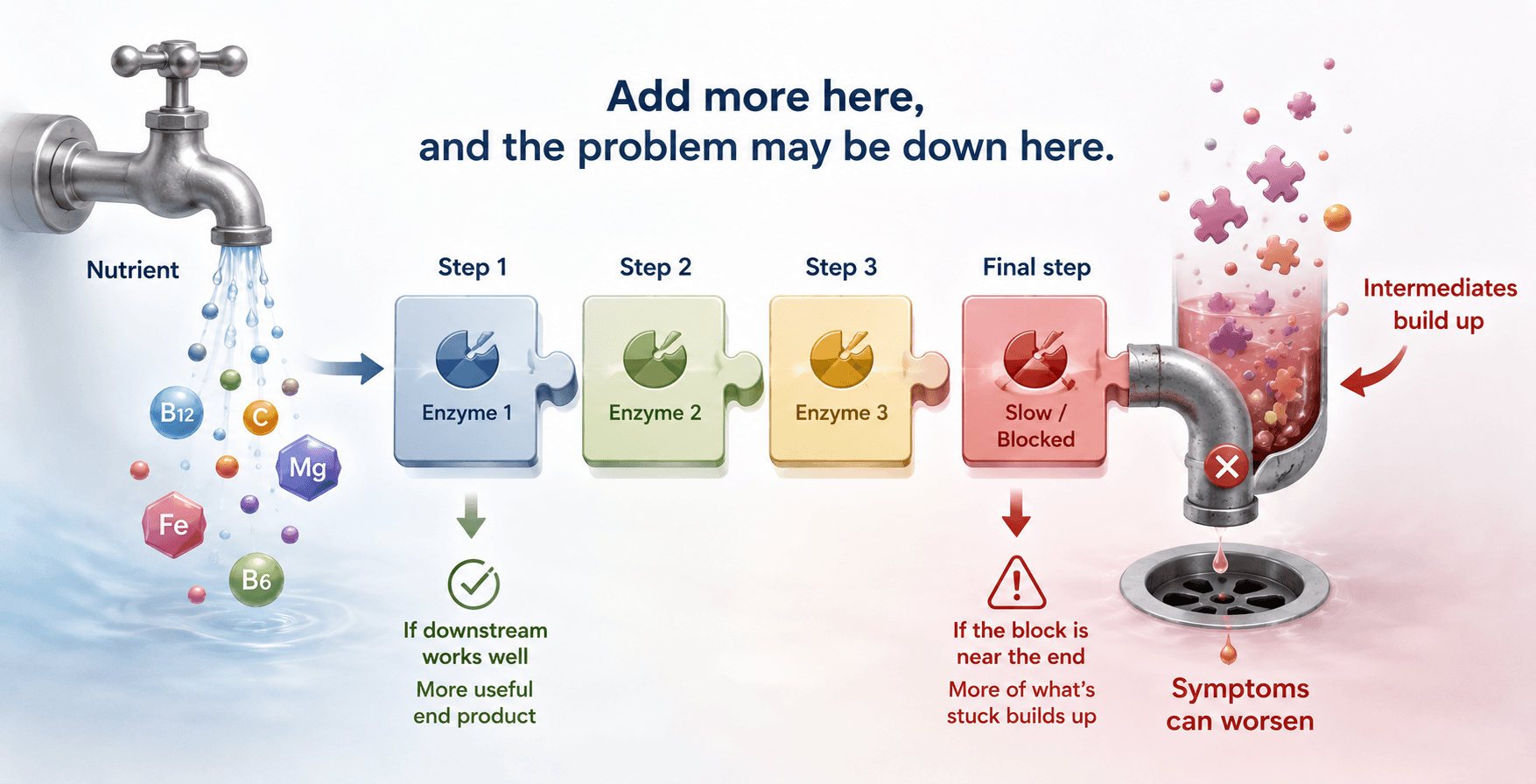
Biochemical pathways run in sequence, and they drain like a bath. If the plug is in at the far end, it makes no difference how good the taps are — filling faster only raises the water. Adding a nutrient that pushes production at the top of a blocked pathway increases the intermediate that was already accumulating, and intermediates are frequently more reactive than the end product.
So the useful question is not whether you need the nutrient. It’s whether anything downstream can currently handle what it produces.
What this pattern looks like
The people this happens to tend to have several of these in common:
- Reactions to things they’ve been told they’re deficient in — iron, B vitamins, magnesium, vitamin C, protein powder
- Reactions that appear within hours or days, not after weeks
- A long list of supplements tried and abandoned, often with detailed notes
- Feeling worse on the things that should help most
- A diet that has narrowed over years as more foods were removed
- Practitioners who added several things at once, so nothing could be attributed
- Being told the reaction was die-off, detox, or a herxheimer response
The tell is that the reactions are specific and reproducible rather than vague. Someone who reacts to exactly the same thing every time, in the same way, is describing their biochemistry.
Why the bottom of a pathway matters more than the top
A pathway is a sequence: a substance enters, an enzyme modifies it, it passes to the next enzyme, and so on until it leaves as something usable or excretable.
Every step in that sequence produces an intermediate. Intermediates are not inert — they’re chemically unfinished, and several of them are considerably more reactive than either the substance that entered or the product that eventually leaves.
Which means a slow enzyme near the end of a pathway causes far more trouble than a slow enzyme near the beginning. At the beginning, everything downstream still works, so the pathway simply runs slower. At the end, there is nowhere for the accumulating material to go.
Now add a supplement that increases flow into that pathway. If the block is at the front, you get more product and feel better. If the block is at the back, you get more of whatever is stuck behind it.
Same nutrient, same person, opposite outcome — determined entirely by where the block sits.
Worked example: histamine, DAO and the enzyme underneath it
This is the clearest illustration, because it explains something people run into constantly.
Histamine has two clearance routes. DAO breaks it down outside the cell, mainly in the gut. HNMT methylates it inside cells.
Here is the part that gets left out. DAO does not convert histamine into something harmless. It converts histamine into imidazole acetaldehyde, which then has to be oxidised by aldehyde dehydrogenase to imidazole-4-acetic acid before anything is finished.¹ ²
The methylation route does the same thing by a different path. HNMT produces tele-methylhistamine, which is then handled by MAO, producing another aldehyde — which also requires aldehyde dehydrogenase.³
Both histamine clearance routes end at ALDH. It is the drain for the entire pathway.
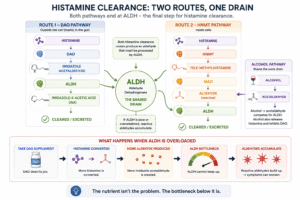
So consider someone with a slow or overwhelmed ALDH who takes a DAO supplement. DAO does its job. Histamine is converted. And the aldehyde produced by that conversion accumulates, because the step underneath cannot move it along.
They have not fixed the problem. They have moved it one step down and generated a reactive aldehyde in the process. Which is a plausible explanation for the common experience of taking DAO and noticing nothing, or feeling worse.
The same logic explains a pattern people notice long before they know why. Alcohol and histamine share aldehyde dehydrogenase, and acetaldehyde from alcohol competes directly with imidazole acetaldehyde for it. Alcohol and acetaldehyde also release histamine from mast cells and inhibit DAO.⁴ So alcohol loads the drain from three directions at once, which is why so many people with histamine problems cannot tolerate a single glass of wine.
Signs the drain is the problem
ALDH failure has a recognisable signature:
- Alcohol producing symptoms out of proportion to the amount — sometimes from just a mouthful
- Hangover-type symptoms without drinking at all
- Headaches from perfume, petrol, paint or cleaning products
- Strong reactions to smells that other people don’t notice
- Feeling worse in damp or mouldy buildings
- Feeling worse when treating yeast or bacterial overgrowth
The last one matters. Yeast and some bacteria produce aldehydes as metabolic by-products, and so does alcohol. Someone whose ALDH is already at capacity from an internal source will react to small external exposures that nobody around them notices.
Worked example: iron, dopamine and two blocked exits
Iron is the one that surprises people most, because low ferritin with normal haemoglobin is common and iron looks like an obvious answer.
Iron is the cofactor for tyrosine hydroxylase, the enzyme converting tyrosine to L-dopa — the first and rate-limiting step in making dopamine. So iron genuinely does raise dopamine production, and low dopamine genuinely does produce the flat, unmotivated, can’t-get-out-of-bed picture that low ferritin so often accompanies.
The problem is what happens to the dopamine next.
Dopamine has two exits. It converts onward to noradrenaline via dopamine beta-hydroxylase, or it’s broken down by monoamine oxidase. Both of those exits can be blocked.
DBH is inactivated by p-cresol, a compound produced by certain gut bacteria — and the inactivation is irreversible, a covalent modification of the enzyme’s active site rather than simple competition.⁵ Recovering that capacity means making new enzyme, not clearing the compound.
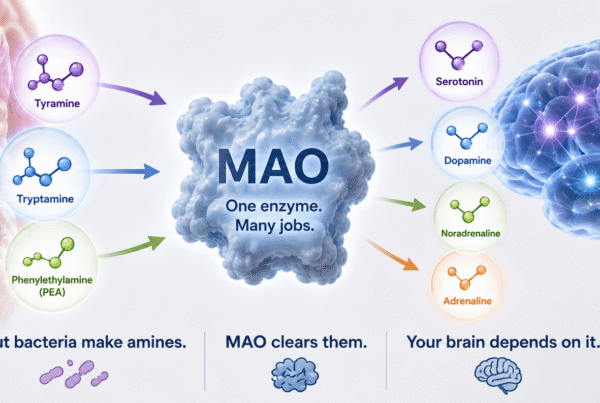
MAO, meanwhile, is handling serotonin, adrenaline, melatonin, the histamine metabolite mentioned above, and any bacterial amines arriving from the gut. It has a long substrate list and finite capacity.
So someone with a bacterial overgrowth producing p-cresol, taking iron for a genuine deficiency, can increase dopamine production into a pathway with both exits congested. The result is agitation, irritability and feeling wired rather than the motivation they were hoping for — while a test might still show their dopamine as low.
There’s a second route entirely. Yeast and many bacteria require iron for their own growth, and supplemental iron is available to them too. Feeling unwell on iron can reflect what the iron fed rather than the iron itself.
Worked example: when one block affects everything at once
Sometimes the bottleneck isn’t in the pathway you’re treating — it’s in something every pathway depends on.
Methylation reactions all use the same donor, SAM (S-adenosylmethionine). Every time a methyl group is handed over, SAM becomes SAH (S-adenosylhomocysteine). SAH then has to be cleared, and the enzyme that clears it works in a direction that stalls when homocysteine accumulates behind it.
SAH is a product inhibitor of the methyltransferases themselves. So when homocysteine is high, SAH rises, and every SAM-dependent enzyme slows down at once — including HNMT for histamine, COMT for stress chemicals and oestrogen metabolites, creatine synthesis for cellular energy, and phosphatidylcholine production for bile.
Which is why someone with high homocysteine can react to almost everything. It isn’t one blocked pathway. It’s a shared resource running short, so no matter which pathway you push, the same limitation appears.
In that situation, nutrients aimed at individual pathways tend not to bring positive results until the shared problem is addressed.
“You need it” and “you can handle it now” are different questions
This is the distinction that changes how you work.
Almost everything in the examples above is indicated. The iron deficiency is real. The DAO is a reasonable idea. The B vitamins are needed. Nothing in the assessment was wrong.
What was wrong was the order.
A nutrient is not good or bad in the abstract. It’s appropriate or inappropriate for a particular person, with a particular set of blocks, at a particular moment. The same iron that causes agitation this month can be exactly right in six months, with nothing about the iron having changed.
Which also means a reaction is information rather than failure. Reacting to a specific nutrient in a specific way tells you something about which pathway is congested and where. That is more useful than tolerating it would have been.
Working out the order
The principle is to start at the drain and work upward. In practice:
Look for the pattern across reactions, not at each one separately. One reaction is an anecdote. Reactions to iron, protein and B vitamins in the same person point at something shared.
Ask what the pathway produces, not just what it needs. If a nutrient increases flow, something has to handle the output. Whether it can is the question.
Treat the end of a pathway as the priority. Blocks near the end produce symptoms on their own and make everything upstream worse.
Ask what the worst outcome would be before starting anything. If you can’t think of a plausible bad outcome for a particular nutrient, it’s a reasonable place to begin. If you can, it probably isn’t the starting point even if it’s needed.
Change one thing at a time, and leave a few days between changes. Enough to tell whether something helped, harmed, or did nothing. Several things introduced together means a reaction can’t be attributed, and the useful information is lost.
Expect the first phase to be uneventful. If reactions have been the norm, the initial aim is finding things that are tolerated at all. That’s progress even when nothing feels dramatically better.
Don’t push through. Persisting with something that consistently produces symptoms rarely resolves. The reaction is telling you the sequence is wrong.
In summary
Feeling worse on a nutrient you need usually isn’t intolerance. It’s that the nutrient increased flow into a pathway that can’t currently move material through, so an intermediate accumulated instead.
Pathways drain from the bottom. A block near the end produces symptoms by itself and turns every upstream addition into a further backlog. Which is why the order things are done in often matters more than what is chosen.
And why a reaction is worth reading rather than overriding — it’s usually the most specific information available about where the actual problem sits.
Frequently asked questions
Why do supplements make me feel worse?
Most often because they increase activity in a pathway that’s blocked further along, so an intermediate accumulates rather than a useful end product. Several of those intermediates — aldehydes in particular — are more reactive than either the starting material or the finished product.
Is feeling worse on a supplement a detox reaction?
Sometimes, but it’s assumed far more often than it’s demonstrated. A reproducible reaction to a specific nutrient, arriving within hours and repeating every time, looks more like a pathway problem than a clearance event. The practical difference is that a detox reaction is something to wait out and a pathway block is something to address.
Why doesn’t the DAO enzyme help my histamine symptoms?
DAO converts histamine into imidazole acetaldehyde, which then requires aldehyde dehydrogenase to finish the job.¹ ² If that step is slow or overwhelmed, the aldehyde accumulates and the histamine symptoms don’t resolve. The block is underneath DAO, not at it.
Why does iron make me feel agitated?
Iron is the cofactor for the first step of dopamine synthesis, so it raises dopamine production. If dopamine’s exits are congested — the conversion to noradrenaline, or breakdown by MAO — the extra dopamine accumulates rather than being used, producing irritability and a wired feeling. Iron is also usable by gut organisms, which is a separate possible route.
What does it mean if I react to almost everything?
It often points at something shared rather than many separate intolerances — a nutrient every pathway depends on, or a clearance step every pathway drains into. Aldehyde dehydrogenase and methylation capacity are two common candidates.
Why can’t I tolerate alcohol at all?
Alcohol produces acetaldehyde, which competes with histamine’s own aldehyde metabolite for the same enzyme, while alcohol and acetaldehyde also release histamine from mast cells and inhibit DAO.⁴ Three demands on the same system at once, which is why the reaction can seem wildly disproportionate to the amount.
Should I push through a reaction?
Rarely helpful. A consistent reaction is information about sequence, and it usually means something needs addressing before that nutrient will be usable.
How long should I wait between starting new things?
Long enough to attribute a change to the thing that caused it — a few days is usually enough to tell whether something helped, harmed or did nothing. Introducing several things together means you lose the information regardless of the outcome.
Will I always react like this?
Usually not. Most of these are capacity problems rather than permanent ones, and the same nutrient that causes a reaction now can be well tolerated once the downstream block is addressed. Nothing about the nutrient changes — what changes is what’s waiting for it.
References
- Dynamics of histamine in the brain. In: Basic Neurochemistry. (Textbook chapter; DAO oxidation to imidazole acetic acid, HNMT methylation to tele-methylhistamine, and MAO-B handling of the latter.)
- Histamine pharmacogenomics. Pharmacogenomics. 2009. (Review; the DAO metabolite imidazole acetaldehyde is metabolised by aldehyde dehydrogenase to imidazole-4-acetic acid.)
- Histamine synthesis and metabolism. (Technical review; tele-methylhistamine is a substrate for MAO-B, and the resulting aldehyde is oxidised by aldehyde dehydrogenase to tele-methylimidazoleacetic acid.)
- Alcohol-histamine interactions. 1999. PMID 10344773. (Review; acetaldehyde competes with imidazole acetaldehyde and methylimidazole acetaldehyde, and alcohol and acetaldehyde liberate histamine from mast cells and inhibit diamine oxidase.)
- Goodhart PJ, DeWolf WE, Kruse LI. Mechanism-based inactivation of dopamine beta-hydroxylase by p-cresol and related alkylphenols. Biochemistry. 1987;26(9):2576-83. PMID 3607034. (In vitro; purified enzyme, irreversible covalent modification.)
- Progress in monoamine oxidase (MAO) research in relation to genetic engineering. 2004. PMID 14697876. (Review; MAO-A and MAO-B both require FAD as a covalently bound cofactor.)