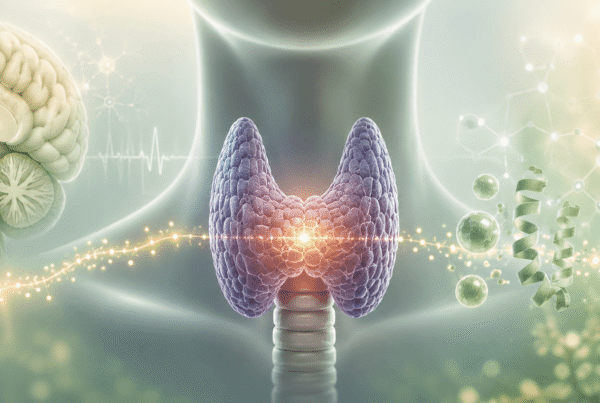

A normal TSH is reassuring, and most of the time it does mean the thyroid is fine. But TSH measures one specific thing — how much the brain (pituitary) is signalling the thyroid — not whether your cells are actually getting enough active thyroid hormone. So it’s possible to have thyroid-like symptoms with a normal TSH, because the problem sits somewhere TSH doesn’t look: in the conversion of thyroid hormone to its active form, or in how much of that active hormone reaches the tissues. TSH is a good first screen, not the whole story.
What TSH actually measures
TSH stands for thyroid-stimulating hormone, and the name is the clue: it’s not made by the thyroid at all. It’s made by the pituitary gland, which uses it to tell the thyroid how much hormone to produce.
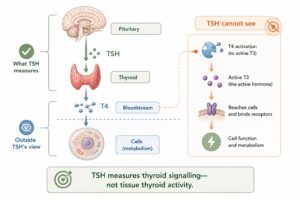
The logic of the test is a feedback loop. When thyroid hormone is low, the pituitary raises TSH to push the thyroid harder; when thyroid hormone is adequate, it lowers TSH. So a high TSH suggests an underactive thyroid, and a normal TSH suggests the pituitary is satisfied with what the thyroid is producing¹.
That’s genuinely useful, and for straightforward thyroid failure it works well. But notice what it’s really measuring: the pituitary’s perception of circulating thyroid hormone. It’s one step removed from the thing you care about, which is whether your cells are actually being supplied.
The gap: hormone still has to be activated
Here’s the part TSH can’t see.
The thyroid mostly releases T4, which is essentially inactive. To do anything, T4 has to be converted into T3, the active hormone that drives metabolism in your cells. That conversion happens in the tissues, by enzymes called deiodinases — and it can be impaired even when the thyroid itself is producing normally¹ ².
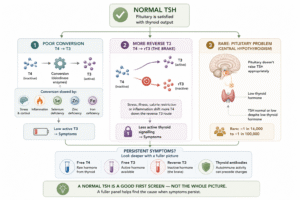
Several common things slow that conversion: chronic stress and raised cortisol, inflammation, chronic illness, and deficiencies of the nutrients the conversion depends on — notably selenium and zinc, and iron². When conversion is sluggish, you can have adequate T4, a satisfied pituitary and a perfectly normal TSH, while the amount of active T3 reaching your cells is low. The blood test looks fine; the tissues don’t have what they need.
This is worth being precise about, because it’s often described loosely. The nutrients here — zinc, selenium, iron — matter mainly at the conversion step, not at TSH production. So a deficiency doesn’t necessarily change your TSH; it changes how much T4 becomes active T3 downstream, which is exactly why TSH can miss it.
Reverse T3: the brake TSH doesn’t register
There’s a second way active hormone can fall without TSH reflecting it.
T4 doesn’t only convert to active T3. It can also convert to reverse T3, an inactive form that occupies thyroid receptors without switching them on — effectively a brake³. Under stress, illness, calorie restriction or inflammation, the body shifts more T4 down the reverse T3 route, reducing active thyroid signalling at the tissue level.
Crucially, this shift can happen while TSH stays normal, because the pituitary is responding to T4 levels, not to how the T4 is being divided between the active and inactive routes³. (This is explored further in the companion article on low T4 with a normal TSH, and the reverse-T3 mechanism in the piece on why metabolism slows when dieting.)
The rarer cause worth naming
There’s one more scenario, and it deserves a mention.
In central hypothyroidism, the problem is the pituitary itself — it doesn’t raise TSH appropriately, so you can have low thyroid hormone with a normal or even low TSH⁴. Because TSH-based screening assumes the pituitary is working normally, this slips through a TSH-only test⁴.
But it’s important to keep this in proportion: central hypothyroidism is rare, estimated at somewhere between 1 in 16,000 and 1 in 100,000⁵. It’s a real reason TSH can mislead, not a common one — and it’s usually accompanied by other signs of pituitary trouble.
Why “normal” doesn’t always mean “optimal” either
Separate from all the above is an important point about the reference range itself.
The TSH reference range is wide, and where the cut-off for “normal” should sit is debated — some argue the upper limit is too high and that people in the upper part of the range with clear symptoms can still be under-served⁶. This is contested rather than settled, but it’s a reminder that “within range” means “statistically common,” which isn’t the same as “optimal for you” — a theme that runs through blood testing generally (covered in the article on normal blood tests and deficiency).
So what does this mean in practice?
Not that TSH is useless — it’s a sensible first screen and usually sufficient. The point is narrower: a single normal TSH doesn’t definitively rule out a thyroid-related problem when symptoms clearly persist.
A fuller picture looks at more than the one number:
- Free T4 — how much raw hormone the thyroid is producing.
- Free T3 — how much active hormone is actually available.
- Reverse T3 — whether hormone is being shunted down the inactive route.
- Thyroid antibodies — whether autoimmune thyroid disease is present, which can precede changes in TSH.
Read together, these can reveal a conversion or activation problem that TSH alone would miss — or confirm that the thyroid genuinely is fine and the symptoms are coming from somewhere else, which is just as useful to know. Thyroid-type symptoms have many non-thyroid causes too (anaemia, sleep problems, and others), so a full picture cuts both ways.
This is a conversation to have with a doctor who can order and interpret a complete panel in the context of your symptoms. The aim isn’t to distrust a normal TSH — it’s to know what it does and doesn’t rule out.
The short version
TSH measures how hard the pituitary is signalling the thyroid, not whether your cells are getting enough active hormone. Conversion of T4 to active T3 can be impaired, or hormone can be shunted to inactive reverse T3, with TSH staying normal throughout. A normal TSH is a good first screen and usually reassuring — but when clear symptoms persist, it doesn’t rule out a thyroid problem on its own, and a fuller panel is what settles it.
Frequently asked questions
Can you have a thyroid problem with a normal TSH?
Yes, though most normal TSH results genuinely are fine. TSH reflects the pituitary’s perception of thyroid output, not whether cells are getting enough active hormone. Impaired conversion of T4 to active T3, a shift toward inactive reverse T3, or (rarely) central hypothyroidism can all occur with a normal TSH.
Why does TSH miss some thyroid problems?
Because it measures pituitary signalling, not tissue-level thyroid activity. The thyroid can produce enough T4 to satisfy the pituitary while the conversion of T4 into active T3 is impaired downstream, leaving cells under-supplied despite a normal TSH.
Do zinc and selenium affect the thyroid?
Yes, mainly at the conversion step. Selenium, zinc and iron are needed to convert T4 into active T3, so a deficiency can lower active hormone at the tissue level without necessarily changing TSH — one reason a standard test can look normal.
What tests are better than TSH alone?
A fuller panel including free T4, free T3, reverse T3 and thyroid antibodies gives a more complete picture, because it shows how much active hormone is available and whether hormone is being diverted to the inactive form — not just how the pituitary is responding.
What is central hypothyroidism?
A rarer form where the pituitary doesn’t raise TSH appropriately, so thyroid hormone can be low with a normal or low TSH. It slips through TSH-only screening, but it’s uncommon — estimated at 1 in 16,000 to 1 in 100,000 — and usually comes with other signs of pituitary problems.
Does a normal TSH mean my thyroid is optimal?
Normal means within a statistically common range, which isn’t necessarily optimal for every individual. Where the cut-off should sit is debated. More importantly, a normal TSH doesn’t rule out a conversion or activation problem, which is why persistent symptoms warrant a fuller look.
References
- TSH reflects the pituitary’s perception of circulating T4 via a negative feedback loop; it does not directly measure T4-to-T3 conversion, reverse T3, or receptor sensitivity. Revitalize Medical Clinic clinical explanation (2026).
- Deiodinase enzymes converting T4 to active T3 are inhibited by chronic stress and elevated cortisol, selenium deficiency, iron deficiency, chronic illness and insulin resistance, lowering tissue T3 while blood tests stay normal. Revitalize (2026); Eureka Health thyroid overview.
- T4 can convert to reverse T3, an inactive form that blocks thyroid receptors; stress, illness and calorie restriction shift more T4 to reverse T3, reducing active signalling while TSH stays normal. RestartMed; thyroid physiology literature.
- Central hypothyroidism: insufficient pituitary TSH stimulation of a normal thyroid; TSH is unreliable for its diagnosis and it evades TSH-based screening. California Center for Pituitary Disorders, UCSF; PMC4629398.
- Estimated prevalence of central hypothyroidism ~1:16,000 to ~1:100,000. PMC11857551 / central hypothyroidism reviews.
- The conventional TSH reference range is debated, with some arguing the upper limit is too high for symptomatic patients — a contested rather than settled position. Eureka Health / clinical commentary (2025).