How much oestrogen you have matters, but how you break it down matters just as much. Oestrogen is metabolised down three main routes, and they aren’t equal: one is relatively safe, one produces the most reactive by-products, and one keeps oestrogen active for longer. Two people with identical oestrogen levels can travel very different routes, and that pattern — more than the total — is what a metabolite test is actually showing you. What counts as an ideal pattern also shifts with life stage, which is why there’s no single “good” result.
Why metabolism matters as much as level
A standard hormone test tells you how much oestrogen is present. It doesn’t tell you what your body is doing with it — and disposal is a multi-step process with several possible paths.
Oestrogen is cleared in two phases. In phase one, the liver hydroxylates it into one of three metabolites. In phase two, those metabolites are deactivated and made water-soluble for excretion¹. Trouble can arise at either phase — sending too much down a reactive route, or failing to deactivate what’s produced.
The three phase-one routes
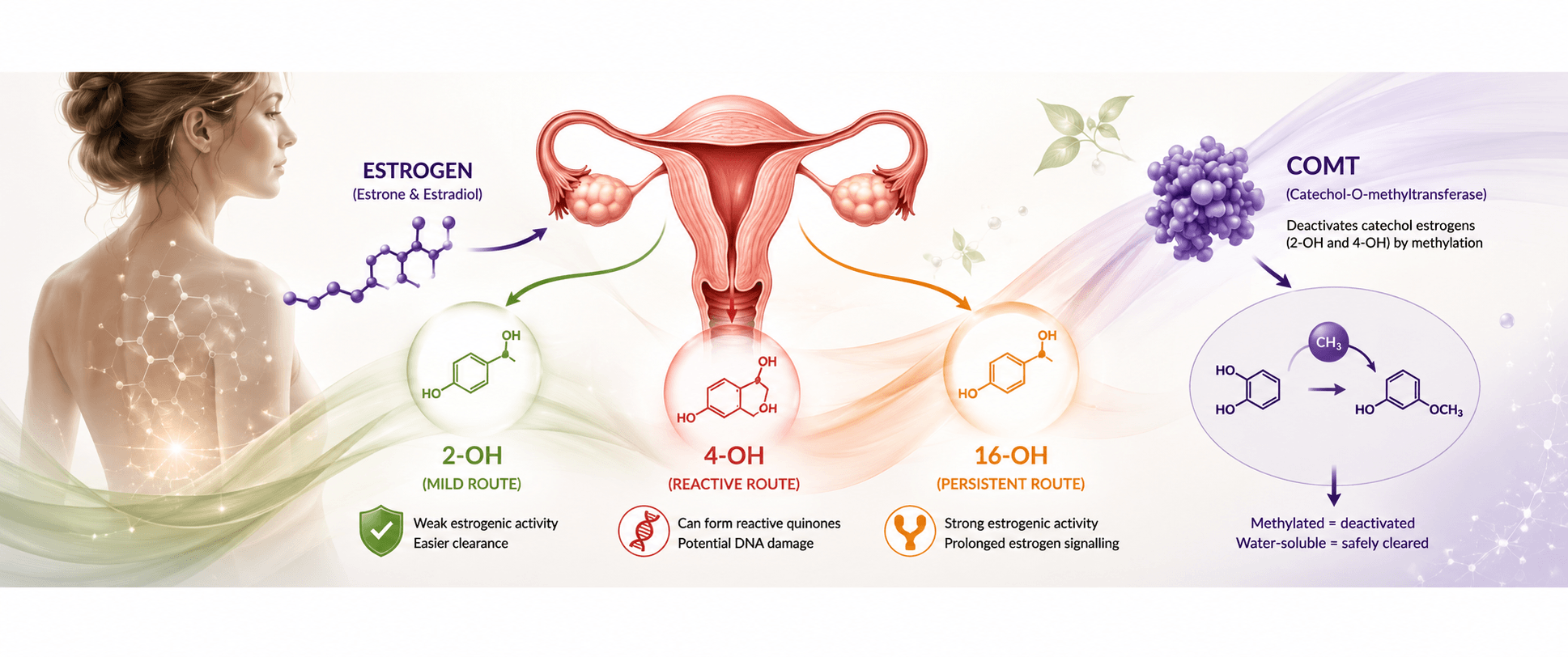
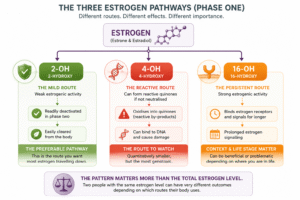
Oestrogen (as estrone and estradiol) is hydroxylated into three metabolites, each by a different enzyme, each with a different character¹ ².
2-hydroxy (2-OH) — the mild route. These metabolites have weak oestrogenic activity and are generally considered the preferable pathway. They’re readily deactivated in phase two and cleared². This is the route you’d want most oestrogen travelling down.
4-hydroxy (4-OH) — the reactive route. This is the one to watch. The 4-OH metabolites can oxidise into quinones — reactive molecules that can bind to DNA and cause damage if they aren’t neutralised quickly² ³. The 4-OH route is quantitatively smaller than the others, but it’s the most genotoxic, and the proportion of oestrogen going down it is meaningful³ ⁴.
16-hydroxy (16-OH) — the persistent route. These metabolites retain strong oestrogenic activity and bind oestrogen receptors, producing prolonged oestrogen signalling². Whether that’s a problem or a benefit depends entirely on context and life stage — which is the part most explanations skip.
The 2:16 ratio, and its limits
A commonly used marker is the ratio of 2-OH to 16-OH. A higher proportion of the mild 2-OH relative to the persistent 16-OH has been studied as a generally more favourable pattern during the reproductive years, particularly in relation to oestrogen-sensitive tissue².
Worth being honest about it, though: the 2:16 ratio is a useful lens, not a verdict. The research linking it to hard outcomes is mixed rather than settled, and it’s one input among several. Reading it as a pass/fail score overstates what it can tell you.
Phase two: where COMT comes in
Producing a metabolite isn’t the end — the reactive ones still have to be deactivated. For the catechol oestrogens (the 2-OH and 4-OH forms), the main deactivation step is methylation, carried out by the enzyme COMT (catechol-O-methyltransferase)² ⁵.
COMT attaches a methyl group, which switches the catechol oestrogen off and stops it oxidising into a damaging quinone². So COMT is a gate. If it’s working well, the reactive metabolites — especially the 4-OH — are neutralised before they can do harm. If it’s sluggish, catechol oestrogens can back up and their reactive potential is left unchecked⁵.
COMT depends on methylation working properly, which means it depends on the same machinery as the rest of your methylation cycle — B vitamins, magnesium, and an unclogged pathway. This is one of the places the oestrogen story and the methylation story meet.
Slow COMT isn’t automatically a problem
Here’s the nuance that gets lost, and it’s an important one.
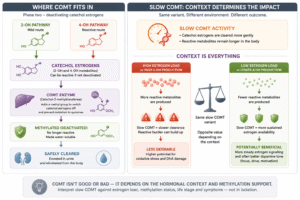
A common genetic variant produces a slower version of COMT. It’s tempting to read “slow COMT” on a report as a fault to be corrected — but whether it’s a disadvantage depends entirely on the context it’s operating in.
Slower COMT clears catechol oestrogens (and dopamine) more gently. When oestrogen load is high, or catechol production is high, that slower clearance can let reactive metabolites accumulate — a genuine liability. But in other contexts the same slow clearance is an advantage: more sustained oestrogen availability, and higher dopamine tone, which can mean better focus and drive⁶.
Same variant, opposite value, depending on the surrounding conditions. So slow COMT is not something to “fix” on sight. It’s something to interpret against everything around it — oestrogen load, methylation status, life stage, symptoms. A slow enzyme in a low-load setting may never be a problem, and may even be serving you.
A note on menopause and COMT
It’s worth correcting a common assumption here, because the direction runs opposite to what’s often stated.
Oestrogen actually restrains COMT — it binds oestrogen response elements on the COMT gene and turns its expression down⁵ ⁷. So when oestrogen falls at menopause, COMT expression tends to rise, not slow⁷. COMT doesn’t downshift after menopause to conserve oestrogen; if anything the reverse.
What genuinely changes the catechol-clearance picture after menopause isn’t COMT slowing down. It’s the altered oestrogen load and the state of your methylation support. So the practical focus post-menopause is less “is my COMT slow” and more “is my methylation well supplied, and what’s the overall oestrogen picture” — which is a more accurate and more useful place to look.
What’s “ideal” depends on life stage
This is why there’s no universal good result.
Reproductive years. With oestrogen relatively high, the priorities are keeping the reactive 4-OH route in check, methylating the catechols efficiently, and generally favouring the mild 2-OH route over the persistent 16-OH. An overactive persistent route is the less desirable direction here.
Around and after menopause. With oestrogen falling, the picture shifts. The 16-OH route retains oestrogenic activity, and some retained oestrogen signalling has value — for bone in particular. So a pattern that would be read as unfavourable in a 30-year-old can be appropriate, even protective, in a post-menopausal woman. The body isn’t making a mistake; it’s adapting to a lower-oestrogen state.
The general principle: a metabolite pattern is only “good” or “bad” relative to the person and where they are in life. The same numbers can mean different things a decade apart.
What the panel is really telling you
Read this way, an oestrogen metabolite panel isn’t a scorecard. It’s a map of how you personally process oestrogen: which route dominates, whether the reactive metabolites are being neutralised, and whether that pattern suits your stage of life.
The 4-OH proportion tells you about reactive load. The methylation of the catechols tells you whether phase two is keeping up. The 2:16 balance tells you something about the overall direction. And your life stage tells you what to make of all of it. No single number carries the answer — the pattern does.
A note on the evidence
The biochemistry — the three hydroxylation routes, the reactivity of 4-OH quinones, COMT’s role in methylating catechols, and oestrogen’s suppression of COMT — is well established¹ ² ⁵ ⁷. Where the evidence is softer is in the clinical predictions: exactly how strongly a given metabolite pattern forecasts a specific outcome in an individual. Much of that research is associational and mixed. So metabolite testing is a genuinely useful interpretive tool and a guide to where to look, not a validated formula for predicting disease. It belongs alongside symptoms, history and the rest of the picture.
The short version
Oestrogen is broken down three ways — a mild route, a reactive route, and a persistent one — and how those balance, plus whether the reactive ones are properly methylated by COMT, matters as much as your oestrogen level. Slow COMT isn’t automatically a fault; it depends on context. And what counts as an ideal pattern changes across life, which is why the same result can be reassuring at one age and worth attention at another.
Frequently asked questions
What do oestrogen metabolites tell you?
They show how your body is breaking oestrogen down, not just how much you have. Oestrogen travels three main routes — 2-OH (mild), 4-OH (reactive), and 16-OH (persistent) — and the balance between them, plus how well the reactive ones are neutralised, is what the pattern reveals.
Which oestrogen metabolite is the most concerning?
The 4-hydroxy (4-OH) route. These metabolites can oxidise into reactive quinones that may damage DNA if not methylated and cleared quickly. It’s a smaller pathway than the others but the most genotoxic, so the proportion going down it matters.
What does COMT do in oestrogen metabolism?
COMT methylates the catechol oestrogens (2-OH and 4-OH), switching them off and preventing them from oxidising into damaging quinones. If COMT is sluggish, these reactive metabolites can accumulate.
Is slow COMT bad?
Not automatically. Slow COMT clears catechol oestrogens and dopamine more gently, which is a liability when oestrogen or catechol load is high, but an advantage in other contexts — more sustained oestrogen and higher dopamine tone. It depends on the surrounding conditions, so it shouldn’t be “fixed” on sight.
Does COMT slow down after menopause?
No — the opposite. Oestrogen suppresses COMT, so when oestrogen falls at menopause, COMT expression tends to rise. The catechol-clearance picture after menopause is shaped more by the changed oestrogen load and methylation support than by COMT slowing.
What is an ideal oestrogen metabolite pattern?
There isn’t a single one — it depends on life stage. In the reproductive years, favouring the mild 2-OH route and keeping the reactive 4-OH in check is generally preferred. After menopause, retained oestrogen signalling via the 16-OH route can be appropriate and even protective, so the same pattern can mean different things at different ages.
References
- Estrogen phase I hydroxylation into 2-OH, 4-OH and 16-OH metabolites, then phase II deactivation (methylation, sulfation, glucuronidation). DUTCH Test / Precision Analytical, Estrogen Metabolism (2024); Understanding Phase I Estrogen Ratios.
- Why Estrogen Metabolism Matters — 2-OH as the milder route, 4-OH forming DNA-damaging quinones, 16-OH retaining estrogenic activity; COMT methylation of catechol estrogens; the 2:16 ratio. Allergy Research Group (2025).
- 4-Hydroxyestradiol and estradiol-3,4-quinone: oxidation to electrophilic quinones that form depurinating DNA adducts; 4-OH quantitatively smaller but highly genotoxic. PMC (2019); ScienceDirect, Estrogen Metabolism overview.
- The proportion of 4-hydroxy metabolites relative to total estrogen as an indicator of risk. Breast-cancer biomarker literature (2019).
- Low COMT activity backs up the catechol pathway, leaving 2-/4-OH estrogens to form reactive quinones; COMT deactivates catechol estrogens by methylation. Precision Analytical, COMT Enzyme (2024).
- COMT Val158Met (slow/Met) variant: lower enzyme activity, greater catechol estrogen and dopamine availability; context-dependent effects including anabolic effects on tissue. Skeletal muscle / COMT polymorphism study, PMC2265555; Seeking Health COMT guide (2026).
- Estradiol down-regulates COMT via estrogen response elements on the COMT promoter; estrogen decline after menopause increases COMT transcription. Human COMT down-regulation by estradiol (Neuropharmacology, 2003); Dopamine-dependent cognitive processes after menopause (2018).