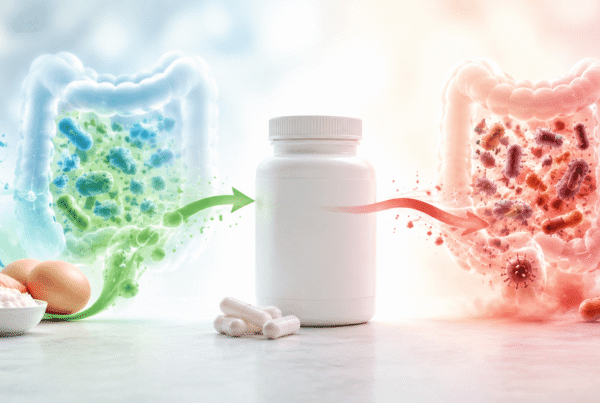
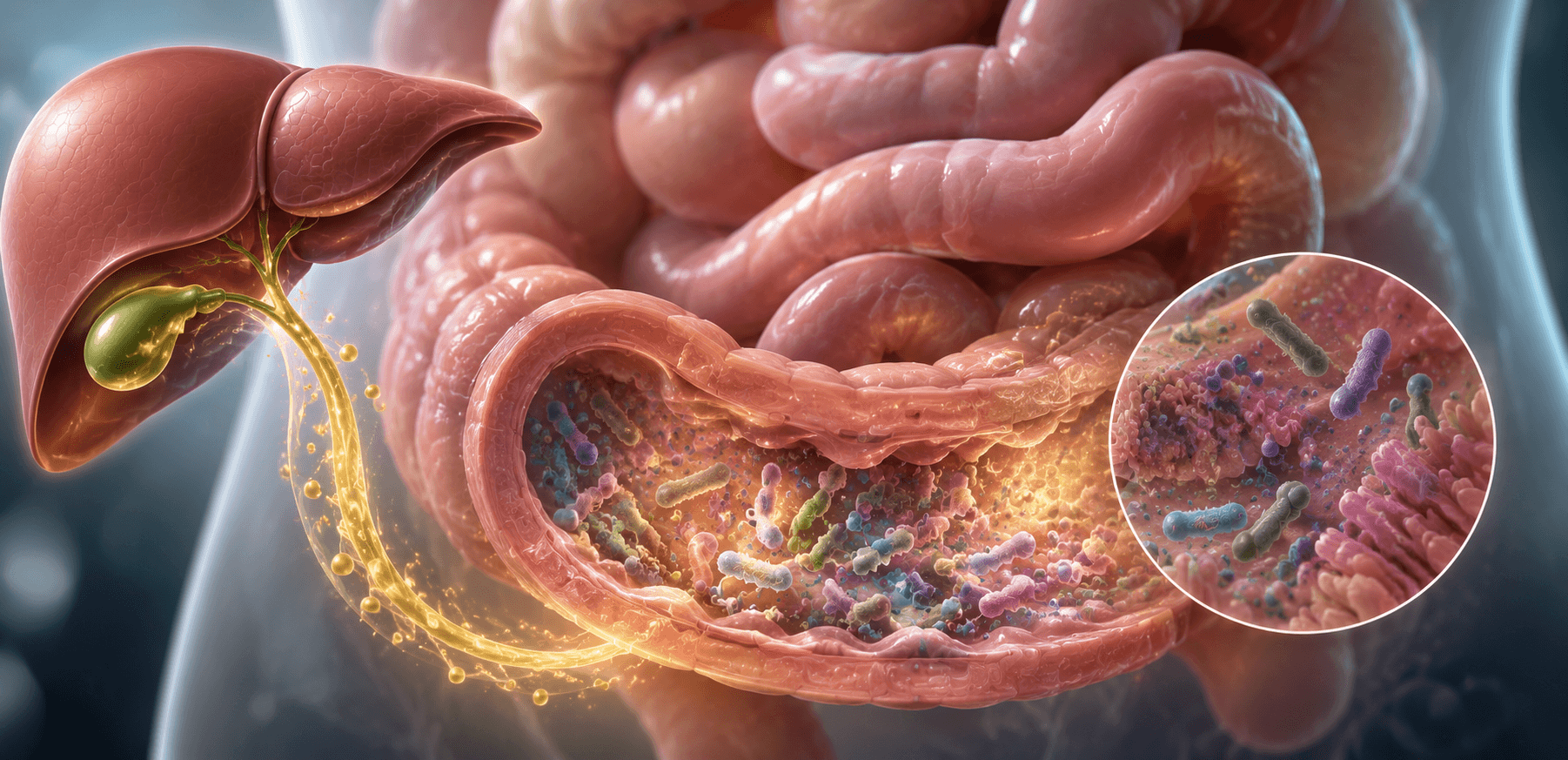
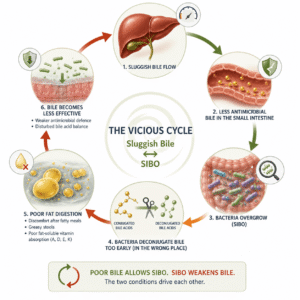
Sluggish bile and small intestinal bacterial overgrowth (SIBO) tend to occur together, and each one worsens the other. Bile is antimicrobial — it’s one of the things that keeps the upper small intestine relatively clear of bacteria. So when bile flow is poor, that control is weakened and bacteria are freer to overgrow. And once they overgrow, those bacteria interfere with bile itself, breaking it down in the wrong place and impairing fat digestion. It becomes a loop, which is part of why SIBO can be so persistent and why treating it without addressing bile often doesn’t result in permanent resolution.
Bile keeps the small intestine clear
Most people think of the small intestine as full of bacteria. It isn’t — or shouldn’t be. The dense bacterial population lives in the large intestine. The upper small intestine is meant to be relatively sparse, and bile is one of the reasons it stays that way.
Bile acids are antimicrobial in two distinct ways.
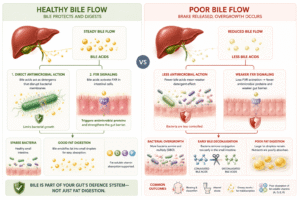
Directly. Bile acids are detergents. In the upper small intestine they disrupt bacterial cell membranes — breaking them open, dissipating the charge across them, and draining the bacteria’s internal energy — which limits bacterial growth by simple chemistry¹ ².
Indirectly, through signalling. Further down, bile acids activate the receptor FXR in the intestinal lining, which switches on genes that produce antimicrobial factors and defend the gut barrier³ ⁴. This is a controlled immune response, not just a detergent effect.
The evidence that this matters is direct: animals engineered to lack FXR have increased bacterial levels in the small intestine and a weakened gut barrier⁴. And low bile acid levels in the gut are associated with bacterial overgrowth and with specific pathogens gaining a foothold⁵.
So bile isn’t only a digestive fluid. It’s part of the gut’s defence — a chemical brake on overgrowth.
Poor bile flow releases the brake
It follows that if bile flow is reduced — sluggish production, poor release, obstruction — that brake weakens. Less bile reaching the small intestine means less antimicrobial pressure, and bacteria that would normally be kept in check have room to expand⁵.
This is one route into SIBO that’s often overlooked. The focus in SIBO is usually on motility — the sweeping movement that clears the small intestine between meals — and motility matters. But bile is a second, parallel control, and impaired bile flow can contribute to overgrowth independently.
Then the overgrowth attacks the bile
Here’s what closes the loop, and it’s the part that makes this self-sustaining.
Bile acids arrive in the intestine conjugated — joined to glycine or taurine. Bacteria carry an enzyme (bile salt hydrolase) that strips that conjugation off, deconjugating the bile acids⁶.
A certain amount of this is normal and necessary. But when there’s an overgrowth, it happens too much and too high up in the small intestine — in the wrong place. Prematurely deconjugated bile acids don’t emulsify fat properly, so fat digestion suffers⁶. That’s a direct cause of the fat-malabsorption symptoms — discomfort after fatty meals, greasy stools, poor fat-soluble vitamin absorption — that overlap so heavily with sluggish bile.
The deconjugated bile acids are also handled differently by the gut, which can further disturb the normal bile acid balance and recycling.
So the overgrowth that poor bile allowed now degrades bile function further — which weakens the antimicrobial brake even more.
The loop
Poor bile flow lets bacteria overgrow. The overgrowth deconjugates bile in the wrong place, impairing digestion and disturbing the bile acid pool. The disturbed bile is less able to control bacteria. Round it goes.
This bidirectional relationship — bile shapes the microbiome, the microbiome shapes bile — is well described⁵ ⁷. And it explains a common clinical frustration: SIBO that’s treated directly, with the overgrowth knocked back, but which returns, because the condition that allowed it — poor bile flow — was never addressed. Break one arm of the loop and leave the other intact, and the loop tends to re-form.
Why the symptoms overlap so much
Sluggish bile and SIBO share a symptom picture — bloating, discomfort after meals, altered stools, fat malabsorption — and now you can see why. They’re not two separate conditions that happen to look alike. They’re frequently two faces of the same disturbed system, driving each other.
Which is why sorting out which is dominant, and addressing both the overgrowth and the bile flow behind it, is usually more durable than treating either alone.
A note on the evidence
The core mechanisms are solid. Bile acids being antimicrobial, FXR driving antimicrobial defence, bacterial bile salt hydrolase deconjugating bile acids, and the bidirectional bile–microbiome relationship are all well established, much of it in animal and mechanistic studies⁴ ⁶ ⁷.
What’s less precisely mapped in humans is exactly how often poor bile flow is the initiating cause of a given person’s SIBO versus a consequence of it, and how much treating bile flow changes SIBO outcomes in controlled trials. So this is a well-supported mechanistic relationship from a clinical lens. As always, it belongs alongside the rest of the picture, not on its own.
The short version
Bile helps keep the small intestine free of overgrowth, so poor bile flow invites SIBO — and SIBO, in turn, degrades bile function and fat digestion. The two reinforce each other, which is a large part of why SIBO recurs. Addressing the overgrowth without addressing the bile behind it often leaves the loop intact.
Frequently asked questions
Can bile problems cause SIBO?
They can contribute. Bile is antimicrobial and helps keep the small intestine clear of overgrowth, so reduced bile flow weakens that control and gives bacteria room to expand. It’s one route into SIBO alongside impaired motility.
How does bile stop bacterial overgrowth?
Two ways. Directly, bile acids are detergents that disrupt bacterial membranes. Indirectly, they activate the FXR receptor in the gut lining, which triggers the release of antimicrobial factors and supports the gut barrier.
Does SIBO affect bile?
Yes. Overgrown bacteria deconjugate bile acids too early and too high in the small intestine, which impairs fat digestion and disturbs the bile acid balance. This is why SIBO often produces the same fat-malabsorption symptoms as sluggish bile.
Why does my SIBO keep coming back?
Recurrence is common when an underlying cause is left unaddressed. If poor bile flow helped allow the overgrowth, treating the bacteria without supporting bile flow leaves that door open, and the overgrowth can re-establish.
Are SIBO and sluggish bile the same thing?
No, but they overlap heavily and drive each other. They share symptoms like bloating, fatty-meal discomfort and altered stools, and they frequently occur together as two parts of one disturbed system.
How do you break the cycle?
By addressing both the overgrowth and the bile flow behind it, rather than either alone. What’s appropriate depends on which is dominant and what’s driving it, which is why assessment matters more than a fixed protocol.
References
- Bile acids are potent antimicrobials that disrupt bacterial membranes, dissipating transmembrane potential and depleting intracellular ATP. Chai, L-N. et al. (2023), Microorganisms, 11(7), 1823; and Bile Acid and Gut Microbiota in IBS (2022).
- Bile Acid and Gut Microbiota in Irritable Bowel Syndrome. Journal of Neurogastroenterology and Motility (2022). — Bile acids as innate antimicrobial defence; unconjugated bile acids more potent.
- Bile acids confer gut mucosal protection against bacteria — conjugated bile acids inhibit overgrowth directly in the proximal small intestine and via FXR-induced antimicrobial factors in the distal small intestine. PNAS commentary (2006).
- Inagaki, T. et al. (2006). Regulation of antibacterial defense in the small intestine by the nuclear bile acid receptor. PNAS, 103(10), 3920–3925. — FXR-knockout mice show increased ileal bacteria and a compromised epithelial barrier.
- Bile Acids: Their Role in Gut Health Beyond Fat Digestion — low gut bile acid levels associated with bacterial overgrowth and pathogens; bidirectional bile–microbiome relationship. Clinical Education review (2019).
- Diagnosis and treatment of SIBO — bacterial bile salt hydrolase deconjugates bile acids in the small intestine, affecting fat digestion and enterohepatic circulation. International Journal of Molecular Sciences (2023).
- Bidirectional relationship between bile acids and the gut microbiota: bile acids shape microbial composition, and the microbiota modifies bile acids. Reviewed in Bile Acid and Gut Microbiota in IBS (2022) and related literature.