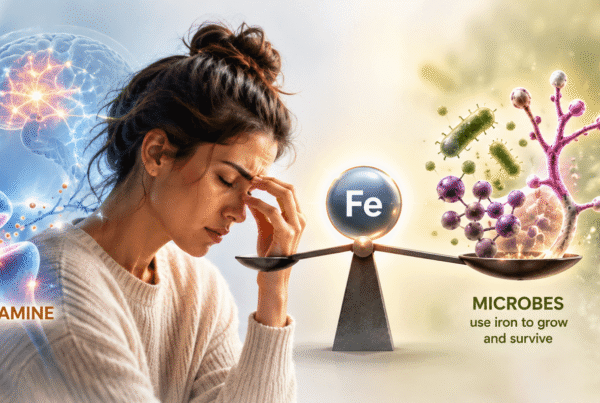

A plan falls through, a message goes unanswered, or something you were looking forward to doesn’t happen. On paper it’s a small thing. But the air goes out of you, and for days you can’t find the energy to start anything. If that sounds familiar, you’re not being dramatic and it isn’t a weakness of character. Deep in your brain sits a small structure whose whole job is to register disappointment and turn your motivation down when it happens. In some people, that system runs louder than it needs to.
The part of your brain that keeps score of disappointment
It’s called the habenula. It is only a few millimetres across, tucked near the centre of the brain, and it’s very old. Fish have one, and so do we.
Your brain is constantly predicting what’s about to happen. When things turn out better than expected, your dopamine system lights up and you feel that lift of reward. When things turn out worse than expected, the habenula fires instead.¹ It’s sometimes called the brain’s anti-reward centre, because when it fires, it switches down the parts of your brain that make dopamine and serotonin.²
That’s the drop you feel. It isn’t only sadness about the thing that went wrong. It’s your reward chemistry being turned down on purpose.

Why a letdown drains your motivation, not just your mood
This system exists for a good reason. If you keep going back to a fruit tree that has no fruit, you waste energy you can’t afford. The habenula’s job is to say, “That didn’t pay off. Stop spending effort there.” It protects you from chasing things that keep failing.³
The trouble is that it doesn’t always aim precisely. When dopamine and serotonin are turned down, they’re turned down broadly. So a disappointment in one area can flatten your drive for everything: the washing, the email you were meant to send, the walk you usually enjoy. You haven’t stopped caring about those things. Your brain has temporarily decided that effort isn’t worth it.
That’s also why the feeling can outlast the event. The disappointment might be over by lunchtime. The dampened reward system takes longer to come back up.
Why some people’s alarm is set louder
Most of what we know about the habenula comes from animal research, because it’s too small and deep to study easily in people. But that research shows a clear pattern. Under ongoing stress, habenula cells start firing in bursts rather than steadily, and those bursts are strongly linked to giving up and losing interest in things that used to be rewarding.²
In other words, a brain that has been under strain for a long time may have a more sensitive disappointment alarm. The same setback lands harder. If you’ve been unwell for a long time, carrying a lot of stress, or living through a run of things going wrong, a stronger reaction to small letdowns makes sense. Your brain has learned to expect that effort doesn’t pay off, and it’s reacting faster.
This is also where the habenula overlaps with the way some people read the worst into ordinary events. A brain primed to expect disappointment will find it more often.

The same system sits behind cravings and withdrawal
The habenula has two halves. The one I’ve been describing, the lateral habenula, handles disappointment. The other half, the medial habenula, handles the unpleasant feelings that push you to avoid something.
The medial habenula is packed with nicotine receptors, and it is part of what makes nicotine feel unpleasant once you’ve had too much, which helps limit how much you take.⁴ It’s also involved in the miserable, restless feeling of withdrawal.⁵ If you’ve ever tried to give something up and felt flat and irritable for weeks, this is part of why. I’ve written more about that in what happens to your memory and mood when you quit smoking.
The medial habenula also carries an unusual receptor that can be switched on by glycine alone, released by the support cells around the nerve cells. Turning that receptor down stopped animals learning to avoid unpleasant situations.⁶ It shows how finely tuned this avoidance system is. It doesn’t mean glycine you eat or take as a supplement affects your mood this way.
What this means for you
Knowing the habenula is involved doesn’t change the feeling, but it can change how you respond to it.
- The crash is chemistry, not a verdict. Feeling like nothing is worth doing after a setback is your reward system turned down. It is not an accurate reading of your life, and it will come back up.
- Avoid big decisions in the dip. A brain with dampened reward will undervalue everything. Quitting a job, ending a friendship or abandoning a plan can wait a few days.
- The system learns from the gap between what you expect and what happens. Small, reliable wins teach it that effort can pay off. A short walk you know you’ll finish does more here than an ambitious plan that falls through.
- Look at the background load. If small things are flattening you more than they used to, ask what has changed. Ongoing stress, poor sleep, illness and long recovery all keep the system on edge.
If the flatness lasts more than two weeks, or you’ve lost interest in nearly everything, please talk to your GP. That’s no longer a passing reaction, and it deserves proper support.
Frequently asked questions
What is the habenula?
The habenula is a tiny, ancient structure near the centre of the brain. It fires when things turn out worse than expected and turns down the brain areas that produce dopamine and serotonin, which reduces motivation to keep trying something that isn’t paying off.
Does the habenula cause depression?
It’s one part of the picture, not the cause. In animal research, an overactive habenula is linked to losing interest and giving up, and it’s being studied as a target in depression. Depression involves many other systems as well, and most of the habenula research so far is in animals.
Why do small disappointments hit me harder when I’m stressed or unwell?
Ongoing stress appears to make the habenula fire more strongly, so the same setback produces a bigger drop in motivation. Your brain has learned to expect disappointment and reacts to it faster.
Is the habenula why quitting smoking feels so bad?
It’s part of it. The medial habenula is rich in nicotine receptors and is involved in both the unpleasant side of nicotine and the low, irritable feeling of withdrawal.
Can glycine supplements change my mood through the habenula?
There’s no evidence for that. The glycine-activated receptor in the habenula responds to glycine released locally by the brain’s own support cells, not to glycine from food or supplements.
How can I tell a normal letdown from something more serious?
A normal letdown eases within days, and you can still enjoy some things in the meantime. If the flatness lasts more than two weeks, spreads to almost everything, or comes with thoughts that life isn’t worth living, see your GP or a mental health professional.
References
1. Matsumoto M, Hikosaka O. Lateral habenula as a source of negative reward signals in dopamine neurons. Nature. 2007;447(7148):1111-1115. PMID 17522629.
2. Yang Y, Cui Y, Sang K, et al. Ketamine blocks bursting in the lateral habenula to rapidly relieve depression. Nature. 2018;554(7692):317-322. PMID 29446381.
3. Hikosaka O. The habenula: from stress evasion to value-based decision-making. Nat Rev Neurosci. 2010;11(7):503-513. PMID 20559337.
4. Fowler CD, Lu Q, Johnson PM, Marks MJ, Kenny PJ. Habenular α5 nicotinic receptor subunit signalling controls nicotine intake. Nature. 2011;471(7340):597-601. PMID 21278726.
5. Salas R, Sturm R, Boulter J, De Biasi M. Nicotinic receptors in the habenulo-interpeduncular system are necessary for nicotine withdrawal in mice. J Neurosci. 2009;29(10):3014-3018. PMID 19279237.
6. Otsu Y, Darcq E, Pietrajtis K, et al. Control of aversion by glycine-gated GluN1/GluN3A NMDA receptors in the adult medial habenula. Science. 2019;366(6462):250-254. PMID 31601771.