
When you cut calories, your body doesn’t just burn its fat stores and carry on as normal. It reads the deficit as scarcity and lowers the rate at which it burns energy — so “calories out” falls to meet “calories in.” The largest drivers are a drop in active thyroid hormone (T3), which slows your resting metabolism, and an unconscious reduction in everyday movement. This is an adaptation, not damage, and it’s the main reason a calorie deficit that worked at first eventually stops delivering, and why lost weight is so easily regained.
Your metabolism is not a fixed number
The common model of dieting assumes your body burns a set number of calories a day, so eating below that number produces steady, predictable loss. If that were true, weight loss would never plateau.
It isn’t true. Your resting metabolic rate — the energy you burn just staying alive, which is the majority of your daily expenditure — adjusts to how much you’re eating. Cut intake substantially and the body, sensing a shortage, turns the rate down to conserve energy. This response has a name: adaptive thermogenesis¹.
The thyroid drops active hormone first
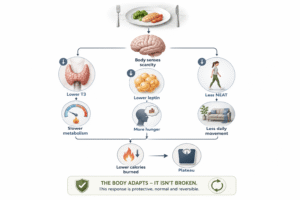
The thyroid is central, because it sets the pace of your resting metabolism — and it responds to calorie restriction quickly.
The thyroid mostly releases T4, an inactive hormone. To have a metabolic effect, T4 must be converted into T3, the active form that actually drives energy use in cells. Under calorie restriction, that conversion falls. In one controlled study, just 25 days of calorie restriction produced a significant drop in T4-to-T3 conversion — roughly a 50% reduction in T3². Trials of longer-term restriction consistently show sustained lower T3, even when T4 and TSH stay put³.
Less active T3 means a lower metabolic rate in cells throughout the body. Nothing is broken — the thyroid is deliberately producing less of the signal that says “burn.” This is why metabolism can slow within weeks of starting an aggressive diet, well before much weight is lost.
The reverse T3 side of it
There’s a second part to the thyroid story, and it’s worth stating precisely because it’s often overstated. T4 can also be converted into reverse T3 — an inactive form that occupies thyroid receptors without activating them, effectively a brake⁴.
The honest version of the evidence: the clearest, most consistent finding in dieting is the fall in active T3. The shift toward reverse T3 is best documented at the tissue level — changes in the deiodinase enzymes in muscle and liver reduce how much active T3 is available locally, producing a kind of local hypothyroidism even when blood levels look normal⁴ ⁵. So the “brake” is real, but it operates as much inside the tissues as in the bloodstream — which is one reason a standard blood test may not capture it. (This is explored further in the companion article on low T4 with a normal TSH.)
You also move less — without deciding to
This one surprises people, and it’s actually the single largest piece of the slowdown for many.
Beyond your resting rate, you burn energy through everyday movement that isn’t formal exercise — fidgeting, walking pace, posture, gesturing, taking the stairs. It has a name: NEAT (non-exercise activity thermogenesis). During calorie restriction, the body quietly turns all of this down. You fidget less, move more slowly, sit more — without any conscious decision.
The scale is significant: NEAT has been shown to fall by several hundred calories a day during prolonged restriction — in some people more than the drop in resting rate itself⁶. So a large part of “calories out” falling is simply that a dieting body becomes stiller, automatically.
Leptin ties it together
The signal coordinating much of this is leptin, a hormone released by fat cells roughly in proportion to how much fat you carry. It reports your energy reserves to the brain.
As you lose fat, leptin falls — and the brain reads falling leptin as a warning. In response, it lowers metabolic rate and increases appetite at the same time⁷. So the further you get into a diet, the stronger the biological push in both directions: burn less, eat more. It isn’t weakness; it’s a coordinated defence of your previous body weight.
Why this is an adaptation, not damage
This matters, because the language around it (“wrecked metabolism,” “starvation mode” as a permanent state) is mostly wrong and unhelpful.
Every part of this response — lower T3, reduced movement, falling leptin — is the body doing exactly what kept humans alive through food shortages. It’s protective machinery working as designed. And it’s largely reversible: returning to adequate intake allows metabolic rate to recover over time⁸. Your metabolism isn’t broken; it’s responding.
What it does mean is that the body actively opposes sustained weight loss, which is why the process is rarely linear and why the loss is easy to regain — after dieting, a lower metabolic rate can persist, so a person who has lost weight may burn less than someone the same size who hasn’t⁷.
Why the plateau happens — and what to do
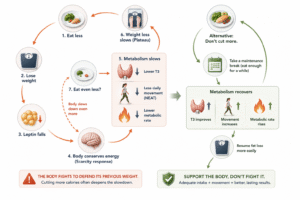
Put it together and the classic plateau makes sense. You cut calories; you lose weight at first; then “calories out” falls to meet your new intake — through less active thyroid hormone, less spontaneous movement, and lower leptin — until you’re back in balance and the scale stops.
The instinctive response is to cut calories further. Sometimes that’s exactly wrong, because it can deepen the very adaptation that caused the stall.
- Don’t automatically eat less when you stall. If metabolism has downshifted, cutting further can push it down more. Sometimes eating a little more, for a while, is what restores the rate.
- Consider a diet break. Returning to maintenance intake for a period can ease the hormonal signals driving the slowdown before resuming⁸.
- Protect movement and muscle. Since so much of the loss is reduced NEAT, deliberately staying active counters it; keeping muscle through resistance work supports resting rate.
- Watch for the symptoms of a downshift — feeling cold, sluggish, low mood, fluid retention, appetite dropping away. These are the felt signs of a slowed metabolism, and they’re information that eating less further is the wrong direction.
- Judge by more than the scale. Because the response is a whole-body adaptation, how you feel and function tells you as much as the number.
The short version
Cutting calories lowers active thyroid hormone, quietly reduces how much you move, and drops leptin — so your body burns less and defends its weight. It’s a protective adaptation, not a broken metabolism, and it’s why deficits stop working and lost weight returns. Understanding it changes the response: when a diet stalls, eating even less is often the opposite of what the situation calls for.
Frequently asked questions
Why does my metabolism slow down when I diet?
Because the body reads a calorie deficit as scarcity and lowers energy expenditure to conserve. The main drivers are a drop in active thyroid hormone (T3), which slows resting metabolism, and an unconscious reduction in everyday movement. Falling leptin coordinates both.
How quickly does metabolism slow when cutting calories?
Quickly. One controlled study found a significant reduction in T4-to-T3 conversion — around a 50% drop in active T3 — after just 25 days of calorie restriction, often before much weight is lost.
Is “starvation mode” real?
The underlying adaptation is real — metabolic rate genuinely falls during restriction. But the popular idea of a permanently “wrecked” metabolism is misleading. It’s a protective, largely reversible response, not lasting damage.
What is reverse T3 and does it matter for dieting?
Reverse T3 is an inactive form of thyroid hormone that occupies receptors without activating them, acting as a brake. In dieting, the clearest change is a fall in active T3; the reverse T3 shift is best documented at the tissue level, which is one reason a standard blood test may not fully capture the slowdown.
Should I eat less if I hit a weight loss plateau?
Not automatically. If metabolism has downshifted, cutting further can deepen the adaptation. Sometimes a diet break at maintenance, protecting movement and muscle, and watching for symptoms of a slowed metabolism is more effective than eating even less.
Why is dieted-off weight so easy to regain?
After weight loss, metabolic rate can stay lowered and appetite raised, so a person who has dieted may burn less and feel hungrier than someone naturally the same size. The body is defending its previous weight, which biases toward regain.
References
- Adaptive thermogenesis — the reduction in energy expenditure below what body size predicts, during and after calorie restriction. ScienceInsights review (2025); Trexler et al. (2014).
- 25 days of calorie restriction significantly reduced T4-to-T3 conversion, roughly a 50% reduction in T3, with a concurrent fall in TSH. American Journal of Physiology — Endocrinology and Metabolism; summarised by Holtorf Medical Group.
- Long-term calorie restriction with adequate protein and micronutrients produces sustained lower T3 without changing T4 or TSH; a randomised trial found T3 fell with calorie restriction but not with equivalent exercise-induced fat loss. Calorie-restriction thyroid-hormone studies (2006).
- T4 can convert to reverse T3, an inactive form that blocks thyroid receptors; too much rT3 relative to T3 produces cellular hypothyroidism with a reduced metabolic rate. Holtorf Medical Group summary.
- Adaptive thermogenesis and catch-up fat: increased muscle type 3 deiodinase and decreased hepatic type 1 deiodinase reduce local tissue T3 availability, producing local hypothyroidism despite normal circulating levels. PMC7971177; PMC12534267.
- Non-exercise activity thermogenesis (NEAT) can fall by several hundred kcal/day during prolonged restriction, sometimes exceeding the reduction in resting metabolic rate. Macro Balance Lab / adaptive thermogenesis literature (2026).
- Leptin falls as fat is lost, signalling the brain to lower metabolic rate and raise appetite; reduced expenditure can persist after weight loss, favouring regain. ScienceInsights (2025).
- Adaptive thermogenesis is largely reversible; returning to maintenance intake (diet breaks, gradual calorie restoration over roughly 8–16 weeks) helps restore metabolic rate. Metabolic-adaptation reviews (2026).