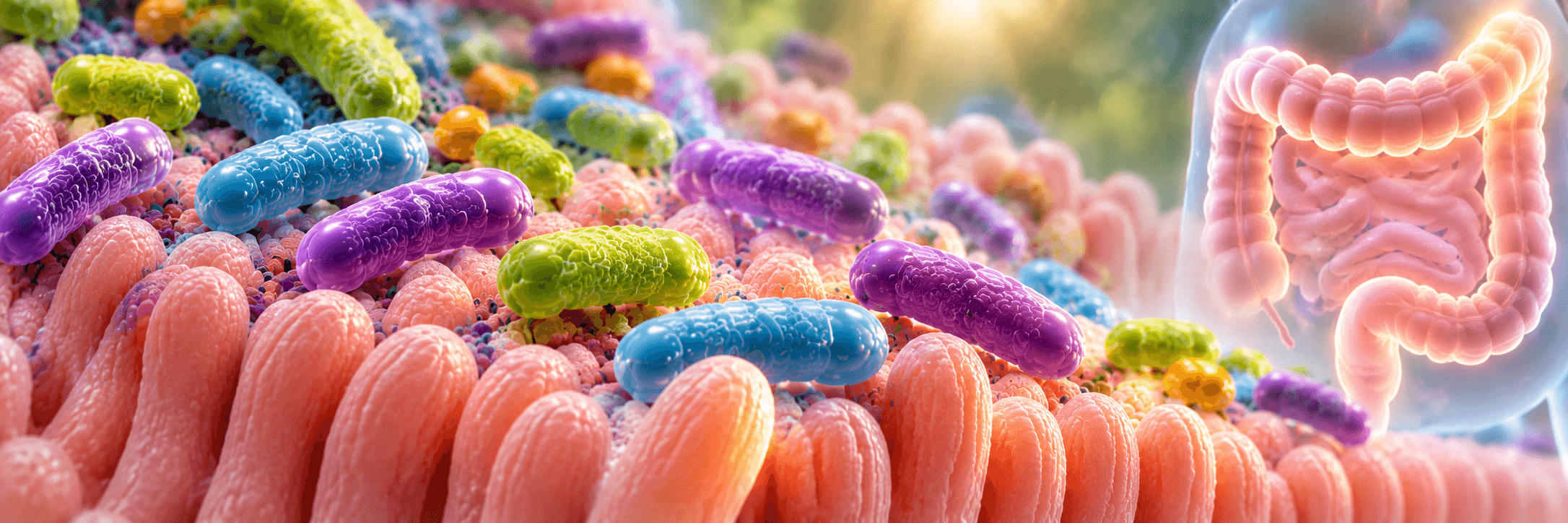
After a course of antibiotics, your digestion was never quite the same. Or you’ve developed food reactions, oxalate problems or hormone symptoms that nobody can explain. It’s easy to think of gut bacteria as passengers that only matter when something goes wrong. In fact they work like an extra organ, one we’ve largely forgotten about. They make vitamins, turn bile into a form that protects you, break down oxalate, help clear oestrogen, train your immune system and send signals that reach your genes. When this organ is damaged, the effects turn up far from the gut.
How many bacteria are we talking about?
You’ve probably heard that bacteria outnumber your own cells ten to one. That figure was never well supported. A careful recount puts the number of bacteria in the body at roughly the same as the number of human cells, about 38 trillion against 30 trillion, weighing about 200 grams in total.¹ Nearly all of them live in the large bowel. Even at one to one, that’s a large, active organ, and it carries far more genes than you do.
What your gut bacteria do
| Job | What happens |
|---|---|
| Make short-chain fatty acids | Bacteria ferment fibre into butyrate, acetate and propionate. Butyrate is the main fuel for the cells lining your colon, and these fatty acids also act on immunity, appetite hormones and gene expression.² |
| Make vitamins | Gut bacteria and the bacteria in fermented foods can make B vitamins such as folate, riboflavin and B12, as well as vitamin K.³ |
| Convert bile acids | Bacteria turn the primary bile acids your liver makes into secondary bile acids, changing how bile acts on digestion, metabolism and other microbes.⁴ |
| Break down oxalate | Oxalobacter formigenes uses oxalate as its food. People who carried it were about 70% less likely to have recurrent kidney stones.⁵ |
| Help clear oestrogen | Some bacteria reactivate oestrogen that the liver has packaged for removal, so it’s reabsorbed rather than leaving in the stool. The balance of these bacteria affects how much oestrogen recirculates.⁶ |
| Train the immune system | Most of your immune tissue lines the gut. Bacteria and their products teach it the difference between threat and harmless. |
| Crowd out troublemakers | A full, diverse community leaves little room or food for opportunists such as yeast and harmful bacteria to take hold. |
A few of these deserve a closer look.
Vitamins. Bacterial vitamins are real, but how much reaches you depends on where they’re made. Much of the B12 made by gut bacteria is produced in the large bowel, past the point where B12 is absorbed, so it does little for your own levels. Folate made by bacteria is a different story, which I’ve explained in how your gut microbiome supports your MTHFR.
Bile acids. Secondary bile acids, made by bacteria, help keep yeast and other organisms in check, while the primary bile acids from the liver can do the opposite. I’ve covered the difference in primary vs secondary bile acids.
Oxalate. Interestingly, carrying Oxalobacter didn’t change how much oxalate people passed in their urine, even though it lowered their stone risk.⁵ So its benefit may work in ways beyond simply eating oxalate. I’ve written about oxalates in why do oxalates cause fatigue, pain and mineral loss?
Oestrogen. The bacteria that reactivate oestrogen help explain why gut problems and hormone symptoms so often travel together. See how bile and gut bacteria affect oestrogen clearance.

What damages the microbiome
Antibiotics. They save lives, and sometimes they’re necessary. But they don’t only hit the infection. After two courses of a common antibiotic, people’s gut bacteria began to recover, but often not completely. Each person’s community settled into a new, altered state.⁷ In healthy young adults given a short course of three broad-spectrum antibiotics, most species returned within six months, but some didn’t, leaving a mild but long-lasting change.⁸ Oxalobacter is particularly sensitive to many common antibiotics.
A low-fibre, processed diet. Gut bacteria live on the fibre and plant carbohydrates that reach the large bowel. When mice ate a low-fibre diet, some bacterial species dropped sharply. Many came back when fibre returned, but over several generations of low-fibre eating, species were lost for good and fibre alone couldn’t bring them back.⁹ In other words, each generation can pass on a slightly poorer microbiome than it received.
The same pattern shows up in people. The Hadza, hunter-gatherers in Tanzania, carry bacteria whose numbers rise and fall with the seasons as their diet changes. The very bacteria that are most changeable in the Hadza are the ones that are rarer or missing in industrialised populations.¹⁰
Stress. In mice, social stress changed the makeup of gut bacteria, and the stress-related rise in inflammatory messengers depended on those bacteria being present.¹¹ Stress also shifts the nervous system away from “rest and digest”, slowing gut movement.
Chemicals. Preservatives, pesticides and antimicrobial products are designed to stop microbes growing, and some affect gut bacteria too. I’ve covered pesticides, plastics and the gut in 5 ways to change your genetic destiny with nutrigenomics.

How to rebuild and protect your microbiome
- Eat a wide variety of plants. Vegetables, fruit, legumes, nuts, seeds, herbs and whole grains if you tolerate them. Different fibres feed different bacteria, so variety matters more than volume.
- Eat fermented foods. Adults who ate fermented foods such as yoghurt, kefir, sauerkraut, kimchi and kombucha every day for 10 weeks had more diverse gut bacteria and lower inflammatory markers. A high-fibre diet on its own didn’t raise diversity over the same time.¹² In my clinical experience, home-fermented vegetables made from organic produce are one of the best and cheapest sources.
- Use antibiotics only when they’re genuinely needed, and pay extra attention to gut recovery afterwards.
- Get outside and get your hands dirty. Gardening, time in nature and contact with soil expose you to the harmless microbes your immune system evolved with.
- Skip antibacterial soaps and cleaners in everyday life, unless someone in the house has a weakened immune system.
- Choose organic produce where you can, and rinse vegetables rather than scrubbing them clean.
- Manage stress and protect your sleep.
- Support digestion higher up. Enough stomach acid, enzymes and bile mean less undigested food reaching the bowel to feed the wrong organisms.
A word of caution: fibre-rich and fermented foods don’t suit everyone straight away. People with small intestinal bacterial overgrowth (SIBO) or histamine intolerance often react to them and may need to build up slowly or address those first.
Why it matters
Many symptoms people put down to their own body are shaped, at least in part, by the organ they’ve forgotten about. Your microbiome changes with what you eat, the medications you take, the chemicals around you and how stressed you are. The good news is that it also responds when you change those things. It’s an organ you can rebuild, and one you hand on to the next generation.
Frequently asked questions
Why is the microbiome called a forgotten organ?
Your gut bacteria carry out organ-like jobs: making vitamins and short-chain fatty acids, converting bile acids, breaking down oxalate, helping clear oestrogen and training the immune system. They were largely overlooked until recently, hence the “forgotten organ”.
Do bacteria outnumber human cells ten to one?
No. That figure was never well supported. A careful recount estimates about 38 trillion bacteria and 30 trillion human cells, so the numbers are roughly equal.
Does the gut microbiome recover after antibiotics?
Mostly, but not always completely. In healthy adults, most species return within months, but some can be lost for good, and repeated courses can leave the community in a permanently altered state.
What vitamins do gut bacteria make?
Gut bacteria and the bacteria in fermented foods can make B vitamins such as folate, riboflavin and B12, as well as vitamin K. Much bacterial B12 is made in the large bowel, where it isn’t absorbed well.
How can I increase gut bacteria diversity?
Eating fermented foods daily increased gut bacteria diversity and lowered inflammation in adults over 10 weeks. Eating a wide variety of plant foods, limiting unnecessary antibiotics, managing stress and spending time outdoors also help.
What does Oxalobacter formigenes do?
Oxalobacter formigenes is a gut bacterium that uses oxalate as its food. People colonised with it are much less likely to have recurrent calcium oxalate kidney stones. It’s easily wiped out by many common antibiotics.
References
1. Sender R, Fuchs S, Milo R. Revised estimates for the number of human and bacteria cells in the body. PLoS Biol. 2016;14(8):e1002533. PMID 27541692.
2. Koh A, De Vadder F, Kovatcheva-Datchary P, Bäckhed F. From dietary fiber to host physiology: short-chain fatty acids as key bacterial metabolites. Cell. 2016;165(6):1332-1345. PMID 27259147.
3. LeBlanc JG, Milani C, de Giori GS, Sesma F, van Sinderen D, Ventura M. Bacteria as vitamin suppliers to their host: a gut microbiota perspective. Curr Opin Biotechnol. 2013;24(2):160-168. PMID 22940212.
4. Ridlon JM, Kang DJ, Hylemon PB. Bile salt biotransformations by human intestinal bacteria. J Lipid Res. 2006;47(2):241-259. PMID 16299351.
5. Kaufman DW, Kelly JP, Curhan GC, et al. Oxalobacter formigenes may reduce the risk of calcium oxalate kidney stones. J Am Soc Nephrol. 2008;19(6):1197-1203. PMID 18322162.
6. Baker JM, Al-Nakkash L, Herbst-Kralovetz MM. Estrogen-gut microbiome axis: physiological and clinical implications. Maturitas. 2017;103:45-53. PMID 28778332.
7. Dethlefsen L, Relman DA. Incomplete recovery and individualized responses of the human distal gut microbiota to repeated antibiotic perturbation. Proc Natl Acad Sci U S A. 2011;108(Suppl 1):4554-4561. PMID 20847294.
8. Palleja A, Mikkelsen KH, Forslund SK, et al. Recovery of gut microbiota of healthy adults following antibiotic exposure. Nat Microbiol. 2018;3(11):1255-1265. PMID 30349083.
9. Sonnenburg ED, Smits SA, Tikhonov M, Higginbottom SK, Wingreen NS, Sonnenburg JL. Diet-induced extinctions in the gut microbiota compound over generations. Nature. 2016;529(7585):212-215. PMID 26762459.
10. Smits SA, Leach J, Sonnenburg ED, et al. Seasonal cycling in the gut microbiome of the Hadza hunter-gatherers of Tanzania. Science. 2017;357(6353):802-806. PMID 28839072.
11. Bailey MT, Dowd SE, Galley JD, Hufnagle AR, Allen RG, Lyte M. Exposure to a social stressor alters the structure of the intestinal microbiota: implications for stressor-induced immunomodulation. Brain Behav Immun. 2011;25(3):397-407. PMID 21040780.
12. Wastyk HC, Fragiadakis GK, Perelman D, et al. Gut-microbiota-targeted diets modulate human immune status. Cell. 2021;184(16):4137-4153. PMID 34256014.