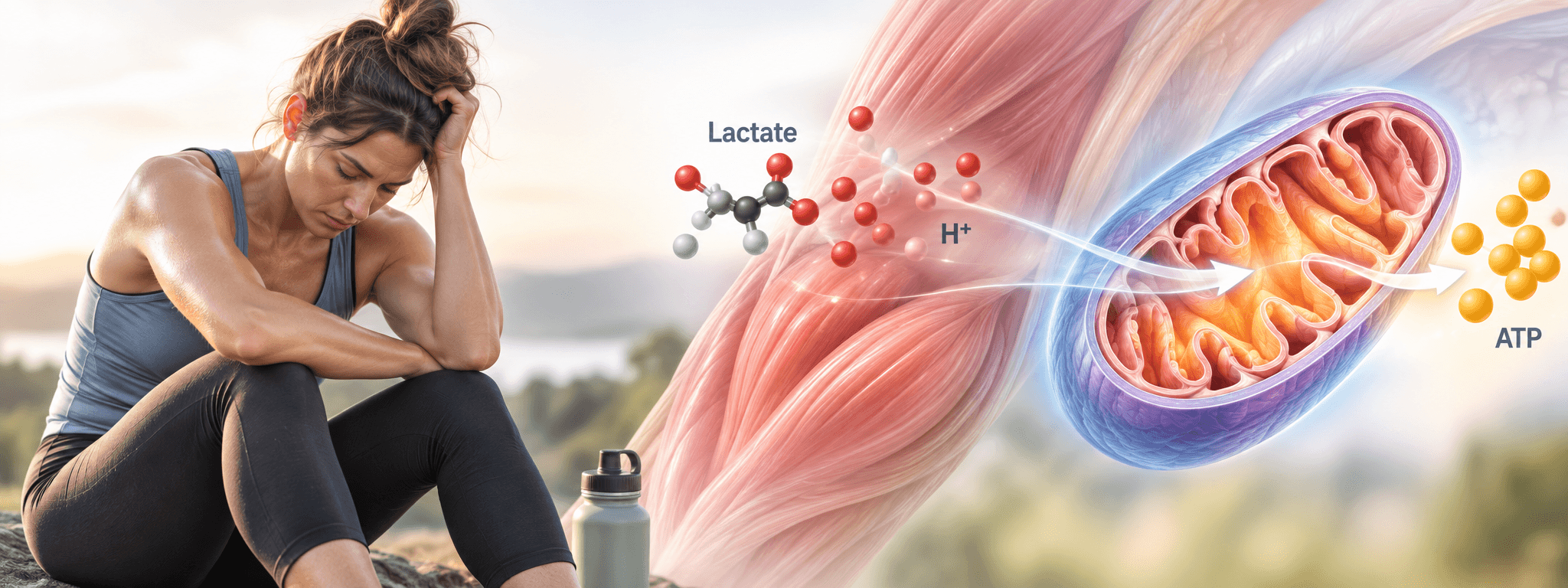
You wake up feeling like you ran a half marathon yesterday. You did not. Your legs are heavy, your arms ache, and everything feels like the day after a hard session at the gym you never went to. That sensation is not imagined and it is not a lowered pain threshold making normal feelings seem worse. The heaviness you feel after exercise is produced by chemicals that build up in your muscles while you work. If those chemicals are present without the work, you get the feeling without the work. That has been shown directly in people, and it reframes the question. The thing to ask is not why your muscles hurt when you have not used them, but why your muscles are producing exercise chemistry while sitting still.
The experiment that explains the feeling
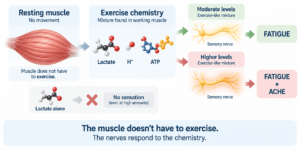
Researchers put a fine needle into a small muscle in the thumb of ten volunteers and infused tiny amounts of the substances muscles produce during exercise. Then they asked what the volunteers could feel.1
The results are worth going through, because each one rules something out.
- Any single substance on its own produced nothing. Lactate alone, even at maximum amounts, was not felt at all.
- The mixture found in a resting muscle produced nothing. No surprise there, but it confirms the method was not just registering the needle.
- The mixture found during moderate exercise produced fatigue. The muscle had not moved. People felt tired in it anyway.
- The mixture found during hard exercise produced fatigue and ache. Same still muscle, stronger sensation.
The researchers concluded that two different sets of sensory nerves are doing this. One picks up low levels and reports fatigue. The other picks up higher levels and reports ache and heat. Neither responds to any single chemical, which is why lactate on its own did nothing.
Whilst a small study, it establishes the principle. The feeling of having exercised is a readout of what is sitting in your muscle, and that readout can be produced without the exercise.
Why “lactic acid build-up” is the wrong phrase
It gets used constantly, including by practitioners, and it gets two things wrong.
The first is the acid part. Lactate production actually soaks protons up rather than releasing them, so it slows the acidity down instead of causing it. The protons come from using ATP, which releases one every time it is broken down for energy.2 Lactate rises at the same time as acidity because both come from the same busy pathway, which is how the association survived a hundred years of being backwards.
The second is the waste part. Lactate is a fuel. It gets passed between cells and burned by muscle, heart and brain, and the heart will take it in preference to glucose under some conditions.3 It is not rubbish that needs flushing out.
None of that makes lactate useless to measure. A high lactate tells you the fast pathway is outrunning the slow one. That is useful information about where your energy production has jammed. It just is not the substance causing your symptoms.
Where lactate comes from
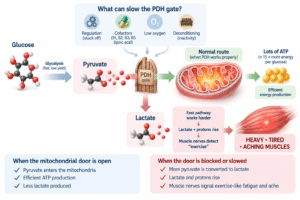
Glucose gets broken down in the body of the cell into a substance called pyruvate. That first stage is quick and yields very little energy. Pyruvate then reaches a fork.
- Into the mitochondria. This is the slow route, and it produces roughly fifteen times more energy per unit of glucose. A gatekeeper enzyme called pyruvate dehydrogenase (PDH) controls the door.
- Converted to lactate. This is the escape valve. It produces no extra energy, but it clears the backlog so the fast first stage can keep running.
The escape valve exists for good reason. Sprinting for a bus needs energy faster than the mitochondria can deliver it, so the fast pathway runs flat out and the excess leaves as lactate. That is normal.
The problem is when the escape valve becomes the main route while you are doing nothing. Because the fast pathway produces so little energy per unit of glucose, a cell depending on it has to run it hard, and running it hard generates lactate and protons in proportion.
The full sequence, and where each pathway takes over, is in my article on how mitochondria produce ATP through different pathways.
What blocks the door into the mitochondria
Several things slow that gatekeeper enzyme down, and they have different implications.
The switch is stuck off. Pyruvate dehydrogenase is deliberately switched off and on by other enzymes. This is normal housekeeping, letting your body spare glucose during fasting and burn fat instead. It becomes a problem when the off signal does not lift.
Missing tools. The gatekeeper is not one enzyme but a large assembly, and it requires thiamine (vitamin B1), riboflavin (vitamin B2), niacin (vitamin B3), pantothenate (vitamin B5) and lipoic acid to function. Short of any of them, the assembly works slowly.
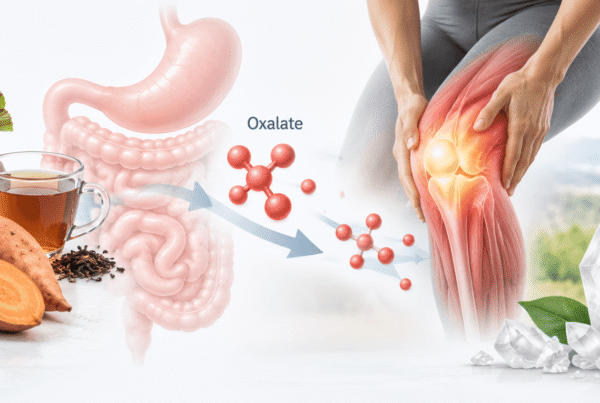
A blockage further back. Oxalate inhibits the enzyme that makes pyruvate in the first place, at levels close to what circulates in blood. The result is glucose that cannot finish its journey, which is one of the mechanisms behind the fatigue and mineral loss that comes with high oxalate.
Not enough oxygen arriving. The mitochondrial route needs oxygen. Anaemia, or breathing badly through the night, pushes cells onto the fast pathway no matter how well the enzymes are working.
Being still for too long. This is the one to rule out first. Months of inactivity reduce the number of mitochondria and the blood supply in your muscles, which lowers the point at which lactate starts accumulating. Someone who has been in pain and barely moving for a year will show this pattern with nothing else wrong. It reverses, and it usually sits on top of the other causes rather than replacing them.
What a high LDH result really tells you
LDH appears on ordinary blood panels, and because its full name is lactate dehydrogenase it gets read as a measure of lactate. It is not.
LDH is an enzyme that sits inside nearly every cell in your body. It only turns up in your blood when cells break open and spill their contents. So a high result means cells somewhere have been damaged, without telling you which cells.4 There are five versions of it spread across heart, red cells, liver, muscle and lung, and separating them out is how you narrow the source when it matters.
Three things to know:
- The blood sample itself. This is the commonest explanation for a lone high LDH on an otherwise clean panel. Red blood cells are packed with LDH, so any damage to them in the tube inflates the result. One study found LDH up to 149% higher in samples sent by pneumatic tube through a hospital compared with samples carried by hand.5 A careful repeat test resolves a lot of these.
- Red cells breaking down inside you. This raises LDH too, but it comes with changes in bilirubin and other markers that make it identifiable.
- Genuine tissue damage or rapid cell turnover. Liver, muscle, heart, lung, and some cancers.
A raised LDH deserves an explanation rather than a shrug. It is just not evidence that you are making too much lactate. If lactate is the question, measure lactate.
What has been found in people with these symptoms
Two findings and both come with limits.
Fibromyalgia. Rather than measuring blood, researchers sampled the fluid sitting directly between the muscle cells in the shoulders of people with fibromyalgia. They found raised lactate, and raised pyruvate alongside it.6 The pyruvate matters. Pyruvate backing up at the same time as lactate is what you would expect if the door into the mitochondria has jammed, rather than if there were simply nothing to burn. This sits alongside the other findings in fibromyalgia, which I have written about in why fibromyalgia pain feels like burning.
Chronic fatigue. In a study of two hundred people with ME/CFS, the amino acids that feed into energy production below the gatekeeper were depleted, while those entering above it were untouched. The reading was that pyruvate cannot get through the door, so the body burns other things downstream instead. Muscle cells grown in blood from these patients poured out lactate when pushed energetically.7
That last study gets cited as proof of a pyruvate dehydrogenase defect in chronic fatigue, and it does not show that. A published critique argued the chain of reasoning was too indirect to support the claim.8 The fair reading is that something is interfering with this step, the gatekeeper is a plausible place for it, and nobody has confirmed it.
The other thing that runs out
There is a second energy system that fails quietly and produces much the same feeling.
Creatine phosphate is your instant reserve. It covers the first few seconds of any effort, before the fast pathway has spun up and long before the mitochondria have noticed. Standing up from a chair runs on it.
Making creatine is expensive. The final step is a methylation reaction, and creatine synthesis is one of the largest consumers of methyl groups in the whole body. If your methylation system is stretched, the reserve is thinner.
The consequence is that you drop onto the fast pathway sooner and at lower efforts. Lactate then arrives in response to walking to the letterbox rather than in response to running. The muscle chemistry described at the top of this article turns up after very little.
That is mechanism rather than a proven clinical sequence. It is one reason the same complaint can have two completely different explanations in two people.
What is worth measuring
If heavy, aching muscles without exertion is the problem, the useful tests are not usually the ones ordered first.
- Lactate, taken properly. Blood lactate is extremely sensitive to how the sample is collected. A tourniquet left on too long, a clenched fist, or a delay getting it to the machine will all push it up. A result without that care is not worth interpreting.
- Organic acids in urine. This gives lactate and pyruvate together, plus what sits downstream of them. The pattern carries far more information than either number alone, because lactate high with pyruvate high means something different from lactate high with pyruvate low.
- The ordinary things, first. Full blood count, thyroid function, iron studies, creatine kinase, vitamin D and B12. Anaemia, an underactive thyroid and statin-related muscle effects are all common, all produce exactly this complaint, and all get missed when the search starts at the mitochondria.
Where this leaves you
Muscles that ache without exertion are reporting their own chemistry accurately. They are telling you something true.
The chain runs in one direction. Energy production jams at the door into the mitochondria. The fast pathway compensates by running harder. Lactate and protons accumulate. The nerves in your muscle read that combination and report exertion. Your brain receives a message that says you have been working.
The useful work is at the first step. That is why treating the muscle itself tends to disappoint, and why this particular complaint deserves a different investigation from muscle pain that follows activity.
Frequently asked questions
Why do my muscles feel like I worked out when I did nothing?
Because the feeling comes from the chemicals in your muscle, not from the activity. When researchers infused an exercise-level mixture into a resting human muscle, people felt fatigue, and a stronger mixture produced ache, in a muscle that had not moved.1 If your cells are running the fast energy pathway while you sit still, that chemistry is present without the exercise.
Does lactic acid build-up cause muscle pain?
Not the way the phrase suggests. Lactate on its own, infused into human muscle, produces no sensation at all.1 The sensation needs lactate together with protons and ATP hitting several receptors at once. Lactate also soaks up protons rather than releasing them, so it slows acidity rather than causing it.2
What does a high LDH blood test mean?
That cells somewhere have spilled their contents, without saying which cells. LDH sits inside nearly every tissue, so a raised total is a general signal of cell damage or turnover.4 A lone high result with everything else normal is very often the blood sample itself, since damage to red cells in the tube inflates it substantially.5
Does high LDH mean I am producing too much lactate?
No. LDH is the enzyme that converts pyruvate into lactate, and the level in your blood reflects enzyme leaking out of broken cells, not how much lactate you are making. Lactate has to be measured separately.
Why would lactate be high when I am not exercising?
Because pyruvate cannot get into the mitochondria quickly enough, so the fast pathway runs harder and converts the surplus to lactate. Causes include the gatekeeper enzyme being switched off, shortfalls in the vitamins it needs, a blockage earlier in the pathway, poor oxygen delivery, and loss of mitochondria from long inactivity.
Is this the same as fibromyalgia?
It overlaps without being the same. Raised lactate and pyruvate have been found in the shoulder muscles of people with fibromyalgia,6 so this appears to be one contributor among several. Burning pain, which comes from fascia and nerve rather than from energy production, is a separate mechanism.
Can being unfit explain all of this?
Sometimes, and it should be considered first. Long inactivity reduces the number of mitochondria and the blood supply in muscle, which lowers the effort at which lactate starts building. It also commonly sits alongside a genuine metabolic problem, since pain stops people moving, so finding it does not rule anything else out.
References
- Pollak KA, Swenson JD, Vanhaitsma TA, et al. Exogenously applied muscle metabolites synergistically evoke sensations of muscle fatigue and pain in human subjects. Experimental Physiology. 2014;99(2):368-380. PMID 24142455.
- Robergs RA, Ghiasvand F, Parker D. Biochemistry of exercise-induced metabolic acidosis. American Journal of Physiology: Regulatory, Integrative and Comparative Physiology. 2004;287(3):R502-R516.
- Gladden LB. Lactate metabolism: a new paradigm for the third millennium. The Journal of Physiology. 2004;558(Pt 1):5-30. PMID 15131240.
- Ballas SK. Lactate dehydrogenase and hemolysis in sickle cell disease. Blood. 2013;121(1):243.
- Falsely increased plasma lactate dehydrogenase without hemolysis following transport through pneumatic tube system. The Journal of Applied Laboratory Medicine. 2019;4(3):433-441.
- Gerdle B, Söderberg K, Salvador Puigvert L, Rosendal L, Larsson B. Increased interstitial concentrations of pyruvate and lactate in the trapezius muscle of patients with fibromyalgia: a microdialysis study. Journal of Rehabilitation Medicine. 2010;42(7):679-687.
- Fluge Ø, Mella O, Bruland O, et al. Metabolic profiling indicates impaired pyruvate dehydrogenase function in myalgic encephalopathy/chronic fatigue syndrome. JCI Insight. 2016;1(21):e89376. PMID 28018972.
- Morken T. Tenuous link between chronic fatigue syndrome and pyruvate dehydrogenase deficiency. Tidsskrift for Den norske legeforening. 2017.