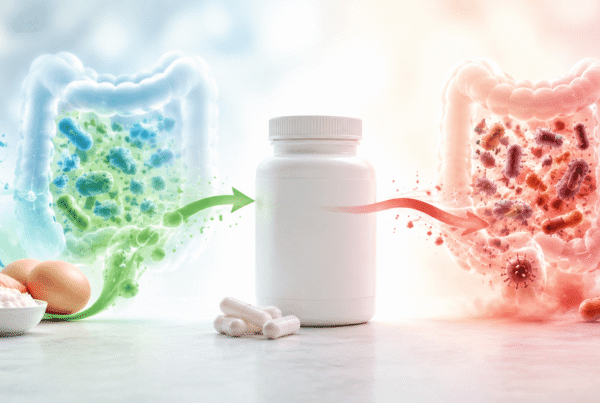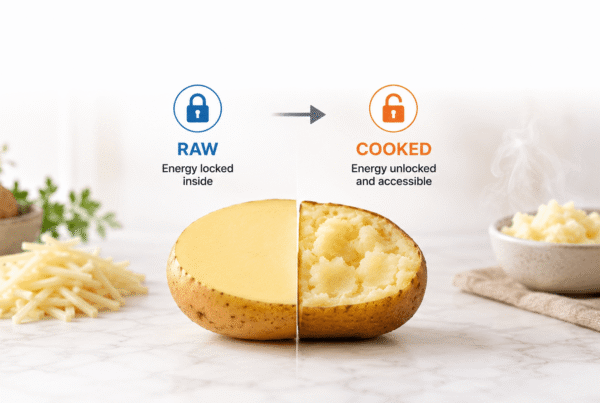
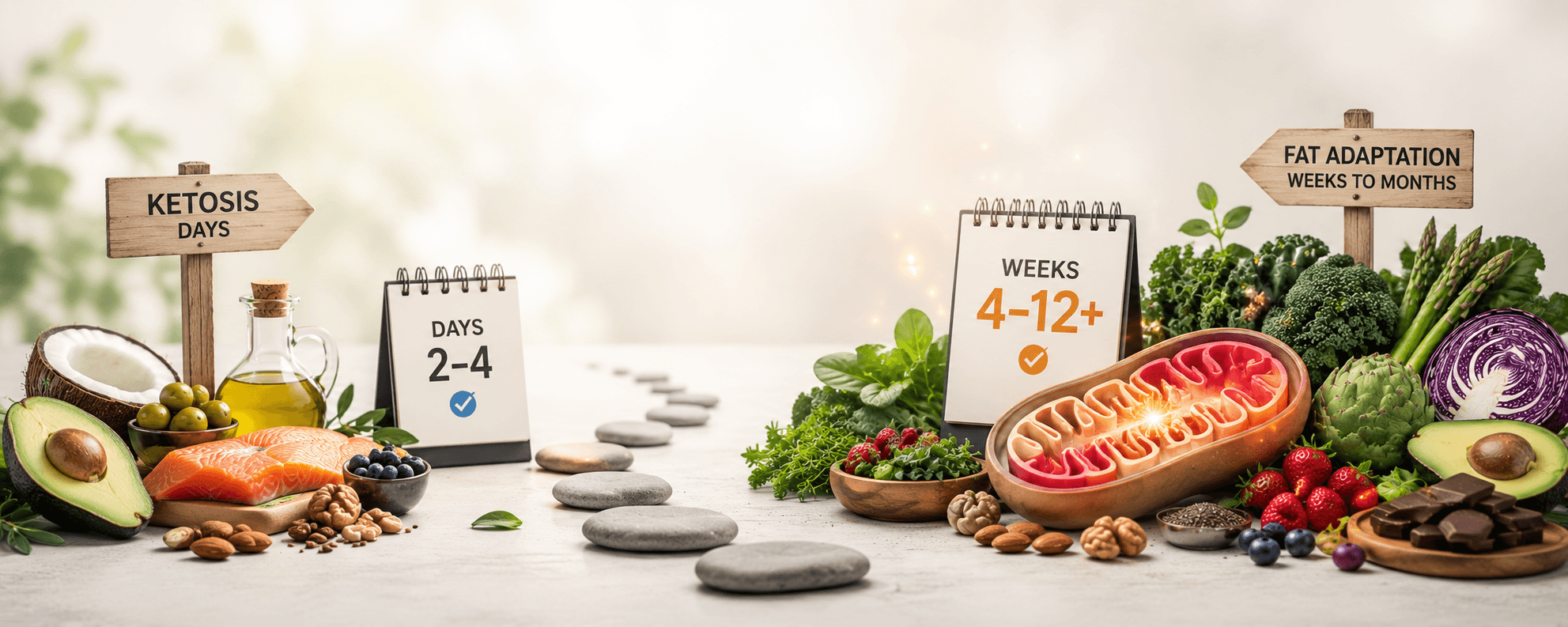
Getting into ketosis takes a few days. Becoming genuinely “fat adapted” — where your body efficiently burns fat as its main fuel — takes much longer, usually somewhere between four and twelve weeks. The two are often confused, but they’re different things: ketosis is a quick metabolic switch, while fat adaptation is a slower, structural change involving your mitochondria, enzymes and transport proteins. This distinction matters, because a lot of the confusion around low-carb diets — and some of the studies that found “no difference” between diets — comes from measuring the fast change while missing the slow one.
Ketosis and fat adaptation are not the same
When you cut carbohydrates low enough, your body runs short of glucose and starts producing ketones from fat as an alternative fuel. This is ketosis, and it’s fast — most people reach it within two to four days of restricting carbs¹.
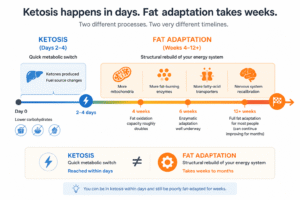
But being in ketosis doesn’t mean your body is yet good at running on fat. Fat adaptation is the deeper change: your cells becoming genuinely efficient at burning fatty acids for energy, to the point where you have metabolic flexibility — the ability to switch smoothly between fuels². You can be in ketosis within days and still be poorly fat-adapted for weeks.
Confusing the two is where a lot of people go wrong. They hit ketosis quickly, expect to feel and perform well immediately, and are discouraged when they don’t — not realising the adaptation that delivers those benefits hasn’t happened yet.
What fat adaptation actually involves
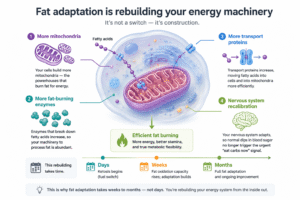
The reason adaptation is slow is that it requires the body to physically rebuild parts of its energy machinery. This isn’t a switch being flipped; it’s construction.
Becoming fat-adapted involves³:
- Building more mitochondria — the cellular structures where fat is burned for energy.
- Increasing the enzymes that break down fatty acids, so the machinery to process fat is more abundant.
- Upregulating the transport proteins that move fatty acids into cells and into the mitochondria.
- Recalibrating the nervous system, so it stops reacting to a normal dip in blood sugar with the urgent “eat carbs now” signal it once sent.
These are structural, enzymatic changes, and they take time to develop. That’s the whole reason the process can’t be rushed — you’re not just depleting glycogen, you’re re-equipping cells.
The timeline — and why two weeks isn’t enough
The research is fairly consistent on the shape of this, even if individuals vary.
Fat oxidation capacity — how much fat your body can actually burn per minute — roughly doubles over the first three to four weeks of consistent low-carb eating⁴. And most researchers who study the process put full enzymatic adaptation at a minimum of around six to twelve weeks, with improvements continuing for months beyond that⁵ ⁶.
This is exactly why a two-week study can badly mislead. A number of the older trials that concluded there was “no metabolic difference” between low-carb and other diets ran for only a week or two — which is long enough to reach ketosis but nowhere near long enough to become fat-adapted. They were measuring people mid-transition, before the adaptation they were supposedly testing had occurred. It’s like judging someone’s fitness two days into a training program.
Individual variation is real, too. Someone who is metabolically healthy and active may adapt in four to six weeks; someone with significant insulin resistance can take considerably longer, because insulin resistance itself impairs the shift toward fat-burning⁷.
Why the “adaptation phase” feels bad
The transition period has a bad reputation for a reason.
In the gap between “no longer running well on carbs” and “running well on fat,” you’re temporarily not efficient on either fuel. That’s when people report the low energy, brain fog, irritability and cravings often called “keto flu”⁸. Much of the acute version comes from sodium and fluid loss rather than fat metabolism itself, and it typically resolves within about a week⁸ — but the deeper sense of “I don’t have my energy back yet” can persist for several weeks until adaptation catches up.
The key point: feeling flat during this window is usually a sign of being mid-adaptation, not a sign that the approach is failing. People who quit here often quit right before the change they were waiting for.
An important note — this isn’t an argument for keto
Because most of the research on fat adaptation comes from the ketogenic and low-carb world, it’s worth being clear about what this does and doesn’t say.
Fat adaptation is a real, measurable physiological process. But “fat-adapted” is not automatically “healthier,” and a very low-carb diet isn’t required or superior for everyone. Metabolic flexibility — being able to use both fuels well — is arguably the more valuable goal than being locked into fat-burning, and you don’t have to live in ketosis to have it. Plenty of people do well on moderate-carbohydrate diets, and the right approach depends on the person, their health and their goals.
So the useful takeaway isn’t “go keto.” It’s that shifting how your body fuels itself is a slow, structural process, and evaluating it — whether in yourself or in a study — over a week or two will give you the wrong answer.
What to take from this
- Ketosis is fast; adaptation is slow. Reaching ketosis in days doesn’t mean you’re fat-adapted — that takes weeks.
- Give a metabolic change a fair trial. If you’re testing how you respond to a lower-carb approach, weeks, not days, is the honest timeframe.
- Feeling flat early is often mid-adaptation, not failure — though real, persistent poor health on any diet is worth taking seriously.
- Metabolic flexibility is the real prize — using fuels well — and that doesn’t require permanent carb restriction.
- Individual variation is large. Insulin resistance, activity and metabolic health all change how long adaptation takes.
The short version
Ketosis takes days; fat adaptation — the structural rebuild of mitochondria, enzymes and transporters that makes you genuinely efficient at burning fat — takes roughly four to twelve weeks. Confusing the two explains a lot of frustration and a number of misleading short studies. It’s a real process, but it’s not an argument that everyone should eat very low carb — it’s a reminder that changing how your body fuels itself is slow, and can’t be judged in a fortnight.
Frequently asked questions
What is the difference between ketosis and fat adaptation?
Ketosis is a quick metabolic switch — producing ketones from fat when carbs are low — reached within days. Fat adaptation is a slower structural change that makes your cells genuinely efficient at burning fat, involving more mitochondria and enzymes, and takes weeks to develop.
How long does it take to become fat adapted?
Usually around four to twelve weeks of consistent low-carb eating. Fat oxidation capacity roughly doubles in the first three to four weeks, but full enzymatic adaptation typically takes six to twelve weeks or more, and varies with individual metabolic health.
Why do I feel worse when I first cut carbs?
Because you’re temporarily inefficient on both fuels — no longer running well on carbs, not yet adapted to fat. The acute “keto flu” is largely sodium and fluid loss and usually eases within a week, but full energy can take several weeks to return as adaptation completes.
Why did some studies find no difference between low-carb and other diets?
A number ran for only one or two weeks — long enough to reach ketosis but far too short for fat adaptation. They measured people mid-transition, before the adaptation they were testing had occurred, which can produce a misleadingly “no difference” result.
Does everyone adapt at the same rate?
No. Metabolically healthy, active people may adapt in four to six weeks, while significant insulin resistance can extend it considerably, because insulin resistance itself impairs the shift toward fat-burning.
Do I need to be in ketosis to be metabolically flexible?
No. Metabolic flexibility — using both carbs and fat well — is arguably more valuable than being locked into fat-burning, and doesn’t require permanent carb restriction. What suits you depends on your health and goals.
References
- Ketosis is typically reached within two to four days of restricting carbohydrates to roughly 20–30g net per day. Ruled.me; HVMN keto-adaptation overview.
- Fat adaptation as a durable shift to efficient fat-burning and metabolic flexibility — the ability to switch between fuels. Perfect Keto; Healthline, “Fat Adapted.”
- Structural changes of fat adaptation: increased mitochondrial density, upregulated fatty-acid-oxidation enzymes and transport proteins, and a recalibrated nervous-system response to mild hypoglycaemia. Ruled.me review of keto-adaptation physiology (2026).
- Fat oxidation capacity roughly doubles within 3–4 weeks of a ketogenic diet (approx. 0.7 to 1.5 g/min). 2021 review in Nutrients on the timeline of keto adaptation.
- Most researchers place full enzymatic adaptation at a minimum of ~6–12 weeks, with improvements continuing for months. Ruled.me; 2024 ISSN position stand summary.
- Fat adaptation commonly cited as taking 4–12 weeks of consistent low-carb eating; ketosis within days. Healthline; multiple keto-adaptation reviews.
- Individual variation: metabolically healthy, active individuals adapt faster; insulin resistance impairs and prolongs the shift toward fat oxidation. Keto-adaptation clinical summaries.
- “Keto flu” (headaches, fatigue, brain fog) is largely due to sodium and fluid loss; median symptom resolution around 4–5 days with electrolyte replacement. Prospective cohort summarised in PMC7082414.