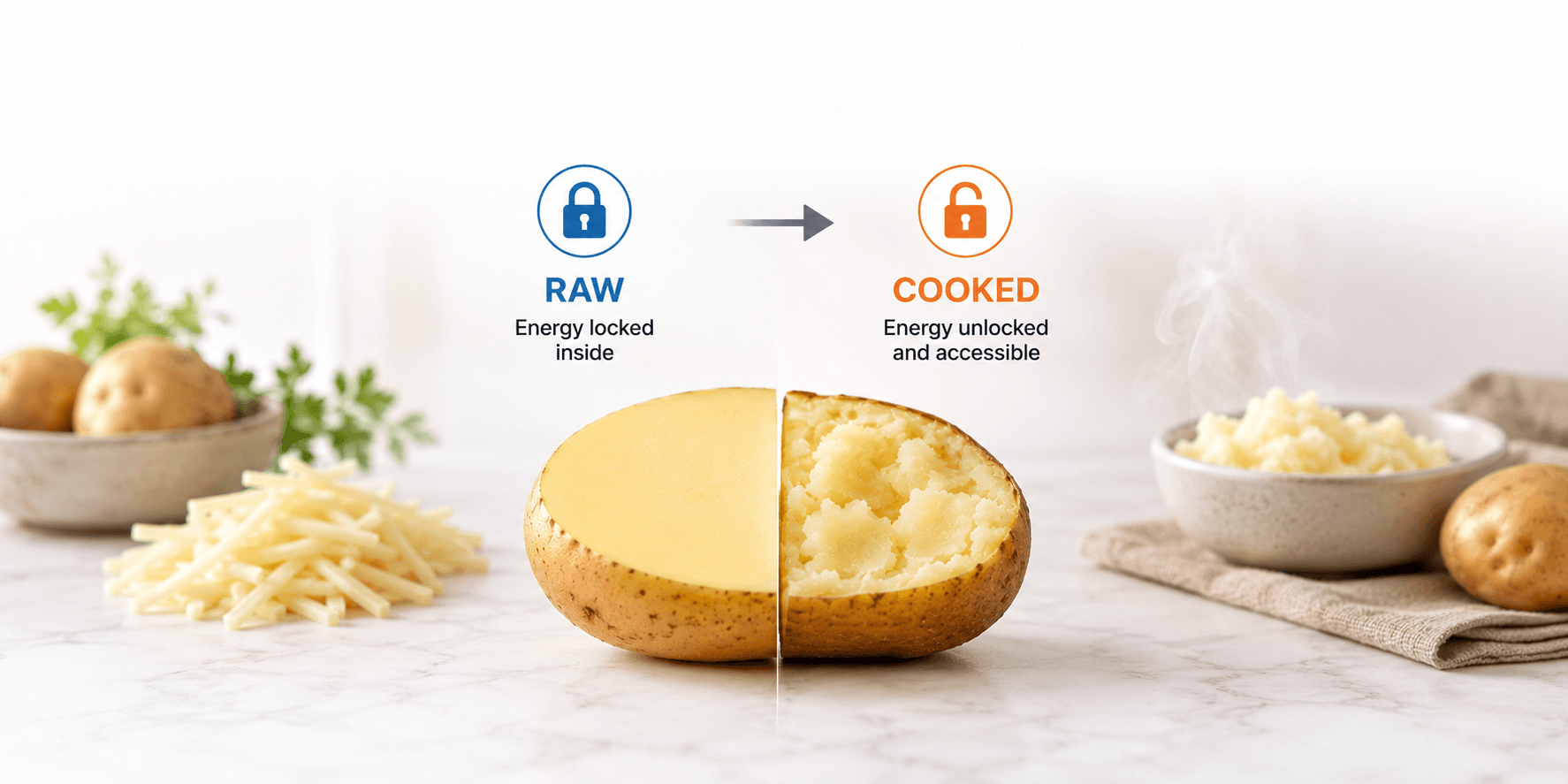
The calories you actually absorb from a food can change depending on whether it’s raw or cooked — even though the number on a label stays the same. Cooking breaks down the structures that lock energy inside food, so your body extracts more from a cooked meal than the identical food eaten raw. It also lowers the energy your body spends on digestion. This is well-established science, not a fringe claim, and it’s one of the clearest examples of why “a calorie is a calorie” doesn’t survive contact with how digestion actually works.
Why cooking changes the number
Food stores energy inside physical structures — cell walls, tightly packed starch granules, protein layers that shield fat. To get the energy out, your digestion has to break those structures down. Anything the enzymes can’t reach passes through unabsorbed.
Cooking does a lot of that breaking-down before the food ever reaches you. Heat ruptures cell walls, unravels proteins and loosens starches, exposing far more of the food’s energy to your digestive enzymes. So a cooked food gives up more of its theoretical calories than the same food raw — not because the food contains more energy, but because you can now access more of it¹.
Starch: the clearest case
Starchy foods show this most dramatically.
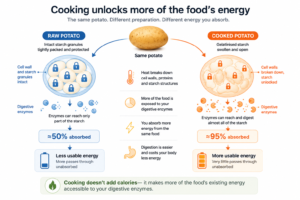
Raw starch is packed into granules so tightly that digestive enzymes struggle to break it down — a significant portion passes through the small intestine undigested². Cooking “gelatinises” the starch: heat and water swell the granules and release the starch molecules, exposing them to enzymes¹ ³.
The difference in what you absorb is large. Raw starch is digested at roughly 50% efficiency; cooked starch, closer to 95%⁴. So the same potato, oats or grain delivers substantially more usable energy cooked than raw — which is also, incidentally, why we don’t eat raw potatoes and why raw oats sit heavily.
It’s not just starch — protein and fat too
The effect extends across food types.
Eggs. Cooked egg protein is far more digestible than raw. This is settled enough that it’s one of the standard examples — the body absorbs markedly more of the protein from a cooked egg than a raw one. (It’s also the real reason the raw-egg-in-a-shake habit was never as useful as it looked.)
Fat-rich foods. A controlled study on peanuts found cooking consistently increased the energy the body gained, because heat damaged the cell walls and protein layers that normally shield the fat from digestion⁵. Notably, blending the raw peanuts — a non-thermal processing — didn’t produce the same benefit, showing it’s specifically the cooking doing the work⁵.
Meat. Cooking denatures the proteins in meat, making them easier to break down, and reduces the energy your body has to spend digesting it⁶.
The hidden factor: the cost of digestion
There’s a second way cooking increases net energy, and it’s easy to overlook.
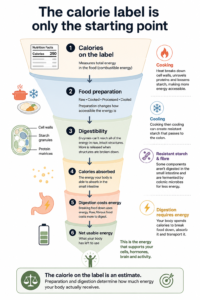
Digestion itself costs energy — breaking food down uses fuel. Raw, tough, fibrous food is expensive to digest; cooked, softened food is cheaper⁶. So cooking gives you a double benefit: you absorb more energy and spend less getting it. The “net” calories — what you’re left with after the cost of digestion — rise on both counts.
This is part of why the calorie figure on a label, which measures only the food’s total combustible energy, misses the real picture. It doesn’t account for what you can absorb, or what absorbing it costs you⁶.
The most telling evidence: people who eat mostly raw
If cooking didn’t matter energetically, people eating predominantly raw diets would maintain weight normally. They tend not to.
Studies of long-term raw-food eaters consistently find low energy status and difficulty maintaining body weight, and a substantial proportion of women on strict raw diets stop menstruating — a classic sign of insufficient energy availability⁷. And this is despite modern raw-foodists using blenders, dehydrators and other sophisticated non-thermal processing⁷. The processing helps, but it doesn’t replace what cooking does.
That’s a real-world demonstration: remove cooking, and even with plenty of food available, people struggle to extract enough energy.
Cooling can push it the other way
There’s a twist worth knowing, because it really is useful.
Cooking then cooling certain starchy foods — rice, potatoes, pasta — converts some of the now-accessible starch into resistant starch, which re-forms into a structure the small intestine can’t digest⁸. That portion then passes to the colon and is fermented by gut bacteria rather than absorbed as glucose, yielding less energy² ⁸.
So the same rice, cooked and eaten hot versus cooked, cooled and reheated, can deliver slightly different amounts of available energy. It’s a small effect, but it illustrates the wider point: how a food is prepared changes what you get from it.
Does this mean cooked food is “bad” or raw is “better”?
No — and this is worth being clear about, because it’s easy to twist.
None of this makes cooking harmful or raw eating superior. Cooking is arguably one of the most important things our species ever did; it’s a large part of how humans could afford energy-hungry brains on a manageable amount of food. More absorbable energy is a feature, not a flaw.
The point isn’t that you should eat food raw to “absorb fewer calories” — raw diets carry real risks, including nutrient and energy insufficiency, and some foods are unsafe raw. The point is narrower and more useful: the calories you absorb depend on preparation, so a calorie count is an approximation, not a fixed fact. Knowing that helps you understand why identical-on-paper foods can behave differently — not to eat everything raw.
What to take from this
- Calorie counts are approximations. The same food raw and cooked can deliver different usable energy, and the label reflects neither reliably.
- Whole, less-processed foods give up less of their energy — part of why they tend to be more filling per calorie than processed equivalents.
- Preparation is a lever, not a rule. Cooling cooked starches slightly reduces their available energy; heavy processing increases it. These are real but modest effects.
- Don’t chase “fewer absorbed calories” by eating raw. The energy and nutrient risks outweigh the benefit, and the more important lesson is simply that the calorie number isn’t absolute.
The short version
Cooking breaks down the structures that lock energy inside food, so you absorb more from cooked food than the same food raw — and you spend less energy digesting it. Raw starch is about 50% digestible, cooked closer to 95%; the effect holds for protein and fat too, and shows up clearly in the low energy status of people who eat mostly raw. It doesn’t mean cooked food is bad — it means the calorie on the label isn’t the calorie you actually get.
Frequently asked questions
Does cooking food increase its calories?
It increases the calories you can absorb, though not the food’s total energy content. Cooking breaks down cell walls, starches and proteins so digestive enzymes can reach more of the energy, so you extract more from cooked food than from the same food raw.
How much more energy do you get from cooked food?
It varies by food. Raw starch is digested at roughly 50% efficiency versus around 95% cooked, a large difference. Cooked eggs, meat and fat-rich foods also yield more absorbable energy than raw, and cooking additionally lowers the energy cost of digestion.
Do you absorb fewer calories eating raw food?
Generally yes, because raw food is harder to digest and more passes through unabsorbed. But this isn’t a good weight-loss strategy — raw diets carry real energy and nutrient risks, and some foods are unsafe raw. It mainly illustrates that calorie counts aren’t fixed.
Does cooling cooked rice or pasta reduce calories?
Slightly. Cooking then cooling starchy foods converts some starch into resistant starch, which the small intestine can’t digest, so it’s fermented in the colon rather than absorbed as glucose. The effect is real but modest.
Why don’t food labels account for cooking?
Labels are based on a century-old system that measures a food’s total combustible energy and assumes fixed absorption. It doesn’t account for how preparation changes digestibility, or for the energy your body spends digesting — so the number is an approximation.
Is raw food healthier than cooked?
Not as a rule. Some nutrients are better preserved raw, but cooking increases digestibility and energy availability, makes many foods safe, and reduces the cost of digestion. Neither is universally better; it depends on the food.
References
- Carmody, R. N., Weintraub, G. S. & Wrangham, R. W. (2011). Energetic consequences of thermal and nonthermal food processing. PNAS, 108(48), 19199–19203. Cooking increases the energetic value of starch beyond what the Atwater system represents.
- Cooked starch is more completely digested in the small intestine; resistant starch that escapes digestion is fermented by gut bacteria into short-chain fatty acids, yielding less energy than glucose. Carmody & Wrangham; Englyst & Cummings (1987).
- Cooking gelatinises starch — heat and water release amylose and amylopectin from tightly packed granules, exposing them to digestive enzymes. Discover Magazine / Wrangham (2011).
- Raw starch is digested at roughly 50% efficiency versus approximately 95% for cooked starch. Wrangham, Catching Fire; Meal Mentor summary of the energy theory of cooking.
- Carmody, R. N. et al. (2019). Cooking increases net energy gain from a lipid-rich food (peanuts) in mice; blending (non-thermal) did not, due to disrupted cell walls and oleosin protein layers. PMC4272645.
- Carmody, R. N. & Wrangham, R. W. (2009). The energetic significance of cooking. Journal of Human Evolution, 57(4), 379–391. Increased digestibility of starch and protein, plus reduced cost of digestion for cooked versus raw. PMID 19732938.
- Raw-foodists show compromised energy status despite extensive non-thermal processing; a high proportion of women on strict raw diets develop amenorrhoea. Koebnick et al.; Wrangham & Conklin-Brittain (2003).
- Cooking then cooling starchy foods forms retrograded resistant starch, reducing the proportion digested and absorbed in the small intestine. Resistant starch / food-processing literature.