The usual explanation is that oxalate forms sharp crystals which lodge in your muscles and joints and cut into the tissue. That does happen, and there are microscope images to prove it, but almost always in people with a genetic oxalate disorder or advanced kidney failure. If your kidneys work and you have no family history of oxalate disease, crystals in your joints are unlikely to be your problem. There is a second route, it needs no crystals at all, that explains muscle and joint discomfort in the presence of oxalates.
Where oxalate comes from
Two sources, and they matter differently.
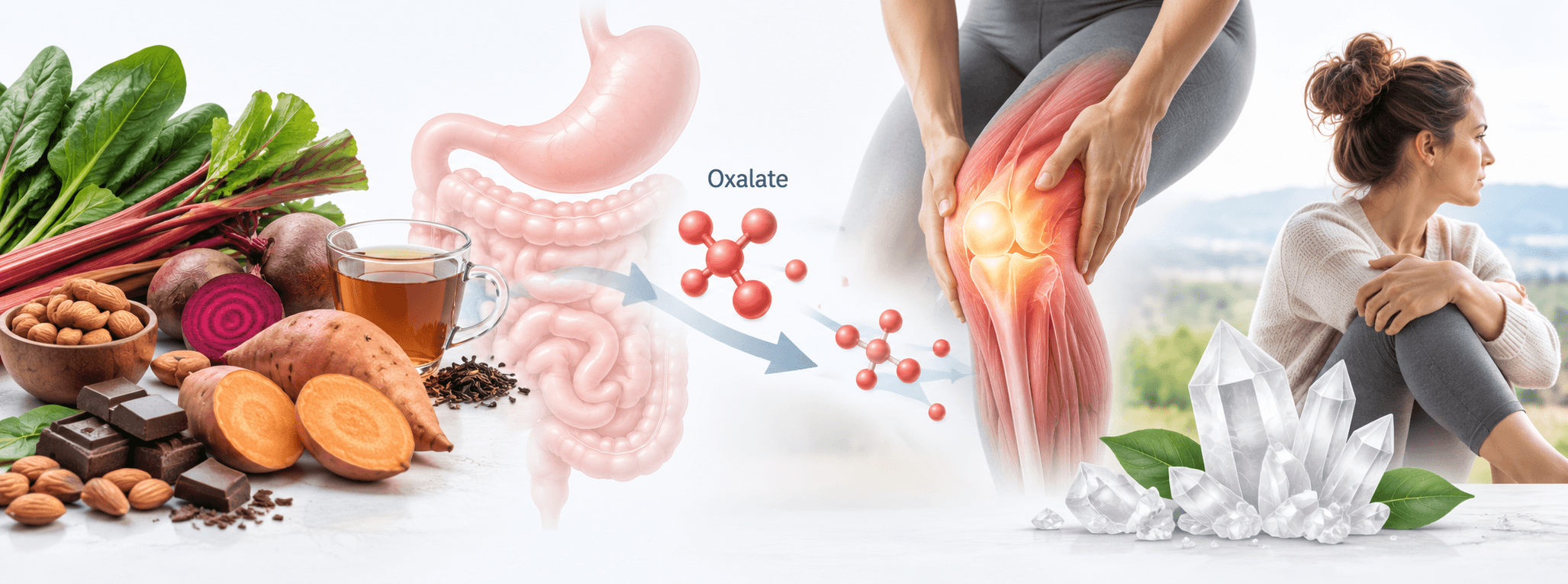
Some arrives in food. Spinach, rhubarb, beetroot, almonds, chocolate, sweet potato and black tea. In most of it, oxalate is already bound to calcium, which makes it poorly absorbed. It passes through.
The rest your own body makes, as an end product of metabolism that serves no further purpose. For most people this internal production accounts for more of their oxalate than food does.
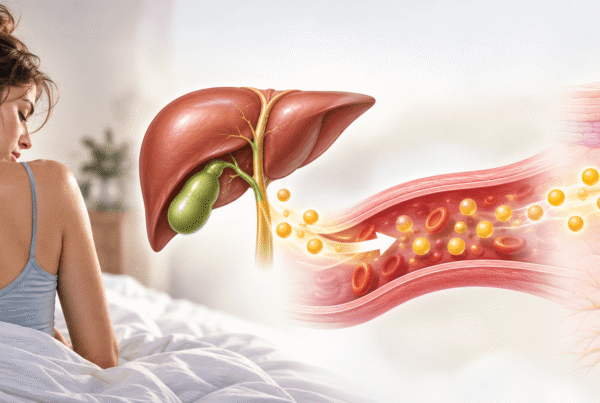
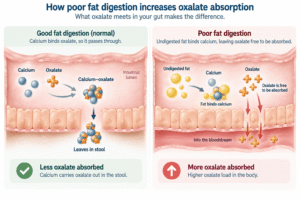
The amount that gets absorbed matters more than the amount you eat, and that depends on what oxalate meets on the way through. Calcium in the same meal binds it and carries it out. Fat that hasn’t been digested properly binds the calcium instead, leaving oxalate free to be absorbed.
The crystal story, and who it applies to
Calcium oxalate does form crystals in body tissue, and it does cause arthritis when it does. This is a documented condition called oxalate arthropathy or oxalate crystal deposition disease.
The important part is where it happens. Oxalate crystal deposition disease is described in people with primary hyperoxaluria, a rare inherited disorder, and in people with end-stage kidney disease on long-term dialysis. Deposits turn up mostly in kidneys, bone, skin and blood vessels, and less often inside joints.1
The reason is mechanical. Oxalate is cleared by the kidneys, so as long as they work, it leaves. When kidney function drops far enough, clearance fails, blood levels climb, and oxalate starts depositing throughout the body.2 That state has a name too, oxalosis, and it is a consequence of the kidneys failing rather than of eating too many oxalate-rich foods.
What happened when someone actually tested it
The most thoroughly studied claim about oxalate causing pain is in vulvodynia, a chronic vulval pain condition. The theory was that oxalate in urine irritates the tissue, and low-oxalate diets with calcium citrate became a standard suggestion.
Then someone measured it. Urine was collected over 24 hours from 130 women with the condition and 23 without. Oxalate excretion was almost identical between the two groups. Fifty-nine of the patients then tried a low-oxalate diet with calcium citrate for three months, and a little over 14% got clear relief.3
That is the evidence on oxalate and pain in people without kidney disease. A minority respond, which is not nothing. But the group as a whole did not have more oxalate than anyone else, which undermines the mechanism of oxalate in urine irritating tissues.
I still use low-oxalate trials in practice, and I still see people improve. But the reason is probably not crystals.
The mechanism that needs no crystals
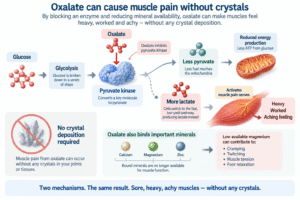
Turning glucose into energy runs through a series of enzyme steps. One of them, pyruvate kinase, produces pyruvate, which is the molecule that carries your glucose into the mitochondria to be burned properly for energy.
Oxalate inhibits pyruvate kinase. It was measured in liver cells decades ago, and the concentration at which it does so sits close to the level found in blood.4 It is not a dose you would never encounter.
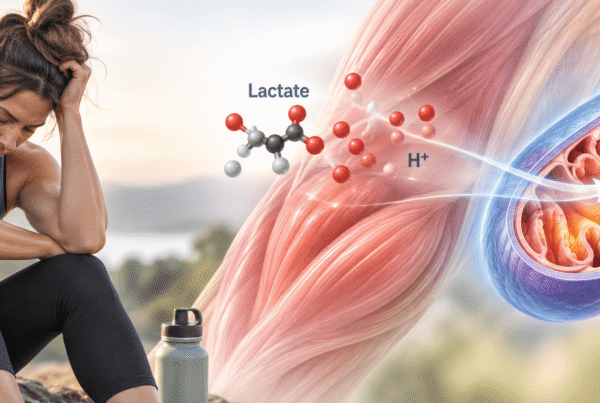
The consequence is a traffic jam. Glucose gets partway through the pathway and stalls before the step that would let it finish. It cannot reach the mitochondria in useful quantity, so the cell falls back on the fast, low-yield route and produces lactate instead.
Which is exactly the chemistry that makes a resting muscle feel like it has been working. I’ve written about that separately in why muscles ache when you have not exercised, and it is the better explanation for the heavy, worked, day-after-the-gym feeling that people with high oxalate describe.
The mineral problem underneath it
There is a second route, and it compounds the first.
Oxalate binds positively charged minerals. Calcium is the well-known one, but it also binds magnesium and zinc. Once bound, those minerals are no longer available to the enzymes in your body that need them.
Magnesium is important for muscles. It is required for muscle relaxation after contraction, and for the enzymes that handle ATP. Low available magnesium produces cramping, twitching and a muscle that’s restless.
So a high oxalate load has two ways to produce the same complaint. It slows the pathway that makes energy, and it removes the mineral that muscles need to relax.
Why this often sits alongside a fibromyalgia diagnosis
Widespread muscle pain with normal blood tests is the standard route to a fibromyalgia diagnosis, and oxalate is not usually considered as part of the problem.
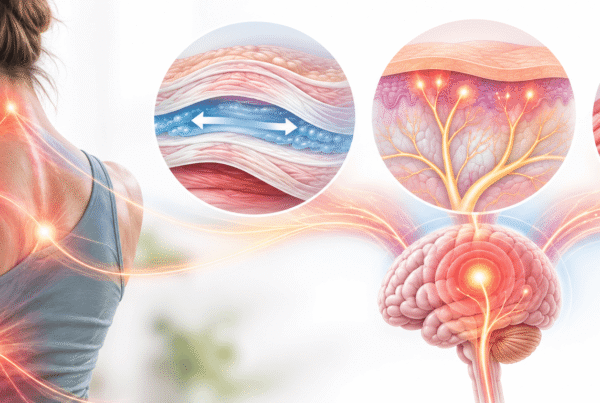
It is worth separating the symptoms, because they point at different things. Burning pain that spreads, and skin that hurts to touch, points at connective tissue and nerve, which I’ve covered in why fibromyalgia pain feels like burning. A heavy, worked, post-exertional ache without the exertion points at energy production, which is where oxalate belongs.
Many people have both.
The thing upstream of all of it
If oxalate is genuinely high, the next question is why, and the most common answer in practice is not diet.
When fat isn’t being digested properly, it stays in the gut and binds the calcium that would otherwise have bound oxalate. Free oxalate is then absorbed at a much higher rate. This is the established route to raised oxalate in people with digestive conditions,2 and it means poor bile flow can raise oxalate even on an ordinary diet.
The signs are usually there if you look: discomfort after fatty meals, pale or greasy stools, fat-soluble vitamins like vitamin D that stay low despite supplementing. I’ve listed them in the signs bile isn’t flowing well.
This matters practically. Someone who removes oxalate from their diet without addressing why absorption is high has treated the input and left the mechanism.
One source people never suspect
Collagen and gelatin supplements are widely taken for joint pain, and they raise oxalate.
Collagen is rich in hydroxyproline, which your body converts into oxalate. When this was tested, a large dose of gelatin raised urinary oxalate by more than 40%, and the effect was measurable at more modest doses, though not at very small ones.5
So a daily collagen supplement taken for aching joints is adding to a load that may be contributing to the aching. Not in everyone, and not enough to matter in someone clearing oxalate normally. But worth knowing if you are considering oxalates as part of your health picture.
What is worth doing
- Check kidney function first. This decides which explanation applies rather than whether you have an oxalate problem at all. If clearance is normal, oxalate leaves in the urine rather than accumulating in tissue, so deposits in your joints are unlikely and the energy and mineral routes are the ones worth pursuing. High oxalate with normal kidneys is common, and it still needs explaining.
- Measure rather than assume. Urinary oxalate on an organic acid test tells you whether the load is actually high. It also shows what sits downstream in energy production, which is the part relevant to muscle pain.
- Look at fat digestion. If oxalate is high, absorption is usually the reason, and bile is usually the reason for that.
- Treat a low-oxalate trial as diagnostic. Six to eight weeks tells you whether oxalate is involved. It is not a diet to stay on, since many healthy foods contain oxalates.
- Review supplements. Collagen and high-dose vitamin C both raise oxalate, and both are commonly taken by people with joint pain.
Where this leaves you
Oxalate can contribute to muscle and joint pain.
The crystal story is associated with kidney failure and to a rare inherited condition. The route that applies to everyone else runs through energy production and mineral availability, produces aching rather than sharp pain, and will not show up on any scan.
That distinction changes what you do. Crystals would mean removing oxalate. A metabolic bottleneck means finding out why absorption is high, which is usually a question about fat digestion rather than food. I’ve written about the wider picture in why oxalates cause fatigue, pain and mineral loss.
Frequently asked questions
Can oxalates cause joint pain?
Crystal deposition in joints is documented, but it occurs in primary hyperoxaluria and in end-stage kidney disease on dialysis rather than in people with working kidneys.1 In everyone else, a more likely route is oxalate slowing the enzyme that carries glucose into energy production,4 and binding the magnesium muscles need to relax.
Can oxalates cause muscle pain?
Plausibly, through energy metabolism rather than through crystals. Oxalate inhibits pyruvate kinase at concentrations close to those found in blood,4 which leaves glucose unable to complete its journey into the mitochondria. The result is lactate accumulating and a muscle that feels worked without having worked. The full chain has not been demonstrated in a human trial.
Does a low-oxalate diet help with pain?
For some people. In the most thoroughly studied pain condition, just over 14% of patients got clear relief from a low-oxalate diet with calcium citrate, and oxalate excretion in the patient group was no different from controls.3 Worth an eight-week trial to find out, not worth staying on indefinitely.
Why would my oxalate be high if I don’t eat much spinach?
Most oxalate is made by your own metabolism rather than eaten. And how much dietary oxalate you absorb depends on fat digestion, because undigested fat binds the calcium that would otherwise have carried oxalate out of the body.2 Poor bile flow can raise oxalate on an ordinary diet.
Can collagen supplements raise oxalate?
Yes. Collagen is rich in hydroxyproline, which converts to oxalate. A large dose of gelatin raised urinary oxalate by over 40%, with a measurable effect at moderate doses.5 Relevant because collagen is commonly taken for the joint pain being investigated.
How do I know if oxalate is my problem?
Measure it. Urinary oxalate on an organic acid test shows whether the load is genuinely high, and shows what is happening downstream in energy production at the same time. Assuming it from symptoms leads to long restrictive diets that often turn out to be unnecessary.
References
- Oxalate crystal deposition disease. Current Rheumatology Reports. 2002. PMID 12010612.
- Update on oxalate crystal disease. Current Rheumatology Reports. 2013;15(7):340.
- Baggish MS, et al. Urinary oxalate excretion and its role in vulvar pain syndrome. American Journal of Obstetrics and Gynecology. 1997;177(3):507-511. PMID 9322615.
- Buc HA, et al. Inhibition of pyruvate kinase by oxalate. Biochimie. 1981;63(7):595-602. PMID 7284471. (Isolated cells.)
- Knight J, Jiang J, Assimos DG, Holmes RP. Hydroxyproline ingestion and urinary oxalate and glycolate excretion. Kidney International. 2006;70(11):1929-1934.