
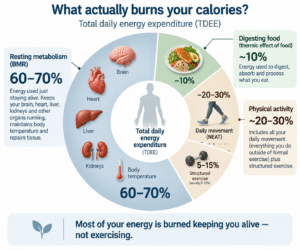
Exercise burns a much smaller share of your daily energy than most people assume. Your resting metabolism — the energy your body uses just staying alive — accounts for around 60–70% of what you burn in a day. Digesting food takes another 10% or so. Deliberate exercise typically makes up only a small slice, often in the range of 5–15%, and for someone who does none, close to zero. More surprising still: when you exercise more, your body tends to quietly compensate by spending less energy elsewhere, so your total burn doesn’t rise as much as the calorie counter on the treadmill suggests. This sounds discouraging, but it’s also good news — it means you don’t have to exhaust yourself with exercise to change your body.
What actually burns your calories
Your total daily energy expenditure breaks into three main parts, and their sizes surprise most people¹:
- Basal metabolic rate (BMR) — roughly 60–70%. This is the energy your body spends just existing: keeping your brain, heart, liver, kidneys and other organs running, maintaining temperature, repairing tissue. It’s by far the largest share, and it happens whether you move or not¹ ².
- Thermic effect of food — around 10%. The energy used to digest, absorb and process what you eat³.
- Physical activity — the rest, and it’s the most variable. This includes both deliberate exercise and all your incidental daily movement. For a sedentary person it’s small; even for fairly active people, structured exercise is commonly cited at around 5–15% of the daily total³ ⁴.
The thing people focus on most for weight — exercise — is the smallest and most variable slice, while the thing they rarely think about — resting metabolism — is the biggest by far.
Why an hour at the gym does less than the machine says
The calorie readout on a treadmill or watch tells you roughly what you burned during the session. What it can’t tell you is what your body does for the rest of the day in response — and that’s where the picture changes.
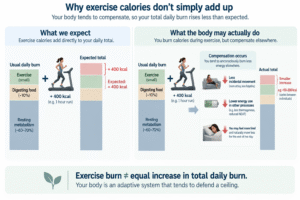
Research on total daily energy expenditure has found something counterintuitive: the body appears to constrain how much it burns. When you increase physical activity, it tends to compensate by reducing energy spent on other things — so your total daily burn rises less than the exercise alone would predict⁵.
The evidence for this is striking. A large analysis found that when people increased their aerobic activity, the actual rise in total energy expenditure was on average only about half of what you’d calculate from the exercise itself — the body clawed back roughly the other half elsewhere⁶. The original observation that launched this idea came from studying hunter-gatherers who are far more physically active than office workers, yet burn a similar number of total calories per day once body size is accounted for⁵.
So the body isn’t a simple calculator where every extra minute of exercise adds neatly to your total. It’s an adaptive system that budgets its energy — and it tends to defend a ceiling. This is a large part of why people who take up exercise to lose weight are so often disappointed by the scale: the burn they expected got partly absorbed.
Where does the compensated energy go?
When the body offsets extra exercise, it does it in quiet ways: you move less the rest of the day without noticing (more sitting, less fidgeting), and it trims energy from background processes⁵. Someone who runs hard in the morning may unconsciously be stiller and more tired for the rest of the day, spending less on the incidental movement that normally adds up.
None of this is a conscious choice, and it doesn’t happen to the same degree in everyone. But it explains why “just burn more through exercise” is a weaker lever than it looks — the body has ways of pushing back.
Why this is good news
Read one way, this is deflating: your hardest workouts move the calorie needle less than you hoped. But read properly, it’s liberating, and it reframes the whole approach.
If exercise is a small and partly-compensated slice, then punishing yourself with it isn’t the key to changing your body — and the two bigger levers are more approachable:
- The largest share is your resting metabolism, and the biggest influence on that is how much lean muscle you carry — muscle is metabolically active tissue, so more of it raises your resting burn around the clock⁷. This is why building and keeping muscle matters more for long-term metabolism than burning calories in any single session.
- The next-largest controllable factor is what you eat — both the energy it contains and the thermic cost of processing it, which is higher for protein than for carbs or fat.
In other words, the levers that actually work — enough protein, building muscle, managing intake — are more sustainable than trying to out-exercise your diet, which the body is set up to resist.
The important caveat: this is not “don’t exercise”
This is the point where this information gets misused, so it needs saying: none of this means exercise doesn’t matter. It means exercise isn’t primarily a calorie-burning tool — which is a completely different claim.
Exercise remains one of the most valuable things you can do for your health, for reasons that have little to do with the calories burned during the session⁸:
- It builds and preserves muscle, which raises your resting metabolic rate — an indirect but real effect on your energy burn.
- It improves insulin sensitivity and how your body handles blood sugar.
- It builds mitochondria, improving how efficiently your cells produce energy.
- It supports cardiovascular health, mood, sleep and a favourable gut microbiome.
So exercise absolutely earns its place — just not as the calorie-torching activity the fitness industry sells. Its real value is what it does to your body, not the number on the treadmill display.
What to take from this
- Don’t rely on exercise as your main calorie lever. It’s a small, partly-compensated share of your daily burn, and the body resists being out-exercised.
- Don’t let that stop you exercising. Its benefits — muscle, insulin sensitivity, heart, mood, mitochondria — are enormous and mostly separate from calories.
- Prioritise muscle. More lean tissue raises the biggest slice of your burn — your resting metabolism — all day, every day.
- Put real attention on food, which influences both the energy in and the thermic cost of processing it.
- Reframe the goal. You don’t have to exhaust yourself to change your body — and the fact that you can’t easily out-exercise a poor diet can be freeing.
The short version
Resting metabolism is the biggest part of your daily energy burn; exercise is one of the smallest, and the body compensates for much of it by spending less elsewhere. That makes exercise a weak calorie lever — but a superb health intervention, and an indirect metabolic one through the muscle it builds. The practical message isn’t “don’t exercise.” It’s that you don’t have to punish yourself with it to change your body, because the levers that matter most are muscle and food.
Frequently asked questions
How many of my daily calories does exercise actually burn?
Less than most people think. Resting metabolism accounts for around 60–70% of daily energy use and digestion about 10%, leaving physical activity as the rest. Structured exercise is commonly cited at roughly 5–15% of the daily total, and near zero for someone who does none.
Why doesn’t exercising more help me lose weight?
Partly because the body compensates. Research shows that when you increase activity, your body tends to reduce energy spent elsewhere — so total daily burn rises by only about half of what the exercise alone would predict. The extra burn gets partly clawed back.
What burns the most calories in a day?
Your basal metabolic rate — the energy used just keeping your organs and body running — is by far the largest, at roughly 60–70% of daily expenditure. The biggest influence you have over it is how much lean muscle you carry.
Does this mean exercise is pointless?
No. It means exercise isn’t primarily a calorie-burning tool. It remains one of the most valuable things you can do — it builds muscle (which raises resting metabolism), improves insulin sensitivity, supports heart health, mood, sleep and the gut microbiome. Its value is what it does to your body, not the calories burned in a session.
How do I raise my resting metabolic rate?
The most reliable lever is building and keeping lean muscle, which is metabolically active and raises your resting burn around the clock. This is one of the strongest reasons to do resistance exercise, even though the calories burned during the session are modest.
Is it better to focus on diet or exercise for weight?
For managing weight specifically, food is the more powerful lever, because exercise is a small and partly-compensated share of your burn. But the healthiest approach uses both — food to manage intake, and exercise for muscle, metabolic health and everything else it does.
References
- Total daily energy expenditure is the sum of basal metabolic rate, the thermic effect of food, and physical activity energy expenditure; BMR is the largest component at ~60–70%. Careaga et al. / energy expenditure reviews; PMC5388457.
- BMR represents the energy needed to sustain the body’s organs (brain, gut, kidneys, heart, liver, muscle); fat-free lean mass, especially skeletal muscle, drives most of its variance. Spinal cord injury nutrition review; energy expenditure literature.
- The thermic effect of food accounts for roughly 10% of total daily energy expenditure; protein has the highest thermic effect of the macronutrients. Nutrition and Physical Fitness (CalState Pressbooks); Wikipedia, Energy expenditure.
- Structured exercise is commonly attributed ~5–10% of daily energy expenditure but is highly variable. RP Strength review of energy expenditure components (2025).
- Pontzer, H. et al. (2016). Constrained total energy expenditure and metabolic adaptation to physical activity in adult humans. Current Biology, 26(3), 410–417. PMC4803033. Total energy expenditure plateaus at higher activity levels; the hunter-gatherer (Hadza) observations.
- Careau, V., Pontzer, H. et al. (2026). The evidence for constrained total energy expenditure in humans and other animals. Current Biology. Human aerobic interventions showed energy compensation averaging ~46% of expected added expenditure without diet restriction.
- Skeletal muscle is metabolically active and a major contributor to resting energy expenditure; increasing lean mass raises resting metabolic rate. Energy expenditure literature; Wikipedia, Energy expenditure.
- Exercise benefits — muscle preservation, insulin sensitivity, mitochondrial biogenesis, cardiovascular and mental health — are largely independent of calories burned during the session. General exercise physiology literature.